奢侈品

Search documents
LV业绩意外回暖,全球奢侈品公司市值一日增加5000亿
Nan Fang Du Shi Bao· 2025-10-17 14:42
Core Viewpoint - The luxury goods industry shows signs of recovery, with LVMH reporting a 1% organic revenue growth in Q3 2025, ending two consecutive quarters of decline and exceeding analysts' expectations of zero growth [2][4][9]. Financial Performance - LVMH's total revenue for Q3 2025 decreased by 4% year-on-year to €18.28 billion, but the organic growth of 1% marks the first sales rebound of the year [4][11]. - For the first nine months of 2025, total revenue fell by 4% to €58.09 billion, with an organic decline of 2% [4][9]. Segment Performance - The fashion and leather goods segment saw a smaller decline of 2% year-on-year, with revenue at €8.497 billion, better than the expected 3.5% drop [8]. - The watches and jewelry segment grew by 2% to €2.319 billion, while perfumes and cosmetics also increased by 2% to €1.958 billion [8]. - The selective retailing segment performed strongly, with a revenue increase of 7% to €3.992 billion [8]. Regional Performance - In terms of regional performance, Europe experienced a 2% organic revenue decline, primarily due to a strong euro and reduced tourist spending [8]. - The U.S. market saw a 3% revenue growth, while the Asia-Pacific market (excluding Japan) also grew by 2% [8]. - Notably, the Chinese market returned to positive growth, achieving mid to high single-digit growth, reversing the trend of declining overseas consumption [9]. Market Reaction - Following the earnings report, LVMH's stock surged by 12.22% to €599 per share, with its market capitalization approaching €300 billion [11]. - Other luxury brands, including Richemont, Hermès, and Prada, also saw significant stock price increases, collectively adding nearly $70 billion in market value [11].


连跌三季!LVMH的时装与皮革制品业务持续承压
Guo Ji Jin Rong Bao· 2025-10-17 12:12
Core Insights - LVMH Group shows signs of performance stabilization with a 1% organic growth rate in Q3, despite challenges in the European market due to currency fluctuations [1][9] Financial Performance - In Q3, LVMH reported revenue of €18.28 billion, reflecting a 4% decline when accounting for a 5% negative currency impact [2] - The fashion and leather goods segment continued its decline, down 2% year-on-year, marking three consecutive quarters of decrease, although the decline rate has narrowed [2] - Wine and spirits revenue increased by 1% year-on-year, driven by restocking in the U.S. market and increased sales of rosé wine [2] - Other segments such as perfumes and cosmetics, watches and jewelry, and selective retailing saw revenue increases of 2%, 2%, and 7% respectively [2] Market Dynamics - The CFO highlighted strong local demand in key markets, particularly in the fashion and leather goods sector, with positive growth in mainland China and improvements in the U.S. market [4] - For the first nine months, LVMH achieved total revenue of €58.09 billion, with fashion and leather goods contributing €27.61 billion, approximately 47.5% of total revenue [5] - In terms of regional performance, the U.S. market saw a 3% year-on-year revenue increase, while Europe and Japan experienced declines of 2% and 13% respectively; Asia (excluding Japan) grew by 2% [6] China Market Insights - The company noted a recovery in the Chinese market, with local consumption showing mid-to-high single-digit positive growth, although overall consumer performance remains close to stable with low single-digit negative growth [9] - Despite challenges in the macroeconomic environment, demand in China is encouraging, although overseas spending by Chinese tourists is still experiencing double-digit declines [9] - The CFO indicated that the fourth quarter may present greater challenges due to base effects and anticipated stronger negative impacts from currency fluctuations compared to Q3 [9]


港股收评:恒生科技大跌4%,科技金融齐跌,半导体军工齐挫,黄金股逆势上涨!阿里巴巴跌4%,新华保险跌7.16%,广发证券跌近7%
Ge Long Hui· 2025-10-17 08:38
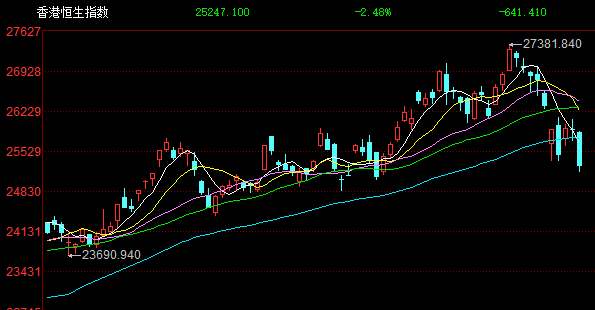
Core Points - The Hong Kong stock market experienced a significant decline, with the Hang Seng Technology Index dropping by 4.05% to close at 5760 points, the Hang Seng Index falling by 2.48% to 25247 points, and the National Enterprises Index decreasing by 2.67%, barely holding above the 9000-point mark [1][3] Group 1: Market Performance - The three major indices in Hong Kong reached recent adjustment lows due to a collective downturn in large technology stocks, major financial stocks (banks, insurance, securities), and state-owned enterprises [1][3] - Notable declines included Meituan and Alibaba, both dropping over 4%, while Xinhua Insurance fell by 7.16%, GF Securities by nearly 7%, and Industrial and Commercial Bank of China by 1.2% [3] Group 2: Sector Performance - Various sectors faced declines, including semiconductor stocks, Apple-related stocks, military industry stocks, automotive stocks, nuclear power stocks, lithium battery stocks, high-speed rail infrastructure stocks, coal stocks, and domestic real estate stocks [3] - Conversely, retail stocks and gold and silver jewelry stocks saw gains, with Chow Tai Fook rising by 5% after announcing its third price increase of the year, and Lao Pu Gold increasing by over 3% [3] Group 3: Notable Stock Movements - Biopharmaceutical stocks showed strength, with Yaojie Ankang surging over 22% after a previous increase of over 46%, and Xuan Zhu Biotechnology reaching a new high with a 16.9% rise on its third day of listing [3]

港股收评:单边下挫!恒科指大跌4%,科技金融齐跌,半导体军工齐挫,金银首饰股逆势上涨
Ge Long Hui· 2025-10-17 08:30
Market Performance - The Hong Kong stock market experienced a significant decline, with the Hang Seng Technology Index dropping by 4.05% to close at 5760 points, while the Hang Seng Index fell by 2.48% to 25247 points, and the National Enterprises Index decreased by 2.67%, barely holding above the 9000-point mark [1] Sector Performance - Major sectors such as large technology stocks, financial stocks (including banks, insurance, and brokerages), and state-owned enterprises collectively contributed to the market downturn. Notable declines included Meituan and Alibaba, both down over 4%, and Xinhua Insurance dropping by 7.16%. Additionally, GF Securities fell nearly 7%, and Industrial and Commercial Bank of China decreased by 1.2% [1] - Other sectors such as semiconductors, Apple-related stocks, military industry stocks, automotive stocks, nuclear power stocks, lithium battery stocks, high-speed rail infrastructure stocks, coal stocks, and domestic real estate stocks also experienced declines [1] Gold and Retail Stocks - In contrast, retail stocks and gold and silver jewelry stocks saw gains, with Chow Tai Fook rising by 5% after announcing its third price increase of the year. Lao Pu Gold surged over 3%, and luxury goods stock Prada increased by over 2% [1] - The biopharmaceutical sector showed strength, with Jiayuan Health surging over 22% after a previous increase of over 46%, and Xuan Bamboo Biotechnology reaching a new high with a 16.9% rise on its third day of trading [1]
限制零售商降价打折,三大奢侈品牌被欧盟重罚1.57亿欧元
Nan Fang Du Shi Bao· 2025-10-17 05:44
Core Points - The European Commission has imposed a total fine of €157 million (approximately 1.3 billion RMB) on luxury brands Gucci, Chloé, and Loewe for anti-competitive practices related to price maintenance [1][2] - The investigation revealed that these companies engaged in resale price maintenance (RPM) by requiring retailers to adhere to suggested retail prices and maximum discount rates, which limited price competition among retailers [1][2] - The anti-competitive behavior has been identified as having occurred until April 2023, and the fines were determined based on the severity, duration, geographical scope, and cooperation of the companies during the investigation [2] Company Summaries - Gucci, part of the Kering Group, was fined €119 million for its role in the anti-competitive practices [2] - Chloé was fined €1.9 million and has stated that it takes the matter seriously, implementing measures to comply with EU competition law since the investigation began in 2023 [2] - Loewe, under the LVMH Group, was fined €1.8 million and has confirmed its commitment to strictly adhere to antitrust laws following the penalty [2] Industry Implications - The penalties serve as a strong signal to the luxury fashion industry against the implementation of RPM practices in both online and physical retail environments [2] - The European Commission emphasizes that all consumers in Europe should benefit from genuine price competition, regardless of where or how they purchase products [2]
10.16日报
Ge Long Hui· 2025-10-16 20:17
Group 1 - The price of spot gold has surpassed 4200, but many gold stocks are still priced below 4000, indicating a disconnect between gold prices and related stocks [1] - The September social financing data shows that the M1 and M2 gap continues to narrow, suggesting increased liquidity efficiency, although the speed of residents moving deposits has decreased, indicating weakened motivation for investment or consumption [1] - OpenAI's revenue data reveals that only 5% of its 800 million users are paying customers, with a high cost of acquiring revenue, averaging 3 dollars spent for every 1 dollar earned [1] - Pop Mart's Labubu has increased production capacity tenfold and remains sold out, while the new IP "Star People" is expected to contribute around 8% to sales, leading Morgan Stanley to upgrade its rating from "neutral" to "overweight" [1] Group 2 - LV's financial report indicates that Q3 revenue in the China region has turned positive, suggesting that wealthy consumers are beginning to purchase luxury goods again, which positively impacts consumer stocks [2]
Deutsche Bank's Maximilian Uleer: Here's why the bull thesis for Europe holds
Youtube· 2025-10-16 16:53
Core Viewpoint - European indices are forecasted to see a 12 to 16% gain by 2026, driven by positive underlying data and increased government spending, particularly in Germany [1][2]. Economic Outlook - Earnings season is expected to outperform expectations in both the US and Europe, with Europe showing particularly strong underlying data despite perceptions of economic disaster [2]. - Germany's government has recently passed a budget allowing for increased spending, which is anticipated to positively impact the economy [3][4]. Government Spending - Germany plans to spend an additional €800 billion over the next four years, with €500 billion allocated for infrastructure and €300 billion for defense, which is expected to be GDP accretive [5][6]. - Recent announcements of defense spending, including €3 billion and €9 billion in the past weeks, indicate a significant shift in fiscal policy [4][5]. Employment and Efficiency - Despite layoffs at companies like Nestle, overall unemployment rates in Europe remain very low, suggesting that these layoffs are not indicative of a structural problem in the labor market [7][8]. - European companies are expected to benefit from advancements in AI, enhancing efficiency without the need for massive capital expenditures [9]. Monetary Policy - The European Central Bank (ECB) has successfully managed inflation, currently at around 2%, providing a stable environment for economic growth [10][12]. - There is uncertainty regarding future rate cuts, but the current economic conditions suggest stability rather than drastic changes [11][12]. Comparative Analysis - When comparing fiscal situations, the US is projected to have a deficit above 7%, while France is expected to have a 5% deficit, indicating a more favorable fiscal outlook for Europe [13][14]. - France's defense industry is positioned to benefit from increased German spending, although the French index has underperformed compared to the rest of Europe [15].


3Q25集团有机增速恢复正增长,客流提升贡献增量
Haitong Securities International· 2025-10-16 15:38
Group 1: Financial Performance - LVMH reported approximately €58 billion in revenue for the first three quarters of 2025, reflecting a 2% year-on-year decline in organic growth[1] - In Q3 2025, organic growth turned positive at 1%, recovering from a -3% decline in the first half of the year[2] - The Fashion & Leather Goods division saw an organic growth of -2%, an improvement from -9% in Q2 2025[3] Group 2: Market Trends - The China market achieved mid-to-high single-digit growth in Q3 2025, outperforming the overall group average[4] - Local consumption in the US and Middle East recovered, primarily driven by increased traffic rather than price adjustments[5] - Europe remained the only major region with negative growth in Q3 due to weaker tourism and currency effects[6] Group 3: Segment Performance - Perfumes & Cosmetics and Watches & Jewelry both recorded a 2% growth, supported by product innovations and strong performance from Tiffany[7] - Selective Retailing grew by 7%, benefiting from increased traffic and average transaction size at Sephora[8] - The Wines & Spirits segment returned to positive growth at 1%, aided by champagne restocking[9] Group 4: Future Outlook - Management anticipates that Q4 2025 performance will be under pressure due to a high base, particularly in Asia, Europe, and the US[10] - Improvement is expected in 2026 as the effects of creative transitions and store renovations begin to reflect in sales performance[11]
LVMH集团财报发布后,全球奢侈品上市公司市值一日增加700亿美元以上!
Sou Hu Cai Jing· 2025-10-16 14:40
Core Insights - LVMH reported a resilient performance in Q3, with organic revenue growth of 1% year-on-year, reversing the decline seen in the first half of the year, particularly in the fashion and leather goods segment, which saw a reduced decline of 2% [1] - The Chinese market returned to positive growth, exceeding market expectations, as analysts had predicted flat overall sales and a 4% decline in the fashion and leather goods segment [1] - Following the earnings report, LVMH's stock surged by 12.22% to €597.9 per share, boosting its market capitalization to nearly €300 billion, reaffirming its position as the world's most valuable luxury goods company [1] Industry Performance - The stock prices of luxury goods companies rose significantly, with 25 out of 27 luxury stocks tracked by the "Huazhi Luxury Goods Index" increasing on October 15, 2023, and a total market value increase of nearly $70 billion [3][4] - Notable stock price increases included LVMH at 12.2%, Hermès at 7.4%, and Richemont at 6.3% [4] Analyst Perspectives - Analysts noted that the luxury goods sector has seen renewed interest from capital markets, with the sector experiencing a recovery for three consecutive months [5] - Bernstein analysts indicated that LVMH's performance reflects a combination of self-rescue measures and slightly positive demand from China, suggesting a potential U-shaped recovery [7] - RBC Capital Markets analysts rated LVMH stock as outperforming the market, highlighting stronger-than-expected organic revenue growth for Q3 2025 and a constructive outlook for the soft luxury segment in 2026 [7] - DWS's portfolio manager remarked that the sales data provided positive surprises for investors, likely sustaining upward momentum in the sector [7] Cautionary Notes - Some analysts cautioned against prematurely declaring a full industry rebound, with Jefferies questioning whether LVMH's early signs of recovery could be misinterpreted as a broader industry revival [8] - UBS projected a 4% organic growth in global luxury goods sales for the following year, with acceleration expected only in the second half of 2026 as new creative directors' collections begin to hit stores [8] Wealth Impact - Bernard Arnault's family wealth increased significantly, rising by $19.1 billion to $179.9 billion, making him the seventh richest person globally and the wealthiest non-American [8]

深度 | 奢侈品股价暴涨,市场太乐观了吗?
Xin Lang Cai Jing· 2025-10-16 12:08
Core Viewpoint - The luxury goods market is showing signs of recovery, as evidenced by LVMH's third-quarter earnings report, which exceeded analyst expectations and marked a potential turning point for the sector [3][5]. Group 1: LVMH Performance - LVMH reported a 4% year-on-year decline in revenue to €18.2 billion, but achieved organic growth of 1%, significantly surpassing analyst forecasts [3][5]. - Following the earnings release, LVMH's stock surged by 12%, pushing its market capitalization above €300 billion, making it the highest-valued company in France [3]. - The positive performance of LVMH has led to a rally in the luxury goods sector, with notable stock increases for brands like Hermès (7.4%), Richemont (6.3%), Kering (4.8%), Moncler (7.8%), and Prada (7.7%) [3]. Group 2: Market Sentiment and Analyst Insights - Analysts from Morgan Stanley and Bernstein indicated that the worst may be over for LVMH, viewing it as a key indicator for the luxury market's recovery [5]. - Citigroup's analyst noted that LVMH's management is addressing structural issues in key fashion brands and the wine and spirits business, while also focusing on cost control and increased brand investment [5]. - Bernstein highlighted that all business segments of LVMH outperformed expectations, particularly the fashion and leather goods division, benefiting from a recovery in local consumption in China and strong demand in the U.S., Southeast Asia, and the Middle East [5]. Group 3: Chinese Market Dynamics - LVMH's CFO stated that the Chinese market returned to positive growth in Q3, with mid to high single-digit growth, despite a decline in overseas consumption [7]. - However, the overall global consumption of LVMH products by Chinese consumers remains in single-digit negative growth, indicating a continued decrease in luxury spending intentions [7]. - The recovery in the Chinese market is largely attributed to the return of domestic consumption as outbound travel decreases, rather than a fundamental improvement in consumer sentiment [7]. Group 4: Industry Challenges and Future Outlook - The luxury sector faces structural challenges, with many brands struggling to reignite widespread consumer interest despite recent positive narratives [9]. - The upcoming changes in creative leadership and product launches are uncertain, as the time lag between fashion shows and retail sales can be significant [9]. - The luxury market is also experiencing competition from emerging local brands in China, which are increasingly challenging established European brands [10][11].