
建筑装饰

Search documents
21股获融资净买入额超1亿元 阳光电源居首
Zheng Quan Shi Bao Wang· 2025-11-06 01:24
Group 1 - On November 5, among the 31 first-level industries tracked by Shenwan, 16 industries experienced net financing inflows, with the power equipment sector leading at a net inflow of 2.739 billion yuan [1] - Other industries with significant net financing inflows included chemicals, steel, construction decoration, public utilities, and retail [1] Group 2 - A total of 1,764 individual stocks received net financing inflows on November 5, with 127 stocks having inflows exceeding 30 million yuan [1] - Among these, 21 stocks had net financing inflows exceeding 100 million yuan, with Sunshine Power leading at 434 million yuan [1] - Other notable stocks with high net financing inflows included Penghui Energy, Canadian Solar, TBEA, LONGi Green Energy, Guodian NARI, Trina Solar, Dymatic Chemicals, and Baogang Group [1]

【立方早知道】自动驾驶“双子星”同日上市/超300亿!贵州茅台大利好/A股一公司董事长被判刑
Sou Hu Cai Jing· 2025-11-06 01:00
Group 1: New Listings - Two autonomous driving companies, Pony.ai and WeRide, are set to list on the Hong Kong stock market on November 6, marking them as the second and third Chinese concept stocks to achieve dual listings in Hong Kong and the U.S. this year after Hesai's return on September 16 [1] Group 2: Guizhou Moutai Announcements - Guizhou Moutai announced a share buyback plan with a total fund of no less than 15 billion yuan and up to 30 billion yuan, with a maximum buyback price of 1887.63 yuan per share [2] - The company also plans to distribute a cash dividend of 23.957 yuan per share, totaling approximately 300.01 billion yuan, subject to shareholder approval [2] Group 3: Macro News - The Central Financial Office emphasized the need to accelerate the construction of a financial power to support high-quality development, focusing on strategic tasks and financial support for key areas [4] Group 4: Tariff Adjustments - The State Council Tariff Commission announced a suspension of the 24% additional tariff on U.S. imports for one year while retaining a 10% tariff [5] Group 5: AI and Industry Integration - The Ministry of Industry and Information Technology is promoting the deep integration of artificial intelligence with industry, focusing on key areas such as AI+ manufacturing and technological innovation [6] Group 6: Gold Industry Development - Anhui Province is seeking to implement a high-quality development plan for the gold industry, aiming for a 5% increase in gold resources and production capacity by 2027 [6] Group 7: New Energy Storage - As of September, China's new energy storage capacity exceeded 100 million kilowatts, marking a more than 30-fold increase since the end of the 13th Five-Year Plan and accounting for over 40% of the global total [10] Group 8: Company Updates - Xintian Technology's stock price surged by 28.95% over two days, with the company stating no significant changes in its operations or external environment [13] - Muyuan Foods reported a revenue of 10.3 billion yuan from the sale of 707.6 million pigs in October, reflecting a 22.28% year-on-year decline [17] - Hengyuan Coal Power plans to acquire 100% equity of two companies for approximately 4.4 billion yuan and assume 11.37 billion yuan in debt [19] - Bertley announced a joint investment of 100 million yuan with Jinrun Electric to establish Bertley Drive, focusing on key components for humanoid robots [23] - Jiayuan Technology signed a cooperation framework agreement with CATL to expand their business relationship in the supply and production of copper foil products [24]


A股走出独立上涨行情:价值板块领涨,市场风格切换已至?
Xin Lang Cai Jing· 2025-11-05 13:07
Core Viewpoint - The A-share market is showing an independent trend amidst global market fluctuations, with significant gains in certain sectors such as coal, power equipment, and retail, while technology stocks are experiencing adjustments [2][4]. Market Performance - On November 5, the Shanghai Composite Index rose by 0.23% to 3969.25 points, the Shenzhen Component Index increased by 0.37% to 13223.56 points, and the ChiNext Index surged over 1% by 1.03% to 3166.23 points [2]. - Key sectors driving the A-share rebound include power equipment (+3.4%), coal (+1.39%), retail (+1.22%), and environmental protection (+1.06%) [3]. Sector Analysis - The rebound in value sectors suggests a potential market style shift, with analysts noting that November is a critical time for portfolio adjustments due to calendar effects and earnings realizations [5][6]. - Historical patterns indicate that November often marks a transition from focusing on current fundamentals to anticipating future performance, particularly in low-valued and undervalued sectors [5][9]. Investment Strategy - Analysts recommend a balanced allocation to navigate market volatility during the style-switching period, while maintaining a focus on technology growth stocks, which are expected to continue leading the market [12][11]. - The current market environment suggests that while high-dividend stocks like coal may provide returns, technology stocks remain a crucial part of the ongoing market narrative [14].

今年前三季度研发投入超1.16万亿,168家企业超十亿,科创板强度领先
3 6 Ke· 2025-11-05 10:52
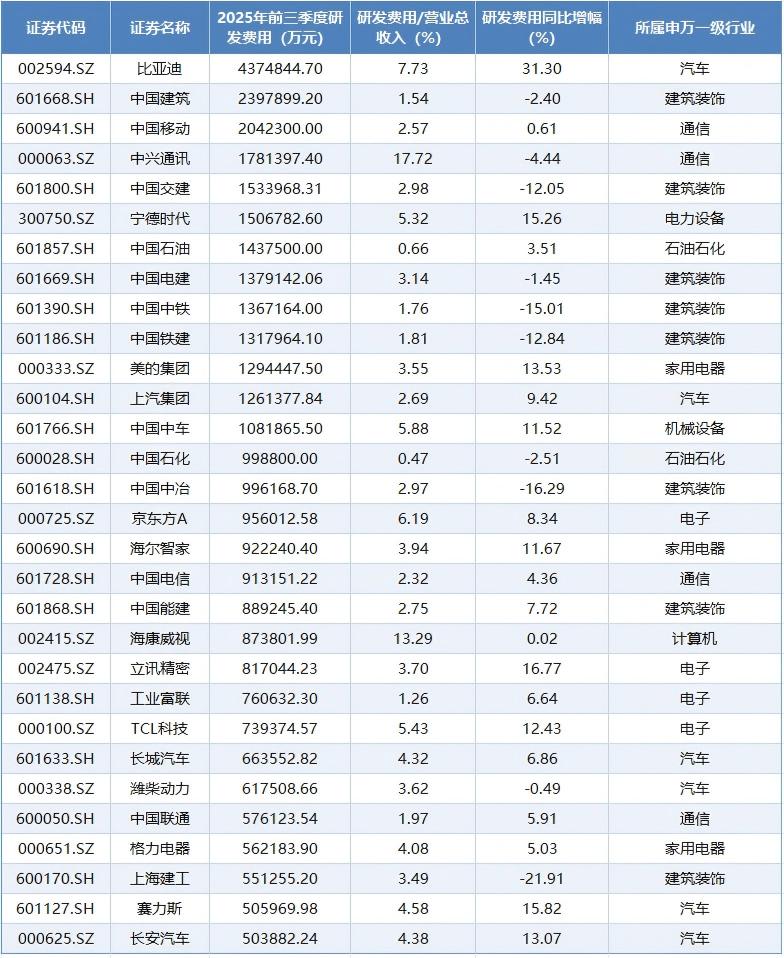
Core Insights - A-share listed companies in China have seen a continuous increase in R&D investment, reaching a total of 1.16 trillion yuan in the first three quarters of 2025, marking a year-on-year growth of 3.88% [1][2] - High R&D investment is becoming a significant driver for performance growth among listed companies, particularly in sectors like biomedicine, semiconductors, and artificial intelligence [1][4] R&D Investment Overview - In the first three quarters of 2025, 168 companies invested over 1 billion yuan in R&D, with 13 companies exceeding 10 billion yuan [2] - BYD leads with R&D expenses of 43.748 billion yuan, followed by China State Construction and China Mobile with 23.979 billion yuan and 20.423 billion yuan respectively [2][3] Sector-Specific Insights - Companies with high R&D investment are primarily in biomedicine, semiconductors, and AI, which are crucial for building technological barriers and driving industry innovation [1][10] - China State Construction is advancing digital innovation and smart construction technologies, while China Mobile has established the world's first 6G small-scale test network [4] Notable Companies - ZTE Corporation reported R&D expenses of 17.814 billion yuan, accounting for 17.72% of its revenue, focusing on AI-related product development [4] - CATL's R&D expenses reached 15.068 billion yuan, with a year-on-year growth of 15.26%, highlighting its innovation in battery technology [5] R&D Intensity by Market Segment - The overall R&D intensity in the A-share market is 2.16%, with the Sci-Tech Innovation Board showing a significantly higher intensity of 11.22% [6] - The median R&D intensity for companies on the Sci-Tech Innovation Board is 12.4%, indicating a strong focus on technology [6][7] Industry Trends - The computer, biomedicine, and electronics sectors exhibit high R&D intensity, with 43 companies in computing, 25 in biomedicine, and 15 in electronics among the top 100 for R&D investment [8] - The differences in R&D investment ratios among A-share companies reflect industry characteristics and corporate strategies, with biomedicine and semiconductors requiring higher investment due to long development cycles and international competition [10]


金螳螂:公司在酒店、办公空间、商业娱乐、医疗康养等领域订单储备充足
Zheng Quan Ri Bao· 2025-11-05 09:10
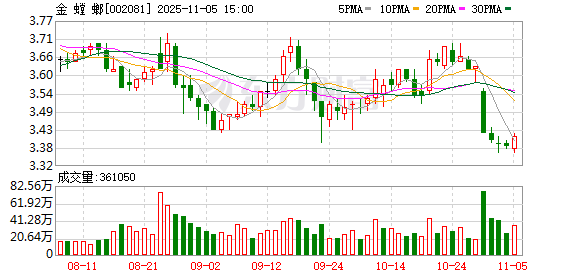
Group 1 - The company is actively responding to structural changes in the construction and decoration industry, demonstrating a proactive approach to transformation [2] - The company's confidence is primarily derived from its long-term focus on the public decoration main channel [2] - In sectors such as hotels, office spaces, commercial entertainment, and healthcare, the company has built a strong reputation and has a substantial order reserve, which serves as a "ballast" for its performance [2]

金螳螂五大项目入选国家级典型案例,藏着建筑装饰行业的下一个增长公式
Da Zhong Ri Bao· 2025-11-05 07:43
Core Insights - Urban renewal has become a new engine for high-quality development in the construction and decoration industry, with the Ministry of Housing and Urban-Rural Development releasing multiple lists of typical urban renewal cases, including projects involving the company Jin Tanglang [1][11] - Jin Tanglang is transitioning from a traditional construction company to a comprehensive service provider, leveraging urban renewal to enhance both project vitality and corporate growth [1][11] Urban Renewal Projects - The Nanjing Yihe Road historical cultural district has been revitalized, transforming 26 garden villas from the 1930s into a vibrant "urban living room" with boutique hotels and creative spaces while preserving their historical essence [2] - In the Shougang Old Industrial Area, industrial relics have been integrated into new venues, showcasing a unique industrial aesthetic and moving away from traditional real estate development [4] - The Qingdao Sifang Road historical cultural district, once a bustling commercial center, is undergoing revitalization to address issues of decay and lack of public facilities, aiming to restore its former vibrancy [6][9] Technological Integration - Jin Tanglang is utilizing Building Information Modeling (BIM) and other digital technologies to enhance project execution, transitioning from experience-driven to data-driven approaches [9][12] - The company has successfully implemented BIM in complex projects, such as the Jingdezhen Taoxichuan Grand Theatre, ensuring precision and efficiency in construction [9] Business Expansion and Diversification - Jin Tanglang's business capabilities now encompass various sectors, including the renovation of old residential areas, public venue upgrades, and historical district preservation, aligning with diverse market demands [10] - The company is also expanding its overseas business, which has seen a nearly 29% year-on-year revenue increase, indicating a shift towards higher-value projects and improved cash flow [11] Future Directions - Urban renewal is identified as a long-term strategic focus for Jin Tanglang, aiming to develop comprehensive capabilities in planning, construction, and operation within this sector [11] - The company is redefining its value proposition by integrating digital capabilities and multi-disciplinary management systems to contribute to national urban renewal efforts [13]

今日82只个股涨停 主要集中在电力设备、机械设备等行业
Zheng Quan Shi Bao Wang· 2025-11-05 07:37
Core Insights - On November 5, a total of 3,198 A-shares in the Shanghai and Shenzhen markets experienced an increase, while 1,811 shares declined, and 146 shares remained flat [1] - Excluding newly listed stocks on that day, there were 82 stocks that hit the daily limit up, and 9 stocks that hit the daily limit down [1] - The sectors with the most stocks hitting the daily limit up were primarily in power equipment, machinery, construction decoration, light industry manufacturing, and electronics [1]
海南自贸概念再度活跃,海马汽车4连板,海峡股份等涨停
Zheng Quan Shi Bao Wang· 2025-11-05 03:05
Core Insights - The Hainan Free Trade Zone is experiencing significant activity, with stocks such as Intercontinental Oil and Gas, Caesar Travel, and Haima Automobile reaching their daily limit up, indicating strong investor interest [1] - The "14th Five-Year Plan" emphasizes the strategic implementation of the free trade zone, with a critical milestone of full island closure operations expected by 2025, marking a transition in investment focus from duty-free shopping to high-end manufacturing and modern services [1][2] Investment Themes - The investment focus in Hainan is shifting from B2C consumption to B2B industrial upgrades and high-value services, with three core investment themes identified: 1. Modern logistics and trade services, positioning Hainan as a new hub for domestic and international circulation [2] 2. High-tech and green energy sectors, driven by favorable tax incentives aimed at strategic emerging industries such as aerospace and digital economy [2] 3. Beyond duty-free tourism, high-value services like healthcare, exhibitions, aircraft maintenance, and international education are expected to become new growth points [2] Economic Indicators - In 2024, tourism traffic remains high while duty-free sales are under pressure, indicating a structural shift in the economy [1] - Investment in high-tech industries and modern services is growing at rates significantly exceeding GDP growth, with increases of 9.1% and 22.8% respectively, highlighting these sectors as new growth engines [1]

47股每笔成交量增长超50%
Zheng Quan Shi Bao Wang· 2025-11-04 16:24
Core Points - The Shanghai Composite Index closed at 3960.19 points with a decline of 0.41% on November 4, while the Shenzhen Component Index and the ChiNext Index fell by 1.71% and 1.96% respectively [1] - A total of 1949 stocks saw an increase in average transaction volume, with 47 stocks experiencing a rise of over 50% [1] - Notable stocks with significant increases in transaction volume include Moen Electric, Luopus Gold, and Hanjian Heshan, among others [1] Transaction Volume Highlights - Moen Electric (002451) had a daily increase of 10.03% with an average transaction volume of 3517 shares, showing a remarkable increase of 421.04% [1] - Luopus Gold (002333) also increased by 10.02% with an average transaction volume of 2971 shares, reflecting a 235.83% rise [1] - Hanjian Heshan (603616) rose by 10.09% with an average transaction volume of 2786 shares, marking a 228.39% increase [1] Transaction Count Highlights - ST Fuhua (600624) recorded a transaction count increase of 2336.18% with 22218 transactions, despite a slight decline of 0.32% in stock price [2] - *ST Aowei (002231) saw a 1367.99% increase in transaction count with 8896 transactions, while its stock price rose by 0.88% [2] - ST Xinhua Jin (600735) had a transaction count increase of 1362.33% with 34862 transactions, with a minor price increase of 0.13% [2] Stocks with Significant Increases in Both Volume and Count - Bofei Electric (001255) had a daily increase of 10.01%, with an average transaction volume of 908 shares (194.55% increase) and a transaction count of 5309 (55.46% increase) [3] - *ST Baoying (002047) increased by 4.95%, with an average transaction volume of 9153 shares (182.43% increase) and a transaction count of 661 (196.41% increase) [4] - Zhongmin Energy (002047) rose by 9.96%, with an average transaction volume of 2935 shares (141.43% increase) and a transaction count of 26089 (118.24% increase) [4]


ST岭南(002717.SZ):涉嫌串通投标罪被起诉
智通财经网· 2025-11-04 11:44
Core Viewpoint - ST Lingnan (002717.SZ) has been indicted for collusion in bidding, with a court date set for October 31, 2025. The incident has not yet significantly impacted the company's operations [1]. Company Summary - The company has received a subpoena from the People's Court of Tangyin County, Henan Province [1]. - The court hearing is scheduled for the morning of October 31, 2025, at 8:30 AM [1]. - Currently, the legal issue has not had a major effect on the company's production and operations [1].
