半导体

Search documents
SaaS 已死!黄仁勋最新演讲宣判:所有软件公司都将变成 Agent 即服务
凤凰网财经· 2026-03-19 06:33
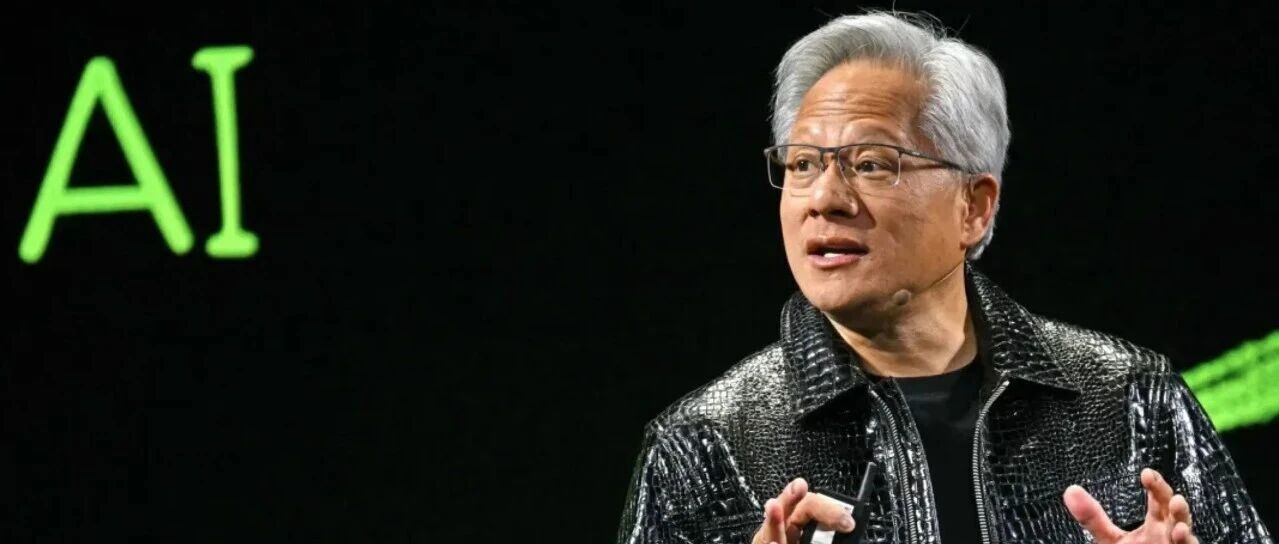
Core Viewpoint - Nvidia is transforming from a "chip company" to an "AI infrastructure and factory company," emphasizing the concept of "Token factory economics" to drive future growth and address market concerns about sustainability and growth potential [2][3]. Group 1: Performance Guidance - Nvidia's CEO, Jensen Huang, projected a demand of at least $1 trillion by 2027, significantly up from the previous estimate of $500 billion [3]. - The company claims that its systems are the "lowest cost infrastructure" globally, capable of running virtually all AI models, ensuring that the projected $1 trillion investment will be effectively utilized [3][4]. Group 2: Token Factory Economics - Huang introduced a new business paradigm where data centers are viewed as "factories" for producing Tokens, the basic units generated by AI [5]. - The performance of these factories is determined by the throughput of Tokens per watt of power, with the highest throughput leading to the lowest production costs [6]. Group 3: Technological Advancements - Nvidia's Vera Rubin system achieved a remarkable 350-fold increase in Token generation speed over two years, showcasing the company's advanced AI computing capabilities [7]. - The integration of Groq's technology aims to address bandwidth bottlenecks for high-speed inference, with distinct roles for each processor type [7]. Group 4: Software and Ecosystem Revolution - Huang highlighted the emergence of Agents, predicting that all SaaS companies will transition to AaaS (Agent-as-a-Service) models, with Nvidia providing enterprise-level designs to ensure secure implementation [8]. - The pricing structure for Token usage is tiered, with costs ranging from $3 to $150 per million Tokens depending on the speed and service level [8]. Group 5: Future Workforce Dynamics - The future workplace will require engineers to have an annual Token budget, with salaries potentially supplemented by Token allocations to enhance productivity [9]. - Nvidia is also developing the next-generation computing architecture, Feynman, and exploring the deployment of data centers in space, expanding the possibilities for AI computing beyond Earth [9].


【招商电子】美光FY26Q2跟踪报告:FY26Q2业绩超预期,上修FY26 Capex至超250亿美元
招商电子· 2026-03-19 06:31
Core Viewpoint - Micron's FY26Q2 financial performance exceeded expectations, with significant revenue and gross margin growth driven by strong demand in the AI sector and effective operational execution [2][9]. Financial Performance - FY26Q2 revenue reached $23.86 billion, a year-over-year increase of 196% and a quarter-over-quarter increase of 75%, significantly surpassing previous guidance [2][21]. - Non-GAAP gross margin was 74.9%, up 37 percentage points year-over-year and 18.1 percentage points quarter-over-quarter, driven by product price increases and cost control [2][21]. - Operating profit margin was 69.0%, reflecting a 44 percentage point increase year-over-year and a 22 percentage point increase quarter-over-quarter [2][24]. Product Performance - DRAM revenue was $18.8 billion, up 207% year-over-year and 74% quarter-over-quarter, with ASP increasing in the mid-60% range [3][21]. - NAND revenue reached $5 billion, a 169% year-over-year increase and an 82% quarter-over-quarter increase, with ASP rising in the high-70% range [3][21]. - The Cloud Memory Business Unit (CMBU) generated $7.75 billion in revenue, while the Core Data Center Business Unit (CDBU) generated $5.69 billion, both achieving record highs [7][22]. Future Guidance - FY26Q3 revenue is projected to be between $33.5 billion and $34.2 billion, representing a year-over-year increase of 260% and a quarter-over-quarter increase of 40% [4][30]. - Gross margin for FY26Q3 is expected to be around 81%, driven by price increases, cost reductions, and product structure optimization [4][30]. - Capital expenditures for FY26 are expected to exceed $25 billion, up from previous estimates of $20 billion, primarily for cleanroom facilities [4][19]. Strategic Developments - Micron signed its first five-year Strategic Customer Agreement (SCA), enhancing business visibility and stability [5][9]. - The company has successfully launched HBM4 products and is advancing in the development of HBM4E, expected to enter mass production in 2027 [5][11]. - Micron's data center products are projected to capture over 50% of the total addressable market (TAM) for DRAM and NAND by 2026, driven by AI demand [11][12]. Market Outlook - The DRAM and NAND markets are expected to experience supply constraints, with DRAM bit shipments projected to grow in the low 20% range in 2026 [17][18]. - Micron anticipates that the demand for low-power DRAM will continue to expand in data centers, with significant growth opportunities in the automotive and embedded markets [12][16]. - The company is well-positioned to capitalize on the AI-driven memory demand, which is reshaping the memory landscape as a strategic asset [9][10].


美光科技(MU):指引FY26Q3毛利率将超80%
SINOLINK SECURITIES· 2026-03-19 06:24
Investment Rating - The report maintains a "Buy" rating for the company, indicating a positive outlook for future performance [5]. Core Insights - The company reported significant revenue growth in FY26Q2, achieving $23.86 billion, a year-over-year increase of 196% and a quarter-over-quarter increase of 75% [2]. - The GAAP gross margin for FY26Q2 was 74.4%, reflecting a year-over-year increase of 37.6 percentage points and a quarter-over-quarter increase of 18.4 percentage points [2]. - The company expects FY26Q3 revenue to be approximately $33.5 billion, with gross margins around 81% [2]. - The demand for data center storage is rapidly increasing, with expectations that by the end of 2026, the demand for data center DRAM and NAND will exceed 50% of the total industry market [3]. - The company is increasing its capital expenditures, projecting over $25 billion for FY26, with further increases expected in FY27 to support HBM and DRAM capacity investments [4]. Summary by Relevant Sections Performance Review - FY26Q2 revenue reached $23.86 billion, with GAAP net profit of $13.78 billion, marking a year-over-year increase of 771% [2]. - Non-GAAP net profit for FY26Q2 was $14.02 billion, up 686% year-over-year [2]. Operational Analysis - DRAM revenue for FY26Q2 was $18.8 billion, up 207% year-over-year, with prices increasing approximately 65% quarter-over-quarter [3]. - NAND revenue was $5 billion, reflecting a 169% year-over-year increase, with prices rising 75-80% quarter-over-quarter [3]. - The company is making progress with HBM products, with HBM4 expected to reach mature yield faster than HBM3E [3]. Profit Forecast and Valuation - The company is projected to achieve GAAP net profits of $60.71 billion, $128.37 billion, and $171.06 billion for FY26, FY27, and FY28, respectively [5]. - The expected revenue growth rates for FY26 to FY28 are 195.7%, 81.9%, and 27.9% [10].
马斯克:对黄仁勋深感钦佩 SpaceX AI与特斯拉(TSLA.US)将持续大规模采购英伟达(NVDA.US)芯片
智通财经网· 2026-03-19 06:23
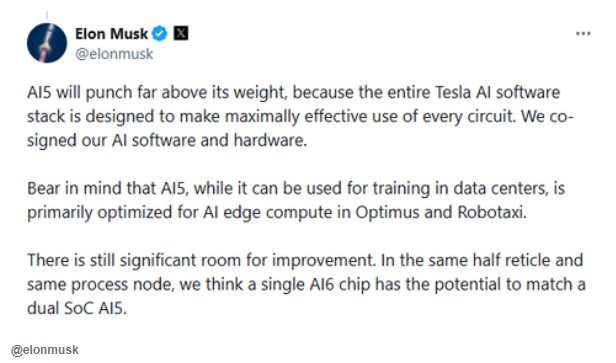
Group 1 - Elon Musk announced that SpaceX AI and Tesla (TSLA.US) will continue to make large-scale purchases of NVIDIA (NVDA.US) chips [1] - Tesla is developing its fifth-generation AI chip aimed at achieving full autonomous driving, which will power its autonomous driving system [1] - The AI5 chip is primarily optimized for AI edge computing support for the Optimus humanoid robot and Robotaxi autonomous vehicles, despite its capability for data center model training [1] Group 2 - Musk indicated that there is significant optimization potential for the AI5 chip, with expectations that the performance of a single AI6 chip could reach the level of a dual-core AI5 system under the same design and manufacturing process [1] - Tesla plans to widely roll out an updated version of its full self-driving (supervised version) software in the coming weeks [1] - SpaceX acquired xAI through an all-stock transaction, occurring ahead of a potential large-scale IPO later this year, marking the first time Musk referred to the merged entity as "SpaceX AI" [2]

英伟达GTC大会宣告AI迈入新阶段,“AI工厂”演进加速,500质量成长ETF鹏扬(560500)有望受益
Xin Lang Cai Jing· 2026-03-19 06:11
Group 1 - The core viewpoint of the news highlights the performance of the CSI 500 Quality Growth Index, which fell by 2.38% as of March 19, 2026, with mixed results among constituent stocks [1] - The recent Nvidia GTC 2026 conference announced a significant shift in the AI industry towards reasoning-driven tasks, with global computing power demand expected to surge by 1 million times in two years due to reasoning tasks [1] - The Vera Rubin full-stack AI platform enhances reasoning throughput by approximately 35 times, indicating a rapid evolution of AI infrastructure towards a system-level "AI factory" [1] Group 2 - A brokerage firm expressed confidence in the A-share market's medium-term outlook, driven by continued fiscal and monetary easing, increased household savings entering the market, and ongoing breakthroughs in global AI technology [2] - The CSI 500 Quality Growth ETF closely tracks the CSI 500 Quality Growth Index, selecting 100 high-profitability, sustainable, and cash-rich growth companies from the index for investors [2] - As of February 27, 2026, the top ten weighted stocks in the CSI 500 Quality Growth Index accounted for 25.36% of the index, with notable companies including Xiamen Tungsten, Western Mining, and Giant Network [2]
每日市场观察-20260319
Caida Securities· 2026-03-19 05:42
Market Overview - On March 18, the three major indices closed higher, with the Shanghai Composite Index ending a four-day losing streak, rising by 0.32%[3] - The Shenzhen Component Index increased by 1.05%, and the ChiNext Index rose by 2.02%[3] Trading Volume and Market Sentiment - On March 19, the trading volume was 2.06 trillion yuan, a decrease of approximately 160 billion yuan from the previous trading day[1] - The market showed signs of weakness in the morning but rebounded in the afternoon, although the volume was insufficient to support the rally[1] Sector Performance - Over half of the sectors saw gains, with telecommunications, computers, electronics, and military industries leading the increases[1] - Conversely, sectors such as oil, real estate, and food and beverage experienced declines[1] Capital Flow - On March 18, net inflows into the Shanghai Stock Exchange were 16.059 billion yuan, while the Shenzhen Stock Exchange saw net inflows of 28.337 billion yuan[4] - The top three sectors for capital inflow were telecommunications equipment, semiconductors, and IT services, while the top outflow sectors included batteries, securities, and passenger vehicles[4] Policy and Investment - The National Development and Reform Commission announced a new batch of 13 major foreign investment projects with a planned investment of 13.4 billion USD, focusing on manufacturing sectors like electronics and chemicals[5] - The Ministry of Industry and Information Technology emphasized promoting advanced technology applications to enhance the comprehensive utilization of waste tires[6] Fundraising Trends - In March, nearly 40 actively managed equity funds raised over 1 billion yuan each, with 7 funds established on March 18 alone, 5 of which exceeded this threshold[16]
大行评级丨小摩:重申英伟达“增持”评级,多个增量收入来源为市场预期提供可观的上行空间
Ge Long Hui· 2026-03-19 05:32
Group 1 - The core viewpoint of the article is that Nvidia has disclosed procurement orders and demand exceeding $1 trillion for Blackwell and Vera Rubin by 2027, which is considered a lower limit as it does not include additional revenue sources such as Groq LPU racks, standalone Vera CPUs, storage systems, and Rubin Ultra [1] - Nvidia aims to return approximately 50% of its free cash flow to shareholders through share buybacks and dividends, an increase from about 42% in fiscal year 2026, indicating over $200 billion combined for 2026 and 2027 [1] - The report highlights Nvidia's management's strong defense of the sustainability of its gross margins, redefining competitive advantages around factory-level token economics rather than chip-level pricing, and dismissing the notion that cheaper chips could undermine its business [1] Group 2 - Approximately half of Nvidia's data center revenue has been driven by a structural shift from CPU workloads to accelerated computing, which is independent of AI training and inference cycles, indicating significant growth potential [1] - The report suggests that multiple incremental revenue sources for Nvidia, previously unconsidered a year ago, provide substantial upside to current market expectations, and the company's competitive position continues to expand [1] - The firm reaffirms its "buy" rating on Nvidia with a target price of $265 [1]
小摩:重申英伟达“增持”评级,多个增量收入来源为市场预期提供可观的上行空间
Xin Lang Cai Jing· 2026-03-19 05:25
Core Viewpoint - Morgan Stanley's report indicates that Nvidia revealed procurement orders and demand exceeding $1 trillion for Blackwell and Vera Rubin by 2027, with this figure being a lower bound as it excludes additional revenue sources from Groq LPU racks, standalone Vera CPUs, storage systems, and Rubin Ultra [1] Group 1 - Nvidia aims to return approximately 50% of its free cash flow to shareholders through share buybacks and dividends, an increase from about 42% in fiscal year 2026, translating to over $200 billion combined for 2026 and 2027 [1] - The management has strongly defended the sustainability of gross margins, redefining competitive advantages around factory-level token economics rather than chip-level pricing, countering the argument that cheaper chips represent a fundamental misunderstanding of its business [1] Group 2 - Approximately half of the data center revenue is driven by a structural shift from CPU workloads to accelerated computing, which is independent of AI training and inference cycles, indicating significant growth potential [1] - The report suggests that multiple incremental revenue sources for Nvidia, previously unconsidered a year ago, provide considerable upside to current market expectations, with the company's competitive position continuously expanding [1]
美联储对关税通胀更谨慎:环球市场动态2026年3月19日
citic securities· 2026-03-19 05:17
Market Overview - U.S. stock indices fell over 1% due to inflation concerns and geopolitical uncertainties, with the Dow Jones down 1.63% to 46,225.2 points, S&P 500 down 1.36% to 6,624.7 points, and Nasdaq down 1.46% to 22,152.4 points[3][11]. - Brent crude oil futures rose nearly 4% to $110 per barrel, driven by escalating tensions in the Middle East and a hawkish stance from the Federal Reserve[4][28]. Federal Reserve Insights - The Federal Reserve maintained the policy interest rate at 3.50%-3.75%, aligning with market expectations, while raising inflation and economic growth forecasts slightly[6][11]. - The February PPI exceeded expectations at 3.4% year-on-year, increasing concerns about inflation and potential rate hikes[11][32]. Asian Market Performance - The Hong Kong Hang Seng Index rose 0.61% to 26,025.42 points, driven by AI computing and power equipment sectors, while real estate and automotive sectors lagged[13][16]. - A-shares saw a collective increase, with the Shanghai Composite Index up 0.32% to 4,062.98 points, led by the computing industry[16]. Commodity and Currency Movements - Gold prices fell 3.74% to $4,818.5 per ounce, marking the sixth consecutive day of decline due to rising oil prices and a stronger dollar[4][28]. - The U.S. dollar index increased by 0.5% to 100.09, reflecting the impact of higher oil prices and inflation concerns[27]. Bond Market Trends - U.S. Treasury yields rose by 4-10 basis points, with the 2-year yield at 3.77% and the 10-year yield at 4.27%[5][32]. - The Asian bond market remained stable, with spreads narrowing by 2-4 basis points, indicating a preference for buying[32].
用价值投资对冲科技板块风险 | 两说
第一财经· 2026-03-19 05:15
Core Viewpoint - The value of active management is stronger than ever, especially in the context of market volatility and the rise of passive investment strategies [3] Group 1: Active Management - Active management is essential for identifying potential winners and losers in various industries, particularly in the rapidly evolving artificial intelligence sector [3] - Researching fundamentals and future prospects is crucial, as it helps uncover areas where positive surprises may occur [3] Group 2: 2026 Market Outlook - The bond market is expected to influence the stock market significantly, with current high valuations indicating a potential market correction [5] - There is uncertainty regarding when this adjustment may occur, but the pressure in the bond market is accumulating [5] Group 3: "American Exception" Theory - The concentration risk associated with the "seven giants" in the U.S. market is becoming apparent, as not all companies will succeed despite previous strong performance [8] - Market differentiation is emerging, which is seen as a positive development [8] Group 4: Artificial Intelligence Volatility - Short-term fluctuations in the AI sector are normal, but long-term confidence in its transformative potential remains strong [10] - The market will eventually distinguish between significant and insignificant developments, creating substantial investment opportunities [10] Group 5: Value Investment as a Hedge - Value sectors tend to have low correlation with growth sectors, providing a balance that can mitigate risks associated with AI volatility [12] - Industries such as energy, industrials, and commodities are highlighted for their stability and resistance to technological disruption [12] Group 6: Chinese Market Outlook - There is optimism regarding China's potential to become a global leader in various industries, including electric vehicles and renewable energy [14] - Investor confidence in China's commitment to AI development is crucial for the next round of asset revaluation [14] Group 7: 2026 Core Investment Belief - The core investment strategy for 2026 emphasizes a positive outlook on AI while focusing on stock selection [16] - Diversification beyond the tech sector is recommended to include more stable areas, underscoring the importance of carefully chosen investment targets [16]