
传媒

Search documents
极致分化!3.2万亿资金上演“高低切换”,后市方向明确了
Sou Hu Cai Jing· 2026-01-29 08:32
Overall Market Overview - The A-share market showed mixed performance with the Shanghai Composite Index slightly up by 0.16% to 4157.98 points, while the Shenzhen Component and ChiNext Index fell by 0.3% and 0.57% respectively. The STAR 50 Index experienced a significant drop of 3.03%, closing at 1507.64 points. Total trading volume reached 3.23 trillion yuan, an increase of over 260 billion yuan compared to the previous day [1][2]. Sector Performance - Traditional blue-chip and cyclical sectors dominated the gainers' list, with the food and beverage sector surging by 6.57%. Notably, liquor stocks saw a rally, with Kweichow Moutai rising by 8% and trading volume exceeding 20 billion yuan. Other sectors like media, real estate, non-bank financials, and oil & petrochemicals also saw gains of over 2% [2]. - The technology and high-end manufacturing sectors, represented by the electronics sector, faced the largest declines, with a drop of 3.56%. Other sectors such as power equipment, defense, and machinery also fell by more than 1.7% [2]. Market Sentiment and Fund Flows - The current market sentiment reflects a clear preference for "reality" over "dreams," with funds moving away from long-term investments in "hard technology" towards short-term performance certainty in "consumer recovery" sectors. This shift indicates a significant change in investment strategy [3]. - Data shows that major broad-based ETFs like CSI 300 and CSI 1000 have experienced substantial net outflows this year, indicating a shift from beta (market overall) to alpha (individual stock opportunities). However, niche products like the STAR 100 ETF have seen continued net inflows, suggesting selective investment in high-potential "hardcore" assets within the technology sector [3]. Future Market Outlook - The current trend of "blue-chip leading, growth resting" is expected to continue in the short term, with sectors like real estate and liquor likely to maintain upward momentum driven by policy and sentiment. The sustainability of this trend will depend on upcoming consumer and real estate sales data validating the strength of the recovery [4]. - Despite the significant pullback in the technology sector, there is no need for excessive pessimism. As valuation pressures are quickly released, the medium to long-term investment value may gradually become more apparent, especially for leaders in emerging industries that align with national policy directions [4].

聚焦AI应用,这只特色ETF火了!
Sou Hu Cai Jing· 2026-01-29 07:52
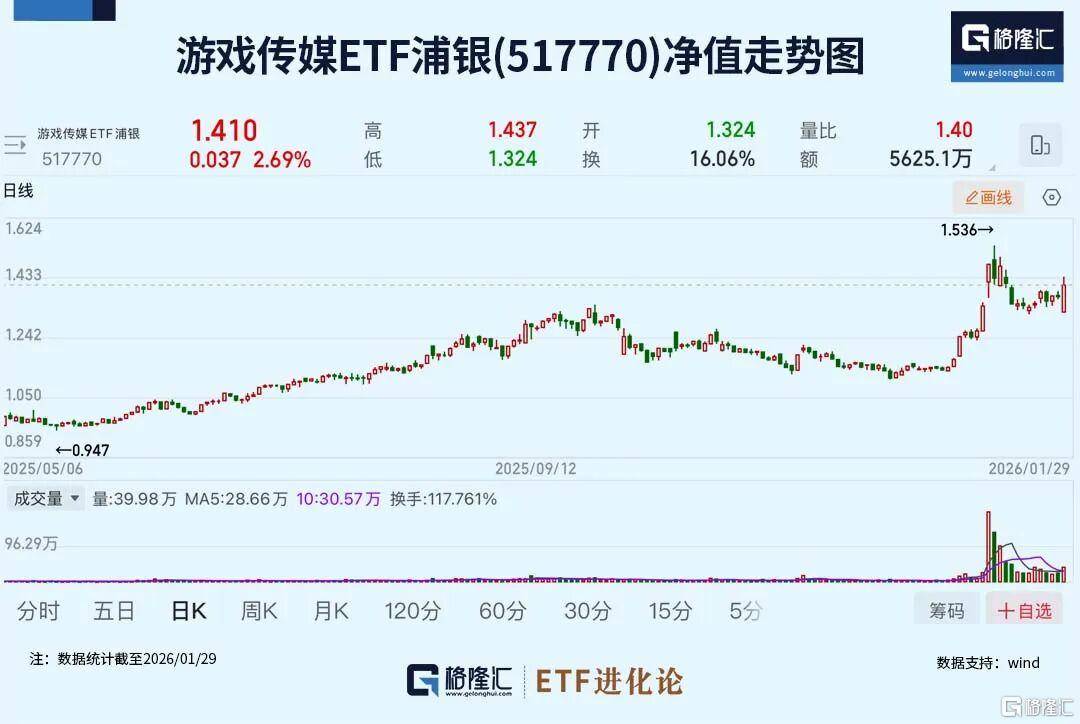
Group 1 - The market is experiencing unusual signals driven by the "application end," particularly in the AI application sector, with companies like 易点天下, 中文在线, and 天龙集团 frequently appearing on the gainers list [1] - The game media ETF浦银 (517770) has seen a 26.75% increase over the last 30 trading days and over 55% since 2025 [2] - The current market dynamics indicate a shift from "upstream capabilities" to "downstream applications," prompting investors to question how AI can be integrated into specific industries and create verifiable business paths [5][6] Group 2 - The emergence of GEO is linked to a significant change in how AI is reshaping information access, making content, gaming, and media focal points for market reassessment [6][10] - The discussion around GEO highlights a fundamental shift in user information acquisition from "search-click-read" to "ask-generate-decide," indicating a change in content's role [12][13] - The gaming and media sectors are being re-evaluated as they are user attention-centric industries with diverse monetization paths, making them prime candidates for AI application [19][21] Group 3 - The game media ETF浦银 (517770) tracks the 中证沪港深游戏及文化传媒指数, covering multiple sectors including gaming, film, advertising, and content platforms, with a notable presence of Hong Kong stocks [25][26] - Recent funding behavior indicates a structural reassessment of AI-related assets in the Hong Kong market, which had previously been affected by negative market sentiment [30][31] - The ETF浦银 (517770) has seen over 257 million yuan in net inflows over the past 20 days, reflecting its growing significance in the market [33] Group 4 -浦银安盛 is advancing its index business brand "指数家," focusing on a systematic approach to index investment that emphasizes transparency and long-term sustainability [35] - The game media ETF浦银 (517770) is not an isolated product but a manifestation of the "指数家" methodology applied to a specific industry direction [35]

粤开市场日报-20260129-20260129
Yuekai Securities· 2026-01-29 07:46
Market Overview - The A-share market showed mixed performance today, with the Shanghai Composite Index rising by 0.16% to close at 4157.98 points, while the Shenzhen Component Index fell by 0.3% to 14300.08 points. The ChiNext Index decreased by 0.57% to 3304.51 points, and the Sci-Tech 50 Index dropped by 3.03% to 1507.64 points. Overall, there were 1801 stocks that rose and 3562 that fell, with a total trading volume of 32.3 billion yuan, an increase of 2.646 billion yuan from the previous trading day [1][2]. Industry Performance - Among the Shenwan first-level industries, food and beverage, media, real estate, non-bank financials, and oil and petrochemicals led the gains, with increases of 6.57%, 3.53%, 2.65%, 2.28%, and 2.23% respectively. Conversely, the electronics, defense and military industry, electric equipment, and machinery sectors experienced declines, with drops of 3.56%, 1.79%, 1.78%, 1.76%, and 1.66% respectively [1]. Concept Sector Performance - The top-performing concept sectors today included liquor, beverage manufacturing, real estate selection, Xiaohongshu platform, oil and gas extraction, short drama games, brand leaders, Pinduoduo partners, virtual humans, insurance selection, Kimi, WEB3.0, rare earths, Chinese corpus, and bank selection. In contrast, sectors such as the SMIC industrial chain, copper-clad laminates, analog chips, and third-generation semiconductors saw a pullback [2].
天龙集团尾盘20%涨停,蓝色光标收涨14%!IP、AI成为2026年传媒双主线
Mei Ri Jing Ji Xin Wen· 2026-01-29 07:26
Group 1 - Tianlong Group (300063) saw a 20% surge in stock price, while BlueFocus Communication Group (300058) rose by 14.93%, and other companies like Hengdian Film and Television (603103) and Zhejiang Wenlian (600986) reached their daily limit [1] - Tianlong Group's performance forecast indicates an expected net profit attributable to shareholders of 100 million to 130 million yuan for 2025, representing a year-on-year growth of 53.44% to 99.48% [1] - The growth in Tianlong Group's net profit is attributed to enhanced operational service capabilities in the internet marketing sector, increased service fee income, and improved management efficiency leading to cost reduction [1] Group 2 - Wanlian Securities highlights that the development trends in the media industry for 2026 will focus on IP and AI as dual main lines, with a shift in consumer perception from "functional" to "emotional value" [2] - The application of AI across various sub-industries in media is driving a new phase of market development [2] - 华夏 Fund recommends using thematic indices like Media ETF Huaxia (516190.SH) for diversified and low-threshold investment opportunities, emphasizing its transparent holdings and high investment efficiency [2]


光线传媒等成立文化科技公司
Qi Cha Cha· 2026-01-29 06:16
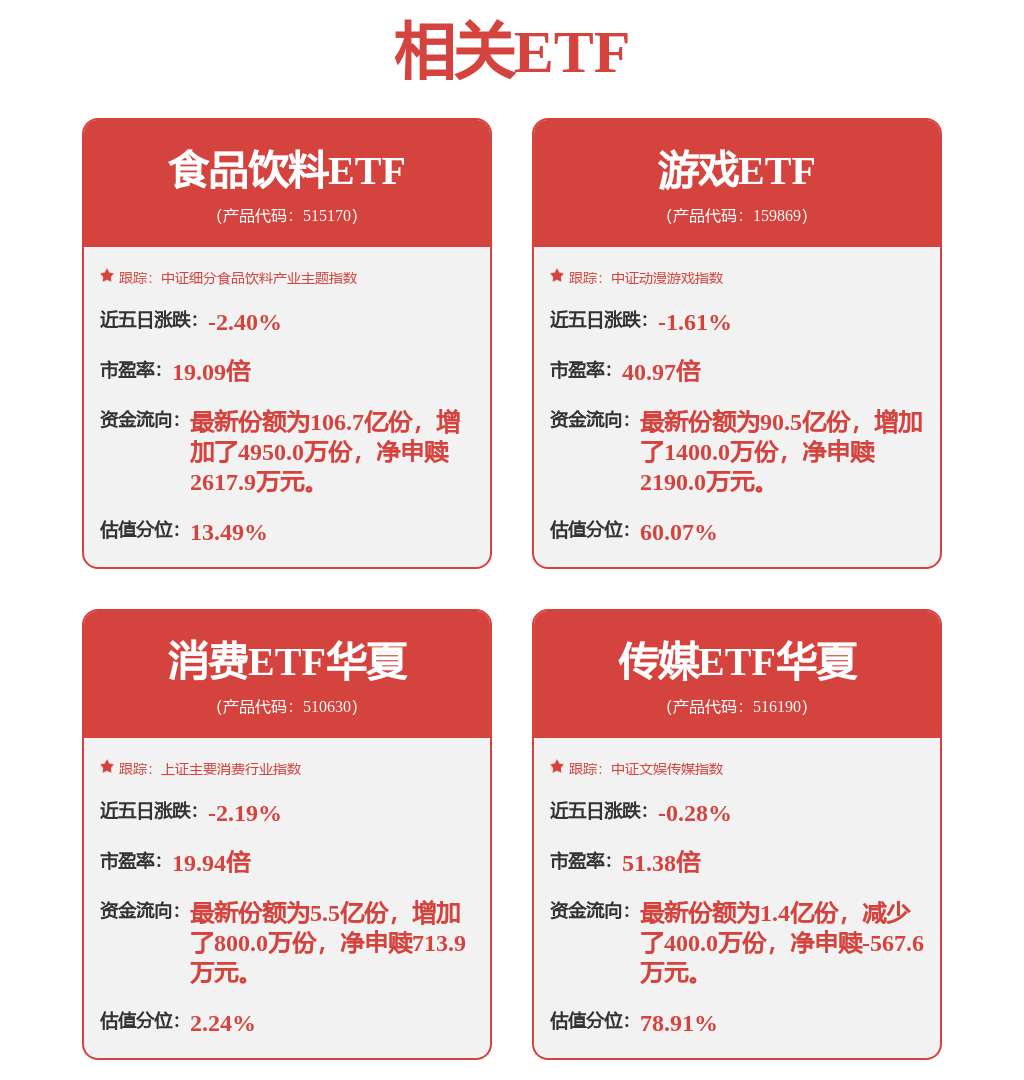
Group 1 - Beijing Yikeguang Cultural Technology Co., Ltd. has been established, with its legal representative being Xing Jiayun, and its business scope includes film production services, radio and television program production and operation, television drama distribution, internet live streaming technology services, film distribution, and retail of publications [1] - The company is jointly held by Beijing Light Media Co., Ltd.'s wholly-owned subsidiary Beijing Light Film Co., Ltd. and Yu Zhigang [1] Group 2 - The Food and Beverage ETF (Product Code: 515170) tracks the CSI Sub-Industry Food and Beverage Theme Index, with a recent five-day decline of 2.40% and a price-to-earnings ratio of 19.09 times [3] - The Gaming ETF (Product Code: 159869) tracks the CSI Animation and Gaming Index, experiencing a five-day decline of 1.61% and a price-to-earnings ratio of 40.97 times [4] - The Consumer ETF (Product Code: 510630) tracks the Shanghai Stock Exchange Major Consumer Industry Index, with a five-day decline of 2.19% and a price-to-earnings ratio of 19.94 times [4] - The Media ETF (Product Code: 516190) tracks the CSI Cultural and Entertainment Media Index, showing a five-day decline of 0.28% and a price-to-earnings ratio of 51.38 times [5]

关注股指企稳时机
Hua Tai Qi Huo· 2026-01-29 05:51
FICC日报 | 2026-01-29 关注股指企稳时机 市场分析 美联储按兵不动。宏观方面,截至2025年底,央企资产总额突破95万亿元,完成固定资产投资5.1万亿元,其中战 略性新兴产业投资2.5万亿元;全年实现利润总额2.5万亿元。国务院国资委表示,将扎实做好新央企组建和战略性 重组,研究起草推动央企培育新兴支柱产业工作文件,探索组建"AI+"产业共同体。海外方面,美联储维持基准利 率在3.50%-3.75%不变,在连续三次降息25个基点后暂停行动,符合市场预期。鲍威尔在新闻发布会上表示,加息 并非任何人对下一步行动的基本假设,不相信美联储会丧失独立性,将建议下一届美联储主席远离政治。 指数分化。现货市场,A股三大指数震荡分化,上证指数涨0.27%收于4151.24点,创业板指跌0.57%。行业方面, 板块指数涨多跌少,有色金属、石油石化、煤炭行业涨幅超3%,传媒、国防军工、美容护理行业跌幅居前。当日 沪深两市成交额升至约3万亿元。海外方面,美国三大股指收盘涨跌不一,纳指涨0.17%报23857.45点。 期指保持升水。期货市场,基差方面,IF、IC、IM基差延续回升,当月合约保持升水。成交持仓方面,股 ...
A股新热点,人气主线大爆发
Zhong Guo Zheng Quan Bao· 2026-01-29 05:33
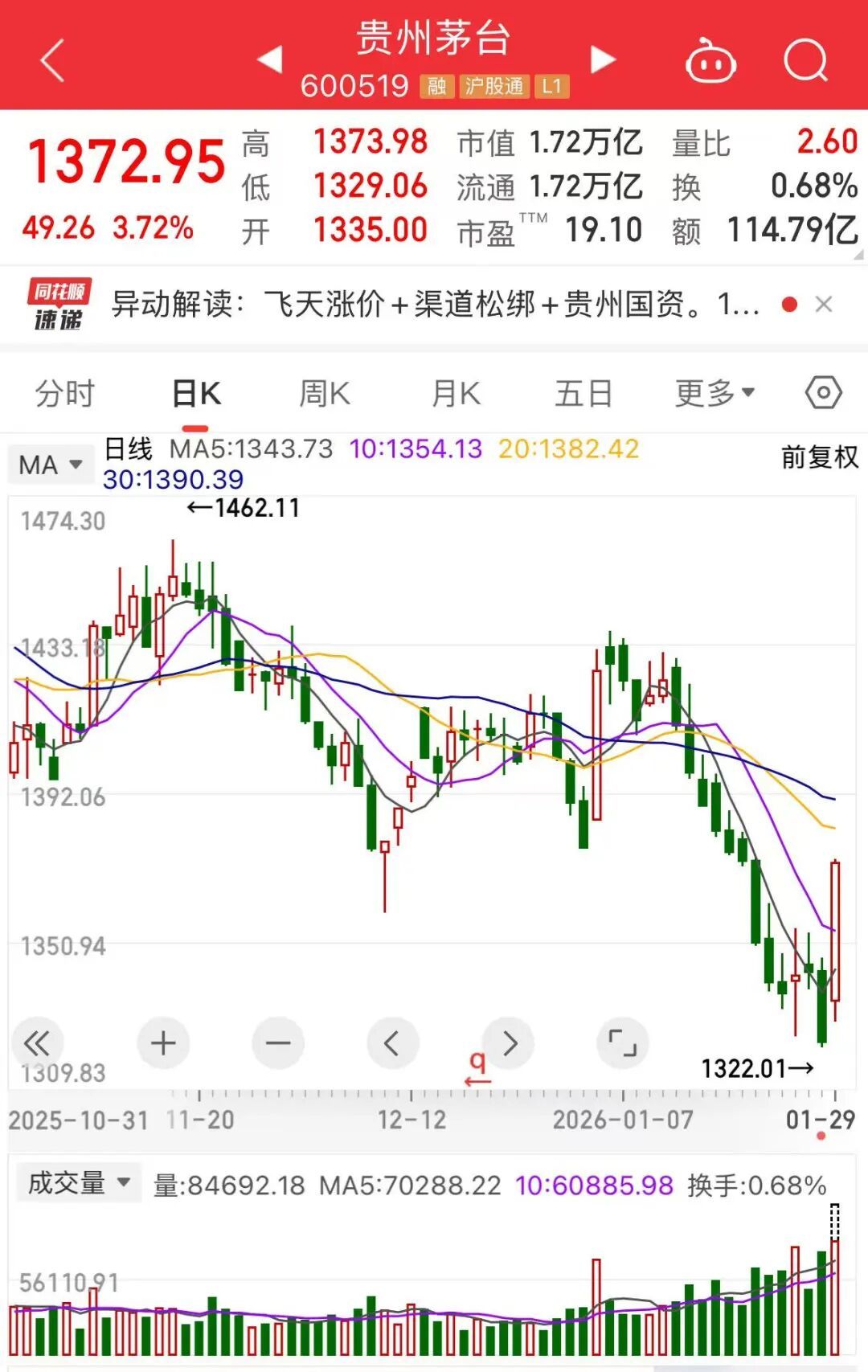
Core Viewpoint - The recent launch of Clawdbot is seen as a turning point for the commercialization of AI applications, leading to significant stock price increases in related companies [1][3]. AI Application Sector - The AI application sector experienced a broad rally, with notable increases in stocks such as BlueFocus, Yidian Tianxia, Zhidema, and Tianlong Group [1][3]. - Clawdbot, an open-source AI assistant, allows users to issue commands through popular messaging apps, enhancing user interaction with AI models [5]. Stock Performance - Guizhou Moutai, a leading stock in the liquor sector, rebounded by 3.72% to reach 1372.95 CNY per share, with a trading volume of 11.479 billion CNY, marking a recent high [1][7]. - The liquor sector, particularly high-end brands, is seeing increased demand as the Spring Festival approaches, contributing to stock price increases [9][10]. Market Trends - The overall market showed mixed results, with the Shanghai Composite Index down 0.1% and the Shenzhen Component Index up 0.01% [3]. - The precious metals and oil & gas sectors continued to rise, indicating a diverse market response [3]. Liquor Industry Insights - The price of Feitian Moutai has been rising, with recent data showing an increase of 20 CNY per bottle, reflecting strong demand ahead of the Spring Festival [9]. - Analysts suggest that the liquor sector is at a valuation low, presenting a potential investment opportunity as demand is expected to surge during the festive season [10].

行业ETF风向标丨有色金属ETF半日放量成交近50亿元,3只传媒ETF半日涨幅超4%
Sou Hu Cai Jing· 2026-01-29 05:02
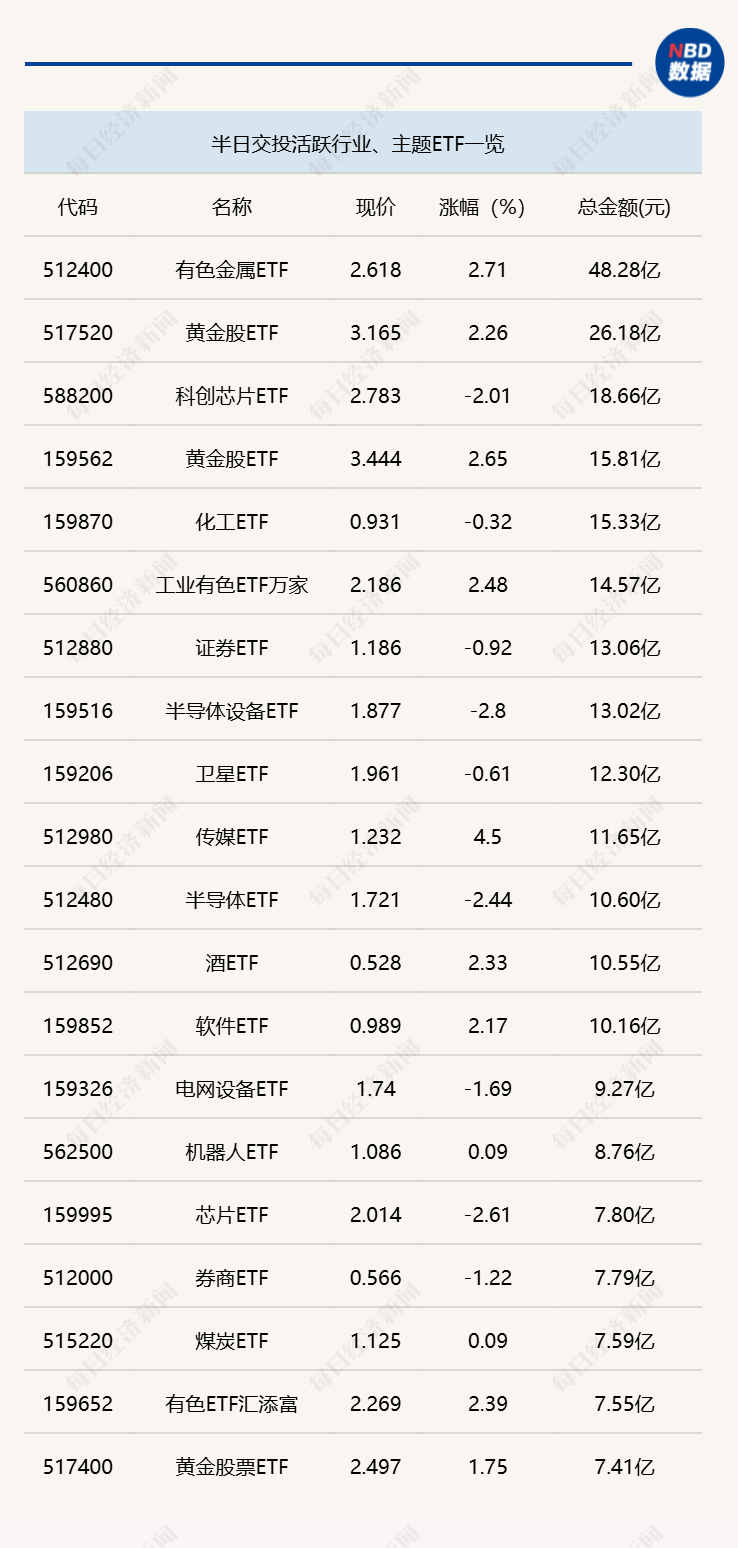
Core Viewpoint - The trading volume of various ETFs has significantly increased, particularly in the non-ferrous metals and gold sectors, indicating heightened investor interest and market activity [1][3][4]. ETF Trading Activity - The non-ferrous metals ETF (512400) recorded a half-day trading volume of 4.828 billion yuan, with a price increase of 2.71% [3]. - The gold stock ETF (517520) also saw a substantial trading volume of 2.618 billion yuan, with a price increase of 2.26% [3]. - The Hang Seng Technology ETF (513130) had a trading volume of 4.219 billion yuan, despite a slight price decrease of 0.79% [4]. Sector Performance - The media sector is experiencing a rebound, with three media ETFs showing half-day price increases exceeding 4% [4]. - The media ETF (512980) and media ETF (159805) had price increases of 4.5% and 4.44%, respectively, with the former having a larger scale of 9.357 billion shares and a trading volume of 1.165 billion yuan [6]. - The media sector benefits from improved policy environments and increased AI applications, which are enhancing content demand and market valuations [6]. Major Holdings in Media ETFs - The major stocks in the media sector include BlueFocus (300058) with a weight of 7.76%, and Focus Media (002027) with a weight of 7.66% in the CSI Media Index [7][10]. - The CSI Media Index reflects the performance of 50 large-cap listed companies in marketing, advertising, cultural entertainment, and digital media [6][8].
下一代中国人,很可能不会搜索了
创业邦· 2026-01-29 03:54
Core Viewpoint - The article discusses the transformative impact of AI on traditional search engines and the media industry, highlighting the shift towards AI-driven content generation and the emergence of new marketing strategies like Generative Engine Optimization (GEO) [6][10][20]. Group 1: AI and Search Engine Dynamics - The number of active users for leading AI applications exceeded 150 million by the end of last year, indicating a significant shift in user behavior from traditional search engines to AI models for information retrieval [7]. - Gartner predicts a 25% decline in traditional search engine traffic by 2024, with a potential 50% reduction by 2028, suggesting a major disruption in how brands attract traffic [11]. - The content distribution and presentation processes differ significantly between traditional search engines and AI applications, leading to a potential loss of visibility for original content [10][14]. Group 2: Impact on Content Creators and Marketing Strategies - Content creators face challenges as their work's visibility diminishes due to the AI's ability to generate answers directly, which reduces user engagement with original content [19]. - The shift from Search Engine Optimization (SEO) to Generative Engine Optimization (GEO) is necessary for brands to ensure their content appears in AI-generated responses, requiring new strategies for content creation and marketing [20]. - The GEO market is projected to reach 24 billion yuan in China by 2030, with a global market size of 100.7 billion USD, indicating a significant growth opportunity for media companies [20]. Group 3: Media Industry Adaptation - AI is contributing to various sectors within the media industry, including marketing, advertising, and digital media, by enhancing creativity and content generation capabilities [24]. - The media ETF (512980) tracks a diversified index of media companies, with significant inflows of over 5 billion yuan in recent weeks, reflecting investor interest in the evolving media landscape [25]. - Content creators are encouraged to adapt to AI changes by enhancing their unique insights and learning new content creation and distribution techniques to thrive in the AI-driven environment [26][27].

招银国际每日投资策略-20260129
Zhao Yin Guo Ji· 2026-01-29 03:21
Market Performance - The Hang Seng Index closed at 27,827, up 2.58% for the day and 8.57% year-to-date [1] - The Hang Seng Tech Index rose by 2.53%, with a year-to-date increase of 6.96% [1] - The Shanghai Composite Index saw a modest increase of 0.27%, with a year-to-date rise of 4.60% [1] - The US markets showed mixed results, with the Dow Jones up 0.02% and the S&P 500 down 0.01% [1] Sector Performance - In the Hong Kong market, the Hang Seng Financial Index increased by 2.62%, while the Hang Seng Real Estate Index rose by 3.03%, reflecting strong performance in these sectors [2] - The Chinese stock market saw gains in materials, energy, and telecommunications, while consumer staples, utilities, and healthcare lagged [3] Company Insights - New Oriental (EDU US) reported a 15% year-on-year revenue growth to $1.19 billion, exceeding Bloomberg consensus estimates by 3% [5] - The company’s non-GAAP operating profit surged by 207% to $89.13 million, driven by improved operational efficiency and utilization in its education business [5] - New Oriental raised its revenue guidance for FY26E to a range of $5.29 billion to $5.49 billion, indicating a year-on-year growth of 8%-12% [5] Economic Indicators - The USD/CNY exchange rate fluctuated around 6.94, indicating stability in the currency market [3] - The US Federal Reserve maintained interest rates, with indications of a hawkish stance in future meetings, suggesting economic activity is expanding steadily [3][4]