
通信

Search documents
20cm速递|科创200ETF国泰(589220)盘中涨超0.5%,制造业与科技产业景气获关注
Mei Ri Jing Ji Xin Wen· 2026-02-06 08:27
Core Viewpoint - The manufacturing and technology sectors are experiencing increased attention due to rising profitability forecasts in AI hardware and price increase chains, with a notable impact on the industry chain [1] Group 1: Industry Insights - The average year-on-year growth rate of net profit forecasts for AI hardware (semiconductors, components, communication network equipment, etc.) and price increase chains (industrial metals, energy metals, agrochemicals, etc.) for Q4 2025 is expected to improve compared to Q3 2025 [1] - Recent price increases have been observed in electronic components and minor metals, indicating a spillover effect from the upstream price hikes [1] - Concerns have emerged regarding potential declines in profit growth for certain midstream manufacturing products in Q4 2025, with expectations of continued challenges into Q1 2026 [1] Group 2: Investment Opportunities - The current market environment suggests that investors may consider sectors with good growth logic that have not yet fully realized their potential gains during the recent spring market rally, such as electronics (components/semiconductors) and communications [1] - The Guotai Science and Technology 200 ETF (589220) tracks the Science and Technology 200 Index (000699), which includes 200 stocks selected from the Sci-Tech Innovation Board, reflecting the overall performance of the market [1] - The index samples cover multiple high-tech and strategic emerging industries, including information technology, biomedicine, and new energy, showcasing strong innovation and growth characteristics [1]
粤开市场日报-20260206-20260206
Yuekai Securities· 2026-02-06 07:45
Market Overview - The A-share major indices mostly closed lower today, with the Shanghai Composite Index down 0.25% at 4065.58 points, the Shenzhen Component Index down 0.33% at 13906.73 points, the ChiNext Index down 0.73% at 3236.46 points, and the Sci-Tech 50 Index down 0.71% at 1422.41 points [1] - Overall, the market saw mixed performance with 2748 stocks rising and 2545 stocks falling, while 180 stocks remained flat. The total trading volume in the Shanghai and Shenzhen markets was 21,457 billion yuan, a decrease of 305 billion yuan compared to the previous trading day [1] Industry Performance - Among the Shenwan first-level industries, sectors such as petroleum and petrochemicals, basic chemicals, and electric equipment led the gains, with increases of 2.55%, 2.05%, and 1.27% respectively. Conversely, industries like food and beverage, defense and military, and social services experienced declines, with drops of 1.86%, 1.66%, and 1.37% respectively [1] Concept Sector Performance - The concept sectors that saw the highest gains today included lithium battery electrolyte, lithium battery anode, and solid-state batteries, among others. Notably, sectors such as liquor, cross-strait integration, and advanced packaging experienced pullbacks [2]
资产配置月报202602:如何衡量黄金的交易拥挤度?
Guolian Minsheng Securities· 2026-02-06 07:25
Investment Rating - The report maintains a neutral to optimistic outlook for the equity market in February 2026, indicating a continued recovery in economic sentiment [26][27]. Core Insights - The report highlights that the recent significant drop in gold prices is attributed to a combination of short-term negative events and the inherent fragility of market structures, despite the long-term bullish outlook for gold remaining intact [9][16][25]. - The analysis suggests that managing positions based on gold's trading congestion can enhance returns while mitigating risks during periods of high volatility [21][25]. - The report emphasizes a favorable outlook for various sectors, particularly non-ferrous metals, basic chemicals, telecommunications, and renewable energy, while also identifying potential opportunities in sectors experiencing recovery from previous downturns [99]. Summary by Sections 1. Measuring Gold Trading Congestion - The report discusses the recent decline in gold prices, with a notable drop of 9.2% on January 30 and 13.2% on February 2, 2026, indicating a significant market reaction to external factors [13][16]. - It identifies that the trading congestion in gold was at a high level prior to the drop, suggesting that the market's speculative positions were vulnerable to negative news [19][25]. 2. Major Asset Quantitative Insights - **Equities**: The sentiment is neutral to optimistic, with a recovery in financial and industrial sectors, and analysts expect stronger net profits in sectors like non-ferrous metals and construction [26][27]. - **Interest Rates**: The report predicts a rise in the 10-year government bond yield by 6 basis points to 1.88% in February, driven by factors such as economic growth and inflation [44][50]. - **Gold**: All four factors analyzed (economic, employment, fiscal, and external debt) are currently favorable for gold, maintaining a bullish outlook [54][57]. - **Real Estate**: The pressure index for the real estate sector has increased slightly, indicating rising supply-side pressures while demand remains stable [64][66]. - **Overseas Markets**: The report notes a potential turnaround in trade conflicts, particularly between India and the US, which could enhance the attractiveness of Indian equities [68][78]. 3. Style Quantitative Insights - The market is expected to continue expanding, with recommendations for growth-oriented and profitability-focused investment styles [80][81]. - There is a specific emphasis on small-cap and growth stocks, with historical data suggesting that small-cap stocks tend to outperform in February [87][96]. 4. Industry Allocation Quantitative Insights - The report recommends a diversified industry allocation strategy, highlighting sectors such as non-ferrous metals, basic chemicals, telecommunications, and renewable energy as key areas for investment [99].
资产配置月报202602:如何衡量黄金的交易拥挤度?-20260206
Guolian Minsheng Securities· 2026-02-06 06:41
- The report introduces a structured static factor model for predicting 10Y government bond yield movements, utilizing four macroeconomic factors: economic growth, inflation, debt leverage, and short-term interest rates[44][50][53] - The model has achieved a historical prediction accuracy of approximately 70% since 2006, with a sample-out accuracy of 68% since 2023[47][50] - For February 2026, the model forecasts a 6BP increase in the 10Y government bond yield to 1.88%, driven by upward trends in all four macroeconomic factors[50][53] - A structured static factor model is also applied to gold price movements, incorporating four key factors: US economy, US employment, US fiscal policy, and US external debt[54][57] - The gold model has demonstrated a historical prediction accuracy of 65% since 2008, with a sample-out accuracy of 78% since 2023[54][55] - The report highlights that fiscal and employment factors are currently supporting gold price increases, while economic and external debt factors show mixed signals[57][60] - A quantitative strategy for managing gold positions based on trading congestion is proposed, using two metrics: 40-day price deviation rate and SHFE gold implied volatility (IV)[19][21] - The strategy suggests reducing portfolio exposure to 40% when the 40-day price deviation rate exceeds 9% and SHFE gold IV surpasses 30%, achieving an excess return of 53.4% and improving the Sharpe ratio from 1.26 to 1.62 during backtesting from 2020 to February 2026[21][19] - The report recommends a multi-dimensional industry allocation strategy combining "win-rate and odds" and "clearance reversal" approaches, with industries such as non-ferrous metals, basic chemicals, and steel being highlighted[99][102][115]
积极布局未来产业,各地有何通关“密码”?
Yang Shi Xin Wen· 2026-02-06 05:58
Group 1 - The concept of "future industries" has gained significant attention in 2026, with a focus on development and strategic planning at various governmental levels [1][3] - Future industries are defined as emerging sectors driven by cutting-edge technologies, currently in the early stages of development, characterized by strategic significance and potential for disruption [2][3] - The "14th Five-Year Plan" emphasizes the importance of forward-looking layouts for future industries, aiming to explore diverse technological routes and typical application scenarios [2][3] Group 2 - China's future industry development is transitioning from technology catch-up to proactive layout, with a mix of leading, parallel, and following positions across different sectors [4][5] - Key regions like Beijing, Guangdong, and Jiangsu are making strides in future industries, with specific focuses on quantum technology, biomanufacturing, and 6G communications [12][14] - Shanghai and Anhui are highlighted as leaders in future industry development, with Shanghai leveraging its comprehensive advantages and Anhui focusing on quantum technology and fusion energy [5][8] Group 3 - Shanghai's strategic initiatives include a dynamic cultivation system for future industries, supported by a fund of approximately 15 billion yuan, aimed at reducing costs and accelerating product commercialization [7][10] - Anhui has established a robust ecosystem for quantum technology and fusion energy, with a significant concentration of enterprises and research institutions [9][11] - The development of future industries is not limited to coastal regions, as demonstrated by Anhui's success in quantum technology and its plans for commercializing fusion energy [8][10] Group 4 - Local governments are encouraged to create open and inclusive innovation ecosystems to support the growth of future industries, emphasizing the importance of regional characteristics and market orientation [17][18] - The national government is implementing major strategic projects and increasing investment in future industries to foster a competitive environment across regions [15][16] - Future industries are expected to thrive through proactive planning, localized development strategies, and supportive policy measures [18]
融资资金暗流涌动,数据揭示机构真实目的
Sou Hu Cai Jing· 2026-02-06 04:35
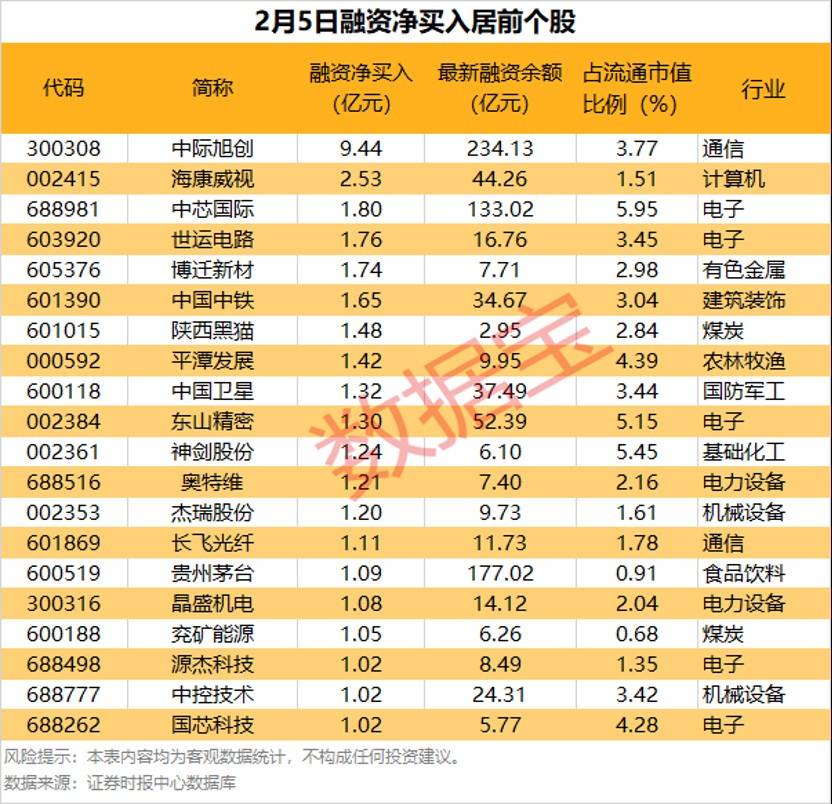
Core Insights - The market is experiencing significant sector rotation, with policy benefits driving strong performance in certain areas, while financing dynamics are changing [1] - A total of 20 stocks have seen net financing purchases exceeding 1 billion yuan, indicating institutional interest [1] - Many investors are misled by market trends and news, often mistaking surface movements for underlying realities, which are actually determined by genuine trading behaviors [1] Financing Data Summary - The top stocks by net financing purchases on February 5 include: - Zhongji Xuchuang (300308) with 9.44 billion yuan - Hikvision (002415) with 2.53 billion yuan - Zhongxin International (688981) with 1.80 billion yuan - Other notable mentions include Shiyun Circuit (603920) and Bo+ New Materials (605376) with 1.76 billion yuan and 1.74 billion yuan respectively [2] Market Behavior Analysis - Investors often rely on past price movements to predict future trends, leading to confusion when similar patterns yield different outcomes [3] - The disparity in stock performance can be attributed to the underlying trading behaviors that are not visible in surface trends [7] Quantitative Data Importance - Institutional trading behaviors significantly influence long-term market trends, and these behaviors can be tracked through quantitative data [9] - The "institutional inventory" metric serves as a key indicator of institutional activity, with active inventory suggesting ongoing participation from large funds [9] Common Trading Illusions - Quantitative analysis can help clarify misleading trading signals, as seen in two contrasting stocks where one showed active institutional participation while the other did not [11] - The presence or absence of institutional inventory can indicate whether price movements are genuine or merely temporary [11] Establishing Objective Investment Recognition - Quantitative data aids in developing an objective understanding of market dynamics, reducing the influence of emotional biases [13] - Continuous observation of institutional inventory can help investors maintain clarity and make informed decisions in a complex market environment [13]

量子通信风口崛起,海能达已提前布局卡位
Xin Lang Cai Jing· 2026-02-06 02:51
Core Insights - Quantum technology is recognized as a strategic technology with significant national importance, receiving strong policy support and investment, which enhances the development of quantum communication and its practical applications [1][4]. Industry Overview - The quantum communication sector is experiencing increased research and development investment, leading to a more complete industrial ecosystem and a collaborative development model among academia, industry, and government [1][4]. - The national policy environment is favorable for companies looking to enter the quantum technology field, providing ample opportunities for growth and innovation [1][4]. Company Collaboration - HaiNengDa, a leading company in the private network communication sector, has over 30 years of technological experience and a global market presence, aligning its focus with national policy by integrating private network communication with quantum encryption technology [1][4]. - In June 2023, HaiNengDa signed a strategic cooperation agreement with China Telecom Quantum Group, and further discussions in March 2024 aimed to leverage each company's strengths in product development, particularly in intercom and platform systems [1][4]. Technological Advancements - China Telecom Quantum Group is a key player in the domestic quantum technology field, possessing a full-chain advantage in equipment manufacturing, network operation, and application services, which enhances the collaboration with HaiNengDa [2][5]. - The partnership aims to quickly penetrate the quantum encryption communication market, creating a unique competitive advantage and technological barrier [2][5]. Practical Applications - HaiNengDa's quantum communication encryption technology has been successfully applied in significant events, such as the 2025 commemoration of the 80th anniversary of the victory in the Chinese People's War of Resistance Against Japanese Aggression, providing an "unbreakable" security barrier for critical communications [2][5]. - The focus on developing quantum encryption intercom terminals and platform systems is tailored to meet the high-security communication needs of sectors like government, public security, and emergency services, thereby enhancing overall communication security [6].

开源晨会 0206:晨会纪要-20260206
KAIYUAN SECURITIES· 2026-02-06 02:30
Group 1: Food and Beverage Industry - The recent strong rally in the liquor sector is driven by a combination of macro policies, valuation adjustments, and fundamental factors, rather than a single catalyst [4][8][9] - Optimized real estate policies and supportive domestic demand measures have effectively boosted market expectations for consumption recovery [8][9] - The valuation of the liquor sector has returned to historical lows, with public fund holdings in the sector dropping to 2.9% in Q4 2025, indicating a clearer and more reasonable chip structure [8][9] - The strong performance of leading companies like Kweichow Moutai in terms of pricing and sales has confirmed the resilience of terminal demand in the liquor market [8][9] Group 2: Retail and Cosmetics Industry - The medical beauty and cosmetics sectors have shown significant growth, with notable stock performances in January, such as Four Seasons Medicine (+28.5%) and 壹网壹创 (+50.8%) [6][26][27] - Medical beauty company Giant Bio received approval for a new product, showcasing its R&D strength and market potential [27] - 美丽田园 has announced positive earnings forecasts, reflecting strong operational resilience and growth potential through strategic acquisitions and store expansions [27][30] Group 3: Semiconductor Materials Industry - The sputtering target market is expected to grow significantly, with projections indicating a global market size of 25.1 billion yuan by 2027 for semiconductor sputtering targets [15] - The supply side is dominated by overseas giants, but domestic manufacturers are transitioning from being mere substitutes to becoming global competitors [17][18] - Price increases in sputtering materials are anticipated due to rising metal costs, with major clients likely to accept these price hikes [16][18] Group 4: Cloud Computing and AI Industry - Google Cloud's revenue for Q4 2025 reached $17.7 billion, a 48% year-on-year increase, exceeding analyst expectations [20][21] - Capital expenditures for Google reached $27.9 billion in Q4 2025, a 95% increase year-on-year, with projections for 2026 capital expenditures between $175 billion and $185 billion [20][21] - Meta and Microsoft also reported strong revenue growth, driven by AI efficiencies, with Meta's Q4 revenue at $59.893 billion, a 24% increase [21][22]
极光星通完成A4轮近3亿元融资
Xin Lang Cai Jing· 2026-02-06 01:45
近日,北京极光星通科技有限公司宣布完成A4轮融资,融资金额近3亿元人民币。本轮融资由北京信息 产业基金、粤开资本、盛景嘉成、远翼投资、赟汇资本、申万宏源、华成创投共同参与。据介绍,本轮 募集资金将主要用于新一代空间激光通信产品的研发迭代、自动化产线建设及在轨技术验证能力的升 级。 ...
财富通每日策略-20260206
Dongguan Securities· 2026-02-06 01:43
Market Performance - The Shanghai Composite Index closed at 4075.92, down by 0.64% (-26.29 points) [2] - The Shenzhen Component Index closed at 13952.71, down by 1.44% (-203.56 points) [2] - The CSI 300 Index closed at 4670.42, down by 0.60% (-28.26 points) [2] - The ChiNext Index closed at 3260.28, down by 1.55% (-51.24 points) [2] - The STAR 50 Index closed at 1432.52, down by 1.44% (-20.95 points) [2] - The Beijing Stock Exchange 50 Index closed at 1507.29, down by 2.03% (-31.28 points) [2] Sector Performance - The top-performing sectors included Beauty Care (3.21%), Banks (1.57%), and Food & Beverage (1.31%) [3] - The worst-performing sectors included Non-ferrous Metals (-4.57%), Electric Power Equipment (-3.41%), and Coal (-2.22%) [3] - Concept sectors showing strength included Horse Racing (1.89%) and Duty-Free Shops (1.33%) [3] - Concept sectors underperforming included BC Battery (-5.18%) and Lead Metal (-4.14%) [3] Market Outlook - The market experienced a weak adjustment with all major indices closing lower, particularly the ChiNext Index [4] - Consumer sectors showed resilience with significant activity in Food & Beverage, Retail, and Tourism [4] - The financial sector strengthened in the afternoon, while commodities like Non-ferrous Metals and Oil & Gas faced declines [4] - The overall market sentiment indicated more stocks declining than rising, with over 3700 stocks down [6] Economic Indicators - The total trading volume in the Shanghai and Shenzhen markets was 2.18 trillion, a decrease of 304.8 billion from the previous trading day [6] - Industrial profits for large-scale industrial enterprises are projected to grow by only 0.6% in 2025, below GDP growth [6] - The People's Bank of China emphasized support for key sectors like technology innovation and small to medium enterprises [5] Risks - Potential risks include unexpected declines in the overseas economy and prolonged high interest rates affecting domestic liquidity [7] - Trade tensions between China and the U.S. could further pressure domestic exports [7]