棉纺

Search documents
9月19日早间重要公告一览
Xi Niu Cai Jing· 2025-09-19 10:01
Group 1 - Fuchun Dyeing and Weaving's controlling shareholders plan to reduce their holdings by a total of 1% of the company's shares, amounting to a maximum of 194.07 million shares [1] - Yaoshi Technology's shareholder plans to reduce holdings by up to 1% of the company's shares, totaling 232.96 million shares [1][2] - Fucai Technology's shareholder plans to transfer 170 million shares, representing 2.0038% of the company's total shares [3] Group 2 - Xiangxia Precision plans to invest 30 million yuan in a joint investment fund, representing 35.09% of the total subscription amount [4] - Anhui Heli intends to acquire 51% of Jianghuai Heavy Industry for 274 million yuan, which will be included in the company's consolidated financial statements [5] - Jida Zhengyuan's shareholder plans to reduce holdings by up to 3% of the company's shares, totaling 565.2 million shares [6] Group 3 - Hanyu Group plans to invest 10 million yuan in the Tianwei Fund, representing 45.43% of the total investment [7] - Tianshun Co. received a government subsidy of 6.375 million yuan, accounting for 71.49% of the company's latest audited net profit [8] - Hongfuhan's vice chairman plans to reduce holdings by up to 0.87% of the company's shares, totaling 77.63 million shares [9] Group 4 - Yunda Co. reported August express service revenue of 4.119 billion yuan, a year-on-year increase of 5.16% [10] - Feile Audio announced no plans to enter the lithography machine field [11] - Xidamen's controlling shareholder plans to reduce holdings by up to 15.7 million shares, representing 0.0821% of the company's total shares [12] Group 5 - Jian Sheng Group plans to invest in a new project in Vietnam with a total investment of 180 million yuan [13] - Yunnan Tourism's cooperation with Zhejiang Humanoid Robot Innovation Center is still in the early stages [14] - Fengcai Technology's shareholder plans to reduce holdings by up to 3% of the company's shares, totaling 341.76 million shares [16] Group 6 - Jinfat Technology has a penetration holding ratio of 0.32% in Yushu Technology [18][19] - Nanjing Public Utility terminated the cash acquisition of 68% of Yiguang Technology due to failure to reach an agreement [20] - Peking University Medicine plans to donate 3 million yuan to the Capital Medical University Education Foundation [21] Group 7 - Qin'an Co. is negotiating to purchase equity in Yigao Optoelectronics for cash [22] - Jinxin Co.'s major shareholder plans to reduce holdings by up to 1% of the company's shares, totaling 662.15 million shares [23] - Capital Online's two shareholders plan to transfer a total of 5.02% of the company's shares, amounting to 25.2076 million shares [24][25]



联发股份涨2.06%,成交额1.77亿元,主力资金净流入541.55万元
Xin Lang Zheng Quan· 2025-09-18 02:56
Group 1 - The core viewpoint is that Lianfa Co., Ltd. has shown significant stock price appreciation this year, with a year-to-date increase of 53.23% and a recent 5-day increase of 7.26% [2] - As of September 18, Lianfa's stock price was 11.37 CNY per share, with a market capitalization of 3.68 billion CNY and a trading volume of 1.77 billion CNY [1] - The company has seen a net inflow of main funds amounting to 5.42 million CNY, with significant buying and selling activity from large orders [1] Group 2 - Lianfa Co., Ltd. has a diverse revenue structure, with fabric sales contributing 61.38%, cotton yarn 14.53%, and other segments including clothing and environmental services [2] - The company has been listed on the stock market since April 23, 2010, and is located in Hai'an City, Jiangsu Province [2] - As of September 10, the number of shareholders decreased by 4.95% to 24,000, while the average circulating shares per person increased by 5.21% to 13,482 shares [3] Group 3 - For the first half of 2025, Lianfa reported a revenue of 2.03 billion CNY, a year-on-year decrease of 17.93%, while net profit attributable to shareholders increased by 274.12% to 184 million CNY [3] - The company has distributed a total of 1.89 billion CNY in dividends since its A-share listing, with 291 million CNY distributed over the last three years [4]

长江期货市场交易指引-20250917
Chang Jiang Qi Huo· 2025-09-17 02:44
Report Industry Investment Ratings - **Macro Finance**: Long-term bullish on stock indices, recommended to buy on dips; hold a wait-and-see attitude towards treasury bonds [1][5] - **Black Building Materials**: Adopt range trading for coking coal and rebar; recommended to buy on dips for glass [1][7][8] - **Non-ferrous Metals**: Hold a wait-and-see attitude or buy on dips for copper; recommended to buy on dips after pullbacks for aluminum; recommended to hold a wait-and-see attitude or sell on rallies for nickel; adopt range trading for tin, gold, and silver [1][10][11][14][15][17][18] - **Energy and Chemicals**: PVC, caustic soda, styrene, urea, and methanol are expected to trade in a range; recommended to conduct an arbitrage strategy of shorting the January contract and going long on the May contract for soda ash; rubber is expected to trade with a bullish bias; polyolefins are expected to trade in a wide range [1][19][20][22][23][25][26][28][30][32] - **Cotton Textile Industry Chain**: Cotton, cotton yarn, and PTA are expected to trade in a range; apples are expected to trade with a bullish bias; jujubes are expected to trade with a bearish bias [1][33][34][35][35] - **Agricultural and Livestock**: Recommended to sell on rallies for live pigs and eggs; corn is expected to trade in a range; soybean meal is expected to trade in a range; oils and fats are expected to trade with a bullish bias [1][37][38][39][42][44][50] Core Views - The market is currently in a state of structural adjustment, with different sectors showing varying trends. Some sectors are supported by positive factors such as improved macro liquidity and strong demand expectations, while others face challenges such as oversupply and weak demand [5][7][8][10][11][12][14][15][16][17][18][20][22][23][25][26][28][30][32][33][34][35][37][38][39][42][44][50] - The Fed's interest rate decision and macro policies will have a significant impact on the market. The market has strong expectations for a Fed rate cut in September, which will create favorable conditions for domestic monetary easing and support the prices of some assets [5][10][11][12][14][15][16][17][18][20][22][23][25][26][28][30][32][33][34][35][37][38][39][42][44][50] - Investors should pay attention to the supply and demand fundamentals, cost factors, and policy changes of different sectors and adjust their investment strategies accordingly [5][7][8][10][11][12][14][15][16][17][18][20][22][23][25][26][28][30][32][33][34][35][37][38][39][42][44][50] Summary by Directory Macro Finance - **Stock Indices**: The market may continue to experience a structural adjustment in the near term, with a search for a clear leading sector. The bull market logic driven by liquidity remains intact, and it is recommended to buy on dips in the medium to long term [5] - **Treasury Bonds**: It is recommended to hold a wait-and-see attitude. Although the central bank's bond purchase operations may have an impact on the market, the market reaction is expected to be more of a phased and impulse-like nature [5][6] Black Building Materials - **Double Coking Coal**: The price increase of pithead coal has slowed down, and the market is in a state of shock. It is recommended to wait for a clear driving factor [7] - **Rebar**: The price of rebar futures has continued to strengthen, but the supply and demand fundamentals are still weak. It is recommended to buy on dips, with a focus on the support level of 3000 - 3100 for the RB2601 contract [7] - **Glass**: The supply of glass has remained stable, and the demand has improved. It is recommended to buy on dips for the January contract, with a focus on the arbitrage opportunity between soda ash and glass [8] Non-ferrous Metals - **Copper**: The price of copper has shown a strong upward trend in the near term, supported by factors such as the Fed's interest rate cut expectations and the improvement in domestic demand. It is recommended to hold a wait-and-see attitude or buy on dips, with a focus on the 82500 resistance level for the Shanghai copper main contract [10][11] - **Aluminum**: The supply of aluminum has increased slightly, and the demand has entered the peak season. It is recommended to buy on dips, with a focus on the arbitrage strategy of going long on AD and shorting AL [12] - **Nickel**: The supply of nickel is expected to increase, but the price is supported by the bottom. It is recommended to sell on rallies moderately in the short term, with a focus on the impact of the macro environment on the price [15][16] - **Tin**: The supply of tin is tight, and the demand is expected to recover. It is recommended to conduct range trading, with a focus on the 26 - 27.8 million yuan/ton range for the Shanghai tin 10 contract [17] - **Silver and Gold**: The prices of silver and gold are expected to be supported by the Fed's interest rate cut expectations and the weakening of the US dollar. It is recommended to conduct range trading, with a focus on the 9700 - 10500 range for the Shanghai silver 10 contract and the 815 - 855 range for the Shanghai gold 10 contract [17][18] Energy and Chemicals - **PVC**: The supply of PVC is high, and the demand is weak. It is recommended to conduct range trading, with a focus on the 4850 - 5050 range for the January contract [19][20] - **Caustic Soda**: The supply of caustic soda has increased slightly, and the demand is expected to improve. It is recommended to conduct range trading, with a focus on the 2550 - 2650 range for the January contract [21][22] - **Styrene**: The supply of styrene is sufficient, and the demand is limited. It is recommended to conduct range trading, with a focus on the 7000 - 7300 range [23][24] - **Rubber**: The supply of rubber is stable, and the demand has improved. It is recommended to conduct range trading, with a focus on the 15600 support level [24][25] - **Urea**: The supply of urea is high, and the demand is weak. It is recommended to conduct range trading, with a focus on the 1630 - 1650 support level for the January contract and the positive arbitrage opportunity for the 1 - 5 spread [26][27][28] - **Methanol**: The supply of methanol has remained stable, and the demand has decreased. It is recommended to conduct range trading, with a focus on the 2330 - 2450 range for the January contract [28] - **Polyolefins**: The supply of polyolefins has decreased slightly, and the demand has improved. It is recommended to conduct range trading, with a focus on the 7200 - 7500 range for the L2601 contract and the 6900 - 7200 range for the PP2601 contract [30] - **Soda Ash**: The supply of soda ash is high, and the demand is weak. It is recommended to conduct an arbitrage strategy of shorting the January contract and going long on the May contract [32] Cotton Textile Industry Chain - **Cotton and Cotton Yarn**: The global supply and demand of cotton have improved, but the new cotton production is expected to increase significantly. It is recommended to prepare for hedging [33] - **PTA**: The supply of PTA is expected to increase, and the price of oil has weakened. It is recommended to conduct range trading, with a focus on the 4600 - 4950 range [34][35] - **Apples**: The price of apples has shown a strong upward trend, supported by the high price of early-maturing apples and the positive procurement sentiment of merchants. It is recommended to pay attention to the development of the market [35] - **Jujubes**: The consumption of jujubes is weak, and the price is under pressure. It is recommended to conduct range trading with a bearish bias [36] Agricultural and Livestock - **Live Pigs**: The supply of live pigs is high, and the demand is weak. It is recommended to sell on rallies, with a focus on the 13700 - 14000 resistance level for the November contract and the 14000 - 14300 resistance level for the January contract. Also, pay attention to the arbitrage strategy of going long on the May contract and shorting the March contract [37][38] - **Eggs**: The supply of eggs is expected to increase, and the price is under pressure. It is recommended to sell on rallies for the near-term contracts (October and November) or hold put options for the November contract. It is recommended to be cautious when shorting the December and January contracts, with a focus on the range trading [38] - **Corn**: The supply of corn is sufficient, and the price is under pressure during the listing period. It is recommended to sell on rallies for the November contract, with a focus on the 2220 - 2250 resistance level. Also, pay attention to the 1 - 5 reverse arbitrage [39][40][41] - **Soybean Meal**: The supply of soybean meal is expected to be loose in the near term, and the price is under pressure. It is recommended to pay attention to the 3030 support level for the M2601 contract, with a focus on the impact of the US - China trade relationship and the procurement of ships after October on the price [42][43][44] - **Oils and Fats**: The prices of oils and fats are expected to be strong in the near term, supported by factors such as the reduction in palm oil production in Malaysia and the improvement in demand. It is recommended to buy on dips or purchase call options, with a focus on the 8550, 9700, and 10300 resistance levels for the January contracts of soybean oil, palm oil, and rapeseed oil respectively. Also, pay attention to the positive arbitrage opportunity for the rapeseed oil 11 - 01 contract spread [44][45][46][47][48][50]
盛泰集团:9月16日召开董事会会议
Mei Ri Jing Ji Xin Wen· 2025-09-16 08:50
Company Overview - Sheng Tai Group (SH 605138) announced its third board meeting on September 16, 2025, held in a hybrid format [1] - The company has a current market capitalization of 4.5 billion yuan [1] Revenue Composition - For the year 2024, the revenue composition of Sheng Tai Group is as follows: - Apparel industry: 62.05% - Textile industry: 25.88% - Other businesses: 7.1% - Cotton spinning industry: 4.62% - Other: 0.34% [1]

金信期货助力棉纺产业稳健经营与高质量发展交流会圆满举行
Cai Fu Zai Xian· 2025-09-03 10:25
Core Viewpoint - The conference aimed to create a platform for resource sharing, experience exchange, and collaborative innovation in the cotton spinning industry, emphasizing the integration of financial tools with the real economy to enhance risk management capabilities [1][11]. Group 1: Conference Overview - The conference was co-hosted by Jin Xin Futures Co., Ltd. and Shanghai Cotton Fengda Commercial Management Co., Ltd., supported by various industry associations and academic institutions [1]. - Nearly a hundred representatives from the cotton spinning industry, financial institutions, and academic organizations gathered to explore transformation paths and high-quality development [1]. Group 2: Industry Insights - The Deputy General Manager of Hangzhou Wanshili Silk Culture Co., Ltd. highlighted the significance of digital printing technology in revolutionizing the traditional dyeing industry, enabling flexible production and reducing inventory pressure [4]. - The integration of technology and industry is reshaping the competitiveness of the textile sector [4]. Group 3: Financial Tools and Risk Management - Jin Xin Futures' research head discussed the core role of futures tools in risk management, explaining price discovery and hedging functions using cotton yarn price fluctuation cases [5]. - The new regulations on cotton yarn futures are expected to enhance market liquidity and provide more precise risk management solutions for real enterprises [5]. Group 4: Green Transformation and ESG - A panel discussion emphasized the importance of blockchain technology in creating a full-process traceability system for cotton, promoting environmental monitoring and carbon footprint management [8]. - Green transformation is viewed not only as a social responsibility but also as a pathway to enhance brand value [8]. Group 5: Collaborative Innovation - The roundtable discussion focused on collaborative innovation and risk response in the textile industry, proposing cost-reduction and efficiency-increasing strategies through strategic partnerships and e-commerce [9]. - The participants stressed the need for international standards to overcome barriers in green trade and enhance industry resilience through blockchain traceability and ESG practices [10]. Group 6: Future Directions - Jin Xin Futures aims to continue serving the real economy by providing customized risk management solutions and forward-looking market analysis, facilitating the high-quality development of the cotton spinning industry [11].

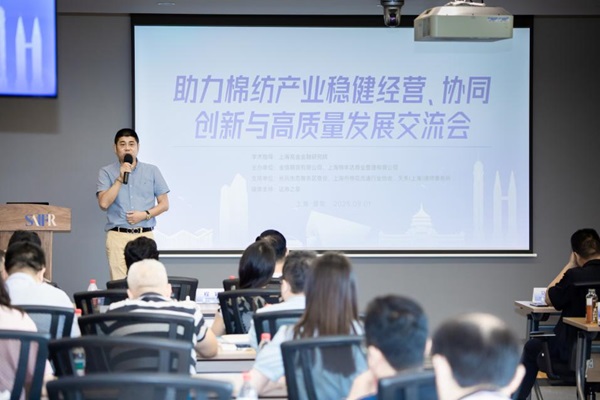
赋能产业升级,共绘发展蓝图——助力棉纺产业稳健经营、协同创新与高质量发展交流会圆满举行
Qi Huo Ri Bao Wang· 2025-09-03 09:24
Core Viewpoint - The conference aimed to create a platform for resource sharing, experience exchange, and collaborative innovation in the cotton spinning industry, emphasizing the integration of financial tools with the real economy to enhance risk management capabilities [1][14]. Group 1: Conference Overview - The conference was co-hosted by Jin Xin Futures Co., Ltd. and Shanghai Mianfengda Commercial Management Co., Ltd., supported by various associations and institutions, gathering nearly a hundred representatives from the cotton spinning industry and financial sectors [1]. - The event focused on exploring transformation paths and high-quality development for the cotton spinning industry amidst increasing global competition [1]. Group 2: Key Presentations - Hu Xiaobo, General Manager of Jin Xin Futures, highlighted the importance of building a platform for collaboration and resource sharing to help enterprises cope with market fluctuations [1][14]. - Ma Tingfang, Deputy General Manager of Hangzhou Wanshili Silk Culture Co., Ltd., discussed the significance of digital printing technology in revolutionizing the traditional dyeing industry, enabling flexible production and reducing inventory pressure [4][6]. - Yao Xinghang, head of Jin Xin Futures Research Institute, explained the core role of futures tools in risk management, emphasizing price discovery and hedging functions [7][9]. Group 3: Industry Innovations - A panel discussion featured industry leaders discussing collaborative innovation and risk management strategies, including the use of blockchain technology for environmental monitoring and carbon footprint management in cotton cultivation [8][10]. - The discussion emphasized the need for green transformation as a means to enhance brand value and fulfill social responsibilities [8][10]. Group 4: Future Directions - Jin Xin Futures aims to provide customized risk management solutions to help cotton spinning enterprises mitigate price volatility risks, while also offering forward-looking market analysis [14]. - The company is committed to deepening its service to the industry and collaborating with various stakeholders to outline a blueprint for high-quality development in the cotton spinning sector [14].

钢铁丝路贯东西 援疆班列激活开放新动能
Ren Min Wang· 2025-08-20 09:19
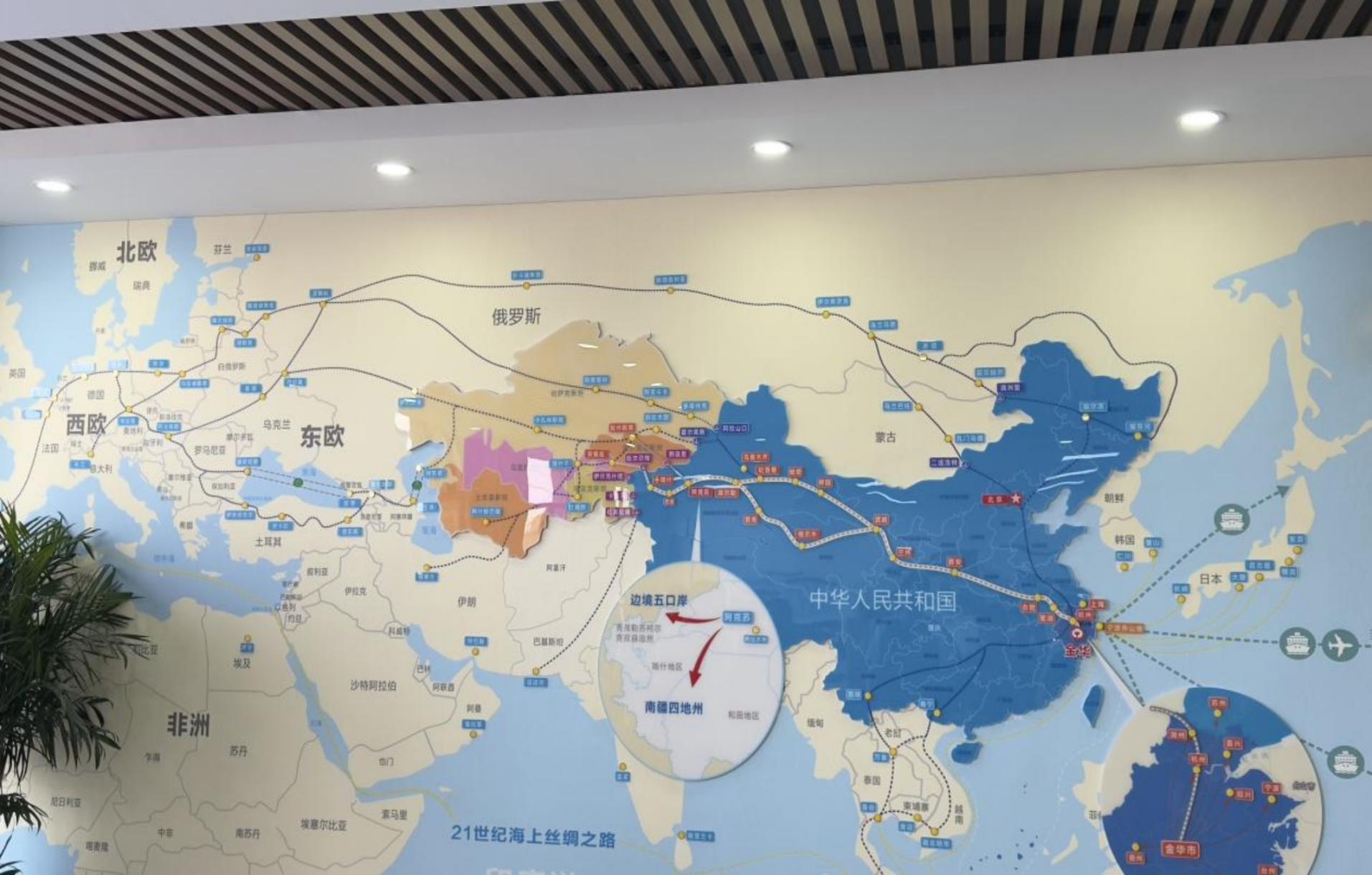
Core Insights - The "Zhejiang New Express" train service is enhancing cross-border trade between Zhejiang and Xinjiang, significantly improving logistics efficiency and reducing costs for businesses [1][3][4] - The establishment of a dual-direction railway freight service is addressing the logistical challenges faced by industries in both regions, facilitating a more integrated supply chain [3][4] Group 1: Trade and Logistics Development - A train loaded with Xinjiang cotton yarn has successfully established a direct route to Zhejiang, marking a significant improvement in trade logistics [1] - The "Zhejiang New Express" train has opened a new trade corridor from Zhejiang to Central Asia, while the "Aid Xinjiang Train" provides a consistent freight service from Southern Xinjiang to the Yangtze River Delta [3] - The dual train services have resulted in over 25% savings in logistics costs and a 40% improvement in transportation efficiency for cotton spinning enterprises [3][4] Group 2: Economic Impact - By July 2025, the "Zhejiang New Express" is expected to operate 37 trains, transporting over 21,000 tons of goods valued at more than 710 million yuan, establishing itself as a stable and long-distance integrated trade route [4] - The "Aid Xinjiang Train" has dispatched 82 trains, delivering 115,000 tons of products worth 2.94 billion yuan to the Yangtze River Delta, accounting for 30% of the total railway freight from Aksu to Zhejiang [4] - The logistics improvements have led to a 35% increase in foreign trade orders for companies, with significant investments in production capacity expansion [4]
百隆东方(601339):单季利润超预期,越南棉纺产能稀缺,凸显盈利能力
Shenwan Hongyuan Securities· 2025-08-17 14:41
Investment Rating - The report upgrades the investment rating of the company from "Outperform" to "Buy" [1] Core Views - The company reported better-than-expected profits due to improved capacity utilization and lower raw material costs, with a significant increase in net profit for the first half of 2025 [6][12] - The company benefits from a high proportion of overseas production capacity, particularly in Vietnam, which enhances its profitability compared to domestic operations [6] - The report anticipates a rebound in cotton prices, which could further improve the company's profit margins [6] - The company plans to distribute a mid-term cash dividend of 0.15 yuan per share, reflecting a high dividend payout ratio [6] Financial Data and Profit Forecast - Total revenue for 2025 is projected at 7,980 million yuan, with a year-on-year growth rate of 0.5% [5] - The net profit attributable to the parent company is expected to reach 702 million yuan in 2025, representing a year-on-year increase of 71.1% [5] - The gross profit margin is forecasted to improve to 16.8% in 2025 [5] - The company’s return on equity (ROE) is expected to rise to 7.1% in 2025 [5] Market Data - As of August 15, 2025, the closing price of the company's stock is 5.60 yuan, with a market capitalization of 8,398 million yuan [1] - The stock has a price-to-earnings (PE) ratio of 20 for 2024, which is expected to decrease to 12 in 2025 [5][16] - The company’s dividend yield is 4.64%, based on the most recent dividend announcement [1]

8月棉纱价格或小幅下跌
Xin Hua Cai Jing· 2025-08-11 07:01
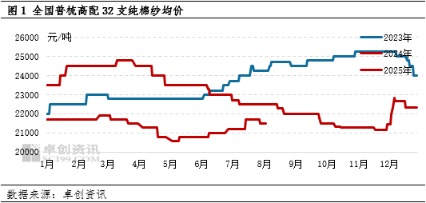
Core Viewpoint - The cotton yarn prices in China are expected to experience a slight decline in August due to high inventory levels and weak demand in the textile market, despite a recent increase in cotton prices [1][10]. Group 1: Price Trends - In July, cotton yarn prices rose slightly, driven by a significant increase in cotton prices, with the average price of cotton reaching approximately 14,741 yuan per ton, up 3.41% month-on-month [2]. - The average price of pure cotton yarn (32 count) was about 21,430 yuan per ton in July, reflecting a month-on-month increase of 2.29% [2]. - It is anticipated that cotton yarn prices may decline by 100 yuan per ton in August, with expected prices ranging from 21,100 to 21,700 yuan per ton [10]. Group 2: Market Conditions - The cotton spinning industry is currently facing a downturn, with many spinning enterprises adopting a cautious approach to high-priced cotton purchases due to the ongoing demand slump [4]. - As of the end of July, the operating rate of cotton spinning enterprises was 61.20%, a decrease of 0.75 percentage points from the previous month [5]. - The average inventory days for pure cotton yarn in large-scale spinning enterprises increased to 30 days, up 11.11% from the previous month, indicating a build-up of inventory [5]. Group 3: Supply and Demand Dynamics - The demand for cotton yarn is weak, with downstream fabric manufacturers showing low order volumes and high inventory levels, leading to cautious procurement of cotton yarn [8]. - The cotton market is expected to return to fundamentals, with limited orders from downstream textile enterprises and poor profit margins for spinning enterprises potentially suppressing cotton demand [8]. - As the traditional peak season ("Golden September and Silver October") approaches, there may be a gradual recovery in demand towards the end of August, potentially increasing orders for spinning enterprises [6].
7月14日晚间重要公告一览
Xi Niu Cai Jing· 2025-07-14 10:17
Group 1 - Aerospace Science and Technology expects a net profit of 68 million to 95 million yuan for the first half of 2025, representing a growth of 1628.83% to 2315.27% compared to the same period last year [1] - Huaxia Airlines anticipates a net profit of 220 million to 290 million yuan for the first half of 2025, an increase of 741.26% to 1008.93% year-on-year [1] - Shida Group forecasts a net loss of 44 million to 65 million yuan for the first half of 2025, marking a shift from profit to loss [1] Group 2 - Jiaao Environmental Protection expects a net loss of 70 million to 90 million yuan for the first half of 2025 [3] - Haima Automobile predicts a net loss of 60 million to 90 million yuan for the first half of 2025, compared to a loss of 152 million yuan in the same period last year [3] - Huaibei Mining anticipates a net profit of approximately 1.027 billion yuan for the first half of 2025, a decrease of about 65% year-on-year [3] Group 3 - Quanfu Automobile expects a net loss of 155 million to 185 million yuan for the first half of 2025 [5] - Gaode Infrared signed a procurement agreement worth 879 million yuan, which is expected to positively impact its operating performance for the year [5] - Zhongchen Co. won a project from Southern Power Grid worth 379 million yuan, representing 12.26% of its audited revenue for 2024 [5] Group 4 - Daheng Technology anticipates a net loss of 406,000 yuan for the first half of 2025, compared to a loss of 988,250 yuan in the same period last year [6] - Dazhongnan expects a net profit of 6.5 million to 8 million yuan for the first half of 2025, a recovery from a loss of 15.325 million yuan last year [6] - Xianfeng Holdings projects a net profit of 34 million to 42 million yuan for the first half of 2025, a year-on-year increase of 524.58% to 671.53% [7] Group 5 - Shuangxiang Co. expects a net profit of 115 million to 150 million yuan for the first half of 2025, a growth of 128.1% to 197.53% year-on-year [8] - ST Xintong anticipates a net loss of 67 million to 97 million yuan for the first half of 2025 [9] - Jishi Media forecasts a net loss of 187 million to 233 million yuan for the first half of 2025 [10] Group 6 - Suli Co. expects a net profit of 72 million to 86 million yuan for the first half of 2025, a year-on-year increase of 1008.39% to 1223.91% [11] - Wanli Co. anticipates a net loss of 19 million yuan for the first half of 2025, compared to a loss of 12.9238 million yuan last year [12] - Langzi Co. projects a net profit of 22 million to 26 million yuan for the first half of 2025, an increase of 31.74% to 55.69% year-on-year [14] Group 7 - Changjiang Securities expects a net profit of 1.652 billion to 1.81 billion yuan for the first half of 2025, a growth of 110% to 130% [15] - Huahong Technology anticipates a net profit of 70 million to 85 million yuan for the first half of 2025, a year-on-year increase of 3047.48% to 3721.94% [16] - Chenhua Co. plans to invest 30 million yuan in financial products with an expected annual yield of 3.20% [16] Group 8 - Zijing Mining expects a net profit of approximately 23.2 billion yuan for the first half of 2025, a growth of about 54% year-on-year [28] - Limin Co. anticipates a net profit of 26 million to 28 million yuan for the first half of 2025, a year-on-year increase of 719.25% to 782.27% [29] - Huazhong Securities expects a net profit of 1.035 billion yuan for the first half of 2025, a growth of 44.94% year-on-year [30]