
智能驾驶

Search documents
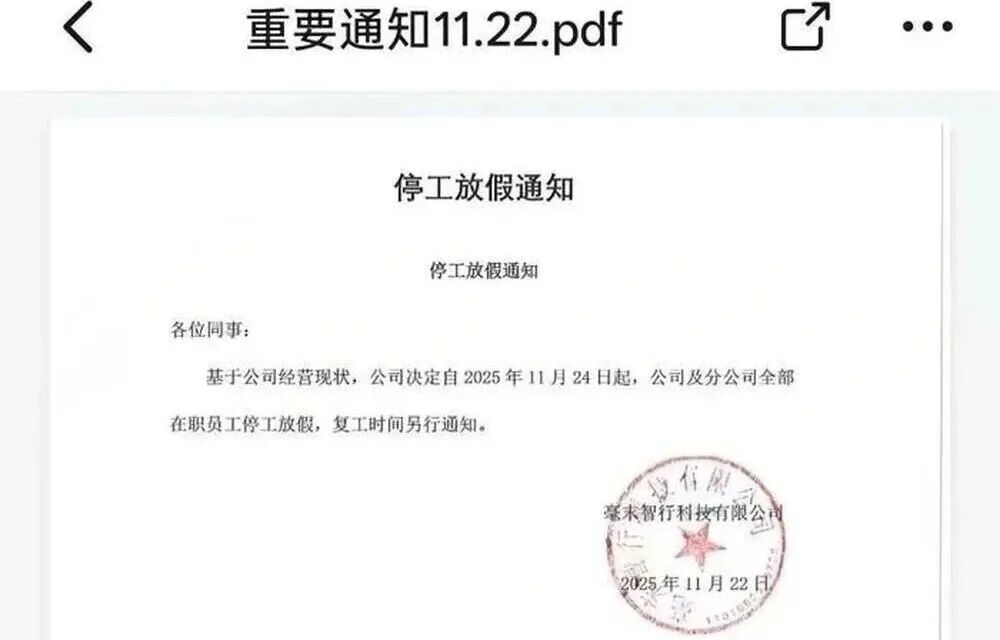
明星公司全部员工停工放假,公司剩不到300人,高管曾放话“不存在死这件事”
2 1 Shi Ji Jing Ji Bao Dao· 2025-11-29 13:47
Core Viewpoint - The recent announcement by Haomo Technology regarding a complete shutdown and holiday for all employees starting November 24, 2025, marks a significant downturn for the company, which has seen a drastic reduction in workforce and challenges in maintaining its position in the intelligent driving sector [2][3][22]. Company Overview - Haomo Technology, incubated by Great Wall Motors in 2019, was once a leading player in the intelligent driving industry, primarily supplying Great Wall's brands with its driving systems [2][3]. - The company had a peak workforce of nearly 800 employees, focusing on the development of intelligent driving technologies for passenger vehicles [2][3]. Recent Developments - In late 2023, Haomo lost a key contract with Great Wall's Weipai brand, which shifted to a competitor, Yuanrong Qixing, for its intelligent driving solutions due to delays in Haomo's product development [3][9]. - Despite retaining contracts with Great Wall for mid- and low-tier models in 2024, Haomo is not the sole supplier for other major automakers like Beijing Hyundai, Toyota, and BMW [8][9]. Strategic Challenges - Haomo's initial strategy involved a heavy investment in high-level talent and technology, but the company struggled to keep pace with competitors who adopted more advanced technological approaches [5][12]. - The company's reliance on Qualcomm chips limited its ability to compete effectively in the high-performance segment of the intelligent driving market, as its AI computing power was insufficient for urban driving applications [11][12]. Financial and Operational Issues - Haomo's financial health has deteriorated, with a significant drop in valuation from $1 billion in 2021 to approximately 900 million yuan in 2024, reflecting limited growth and investor confidence [20][22]. - The company has faced challenges in converting its technological advancements into cash flow, leading to a reliance on external financing to sustain operations [18][20]. Conclusion - The trajectory of Haomo Technology illustrates the complexities of navigating the intelligent driving landscape, where strong initial backing from Great Wall Motors ultimately constrained its ability to diversify partnerships and adapt to rapid technological changes [22][23].


明星公司全部员工停工放假,公司剩不到300人,高管曾放话“不存在死这件事”
21世纪经济报道· 2025-11-29 13:20
Core Viewpoint - The article discusses the decline of the autonomous driving supplier, Haomo Technology, highlighting its operational challenges, loss of key partnerships, and the impact of its reliance on Great Wall Motors [4][22]. Company Overview - Haomo Technology, incubated by Great Wall Motors in 2019, was once a leading player in the autonomous driving sector, primarily supplying technology for Great Wall's various vehicle brands [4][6]. - The company had a peak workforce of around 800 employees, focusing on autonomous driving technology, but has since dwindled to fewer than 300 employees [4][6]. Key Events - In 2023, Haomo faced significant setbacks, including the loss of its exclusive partnership with Great Wall Motors, which shifted to another supplier, Yuanrong Qixing, for its new models [5][10]. - Despite retaining some contracts with Great Wall for lower-tier models, Haomo's overall market position weakened as it became one of several suppliers for other major automakers like Hyundai, Toyota, and BMW [8][10]. Financial and Operational Challenges - Haomo's financial health has deteriorated, with a reported valuation of approximately 900 million yuan in 2024, showing limited growth compared to its previous valuation of 1 billion USD in 2021 [21][22]. - The company has undergone five rounds of financing, raising about 1.5 billion yuan, but has struggled to convert its technology into cash flow due to operational inefficiencies and a lack of market traction [21][22]. Technological Development - Haomo's technology strategy has been criticized for lagging behind competitors, particularly in the transition to more advanced autonomous driving systems that do not rely on high-definition maps [14][17]. - The company initially focused on a "heavy perception, light mapping" approach but failed to adapt quickly to industry shifts towards end-to-end models, which integrate perception, prediction, and planning into a single system [15][17]. Market Position and Future Outlook - The article suggests that Haomo's close ties with Great Wall Motors have limited its ability to establish deeper partnerships with other automakers, hindering its growth potential [22]. - As the industry moves towards more autonomous solutions, Haomo's inability to innovate and adapt may lead to further decline, raising questions about its long-term viability [22].

汽车行业2026年年度策略报告:高端化+出口驱动总量,智驾+机器人带动产业升级-20251129
CAITONG SECURITIES· 2025-11-29 08:02
Group 1 - The overall demand for passenger vehicles is expected to remain stable, with incremental growth driven by high-end market expansion and exports [3][6][35] - The penetration rate of new energy vehicles (NEVs) is stabilizing, with domestic market competition gradually reaching a steady state [23][35] - The average price of passenger vehicles is anticipated to increase, particularly in the mid-to-high-end market, as domestic brands continue to replace foreign brands [6][35] Group 2 - The heavy truck market faces pressure domestically, but exports are expected to recover as the pressure on sales to Russia eases [46][50] - The export of medium and large buses is projected to maintain rapid growth, with profitability largely dependent on the European market [55] - The rapid growth of AI data centers is expected to create additional demand in the diesel engine sector [3][46] Group 3 - The smart driving sector is entering a new phase of resonance between China and the US, with advancements in L2 and L3 driving standards expected [58][63] - The Robotaxi market in the US is anticipated to experience explosive growth, driven by companies like Tesla and Waymo [72][75] - The integration of robotics into the automotive supply chain is becoming increasingly significant, with automotive suppliers likely to extend their capabilities into the robotics sector [87][90] Group 4 - Recommended stocks in the passenger vehicle sector include Jianghuai Automobile, BYD, and BAIC Blue Valley, with a focus on high-end vehicles and exports [4][94] - In the robotics sector, recommended stocks include Top Group, Yinlun, and BlueDye Technology, with a focus on companies capable of transitioning into robotics [4][94] - For smart driving, recommended stocks include Bertel, Horizon, and Pony.ai, focusing on the growth of L2 driving technology and Robotaxi commercialization [4][94]




三年半亏损超7.7亿元 魔视智能背水一战赴港IPO
Zhong Guo Jing Ying Bao· 2025-11-28 20:50
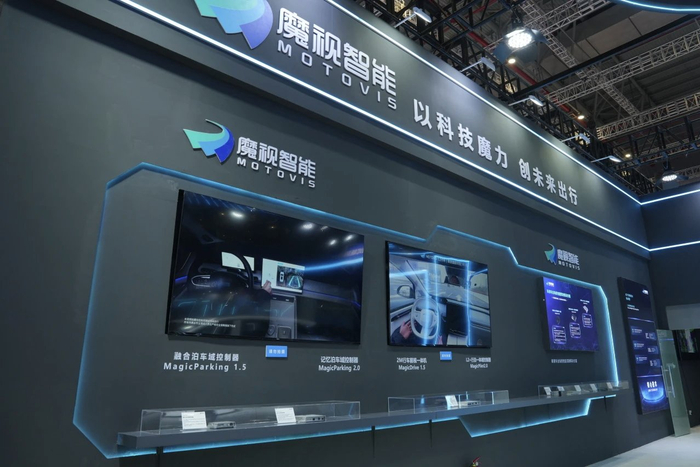
Core Viewpoint - Magic Smart Technology (Shanghai) Co., Ltd. is seeking to go public on the Hong Kong Stock Exchange despite facing challenges such as long-term losses and low market share, aiming to capitalize on the current industry development window and market conditions [3][4]. Company Overview - Founded in 2015, Magic Smart integrates AI algorithms and advanced chips to provide automotive intelligent products and solutions, with aspirations to become the "Huawei of the automotive industry" [5][6]. - The company has developed solutions for 92 vehicle models and delivered over 3.3 million units, ranking third among Chinese intelligent driving solution providers based on revenue for L0 to L2+ solutions in 2024 [5][6]. Financial Performance - Revenue figures for Magic Smart from 2022 to 2024 are as follows: 118 million yuan, 147 million yuan, and 357 million yuan, with a 76.4% year-on-year increase in the first half of 2024 [7][10]. - Despite revenue growth, the company has reported significant losses, totaling approximately 774 million yuan over three and a half years, with adjusted losses of 557 million yuan [10][11]. Market Position - Magic Smart holds a market share of approximately 0.4% in the intelligent driving solutions sector, significantly trailing behind the top three competitors with market shares of 8.0%, 1.4%, and 1.4% [6][10]. - The company aims to differentiate itself through technological strength, commercialization capabilities, and unique market positioning, claiming to be one of the few suppliers with full-stack self-research capabilities [6][12]. Product Solutions - The company's revenue primarily comes from three main solutions: Magic Drive, Magic Parking, and Magic Safety, with Magic Drive being the largest contributor [8][9]. - The revenue breakdown for Magic Drive from 2022 to 2025 (first half) shows it accounted for 60.3%, 47.6%, 63.6%, and 61.8% of total revenue, respectively [8][9]. Production Capacity - Magic Smart's production capacity utilization rates from 2022 to the first half of 2025 were 46.9%, 19.5%, 56.6%, and 79.7%, with fluctuations attributed to business expansion [12]. - The company plans to use funds from its IPO to enhance R&D capabilities, establish a global R&D network, and expand production capacity [11][12].
资本加速布局 卓驭科技投后估值破百亿背后的逻辑
Zhong Guo Jing Ying Bao· 2025-11-28 20:48
Core Insights - China FAW Group Corporation (China FAW) has made a strategic investment exceeding 3.6 billion yuan in Shenzhen Zhuoyu Technology Co., Ltd. (Zhuoyu Technology), signaling a shift in the smart driving industry towards centralized control of key technologies by state-owned enterprises [1][2] - The investment is seen as a pivotal moment for Zhuoyu Technology, marking its entry into the spotlight of industrial capital and indicating a significant resource reallocation within the industry [2][3] Investment Details - The investment allows Zhuoyu Technology to maintain its independent operational framework, preserving its management, technical direction, and brand strategy, with a post-investment valuation exceeding 10 billion yuan [2][3] - China FAW's role is primarily as a strategic supporter rather than a controlling entity, focusing on business collaboration and resource supplementation for Zhuoyu Technology's growth [2][3] Historical Context - The collaboration between China FAW and Zhuoyu Technology began with a strategic cooperation agreement signed in April 2024, which involved joint development of intelligent driving systems for key models [3] - Zhuoyu Technology has been responsible for the intelligent driving systems in several major models from China FAW, demonstrating a high level of trust and synchronization in strategic objectives [3] Future Plans - The newly acquired funds will be allocated towards advancing L3/L4 level autonomous driving technologies, expanding commercial applications, and building a more resilient ecosystem encompassing talent, branding, and supply chain capabilities [4] - Zhuoyu Technology's client base includes 10 major domestic and international automakers, with over 30 models already in mass production and more than 30 additional models in the development pipeline [4] Global Expansion - Zhuoyu Technology is accelerating its global market entry, having announced its European strategy at the Munich Auto Show, with plans to establish a local team and operational framework [5] - The company aims to leverage its partnership with China FAW to transition from domestic to international markets, capitalizing on technological advantages [5] Capital Dynamics - Zhuoyu Technology's shareholder structure has attracted several prominent domestic and international investors, including BYD, which is seen as a strategic partner rather than a direct competitor [6][7] - The entry of multiple capital players reflects the growing recognition of Zhuoyu Technology's unique position in the smart driving sector, characterized by its technical depth and independent stance [7] Challenges and Governance - The partnership with China FAW introduces complexities due to differing operational mechanisms between state-owned enterprises and technology firms, potentially impacting research and development efficiency [7][8] - Experts suggest establishing independent technical decision-making bodies and maintaining management autonomy to mitigate risks associated with bureaucratic processes [8]

“智驾普及元年”年终大考:奇瑞猎鹰智驾的承诺兑现了吗?
Tai Mei Ti A P P· 2025-11-28 14:16
Core Insights - The article highlights the transition of China's intelligent driving industry from concept to practical application, with Chery's commitment to its intelligent driving strategy serving as a milestone [1][3]. Industry Overview - By 2025, the Chinese intelligent driving industry is expected to shift from "parameter competition" to "real-world validation," with consumer expectations evolving from "availability" to "usability" and "reliability" [3]. - The current stage of the industry is characterized by both technological breakthroughs and challenges in implementation [4]. Chery's Commitment - Chery's chairman publicly committed to equipping all models with the Falcon intelligent driving assistance system within the year, a move that sparked industry discussions due to the previous trend of high-level intelligent driving features being limited to premium models [3][6]. - As of the end of the year, Chery successfully integrated the Falcon system across all models, demonstrating its technical capabilities through real-world testing in complex driving conditions [3][6]. Challenges in Intelligent Driving - Many automakers face issues such as "feature reduction," "delayed functionality," and limitations to high-end models when delivering intelligent driving features [5]. - Current intelligent driving systems exhibit significantly higher error rates on unstructured roads compared to structured ones, with failure rates being 3-5 times higher [5]. Technical Foundation of Falcon Intelligent Driving - The Falcon system's success is attributed to a collaborative foundation of data, algorithms, and hardware, creating a "data loop - algorithm breakthrough - hardware redundancy" structure [7]. - Chery's Tianqiong Intelligent Computing Center has accumulated over 24 billion kilometers of driving assistance data, enhancing the system's adaptability across various road conditions [7][10]. Algorithm and Hardware Integration - The Falcon system utilizes the Momenta R6 reinforcement learning model, which allows for rapid decision-making in unforeseen scenarios, enhancing its performance in complex environments [10][11]. - The hardware setup includes a combination of sensors, ensuring reliable perception in challenging conditions, while the system's computational power is optimized for efficient data processing [12][14]. Long-term Strategy and Collaboration - Chery's approach to intelligent driving is rooted in a long-term commitment to technology development, having invested in intelligent technology since 2010 [17][19]. - The company employs a collaborative ecosystem model, partnering with various tech firms to enhance its capabilities while maintaining core technology independence [19]. Future Outlook - Chery aims to achieve end-to-end integration of its intelligent driving system by 2026, with ongoing updates to enhance functionality [21]. - The intelligent driving industry is moving towards a phase of "refined cultivation," focusing on real-world validation and user-centric solutions [22].

智驾洗牌,一家独角兽陷停摆
3 6 Ke· 2025-11-28 11:52
Core Insights - The core viewpoint of the article highlights the downfall of the autonomous driving unicorn, Haomo Zhixing, which has announced a complete work stoppage due to its deteriorating business conditions, marking a significant shift from its previous status as a leading player in the industry [1][2][3] Company Overview - Haomo Zhixing, once a star in the autonomous driving sector backed by Great Wall Motors, has faced a series of negative developments including layoffs, unpaid salaries, and loss of orders since last year [2][3] - The company was established in 2019 as a spin-off from Great Wall Motors' technology center, focusing on autonomous driving technology [3] - Haomo Zhixing has completed seven rounds of financing, with notable investors including Meituan, Hillhouse Capital, and Qualcomm, achieving a valuation exceeding $1 billion in December 2021 [3][4] Business Operations - The company's business primarily revolves around two areas: automated delivery and passenger vehicles, with a focus on "L2+L4" autonomous driving solutions [5] - Haomo Zhixing made significant progress in automated delivery, partnering with Meituan for strategic cooperation and launching its delivery vehicle "Xiao Mo Tuo" [5][6] - However, the company has struggled to achieve large-scale deliveries and has primarily collaborated with Great Wall Motors' brands, limiting its market expansion [6][7] Industry Context - The autonomous driving industry is undergoing a significant reshuffle, with many companies facing challenges in commercialization and market competition [8][9] - The article notes that the market is increasingly favoring established players, with Great Wall Motors shifting its focus to other partners like Yuanrong Qixing, indicating a loss of confidence in Haomo Zhixing [7][8] - The competitive landscape is tightening, with several autonomous driving firms, including Haomo Zhixing, facing difficulties, leading to a wave of consolidations and failures in the sector [9][10] Future Outlook - Haomo Zhixing's planned IPO for 2025 is now uncertain, as the company has entered a state of suspension, raising questions about its future viability [10][11] - The article concludes that the current state of the company reflects broader trends in the industry, where many firms are struggling to adapt to rapid changes and increasing competition [11]
地平线HSD量产破局:中国车企集体超越特斯拉的关键一跃
Zhong Guo Qi Che Bao Wang· 2025-11-28 05:41
Core Insights - The launch of Chery's Starway ET5 equipped with Horizon HSD marks a significant breakthrough in China's smart driving industry, bringing advanced intelligent driving experiences to mass-market vehicles priced around 150,000 yuan [2][11] - Horizon HSD aims to challenge Tesla's dominance in high-level intelligent driving, facilitating a collective effort among Chinese automakers to surpass industry benchmarks [2][11] Industry Challenges - The Chinese intelligent driving sector faces two main challenges: a focus on high computing power without sufficient algorithm optimization, leading to high hardware costs and limited consumer experience, and the use of segmented technology solutions that result in performance issues [5] - Horizon HSD addresses these challenges with an end-to-end architecture and reinforcement learning, enhancing the driving experience in complex urban scenarios [5] Technological Advantages - Horizon HSD features the "Zhengcheng 6P" chip, providing 560 TOPS of computing power, enabling efficient deployment of advanced driving models [5] - The system's architecture allows for rapid iteration and improvement, with performance enhancements expected to be significant within short timeframes [7] Production Capabilities - Horizon has established itself as the first company to achieve mass production across all levels of driving assistance, with over 40 partnerships and more than 400 models covered, achieving a market share exceeding 30% in the smart driving solutions for domestic passenger vehicles [8] - The company emphasizes a strong engineering and production capability, ensuring seamless integration of technology and mass production [8] Open Empowerment Strategy - Horizon's open empowerment model contrasts with Tesla's closed ecosystem, allowing various automakers to adopt high-level intelligent driving systems without extensive R&D investments [10] - The technology is now accessible to mainstream vehicles priced below 150,000 yuan, breaking the previous barrier that limited advanced driving systems to luxury models [10] Future Goals - Horizon aims to achieve a production target of 10 million units for HSD in the next 3-5 years, driving the widespread adoption of advanced driving assistance systems [11] - The company's efforts are positioned to enhance China's competitiveness in the global smart driving landscape, contributing to a collective advancement beyond Tesla [11]

佑驾创新董事长刘国清增持5万股:坚定看好公司长期价值,无人车业务进展迅猛
IPO早知道· 2025-11-28 05:26
Core Viewpoint - The article highlights the positive signal released by the management's share buyback, indicating confidence in the company's fundamentals and long-term growth potential [2][3]. Business Performance - Youjia Innovation's revenue grew by 46.1% year-on-year, with the L4 new business achieving significant breakthroughs, generating revenue of over 10 million yuan within six months [3]. - As of June 30, 2025, Youjia Innovation has mass-produced for 42 automotive manufacturers, including major domestic brands like SAIC, Changan, and Chery, showcasing strong industry penetration and commercialization capabilities [3]. L4 Business Development - The L4 autonomous vehicle business is opening a second growth curve for Youjia Innovation, which is one of the few companies in China to operate in both "smart mobility and smart logistics" sectors and successfully implement L4 in multiple scenarios [4]. - The company’s fully self-developed autonomous minibus is operational in cities like Suzhou, Shanghai, and Hangzhou, and has recently won significant projects, demonstrating excellent engineering adaptability [5]. Market Trends and Future Outlook - The transition from the "technology validation phase" to the "value realization phase" in intelligent driving is being driven by policy support and the upgrade of OEMs' smart strategies, leading to increased industry penetration [5]. - Youjia Innovation's proactive share buyback reflects management's long-term optimism and a commitment to sharing risks and growth with shareholders, positioning the company for breakthroughs in the new industrial cycle [5].
地平线机器人-W午前涨超4% 地平线J6P方案上车 HSD开启规模化量产
Zhi Tong Cai Jing· 2025-11-28 03:57
Core Viewpoint - Horizon Robotics-W (09660) has seen a stock increase of over 4%, currently trading at 7.84 HKD with a transaction volume of 4.57 billion HKD, following the announcement of the new model ET5 from Xingtu Automobile, which features Horizon's HSD urban driving assistance system [1] Group 1: Product Development and Partnerships - On November 13, Xingtu Automobile officially launched pre-sales for the ET5 model, which is the first globally to incorporate Horizon's HSD urban driving assistance system and the Journey 6P computing solution [1] - Horizon Robotics has announced that its HSD system has secured partnerships with over 10 automotive brands and more than 20 vehicle models for targeted collaboration [1] - With the mass production of the first batch of HSD cooperative models, Horizon Robotics has become the first intelligent driving technology company to achieve mass production across low, medium, and high-level driving assistance [1] Group 2: Market Outlook and Growth Projections - JPMorgan has released a report indicating that Horizon Robotics' competitive product performance and pricing strategy will help the company continue to expand its market share and drive growth [1] - The report forecasts a compound annual growth rate (CAGR) of 56% for the company's revenue from 2024 to 2027, with an anticipated annual growth rate of 73% by 2028, suggesting a positive trend that could further boost stock prices [1]
