
零食

Search documents
西部证券晨会纪要-20250725
Western Securities· 2025-07-25 01:49
Group 1 - The core conclusion of the report highlights the innovative approach of the company, Liuliu Guoyuan, focusing on the "Plum+" strategy to expand its product matrix and adapt to changes in products and channels [1][4] - The plum industry shows stable growth in traditional products, while natural jelly is emerging as a strong segment, with Liuliu Guoyuan holding a leading market share of 45.7% in the natural jelly category [4][5] - The company is actively pursuing new product development, with successful launches such as crispy green plums, seedless western plums, plum jelly, and electrolyte smoothies, indicating a high success rate in recent years [4][5] Group 2 - The report emphasizes the growth potential in traditional distribution channels for existing products, with the company focusing on deepening market penetration and enhancing terminal services [5] - New products are expected to drive revenue growth, particularly the collaboration with Sam's Club on seedless western plums and the introduction of electrolyte smoothies, which are positioned as new flagship products [5] - The North Exchange market is experiencing fluctuations, with a focus on companies with technical barriers and order elasticity, indicating a long-term investment strategy in specialized and innovative enterprises [1][7][9]
关于良品铺子「卖身」国资的五个问题|氪金·大事件
36氪· 2025-07-24 23:52
Core Viewpoint - The company "Liangpinpuzi," known as the "first stock of high-end snacks," is seeking to sell its controlling stake after a series of unsuccessful self-rescue measures, including leadership changes, price reductions, and business transformations [4][14]. Group 1: Share Transfer and Ownership Changes - On July 17, Liangpinpuzi announced that its controlling shareholder, Ningbo Hanyi, plans to transfer 72.24 million shares (18.01% of total shares) to Changjiang Guomao at a price of 12.42 yuan per share, totaling 1.046 billion yuan [4][5]. - The second-largest shareholder, Dayong Limited, also intends to transfer 8.99% of its shares to Changjiang Guomao at a price of 12.34 yuan per share, amounting to 445 million yuan [5]. - If the transfer is successful, the Wuhan State-owned Assets Supervision and Administration Commission will become the largest shareholder with a 29.99% stake [5]. - However, the share transfer faces legal challenges, as Guangzhou Light Industry has filed a lawsuit against Ningbo Hanyi, seeking to freeze 19.89% of Liangpinpuzi's shares [6][7]. Group 2: Financial Performance and Challenges - Liangpinpuzi's revenue growth has significantly slowed, with revenues of 7.894 billion yuan, 9.324 billion yuan, and 9.44 billion yuan from 2020 to 2022 [15]. - The company has experienced a decline in capital investment, with major shareholders like Hillhouse Capital planning to reduce their stakes [15]. - Despite efforts to improve performance, including a major price reduction strategy, Liangpinpuzi's revenue is expected to decline by 11% in 2024, leading to a net loss of between 75 million yuan and 105 million yuan in the first half of 2025 [16][19]. Group 3: Strategic Shifts and Market Position - The company has undergone management changes, with the founder stepping down and a shift in business focus from snack foods to a broader range of food products [17]. - The competitive landscape for snack foods has changed, with a rise in low-cost bulk snack brands that are capturing market share from traditional high-end brands like Liangpinpuzi [36][38]. - Industry experts suggest that the company needs to enhance brand recognition and focus on high-quality products to remain competitive, as price competition alone may not suffice [40][41].


零食行业“大变局”:谁猛打价格战,谁撑不住了?
3 6 Ke· 2025-07-24 09:20
Core Viewpoint - The snack industry is undergoing significant changes, with traditional brands like Liangpinpuzi facing challenges from new players adopting a low-cost, high-volume model, leading to a re-evaluation of brand value and market strategies [7][10]. Group 1: Liangpinpuzi's Situation - Liangpinpuzi announced a plan to introduce Wuhan Yangtze International Trade Group as an investor, with the latter acquiring a 29.99% stake for 1.49 billion yuan, making it the controlling shareholder [1][10]. - The company reported a projected net loss of 75 million to 105 million yuan for the first half of 2025, a stark contrast to a net profit of 23.89 million yuan in the same period of 2024 [4][7]. - In 2024, Liangpinpuzi experienced a revenue decline of 11.02% to 7.159 billion yuan and recorded its first annual net loss of 46.1 million yuan since its IPO in 2020 [5][10]. - The company initiated its first major price reduction in 17 years, lowering prices on 300 products by an average of 22%, with some items seeing discounts of up to 45% [10][11]. - Despite these efforts, the price reduction strategy did not yield the desired results, further compressing profit margins as consumers gravitated towards cheaper alternatives [11][13]. Group 2: Industry Dynamics - The snack industry is witnessing a divide, with traditional brands struggling while new mass-market players like Mingminghenmang and Wancheng Group thrive, reporting significant revenue growth and extensive store networks [6][21]. - Mingminghenmang projected a revenue of 39.3 billion yuan for 2024, with a gross merchandise volume (GMV) of 55.5 billion yuan and a store count of 14,394 across 28 provinces [6][21]. - The rise of mass-market snack brands is attributed to their ability to offer lower prices through economies of scale, with average prices being approximately 25% lower than traditional retail channels [22][25]. - However, the intense competition among these new players is leading to price wars and reduced profit margins, with Mingminghenmang reporting a gross margin of only 7.6% in 2024 [25][26]. - The industry is shifting towards a more complex competitive landscape, where success will depend on balancing cost control, product innovation, and user experience [27].

关于良品铺子「卖身」国资的五个问题|氪金·大事件
3 6 Ke· 2025-07-24 08:27
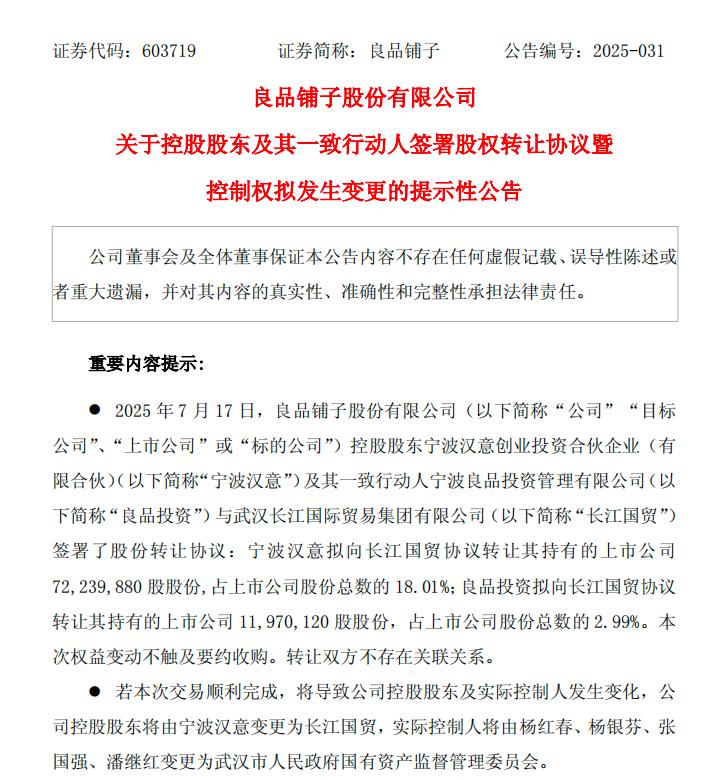
Core Viewpoint - After a series of unsuccessful self-rescue measures including leadership changes, price reductions, and business transformations, "the first stock of high-end snacks" has chosen to sell itself [1] Group 1: Share Transfer Details - On July 17, the company announced that its controlling shareholder, Ningbo Hanyi, plans to transfer 72.24 million shares (18.01% of total shares) and 11.97 million shares (2.99% of total shares) to Changjiang Guomao at a price of 12.42 CNY per share, totaling 1.046 billion CNY [1] - The second-largest shareholder, Dayong Limited, also intends to transfer 8.99% of its shares to Changjiang Guomao at a price of 12.34 CNY per share, amounting to 445 million CNY [2] - If the transfer is successful, the Wuhan State-owned Assets Supervision and Administration Commission will hold 29.99% of the shares, becoming the largest shareholder [2] Group 2: Legal Issues and Uncertainties - On the same day as the announcement, Guangzhou Light Industry filed a lawsuit against Ningbo Hanyi regarding a share transfer dispute, seeking to freeze 19.89% of the company's shares held by Ningbo Hanyi [2][3] - The company indicated that the share freeze and lawsuit may create uncertainties regarding the control transfer to Changjiang Guomao [3] - Legal experts noted that the agreement with Guangzhou Light Industry is a preliminary contract and does not have the same binding effect as the formal transfer agreement with Changjiang Guomao [6] Group 3: Financial Performance and Challenges - From 2020 to 2022, the company's revenue was 7.894 billion CNY, 9.324 billion CNY, and 9.44 billion CNY, showing a significant slowdown in growth [9] - Despite efforts to rescue performance, including a major price reduction initiative, the company reported an expected net loss of between 75 million CNY and 105 million CNY for the first half of 2025 [12] - The company has faced challenges in optimizing its supply chain, leading to increased costs and inevitable losses [14] Group 4: Strategic Shift and Future Prospects - The company aims to leverage Changjiang Guomao's experience in supply chain services to transform into a comprehensive food ecosystem [15][17] - The entry of state-owned capital is expected to provide financial support, potentially alleviating short-term debt pressures [15] - However, there are concerns that state-owned enterprises may not significantly improve operational performance, as seen in other cases [18] Group 5: Market Competition and Positioning - The competitive landscape for snack brands has shifted, with emerging low-cost brands capturing market share from traditional high-end brands [24] - The company has struggled to adapt to changing consumer preferences and market dynamics, leading to a decline in its market position [26] - Analysts suggest that focusing on brand recognition and high-quality products may be a better strategy for the company moving forward [26]
东海证券晨会纪要-20250723
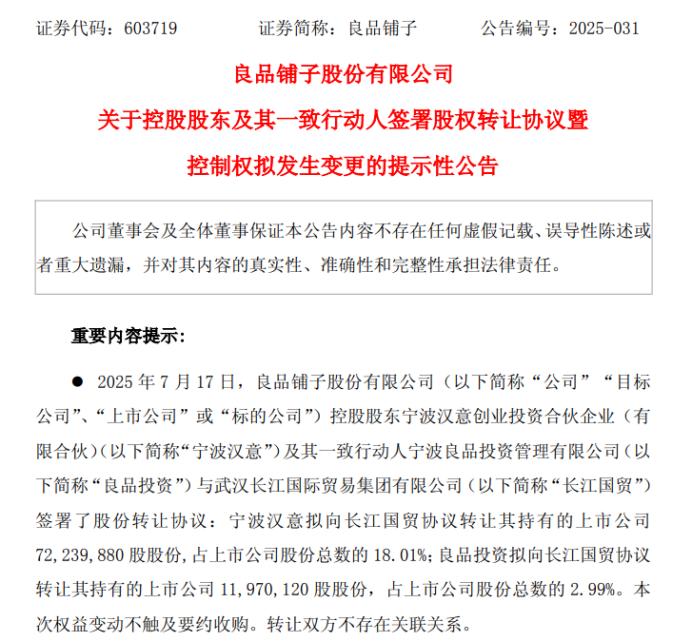
Donghai Securities· 2025-07-23 08:13
Group 1: Securities Industry - The securities industry is experiencing a significant performance increase, with a projected net profit growth of 94% year-on-year for 31 listed brokers in H1 2025, driven by a recovery in the capital market and policy support [6][7][21] - The number of new A-share accounts opened in H1 2025 reached 12.6 million, a year-on-year increase of 32.8%, indicating heightened market participation [7] - Daily trading volume in H1 2025 increased by 61% year-on-year to 1.39 trillion yuan, reflecting improved market activity [7] - The underwriting of IPOs and refinancing in H1 2025 saw a year-on-year increase of 4% and 26%, respectively, with total underwriting amounts reaching 355 billion yuan and 6.326 trillion yuan [7] - The bond underwriting market also showed robust activity, with a total underwriting scale of 7.5 trillion yuan in H1 2025, up 22.3% year-on-year [7] - Mergers and acquisitions in the industry have led to significant profit increases, with Guotai Junan and Haitong Securities reporting net profit growth of 205%-218% in H1 2025 due to consolidation effects [8][21] - Compliance and risk control measures have been effectively implemented, allowing firms like Huaxi Securities to return to profitability, with expected net profit growth of 1025%-1354% in H1 2025 [9][21] Group 2: Food and Beverage Industry - The food and beverage sector saw a 0.68% increase last week, underperforming the CSI 300 index by 0.41 percentage points, ranking 14th among 31 sectors [12][13] - The liquor industry is under pressure, with June retail sales of tobacco and alcohol declining by 0.7% year-on-year, indicating weak demand [13] - Major liquor companies are expected to report varying degrees of decline in H1 2025, with traditional consumption scenarios struggling [13] - The beer sector is anticipated to recover, with low inventory levels and improved sales expected due to seasonal demand and cost reductions [14] - The snack segment is experiencing high growth, driven by strong product categories and new channel developments, particularly in health-oriented products [15][16] Group 3: Agricultural Chemicals Industry - Guangxin Co., a major player in the agricultural chemicals sector, is optimizing its integrated production chain based on phosgene, with a production capacity of 320,000 tons per year [18][19] - The agricultural chemicals market is currently at a relative bottom, with prices expected to rise as global inventory levels decrease and outdated capacities are phased out [19] - The company has a strong cash flow position, with 8.685 billion yuan in liquid assets, supporting its long-term development and cost optimization [19][20]
良品铺子易主惹诉讼 广州国资欲“讨回”控股权
Zhong Guo Jing Ying Bao· 2025-07-22 13:10
中经记者 蒋政 北京报道 良品铺子易主事宜再起波澜。 7月21日,良品铺子发布关于控股股东涉及诉讼的公告。广州市中级人民法院受理了广州轻工工贸集团 有限公司(以下简称"广州轻工")与公司控股股东宁波汉意创业投资合伙企业(有限合伙)(以下简 称"宁波汉意")的股权转让纠纷一案。广州轻工就股权转让纠纷对宁波汉意提起诉讼,并申请财产保 全,冻结宁波汉意所持良品铺子7976.39万股股份。 诉讼焦点在于良品铺子控股权变更。在7月18日,良品铺子发布公告表示,控股股东宁波汉意与武汉国 资旗下的武汉长江国际贸易集团有限公司(以下简称"长江国贸")签署股权转让协议,或将涉及控股权 变更。而在此之前,宁波汉意曾与广州轻工就协议转让上市公司股份的事项进行磋商,后者将投资、控 制良品铺子。不过,此次合作遭遇武汉国资"截胡"。 《中国经营报》记者注意到,两次股权转让,除了接盘方不同之外,良品铺子股权转让方也不尽相同。 在同广州轻工磋商时,只有宁波汉意筹划减持相应股权。而易主武汉国资的方案中,良品铺子的二股东 ——达永有限公司(SUMDEXLIMITED,以下简称"达永有限"),同样在减持之列。该股东背后是投资机 构今日资本,其在良 ...
食品饮料行业跟踪报告:6月餐饮增速放缓,白酒有望筑底企稳
Shanghai Aijian Securities· 2025-07-22 13:00
Investment Rating - The report rates the food and beverage industry as "stronger than the market" [2][47]. Core Insights - The food and beverage sector has shown a slight increase of 0.68% in the week from July 14 to July 18, underperforming slightly compared to the Shanghai Composite Index, which rose by 0.69% [2][6]. - The white liquor segment is expected to stabilize after a period of decline, with major brands maintaining stable prices [3][21]. - The soft drink sector is entering a peak season, with expectations of continued growth driven by new product launches [3][34]. - The snack food segment has shown mixed performance, with some companies experiencing significant profit declines due to rising costs and increased marketing expenses [3][36]. Summary by Sections 1. Market Performance - The food and beverage sector's performance ranked 14th among 31 sub-industries, with soft drinks leading the gains at +2.02% [2][9]. - The overall valuation of the food and beverage sector is at a historical low, with a PE-TTM of 21.26x, placing it in the 16th percentile over the past 15 years [4][13]. 2. White Liquor - The white liquor industry has seen collective declines in performance, but signs of stabilization are emerging [3][21]. - Major brands like Moutai and Wuliangye have maintained stable pricing, with Moutai's price at 1930 RMB per bottle [21][22]. 3. Beer - Beer production in June 2025 was 4.12 million kiloliters, a slight decrease of 0.2% year-on-year, attributed to weak restaurant consumption [3][26]. 4. Dairy Products - Dairy production in June 2025 reached 254.6 thousand tons, up 4.1% year-on-year, but the industry is experiencing mixed performance among companies [3][28]. 5. Soft Drinks - The soft drink sector is expected to maintain high growth rates, with a production increase of 3.2% in June 2025 [3][34]. 6. Snacks - The snack food sector has shown varied results, with some companies like Ganyuan Foods reporting significant profit declines due to rising costs [3][36].
良品铺子卖身国资,零食暴利时代结束
36氪· 2025-07-22 10:21
Core Viewpoint - The article discusses the recent transfer of control of the high-end snack company, Liangpinpuzi, to state-owned enterprise Changjiang Guomao, highlighting the challenges and potential opportunities this change brings to the company and the industry as a whole [3][4][5]. Company Overview - Liangpinpuzi's controlling shareholder, Ningbo Hanyi, has agreed to transfer 21% of its shares to Changjiang Guomao at a price of 12.42 yuan per share, totaling 1.046 billion yuan [3]. - This marks Liangpinpuzi as the first national snack food platform controlled by local state-owned assets, with the actual control shifting from the founders to the Wuhan State-owned Assets Supervision and Administration Commission [3][4]. Market Challenges - The high-end snack market has shifted from "incremental competition" to "stock competition," reflecting broader anxieties among traditional consumer brands in the face of changing market dynamics [5]. - Liangpinpuzi has faced declining performance, with revenue dropping by 14.76% and 11.02% in 2023 and 2024, respectively, while its net profit plummeted by 46.26% and 125.57% during the same period [17][18]. Financial Performance - The company anticipates a loss exceeding 100 million yuan for the first half of 2025, with a non-recurring net profit loss estimated between 100 million to 130 million yuan [15]. - Liangpinpuzi's revenue and net profit have consistently underperformed compared to industry peers, with the median revenue growth for A-share snack companies being significantly higher [17][18]. Strategic Shifts - The company has initiated a price reduction strategy, marking its first significant price cut in 17 years, with an average reduction of 22% across 300 products [20]. - Despite initial sales growth following the price cuts, the effectiveness of this strategy has waned, with subsequent quarters showing significant declines in sales and profit margins [22][23]. Future Prospects - The entry of Changjiang Guomao is seen as a potential lifeline, providing a more stable funding source and access to a broader resource network, which could enhance Liangpinpuzi's resilience against market fluctuations [3][36]. - However, the effectiveness of this transition remains uncertain, as the company must address fundamental issues such as brand rebuilding and consumer trust amidst ongoing quality concerns [4][31]. Industry Context - The snack food industry is experiencing intense competition, with low-cost brands rapidly gaining market share by offering comparable quality at lower prices [28]. - The shift towards e-commerce is significant, with online sales of snacks projected to continue growing, emphasizing the need for Liangpinpuzi to adapt its distribution strategy [39].
食品饮料行业 2025 年中报前瞻:白酒出清探底,食品亮点频现
Huachuang Securities· 2025-07-22 09:25
Investment Rating - The report maintains a "Recommended" rating for the food and beverage industry, particularly highlighting opportunities in the liquor sector and food products [1] Core Insights - The liquor industry is undergoing extreme pressure testing, with a significant focus on inventory clearance and bottoming out of financial reports. The second quarter has shown weak demand due to seasonal factors and regulatory impacts, leading to a notable decline in sales and pricing pressures [5][10] - High-end liquor brands like Moutai are expected to maintain growth, while mid-tier brands face challenges with declining revenues and profits. The overall industry is in a deep clearance phase, with potential for recovery as regulations stabilize [5][12] - The consumer goods sector shows mixed performance, with snacks and beverages remaining strong, while other segments like frozen foods and chain restaurants face ongoing demand pressures [20][25] Summary by Sections 1. Liquor Sector - The liquor industry is experiencing extreme pressure, with weak demand in the second quarter and significant inventory levels. Major brands like Moutai and Wuliangye are expected to show modest growth, while others like Yanghe and Luzhou Laojiao are facing declines [5][11][12] - Moutai's revenue is projected to grow by 7% in Q2, while Wuliangye is expected to see a 1% increase. In contrast, brands like Yanghe and Luzhou Laojiao are forecasted to decline by 35% and 8% respectively [11][12] 2. Consumer Goods - The overall demand for consumer goods remains weak, but segments like snacks and beverages are performing well. For instance, East Peak is expected to see a 33% increase in revenue, while other snack brands are also showing positive trends [20][25] - The beverage sector is projected to see positive growth, with major brands like Qingdao Beer and Yanjing expected to report increases in revenue and profit [25][26] 3. Investment Recommendations - The report suggests focusing on high-performing stocks in the short term while considering long-term investments in liquor brands that are currently at their bottom. Brands like Moutai and Gujing are recommended for their lower risk profiles [7][8] - For consumer goods, companies like Anqi and East Peak are highlighted for their growth potential, while traditional dairy brands like Yili and Mengniu are suggested for a bundled investment approach [7][8]





A股盘前市场要闻速递(2025-07-22)
Jin Shi Shu Ju· 2025-07-22 01:49
Group 1 - The State Council of China has announced the "Housing Rental Regulations," which will take effect on September 15, 2025, requiring rental companies to provide accurate property information and establish rental archives [1] - The regulations mandate local governments to create rent monitoring mechanisms and publish rental level information regularly [1] - The implementation of these regulations aims to enhance the management and transparency of the housing rental market [1] Group 2 - The People's Bank of China and other regulatory bodies have released the "Implementation Rules for Cross-Border Asset Management Pilot Business" in Hainan Free Trade Port, allowing foreign investors to invest in various financial products [1] - This pilot program is expected to enrich the supply of cross-border financial products and attract asset management institutions to Hainan [1] - The rules cover aspects such as pilot institution conditions, product range, investor protection, and monitoring [1] Group 3 - Guangfa Bank is under self-regulatory investigation by the trading association for allegedly guiding prices during a bond issuance process [2] - The association aims to strengthen the regulation of issuers and impose penalties on those found violating rules [2] Group 4 - Dongfang Precision has signed a strategic cooperation agreement with Leju Robotics to focus on humanoid robots, enhancing production and market expansion [3] - The partnership will leverage Dongfang Precision's manufacturing capabilities and Leju Robotics' service solutions to explore applications in various sectors [3] Group 5 - Dongfang Caifu announced a share transfer price of 21.66 yuan per share, representing a 7.24% discount from the closing price, with full subscription from institutional investors [4] - The transfer will not lead to a change in company control or governance structure [4] Group 6 - BYD plans a significant equity distribution for 2024, proposing a cash dividend of 39.74 yuan per 10 shares and a stock split [5] - The record date for A-share shareholders is set for July 28, 2025 [5] Group 7 - Jiangte Electric plans a 26-day equipment maintenance shutdown for its lithium salt production line, which will not affect existing sales contracts [6] - Youfang Technology intends to sign a server procurement contract worth up to 4 billion yuan to support its cloud computing services [6] Group 8 - Haitan Ruisheng expects a substantial increase in net profit for the first half of 2025, driven by growth in AI technology applications [7] - The projected net profit range is between 294.40 million and 441.60 million yuan, reflecting a year-on-year increase of 607% to 961% [7] Group 9 - ST Xifa plans to acquire the remaining 50% stake in Lhasa Beer from Carlsberg, which is expected to constitute a major asset restructuring [8] - The company is currently in a pre-restructuring phase, facing potential bankruptcy risks [8] Group 10 - Nanjing Julong clarified that it has no collaboration with the technology company involved in a high-profile procurement deal [9] - The company's revenue from its composite materials subsidiary is relatively small, accounting for about 0.3 billion yuan [9] Group 11 - Changchuan Technology reported a 98.73% increase in net profit for the first half of 2025, exceeding its performance forecast [10] - The company achieved a revenue of 2.167 billion yuan, marking a 41.80% year-on-year growth [10] Group 12 - Gaode Infrared signed contracts worth 685 million yuan for foreign trade products, which will positively impact future operating performance [11] - The contracts represent 25.59% of the company's audited revenue for 2024 [11] Group 13 - Li Pingpuzi is involved in a legal dispute regarding the transfer of shares, with a claim amounting to 996 million yuan [12] - The outcome of the case may affect the control transfer of the company [12] Group 14 - Fuxin Technology's MicroTEC products for high-speed optical modules have passed validation and are now in bulk supply [13] - These products currently contribute a small percentage to the company's overall revenue [13]