
稀土

Search documents
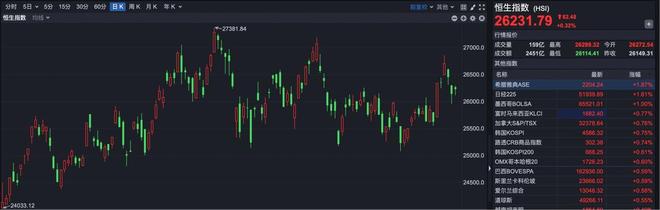
港股复盘|A股狂飙 港股表现平淡 恒指缩量上涨0.32%
Mei Ri Jing Ji Xin Wen· 2026-01-09 09:44
Market Performance - The A-share market experienced a significant increase, with the Shanghai Composite Index achieving a record 16 consecutive days of gains, and total trading volume in the Shanghai and Shenzhen markets surpassing 30 trillion yuan [1] - The Hang Seng Index closed at 26,231.79 points, up 82.48 points, with a gain of 0.32%. However, the Hong Kong market saw a decrease in trading volume, with a total of 245.1 billion HKD, down 23.2 billion HKD from the previous day [1] Sector Highlights - The Hang Seng Technology Index closed at 5,687.314 points, increasing by 8.80 points, or 0.15% [3] - Gold stocks performed well, with Shandong Gold and Laopu Gold rising over 5%, and Zhaojin Mining increasing over 4% [4] - The commercial aerospace sector showed strong performance, with Asia Pacific Satellite (HK01045) initially rising over 22%, but closing with a narrower gain of 3.96% [5] Investment Insights - Analysts noted that recent geopolitical risks and expectations of interest rate cuts are supporting gold prices. Morgan Stanley predicts that gold prices could reach $4,800 per ounce by Q4 2026, driven by lower interest rates and continued buying from central banks and funds [6] - Three new stocks were listed today, with Rebo Bio-B (HK06938) rising over 41%, MINIMAX-WP (HK00100) increasing over 109%, and Jinxun Resources (HK03636) up over 26% [6] Capital Flow - There was a net inflow of southbound funds into Hong Kong stocks, exceeding 6.8 billion HKD by the end of the trading day [8] Future Outlook - Dongwu Securities suggests that the Hong Kong market is entering a period of oscillating upward trends, emphasizing the importance of dividends as a foundation and the potential for technology growth in the first half of the year [10] - CITIC Securities anticipates that the Hong Kong market could see a second round of valuation recovery and further earnings recovery in 2026, driven by internal and external economic policies, recommending focus on technology, healthcare, resource products, essential consumption, paper, and aviation sectors [10]

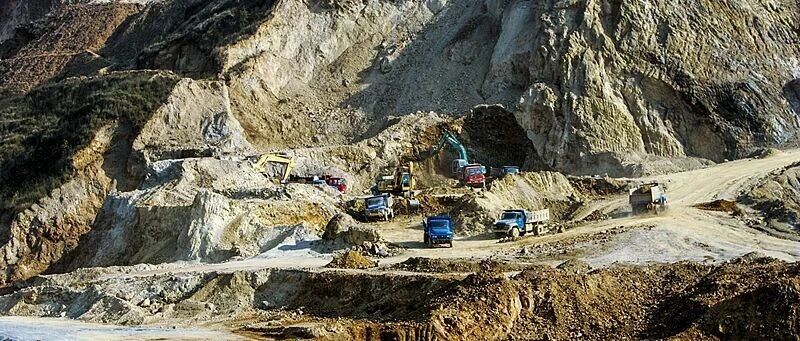
稀土精矿,报价六连涨
财联社· 2026-01-09 09:27
Core Viewpoint - Baotou Steel and Northern Rare Earth have announced an increase in the associated transaction price of rare earth concentrate for the first quarter of 2026 to 26,834 yuan/ton (excluding tax, REO=50%) [1][2]. Group 1: Price Adjustment Announcement - Baotou Steel's announcement states that the price adjustment mechanism for rare earth concentrate was approved at the 2022 annual shareholders' meeting, with the new price set at 26,834 yuan/ton for Q1 2026 [1]. - Northern Rare Earth also confirmed the same price adjustment based on its pricing method and calculations approved in its management meeting [1][2]. - The price for Q4 2025 was previously set at 26,205 yuan/ton, indicating a quarter-on-quarter increase of 2.4% [1]. Group 2: Pricing Mechanism - The unified pricing adjustment mechanism between Northern Rare Earth and Baotou Steel began on April 1, 2023, allowing for quarterly price adjustments based on a fixed pricing formula [2]. - The agreement stipulates that the management will calculate and adjust the prices in the first week of each quarter, followed by the signing of new supply contracts or supplementary agreements [2]. Group 3: Historical Price Trends - Since Q4 2024, the price of rare earth concentrate has seen a continuous increase for six consecutive quarters, recovering from a significant drop of 46.05% from a high of 31,030 yuan/ton in Q2 2023 to 16,741 yuan/ton in Q3 2024 [3][5]. - The price fluctuations indicate a recovery trend starting from Q4 2024, with the current price reflecting a significant rebound from previous lows [5].


北方稀土(600111.SH):2026年第一季度稀土精矿交易价格调整为不含税26834元/吨
智通财经网· 2026-01-09 09:01
智通财经APP讯,北方稀土(600111.SH)发布公告,根据稀土精矿定价方法及2025年第四季度稀土氧化物 价格,经测算并经公司2026年第1次总经理办公会审议通过,2026年第一季度稀土精矿交易价格调整为 不含税26834元/吨(干量,REO=50%),REO每增减1%、不含税价格增减536.68元/吨。 ...
包钢股份(600010.SH)拟将2026年第一季度稀土精矿关联交易价格调整为不含税26834元/吨
智通财经网· 2026-01-09 08:54
智通财经APP讯,包钢股份(600010.SH)发布公告,根据公司2022年年度股东大会审议通过的稀土精矿 价格调整机制及计算公式,公司拟将2026年第一季度稀土精矿关联交易价格调整为不含税26834元/吨 (干量,REO=50%),REO每增减1%、不含税价格增减536.68元/吨。 ...
北方稀土:一季度稀土精矿交易价格调整为不含税26834元/吨
Mei Ri Jing Ji Xin Wen· 2026-01-09 08:48
每经AI快讯,1月9日,北方稀土公告称,根据稀土精矿定价方法及2025年第四季度稀土氧化物价格, 经测算并经公司2026年第1次总经理办公会审议通过,2026年第一季度稀土精矿交易价格调整为不含税 26834元/吨(干量,REO=50%),REO每增减1%、不含税价格增减536.68元/吨。 ...
包钢股份:拟将2026年第一季度稀土精矿关联交易价格调整为不含税26834元/吨
Zheng Quan Shi Bao Wang· 2026-01-09 08:35
人民财讯1月9日电,包钢股份(600010)1月9日公告,根据公司2022年年度股东大会审议通过的稀土精 矿价格调整机制及计算公式,公司拟将2026年第一季度稀土精矿关联交易价格调整为不含税26834元/吨 (干量,REO=50%)。 ...
北方稀土:2026年第一季度稀土精矿交易价格调整为不含税26834元/吨
Xin Lang Cai Jing· 2026-01-09 08:34
北方稀土公告,根据稀土精矿定价方法及2025年第四季度稀土氧化物价格,经测算并经公司2026年第1 次总经理办公会审议通过,2026年第一季度稀土精矿交易价格调整为不含税26834元/吨(干量, REO=50%),REO每增减1%、不含税价格增减536.68元/吨。 ...
盘中“狂飙”逾4.2%!稀土ETF(159713)强势上涨
Mei Ri Jing Ji Xin Wen· 2026-01-09 06:17
Core Viewpoint - The rare earth sector is experiencing significant growth, driven by rising prices of domestic rare earth materials and increasing demand from the new energy and high-end manufacturing sectors, highlighting the strategic value of rare earth resources amid geopolitical tensions [1]. Group 1: Market Performance - The rare earth ETF (159713) saw an intraday increase of 4.26%, currently showing a latest increase of 3.55% [1]. - Key stocks in the index, such as Antai Technology, Xiamen Tungsten, and Goldwind Technology, hit the daily limit up, while Zhong Rare Earth and Jinli Permanent Magnet surged nearly 7%, with nearly 90% of the rising stocks contributing to the index's impressive gains [1]. Group 2: Industry Dynamics - The "14th Five-Year Plan" emphasizes the importance of securing key mineral resources, which is expected to sustain the demand for rare earth permanent magnet materials [1]. - The overall manufacturing sector is gaining attention from investors due to the anticipated growth in demand for rare earth materials, driven by geopolitical competition and the strategic significance of these resources [1]. Group 3: Investment Focus - The rare earth ETF (159713) closely tracks the CSI Rare Earth Industry Index, focusing on the rare earth industry chain, particularly in resource extraction, smelting, separation, and the manufacturing of high-performance permanent magnet materials [1].
中国稀土1月8日获融资买入2.10亿元,融资余额21.98亿元
Xin Lang Cai Jing· 2026-01-09 05:09
资料显示,中国稀土集团资源科技股份有限公司位于江西省赣州市章贡区章江南大道18号豪德银座A栋 14、15层,成立日期1998年6月17日,上市日期1998年9月11日,公司主营业务涉及稀土冶炼分离及稀土 技术研发及服务。主营业务收入构成为:稀土氧化物63.51%,稀土金属及合金35.95%,其他(补 充)0.35%,技术服务收入0.18%。 截至12月19日,中国稀土股东户数22.90万,较上期减少3.74%;人均流通股4634股,较上期增加 3.89%。2025年1月-9月,中国稀土实现营业收入24.94亿元,同比增长27.73%;归母净利润1.92亿元,同 比增长194.67%。 分红方面,中国稀土A股上市后累计派现3.46亿元。近三年,累计派现1.24亿元。 来源:新浪证券-红岸工作室 1月8日,中国稀土跌2.66%,成交额25.42亿元。两融数据显示,当日中国稀土获融资买入额2.10亿元, 融资偿还2.34亿元,融资净买入-2441.42万元。截至1月8日,中国稀土融资融券余额合计22.13亿元。 融资方面,中国稀土当日融资买入2.10亿元。当前融资余额21.98亿元,占流通市值的4.14%,融资余额 ...

ETF午评 | A股一度站上4100点,稀土板块+行业航天领涨,稀土ETF易方达、航空航天ETF天弘涨3%
Xin Lang Cai Jing· 2026-01-09 04:14
Core Viewpoint - The A-share market showed a collective rise in the morning session, with significant trading volume and various sectors experiencing notable performance, particularly in AI applications, military equipment, and commercial aerospace [1] Market Performance - The three major A-share indices rose, with the Shanghai Composite Index increasing by 0.3%, briefly surpassing 4100 points, while the Shenzhen Component Index rose by 0.57% and the ChiNext Index by 0.1% [1] - The total trading volume in the Shanghai and Shenzhen markets reached 20,819 billion yuan, an increase of 3,004 billion yuan compared to the previous day [1] - Over 2,300 stocks in the market experienced gains [1] Sector Performance - Leading sectors included AI applications, military equipment, commercial aerospace, smart healthcare, oil and gas extraction and services, computing power leasing, retail, minor metals, cross-border payments, and controllable nuclear fusion [1] - Underperforming sectors included banking, glyphosate, airport and shipping, brain-computer interfaces, cement, and agriculture [1] ETF Performance - The rare earth sector saw strong gains, with the E Fund Rare Earth ETF and the Jiashi Rare Earth ETF rising by 3.57% and 3.54%, respectively [1] - The commercial aerospace sector continued to thrive, with the Tianhong Aerospace ETF and the Penghua Satellite ETF increasing by 3.54% and 3.43%, respectively [1] - The AI application sector also performed well, with the GF Fund Media ETF rising by 3.39% [1] - The semiconductor sector experienced a pullback, with the Sci-Tech Semiconductor ETF, Semiconductor Materials ETF, and Sci-Tech Semiconductor ETF from Penghua declining by 1.83%, 1.79%, and 1.77%, respectively [1] - Overnight, U.S. tech stocks fell, with the Nasdaq Biotechnology ETF and S&P Biotechnology ETF both dropping by 1% [1]