
造纸

Search documents
午评:沪指涨0.29% 造纸板块涨幅居前
Zhong Guo Jing Ji Wang· 2025-12-25 03:42
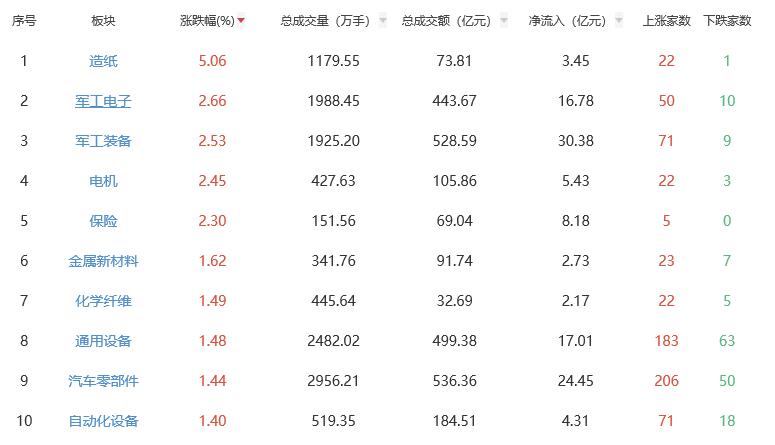
Core Viewpoint - The A-share market showed mixed performance in early trading, with the Shanghai Composite Index slightly up by 0.29%, while the Shenzhen Component and ChiNext Index experienced declines of 0.11% and 0.37%, respectively [1] Market Performance - As of the midday close, the Shanghai Composite Index stood at 3952.50 points, reflecting a gain of 0.29% [1] - The Shenzhen Component Index was reported at 13472.22 points, down by 0.11% [1] - The ChiNext Index closed at 3217.47 points, showing a decrease of 0.37% [1] Sector Performance - The leading sectors in terms of gains included: - Paper industry with a rise of 5.06%, total trading volume of 1179.55 million hands, and a net inflow of 3.45 billion [2] - Military electronics increased by 2.66%, with a trading volume of 1988.45 million hands and a net inflow of 16.78 billion [2] - Main industrial aggregates rose by 2.53%, with a total trading volume of 1925.20 million hands and a net inflow of 30.38 billion [2] - Electric machinery gained 2.45%, with a trading volume of 427.63 million hands and a net inflow of 5.43 billion [2] - Insurance sector increased by 2.30%, with a trading volume of 151.56 million hands and a net inflow of 8.18 billion [2] - The sectors that faced declines included: - Energy metals decreased by 2.68%, with a trading volume of 228.14 million hands and a net outflow of 19.82 billion [2] - Precious metals fell by 2.67%, with a trading volume of 309.80 million hands and a net outflow of 9.64 billion [2] - Small metals dropped by 1.13%, with a trading volume of 635.51 million hands and a net outflow of 8.07 billion [2] - Industrial metals declined by 1.07%, with a trading volume of 1719.83 million hands and a net outflow of 17.05 billion [2]

A股午评:上证指数涨0.29% 商业航天全线走强
Mei Ri Jing Ji Xin Wen· 2025-12-25 03:42
Market Overview - As of the midday session on December 25, the Shanghai Composite Index rose by 0.29%, while the Shenzhen Component Index fell by 0.11%, and the ChiNext Index decreased by 0.38%. The North Stock 50 Index increased by 1.04% [1] - The total market turnover reached 12,119 billion yuan, an increase of 527 billion yuan compared to the previous day's trading volume [1] Sector Performance - The paper-making sector showed strong performance, with Hengda New Materials (301469) hitting the daily limit of 20%, and both Bohui Paper (600966) and Yibin Paper (600793) also reaching the daily limit [1] - The commercial aerospace sector experienced a significant surge, with Guolian Aviation (300900) also hitting the 20% daily limit, alongside multiple stocks such as Shenjian Co. (002361) and Shanghai Port Bay (605598) reaching their daily limits [1] - The precious metals sector weakened, with Zhaojin Gold (000506) and Hunan Silver (002716) both declining by over 4% [1] - The energy metals sector faced adjustments, with Tianqi Lithium (002466), Shengxin Lithium Energy (002240), and Rongjie Co. (002192) all dropping by more than 4% [1]





博汇纸业2025年12月25日涨停分析:公司治理优化+产能扩张+盈利释放
Xin Lang Cai Jing· 2025-12-25 03:13
Core Viewpoint - Bohui Paper (SH600966) reached its daily limit up on December 25, 2025, with a price of 6.81 yuan, a rise of 10.02%, and a total market capitalization of 9.104 billion yuan [1] Group 1: Company Governance and Management - The company has shown a trend of "governance optimization, stable operations, and controllable risks," with a neutral to positive fundamental outlook. Over 20 governance systems have been revised, and a strategic and ESG committee has been established, modernizing the governance structure [2] - In December, several new executives were hired, injecting new vitality into the company's development [2] Group 2: Capacity Expansion and Financial Performance - The company has a clear capacity expansion strategy, with a 320,000-ton chemical wood pulp expansion project (investment of 1.7 billion yuan) aimed at achieving self-sufficiency in key raw materials, with industry-leading technical indicators [2] - The Q3 2025 report shows a year-on-year increase in operating cash flow of 1537%, reaching 2.276 billion yuan, indicating enhanced receivables capability [2] Group 3: Employee Engagement and Market Performance - The combined shareholding of the "Pioneers/Fighters" employee stock ownership plan is 7.48%, with a participation rate of 82.81%, which is beneficial for the company's stable development [2] - On the same day, other stocks in the paper-making sector also performed well, creating a certain sectoral linkage effect [2] Group 4: Technical Analysis and Market Dynamics - If the stock price breaks through key resistance levels, it may attract more technical investors' attention and buying [2] - There may have been inflows of main funds on that day, driving the stock price to its limit up, with specific fund data available for further verification through platforms like Dongfang Caifu [2]
离岸人民币对美元升破7.0关口!为2024年9月以来首次,对A股市场影响几何?
Sou Hu Cai Jing· 2025-12-25 02:42
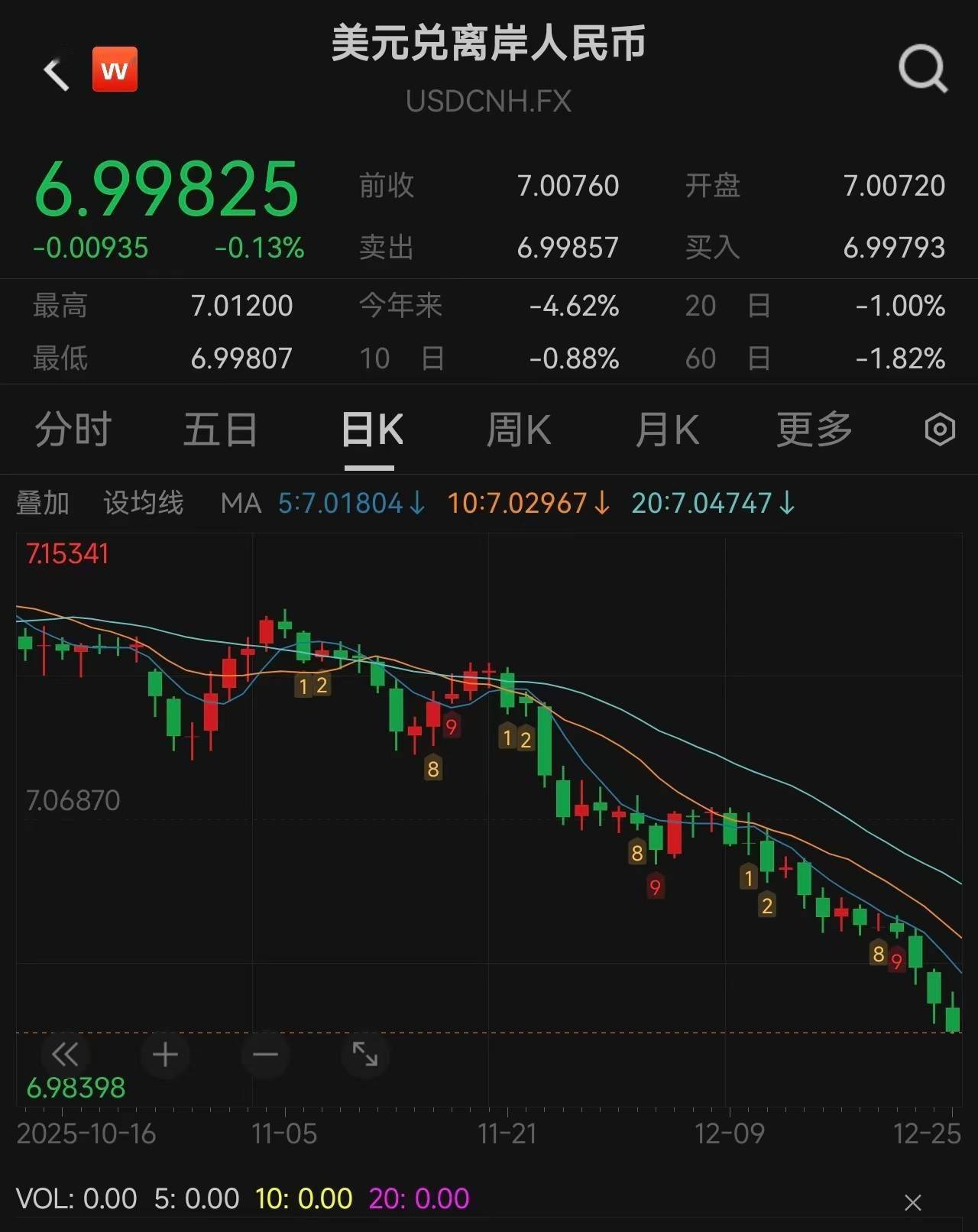
Group 1 - The offshore RMB has surpassed the 7.0 mark against the USD for the first time since September 2024, currently reported at 6.99825 [1] - The People's Bank of China (PBOC) aims to enhance the resilience of the foreign exchange market and stabilize market expectations, preventing excessive fluctuations in the exchange rate [3] - The appreciation of the RMB is expected to increase the attractiveness of RMB-denominated assets, particularly for foreign investors focused on exchange rate gains [3] Group 2 - Historical data indicates that during periods of RMB appreciation, foreign capital, represented by "northbound funds," tends to show accelerated net inflows, favoring liquid assets that align with international valuations [3] - A-share market valuations are currently at historically low levels, and a stronger RMB may catalyze long-term foreign capital to reassess and increase allocations to Chinese assets, potentially stabilizing or boosting market indices [3] - The impact of RMB appreciation on listed companies is not uniform; export-oriented industries such as home appliances, electronics, textiles, and machinery may face reduced price competitiveness in international markets, leading to potential downward pressure on profit expectations [4] Group 3 - Beneficiaries of RMB appreciation include industries with significant dollar-denominated liabilities, such as airlines, which may see improved financial statements due to increased exchange gains [4] - Cost-importing sectors, like paper and basic chemicals, will benefit from reduced procurement costs for raw materials, enhancing profit margins [4] - The psychological impact of RMB appreciation is significant, as it signals economic stability and effective policy, which can fundamentally boost market risk appetite [4] Group 4 - The significance of the RMB surpassing the 7.0 mark is more psychological and directional rather than indicative of long-term trends; sustainable appreciation is contingent on confirmed domestic economic recovery and substantial improvements in corporate earnings [5] - Investors should closely monitor upcoming key economic data releases and monetary policy trends from major economies to gauge the sustainability of RMB appreciation [5]
松炀资源跌2.08%,成交额5147.96万元,主力资金净流出249.38万元
Xin Lang Cai Jing· 2025-12-25 02:39
Group 1 - The core viewpoint of the news is that Songyang Resources has experienced fluctuations in stock price and trading volume, with a recent decline of 2.08% on December 25, 2023, and a total market capitalization of 4.238 billion yuan [1] - As of December 25, 2023, the stock price of Songyang Resources is reported at 20.71 yuan per share, with a trading volume of 51.48 million yuan and a turnover rate of 1.20% [1] - The company has seen a year-to-date stock price increase of 2.98%, with a recent 5-day decline of 1.38% and a 20-day increase of 7.31% [1] Group 2 - Songyang Resources operates in the light industry manufacturing sector, specifically in paper production, and is involved in environmental protection and recycling [2] - The company reported a revenue of 314 million yuan for the first nine months of 2023, reflecting a year-on-year decrease of 40.20%, while the net profit attributable to shareholders was -86.74 million yuan, showing a year-on-year increase of 17.11% [2] - The main business revenue composition includes 66.70% from high-strength corrugated paper, 31.09% from specialty paper, and 2.27% from other businesses [1] Group 3 - Since its A-share listing, Songyang Resources has distributed a total of 20.59 million yuan in dividends, with no dividends paid in the last three years [3]

青山纸业跌2.09%,成交额7.53亿元,主力资金净流出1.13亿元
Xin Lang Cai Jing· 2025-12-25 02:04
Core Viewpoint - Qing Shan Paper Industry's stock price has shown significant volatility, with a year-to-date increase of 65.62%, but recent trading indicates a net outflow of funds, suggesting potential investor caution [1][2]. Group 1: Stock Performance - On December 25, Qing Shan Paper's stock price fell by 2.09% to 4.22 CNY per share, with a trading volume of 7.53 billion CNY and a turnover rate of 7.92%, resulting in a total market capitalization of 94.56 billion CNY [1]. - The stock has increased by 9.33% over the last five trading days, 4.71% over the last 20 days, and 7.65% over the last 60 days [1]. - The company has appeared on the trading leaderboard 14 times this year, with the most recent appearance on October 20, where it recorded a net purchase of 51.29 million CNY [1]. Group 2: Financial Performance - For the period from January to September 2025, Qing Shan Paper reported a revenue of 1.768 billion CNY, a year-on-year decrease of 11.87%, and a net profit attributable to shareholders of 64.99 million CNY, down 25.07% year-on-year [2]. - The company has distributed a total of 321 million CNY in dividends since its A-share listing, with 175 million CNY distributed over the last three years [2]. Group 3: Business Overview - Qing Shan Paper, established on April 1, 1993, and listed on July 3, 1997, is primarily engaged in the production and sale of paper products, including paper bags, board paper, and corrugated paper, as well as other products like pharmaceuticals and electronic products [2]. - The revenue composition of the company is as follows: 67.47% from the pulp industry, 15.32% from pharmaceuticals, 11.45% from paper product processing, 7.54% from optoelectronics, and smaller contributions from other sectors [2]. - The company is classified under the light industry manufacturing sector, specifically in the paper and specialty paper category, and is associated with various concepts such as the Belt and Road Initiative and state-owned enterprise reform [2]. Group 4: Shareholder Information - As of September 30, 2025, Qing Shan Paper had 207,900 shareholders, an increase of 113.93% from the previous period, with an average of 10,640 circulating shares per shareholder, a decrease of 53.26% [2][3]. - Hong Kong Central Clearing Limited is the fifth-largest circulating shareholder, holding 17.0744 million shares, which is a decrease of 4.1228 million shares from the previous period [3].

再生纸浆“带病”进口为何屡禁不止
Ke Ji Ri Bao· 2025-12-25 00:22
今年9月,青岛海关查获746.78吨以"再生纸浆"名义申报入境的货物。该货物为压缩褐色絮状浆包,有 异味,夹杂塑料片、金属等杂质。经专业机构鉴定,其属于国家禁止进口的固体废物。 2021年1月,我国全面禁止进口固体废物(俗称"禁废令"),其中就包括废纸。我国企业进口废纸等再 生纤维造新纸由来已久。"禁废令"的全面实施,要求从进口"纸"转变为进口"浆",意在避免把污染物输 送到国内。 但目前,国内部分造纸企业在海外通过干法制浆,把废纸"干磨"成"纸浆"再进口,实则进口的还是废 纸。公开资料显示,2021年以来,全国发生多起海关查验出以"再生纸浆"名义进口固体废物并退运的案 例。 业内人士呼吁,应加强对进口再生纸浆监管,提高进口干法纸浆标准,加强技术创新,从而解决造纸原 料供应紧张、原料利用率不高等问题。 干法制浆工艺惹争议 2024年11月,海关总署公布打击"洋垃圾"典型案件。其中,厦门某进出口有限公司向海关申报一批再生 牛卡纸,申报数量为256.76吨。经查验,部分再生牛卡纸存在脏污、破损、霉变等情况。经鉴定,该批 再生牛卡纸中有65.57吨为固体废物。 业内专家表示,再生纸浆之所以会出现"带病"进口问题,缘 ...
离岸人民币兑美元升穿7.0!是什么在助推这波上涨,谁将受益?
Sou Hu Cai Jing· 2025-12-24 14:43
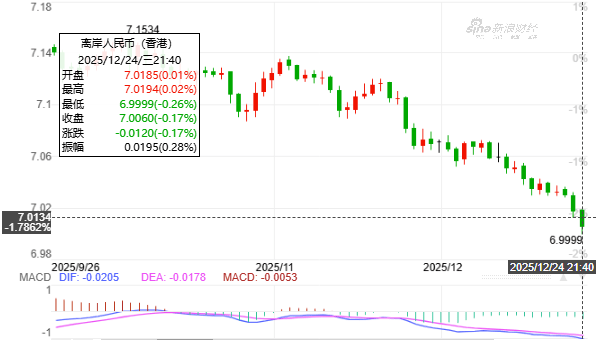
Group 1 - The core driving factors for the recent appreciation of the offshore RMB against the USD include a shift in economic focus towards domestic demand and consumption, significant gold purchases by the central bank, and a weakening USD due to market conditions [1][4][5] - The offshore RMB has seen a strong upward trend, breaking the 7.0 mark against the USD, reaching 6.9999, the highest since October 2024, with onshore RMB also surpassing 7.02 [1][2] - The appreciation trend began in late November 2025, with onshore and offshore RMB appreciating over 900 and 1000 basis points respectively, with annual appreciation rates of 3.7% and 4.4% [4][5] Group 2 - The international metal market has experienced a surge in prices, with spot gold exceeding $4500 per ounce, silver above $70 per ounce, and copper reaching $12000 per ton, all setting historical peaks [2] - Domestic exporters are increasingly converting their foreign currency receipts into RMB immediately upon arrival, indicating a shift in behavior due to currency fluctuations [2][5] Group 3 - The appreciation of the RMB is expected to benefit several industries, particularly the non-ferrous metals sector, which is closely tied to price movements and performance in the context of global liquidity [9] - Import-dependent industries such as paper manufacturing, aviation, and oil refining will also benefit from the RMB appreciation, as it reduces costs for raw materials priced in USD [11][12][16] - Financial institutions, including banks and brokerages, are likely to see increased opportunities due to foreign capital inflows and the appreciation of RMB-denominated assets [16] Group 4 - The appreciation of the RMB may put pressure on export-oriented industries, which will need to find ways to balance profit margins amid rising costs and competitive pricing challenges [18] - Key sectors to watch include non-ferrous metals and paper manufacturing, which are expected to resonate positively with the appreciation and price increases, while consumer and pharmaceutical sectors may also attract foreign investment [18]
景兴纸业:2025年第五次临时股东会决议公告
Zheng Quan Ri Bao· 2025-12-24 12:11
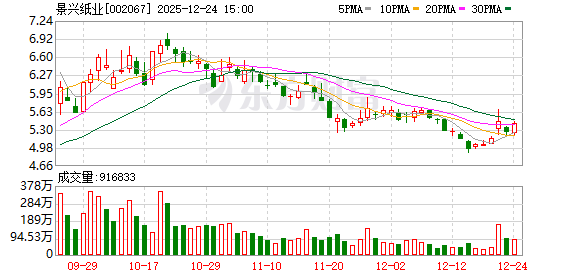
证券日报网讯 12月24日,景兴纸业发布公告称,公司12月24日召开2025年第五次临时股东会,审议通 过《关于为全资子公司景兴控股(马)有限公司提供担保的议案》。 (文章来源:证券日报) ...

7股尾盘主力资金净流入均超1亿元
Zheng Quan Shi Bao Wang· 2025-12-24 11:10
Group 1 - The core point of the article highlights that on December 24, the net inflow of main funds in the Shanghai and Shenzhen markets reached 129 million yuan [1] - The telecommunications industry saw a significant net inflow of over 500 million yuan in main funds [1] - Other industries such as electronics, banking, light manufacturing, and non-ferrous metals also experienced net inflows exceeding 100 million yuan [1] Group 2 - Among individual stocks, Zhongji Xuchuang had a net inflow of over 200 million yuan in main funds [1] - Companies like Qingshan Paper, Haixia Innovation, Lingyi Zhizao, Luxshare Precision, Deep Technology, and Dongshan Precision each saw net inflows exceeding 100 million yuan [1]



