啤酒

Search documents
国盛证券:2026年白酒业有望迎来改善 大众品配置优选两条复苏与成长双主线
Zhi Tong Cai Jing· 2026-01-07 03:29
Group 1: Core Insights - The report from Guosheng Securities indicates that the liquor industry is expected to fully release risks by 2025, with improvements in supply and demand anticipated in 2026, characterized by a "supply-first, demand-gradual" recovery [1] - Current market conditions show a triple bottom in sales, pricing, and financial reports, with short-term improvements in sales expected during the Spring Festival, and mid-term recovery in sales, pricing, and financial reports anticipated [1] Group 2: Consumer Trends - The overall consumption landscape is stabilizing, but prices are under pressure, with structural growth changes continuing; the food and beverage sector saw a cumulative decline of 4% in 2025, with liquor significantly impacted, down 7% year-to-date [1] - High-end consumption is recovering first, with experiential consumption leading the way; product life cycles are shortening, and there is a clear trend towards health-oriented products and improved trust in channels [1] Group 3: Liquor Industry Analysis - The supply side is clearing, with leading companies like Kweichow Moutai and Wuliangye stabilizing prices and boosting channel confidence; the industry is expected to prioritize volume over price and focus on sales and market share in 2026 [2] - Demand is gradually recovering, with sales showing signs of improvement; the peak sales period around the Spring Festival is expected to see continued recovery, particularly for leading brands [2] Group 4: Beer and Beverage Sector - The beer sector is anticipated to benefit from restaurant recovery, with expectations for volume and price performance to exceed forecasts; key stocks include Beijing Beer and China Resources Beer [3] - The beverage industry is expanding steadily, with segments like sugar-free tea and energy drinks leading growth; companies with strong brand and channel capabilities are likely to stand out in a competitive landscape [3] Group 5: Food Sector Insights - The restaurant supply chain is seeing a recovery in demand, with price wars easing; leading companies like Anjijia are expected to navigate price pressures effectively [4] - The snack sector is focusing on retail transformation and product-driven growth, with opportunities for standout products; the dairy sector is expected to see a turning point in raw milk cycles in the second half of 2026 [4] - The health supplement market in China is still in a growth phase, with new ingredients and effects presenting explosive opportunities; companies like H&H International Holdings are highlighted for their resilience [4]



重庆啤酒18年包销纠纷了结增利1908万 啤酒卖不动年砸25亿销售费营收仍降
Chang Jiang Shang Bao· 2026-01-06 23:40
Core Viewpoint - The long-standing distribution dispute between Chongqing Beer and its affiliate, Jiawei Beer, has been resolved through court mediation, allowing the company to potentially improve its financial position and operational focus moving forward [1][2]. Group 1: Dispute Resolution - The contract dispute between Chongqing Beer and Jiawei, which lasted for 18 years, has been settled, with Chongqing Beer agreeing to pay a total of 100 million yuan (approximately 14.1 million USD) for all price difference settlements up to the end of 2025 [1][4]. - The mediation agreement includes provisions for the distribution of profits and the sales cooperation model between 2026 and 2028 [4]. Group 2: Financial Impact - Following the resolution, Chongqing Beer plans to reverse a previously accrued liability of 254 million yuan (approximately 35.8 million USD) and recognize a new liability of about 217 million yuan (approximately 30.7 million USD) for the settlement [1][4]. - This accounting adjustment is expected to increase the company's net profit attributable to shareholders by approximately 19.08 million yuan (around 2.7 million USD) for the year 2025 [4]. Group 3: Performance Challenges - Chongqing Beer has faced declining sales, with a reported revenue of 14.645 billion yuan (approximately 2.06 billion USD) in 2024, down 1.15% year-on-year, and a net profit of 1.115 billion yuan (around 157 million USD), down 16.61% [5]. - The company's net profit has continued to decline in the first three quarters of 2025, with revenues and net profits both showing a decrease compared to the previous year [5][6]. - The beer industry is experiencing challenges due to changing consumer habits and market conditions, impacting Chongqing Beer's sales performance [6]. Group 4: Strategic Initiatives - In response to market pressures, Chongqing Beer is focusing on expanding non-traditional sales channels and increasing its canning rate to adapt to changing consumption trends [6]. - The company has invested significantly in marketing, employing various celebrity endorsements to enhance brand visibility and appeal [6].

百威英博将斥资30亿美元回购美国金属包装厂股份
Ge Long Hui A P P· 2026-01-06 15:39
Group 1 - The core point of the article is that Anheuser-Busch InBev, the world's largest beer brewer, plans to spend approximately $3 billion to repurchase a 49.9% stake in its U.S. metal container plant [1] - The company will utilize cash to execute the buyback option, with the transaction expected to be completed in the first quarter [1] - In 2020, the company sold a minority stake in its U.S. packaging business to fund debt repayment [1]

青岛啤酒集团注册资本增至16.3亿元
Zheng Quan Ri Bao Wang· 2026-01-06 13:45
Group 1 - The core point of the article is that Qingdao Beer Group Co., Ltd. has increased its registered capital from approximately 1.34 billion yuan to about 1.63 billion yuan [1] Group 2 - The change in registered capital indicates a potential expansion or investment strategy by the company [1] - The increase in capital is significant, reflecting a growth trend within the company [1] - This adjustment in capital structure may enhance the company's financial stability and operational capacity [1]

重庆啤酒、嘉威“窝里斗”两年画句号,3.53亿索赔降至1亿
Xin Lang Cai Jing· 2026-01-06 11:11
Core Viewpoint - The long-standing legal dispute between Chongqing Beer and its subsidiary Chongqing Jiawei has been resolved through mediation, allowing both parties to focus on improving performance and reducing legal risks [2][3][31]. Group 1: Mediation Outcome - On January 6, Chongqing Beer announced that it reached a mediation agreement with Chongqing Jiawei, concluding a two-year legal battle [2][30]. - The original court ruling required Chongqing Beer to pay approximately 353 million yuan, but the mediation reduced this to a one-time payment of 100 million yuan by December 31, 2025 [2][30]. - The mediation is expected to alleviate financial burdens and stabilize operational expectations for Chongqing Beer [3][31]. Group 2: Financial Implications - The mediation agreement allows Chongqing Beer to reverse a previously accrued liability of approximately 254 million yuan and recognize a new liability of about 217 million yuan, resulting in an estimated profit increase of 37.11 million yuan for 2025 [7][53]. - The agreement also locks in a sales volume of 142,600 kiloliters per year at a price of 4,000 yuan per kiloliter for the years 2026 to 2028, providing financial stability [53][54]. Group 3: Strategic Challenges - Chongqing Beer faces challenges in a competitive market and pressure from consumer downgrade, which has slowed its high-end strategy and national expansion efforts [8][36]. - The company must consolidate its market position in Southwest China while establishing a competitive advantage in its nationwide strategy [36][54]. Group 4: Historical Context - The relationship between Chongqing Beer and Chongqing Jiawei dates back to before 2013, characterized by an unequal partnership that has evolved over time [39][40]. - The original sales agreement, signed in 2009, has been a source of contention, with Chongqing Jiawei benefiting significantly from the arrangement [39][42]. - The strategic shift towards high-end brands has created conflicts between the two companies, as Chongqing Beer focuses on national brands while Chongqing Jiawei relies on local brands for stable revenue [40][54].

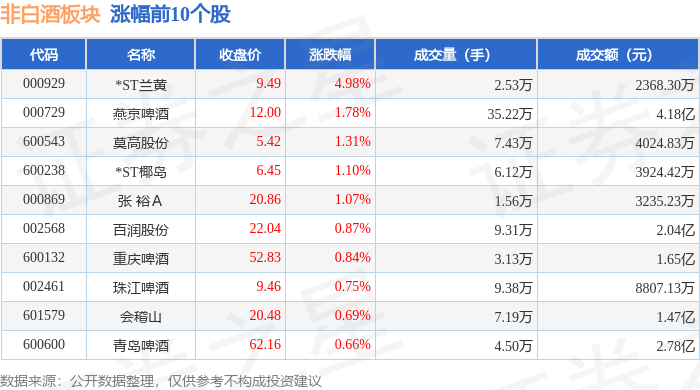
非白酒板块1月6日涨0.86%,*ST兰黄领涨,主力资金净流出1692.41万元
Zheng Xing Xing Ye Ri Bao· 2026-01-06 08:56
Market Overview - The non-baijiu sector increased by 0.86% compared to the previous trading day, with *ST Lanhua leading the gains [1] - The Shanghai Composite Index closed at 4083.67, up 1.5%, while the Shenzhen Component Index closed at 14022.55, up 1.4% [1] Stock Performance - The top-performing stock was *ST Lanhua, closing at 676 with a rise of 4.98% and a trading volume of 25,300 shares [1] - Other notable stocks included Zai Liang Beer, which rose by 1.78% to 12.00, and Mogaogongsi, which increased by 1.31% to 5.42 [1] - The overall trading volume and turnover for various stocks in the non-baijiu sector were significant, with Zai Liang Beer achieving a turnover of 418 million yuan [1] Capital Flow - The non-baijiu sector experienced a net outflow of 16.92 million yuan from institutional investors, while retail investors saw a net outflow of 6.90 million yuan [2] - Conversely, speculative funds recorded a net inflow of 23.83 million yuan [2] Individual Stock Capital Flow - Qingdao Beer had a net inflow of 22.44 million yuan from institutional investors, representing 8.06% of its total capital flow [3] - *ST Lanhua saw a net inflow of 6.04 million yuan from institutional investors, accounting for 25.51% of its capital flow [3] - In contrast, Huichuan Beer experienced a net outflow of 2.87 million yuan from institutional investors, indicating a negative sentiment [3]


海通国际1月必选消费投资策略:建议短期跟随上涨 长期首选乳业
智通财经网· 2026-01-06 07:52
Core Viewpoint - The report from Haitong International indicates a rebound in investor risk appetite during the New Year period, with expectations for the consumer staples sector to follow suit, although the overall fundamentals lack catalysts [1] Demand - Among the eight key consumer sectors tracked in December, four showed positive growth while four experienced negative growth. The growing sectors included condiments, frozen foods, soft drinks, and dining, while the declining sectors included high-end and mid-range liquor, dairy products, and beer. Compared to the previous month, most sectors, except high-end liquor, saw improvements in year-on-year growth rates [2] Pricing - In December, the prices of most liquor products stabilized, with specific prices for various brands noted. For example, the price for Feitian liquor was 1600 yuan per box, down 50 yuan from the previous month and down 720 yuan year-on-year. The price for Wuliangye was 820 yuan, up 20 yuan from the previous month but down 100 yuan year-on-year [3] Cost - The cost index for six categories of consumer goods showed mixed results in December. The cost indices for soft drinks, instant noodles, condiments, dairy products, frozen foods, and beer changed by +1.06%, +0.49%, -0.29%, -0.45%, -0.54%, and -1.05% respectively. Prices for raw materials such as aluminum cans and paper saw significant year-on-year changes [4] Capital - As of the end of December, net inflows into Hong Kong Stock Connect amounted to 20.825 billion yuan, a decrease from the previous month's inflow. The market capitalization of the consumer staples sector accounted for 5.61% of the total, an increase of 0.2 percentage points from the previous month [5] Valuation - By the end of December, the historical PE ratio for A-share food and beverage sectors was at 16% (20.3x), a decrease of 5 percentage points from the previous month. The median valuation for leading food and beverage companies in A-shares remained stable at 22x [6]
2026食饮年度策略:消费者大时代
GOLDEN SUN SECURITIES· 2026-01-06 06:35
Group 1 - The report suggests that the liquor industry is expected to experience a dual improvement in supply and demand in 2026, following a risk release in 2025, with a focus on short-term sales recovery and mid-term structural and dividend considerations [4][78] - The consumer market is stabilizing, with structural growth changes continuing, as evidenced by a 4% decline in the food and beverage sector in 2025, which underperformed the Shanghai and Shenzhen 300 index by 20% [15][18] - The report highlights a significant differentiation in performance among consumer goods, with health products and frozen food sectors showing increases of 18% and 15% respectively, while liquor and beer sectors faced declines of 7% and 9% [15][18] Group 2 - The liquor sector is characterized by a threefold bottoming out, with supply clearing and value becoming more apparent, as major brands like Moutai and Wuliangye stabilize prices and restore confidence in the market [52][78] - The beer and beverage sectors are expected to benefit from a recovery in dining, with a focus on leading brands that can outperform expectations in terms of volume and price [4][52] - The food sector is positioned for recovery and growth, with a focus on strong alpha stocks, particularly in the restaurant supply chain and snack categories, as demand begins to rebound [4][52] Group 3 - The report indicates that the high-end consumer segment is showing signs of recovery, with luxury retail sales improving and experience-based consumption leading the way [30][33] - The report notes that the overall retail landscape is evolving towards discount retail, quality retail, and instant retail, reflecting a shift in consumer preferences [40][46] - The report emphasizes the importance of product innovation and channel development in the liquor industry, with a focus on lower alcohol content and appealing to younger consumers [72]



一瓶青岛原浆的自白:用“鲜活”定义消费主张
2 1 Shi Ji Jing Ji Bao Dao· 2026-01-06 05:54
Core Viewpoint - The article highlights the rising popularity of Qingdao Draft Beer, emphasizing its freshness and unique qualities that appeal to consumers, particularly during festive gatherings like the Spring Festival [2][3]. Group 1: Product Definition and Standards - Qingdao Draft Beer is defined as "fresh beer" according to the national standard, which allows for the presence of live yeast and does not undergo pasteurization or sterilization [3][4]. - The introduction of the group standard for "Draft Beer" in 2020, led by Qingdao Beer, provides a specific definition and quality assurance for this product category [3][4]. Group 2: Production and Quality Control - The production process ensures that each milliliter of beer contains a significant amount of live yeast, enhancing its nutritional value [4][5]. - The manufacturing environment is highly controlled, with a 10,000-level sterile filling workshop and strict monitoring of temperature and humidity to maintain product integrity [5][6]. Group 3: Transportation and Distribution - Qingdao Draft Beer employs a cold chain logistics system to ensure that the beer is transported at a constant temperature of 5°C, with real-time monitoring to prevent temperature fluctuations [6][7]. - The company has developed a rapid delivery system, covering over 38 cities and 1,100 stores, allowing consumers to receive fresh beer within 30 minutes of ordering [8]. Group 4: Market Expansion and Consumer Engagement - The company has seen a significant increase in international visitors, particularly from South Korea, with a 63% year-on-year growth in arrivals, leading to higher demand for Qingdao Draft Beer [8]. - Qingdao Beer has launched over 20 new products in the past year, expanding its portfolio to 119 products across various categories, catering to diverse consumer preferences [13][14]. Group 5: Sustainability and Industry Leadership - Qingdao Beer aims to become a leader in sustainability, with a target of 86.8% green electricity usage by 2025 and multiple factories certified for carbon neutrality [14]. - The company has been recognized for its innovative practices and has participated in numerous international events, enhancing its brand visibility and consumer engagement [14].
晨星:下调华润啤酒公允值预测3% 认为估值仍被低估
Zhi Tong Cai Jing· 2026-01-06 03:40
Core Viewpoint - Morningstar has downgraded the fair value estimate of China Resources Beer (00291) by 3% to HKD 37.5, while also reducing the earnings forecast for 2025-2029 by 4-5% [1] Group 1: Financial Estimates - The company is still considered undervalued, supported by a 4.4% dividend yield expected in 2025 [1] - Sales growth forecast for the company's liquor business has been revised down from 7% to 3% over the next five years, reflecting weak industry demand [1] - The sales and net profit expectations for 2025 have been lowered by 0.2% and 4% respectively, due to rising operating costs and declining profitability in the liquor segment [1] Group 2: Market Challenges - The performance of the "Jinsha Liquor" brand portfolio in the high-end liquor market is expected to lag behind other brands [1] - Consumer channels for both beer and liquor businesses will continue to face challenges in the second half of 2025, with consumer confidence remaining weak [1] - The price growth forecast for 2026 has been reduced by 2 percentage points due to pressure on low-end beer prices [1] Group 3: Growth Drivers - Heineken's channel expansion remains the main driver for volume growth in the beer business [1]