投资银行

Search documents
英伟达“宇宙级”财报竟成美股“多头陷阱” 高盛预警:市场已伤痕累累
智通财经网· 2025-11-21 03:04
Group 1 - The core viewpoint is that despite Nvidia's impressive earnings, the US stock market experienced a significant reversal, indicating that traders did not receive the risk "full relief" signal they anticipated, leading them to seek hedges against further losses [1] - The S&P 500 index initially surged by 1.9% but later fell by 1.1%, marking the largest intraday volatility since April, with over $2 trillion in market value evaporating from its peak [1] - The VIX index rose above 26, reflecting increased market fear and uncertainty [1] Group 2 - Goldman Sachs' trading department noted an increase in short positions across macro products, including ETFs and futures, indicating a shift in market sentiment [1] - The report highlighted poor market liquidity, with the depth of S&P 500 orders dropping below $5 million, compared to an average of $11.5 million over the past year, which may amplify market volatility [1] - Historical data shows that since 1957, there have been eight instances of the S&P 500 opening up over 1% and then reversing to close down, with an average positive performance following such events [2]


AI与19世纪铁路热相似,破产潮是必然?
3 6 Ke· 2025-11-21 02:59
Core Viewpoint - The infrastructure investment supporting the development and popularization of artificial intelligence (AI) is becoming overheated, drawing parallels to the 19th-century railway investment boom that led to numerous failures [1][3]. Group 1: AI Investment Landscape - OpenAI's CEO Sam Altman warns that some investors may suffer severe losses due to "stranded assets" as infrastructure costs decrease, allowing anyone to use general-purpose AI on personal devices [2]. - Major hyperscalers like OpenAI, Google, Meta, and Amazon are making unprecedented large-scale investments, with McKinsey estimating nearly $7 trillion will be invested in data centers by 2030 [2]. - The current investment climate is likened to the early days of the railway boom, with significant capital being funneled into AI infrastructure [2]. Group 2: Historical Context of Investment Booms - The 19th-century railway investment boom in the UK and the US saw massive capital influxes, leading to many bankruptcies due to over-speculation and mismanagement [3][4]. - In the US, 55 companies went bankrupt in 1877 alone, with further failures in subsequent years, highlighting the risks associated with over-investment [4]. - The financial turmoil led to the development of financial technologies and investment banking practices, as institutions like J.P. Morgan began underwriting railway bonds [4]. Group 3: Current Challenges and Market Reactions - The financial community is grappling with the timing of returns on AI investments, as companies like Meta and Alphabet face declining return on assets (ROA) [5][6]. - Meta announced a capital expenditure of $72 billion for the year, predicting further increases, which resulted in a significant stock sell-off [6]. - Approximately 95% of organizations are currently unable to profit from generative AI investments, raising concerns about the sustainability of ongoing investments in AI infrastructure [6].
比特币“金库”模式坍塌! “持币大户”Strategy(MSTR.US)从“信仰飞轮”变流动性黑洞
智通财经网· 2025-11-21 02:56
Core Viewpoint - Strategy Inc., led by Michael Saylor, is facing significant risks due to the failure of its Bitcoin treasury model and the potential removal from major indices like the Nasdaq 100, which could severely impact its market presence and liquidity [1][2]. Group 1: Company Performance and Market Impact - The price of Bitcoin has dropped over 30% from its historical peak, leading to a more than 60% decline in Strategy's stock price since July [1]. - Strategy's market capitalization has fallen to around $50 billion, with passive ETFs linked to the company holding nearly $9 billion in market exposure [2]. - The company's stock price has plummeted over 70% since reaching a record high in November, although it has still increased by approximately 1300% since Saylor's first Bitcoin purchase in August 2020 [5][7]. Group 2: Index Inclusion and Financial Implications - Analysts from JPMorgan warn that Strategy may lose its positions in the MSCI USA and Nasdaq 100 indices, which could lead to forced outflows of up to $2.8 billion if adjustments are made [2][3]. - The MSCI has indicated that companies like Strategy, which hold a significant portion of digital assets, may be treated more like investment funds and thus not qualify for index inclusion [4]. - The removal from major indices could negatively affect Strategy's liquidity, financing costs, and overall investment appeal [3]. Group 3: Business Model and Market Sentiment - Strategy's business model, which relies on selling stock to buy Bitcoin, has seen its premium diminish, with the current market value closely aligning with its Bitcoin reserves [2][9]. - The company's mNAV (market value to Bitcoin holdings ratio) has dropped to just above 1.1, indicating a loss of investor confidence in the Bitcoin treasury model [9]. - The recent downturn in cryptocurrency prices has also affected Strategy's financing tools, with perpetual preferred shares trading significantly below their issue price [7][8]. Group 4: Broader Industry Context - The recent cryptocurrency market downturn has impacted various investor groups, including retail traders and high-leverage mining companies, contrasting sharply with the bullish sentiment observed just months prior [4]. - The traditional mechanisms of index inclusion, once seen as a legitimizing force for market participation, are now being tested against the sustainability of the cryptocurrency investment narrative [12].



高盛:上调2025年12月铜价预测,未来12个月仍看空铝价
Wen Hua Cai Jing· 2025-11-21 00:38
Group 1 - Goldman Sachs raised its 2025 copper price forecast from $10,385 per ton to $10,610 per ton, reflecting an upward trend in the fourth quarter [1] - The bank maintains a price range of $10,000 to $11,000 per ton for 2026-2027, anticipating a slight market surplus [1] - A supply deficit is expected in the latter part of this decade due to increasing resource constraints and accelerated demand in key sectors, driving prices higher [1] Group 2 - Goldman Sachs projects a long-term copper price of $15,000 per ton by 2035, which is above market expectations and forward contract prices of approximately $10,390 per ton, based on the assumption that long-delayed mining projects will not come online [1] - The bank remains bearish on aluminum prices for the next 12 months, forecasting a decline to $2,350 per ton by the fourth quarter of 2026 due to new supply leading to market oversupply [1] - Although aluminum prices are expected to recover thereafter, they are not anticipated to return to current levels until the early part of the next decade, with long-term forecasts predicting prices to fluctuate between $2,900 and $3,400 per ton from 2030 to 2035 [1]
高盛:预计下周股票抛售将达400亿美元
Xin Lang Cai Jing· 2025-11-20 16:37
Core Viewpoint - The S&P 500 index has fallen below a critical level, potentially triggering hedge funds that follow trends to sell approximately $40 billion in stocks over the next week [1] Group 1: Market Movement - The S&P 500 index dropped below 6725 points, which is a closely monitored threshold [1] - Following this drop, it is estimated that $39 billion in stocks may be sold globally by trend-following hedge funds in the upcoming week [1] - If the decline continues, systemic trend hedge funds could sell up to approximately $65 billion in stocks [1] Group 2: Hedge Fund Behavior - Trend-following hedge funds aim to capitalize on market trends, whether upward or downward, based on signals from trading volume, price changes, or the speed of asset price changes [1] - Prior to the anticipated sell-off, these hedge funds had taken long positions in global stocks valued at around $150 billion [1] Group 3: Historical Context - The last time the stock price fell below this critical level was in October, with a previous occurrence on April 2 when President Trump announced a series of tariff proposals [1]
黄金惊魂一日:4000美元关口失而复得,多空激战后谁主沉浮?
Sou Hu Cai Jing· 2025-11-20 07:48
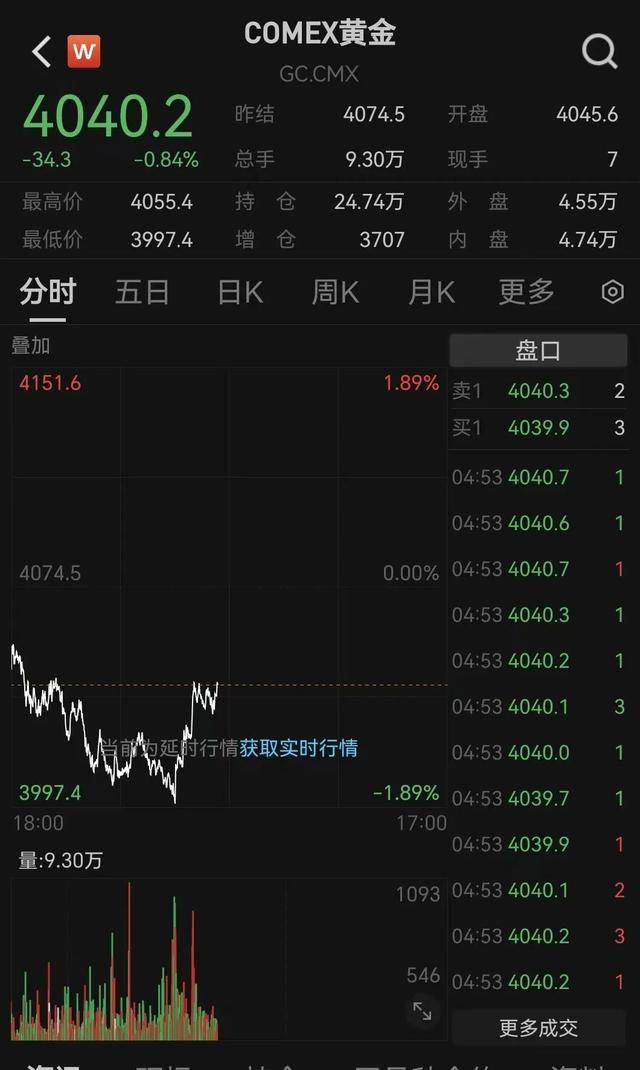
Core Viewpoint - The gold market experienced significant volatility on November 18, 2025, with spot gold prices dropping below $4000 per ounce before rebounding due to comments from Federal Reserve Governor Waller supporting interest rate cuts [1][3][4] Group 1: Market Movements - Spot gold prices fell to $3998.2 per ounce, marking the first drop below $4000 since November 10 [3] - COMEX gold futures also declined, reaching a low of $3985.6 per ounce, while silver prices fell below $50 per ounce, with a daily drop exceeding 2% [3] - Following Waller's comments, spot gold rebounded nearly $40, closing at $4038.677 per ounce, while COMEX futures recovered above $4040 [3][4] Group 2: Federal Reserve Policy Impact - Recent hawkish statements from several Federal Reserve officials dampened market expectations for interest rate cuts, with the probability of a December cut dropping from 93.7% to 48.6% [3][4] - Waller's dovish remarks emphasized the need for rate cuts to mitigate risks in the labor market, which reignited bullish sentiment in the gold market [4][5] Group 3: Long-term Outlook - Despite short-term volatility, the long-term bullish outlook for gold remains intact, supported by central bank gold purchases and geopolitical risks [4][6] - Central banks are expected to continue significant gold purchases, with 800 tons acquired in the first three quarters of 2024, a 34% year-on-year increase [4] - Analysts predict gold prices could rise to $4900 by the end of 2026, driven by ongoing demand from both central banks and private investors [4] Group 4: Upcoming Economic Data - The upcoming non-farm payroll report and unemployment rate will be critical for the gold market, as strong employment data could delay rate cuts, while weak data may boost gold prices [5][6] - Other significant events, such as the October CPI data and the European Central Bank's interest rate decision, will also impact the gold market [6]
爆雷倒计时!人均11万美元!美国国债压垮每个家庭,经济定时炸弹正在嘀嗒作响
Sou Hu Cai Jing· 2025-11-20 07:02
Core Viewpoint - The article draws a parallel between the fiscal challenges faced by ancient Rome and the current economic situation in the United States, highlighting the tension between a robust GDP and soaring national debt. Group 1: GDP Lion - The World Bank projects the U.S. GDP for 2024 to be $29 trillion, which is equivalent to the combined GDP of Germany, Japan, India, and Canada [2] - The U.S. economy is growing at an annual rate of 3%, which is significantly higher than other developed nations like Germany (0.5%), Japan (1%), and the UK (negative growth) [2] - Economist John Kenneth Galbraith warned that while debt can support economic health, excessive debt can lead to destruction [2] Group 2: National Debt Dragon - The U.S. national debt is projected to exceed $38 trillion by October 2025, with a stark increase from $20 trillion in January 2017 to $36 trillion in January 2025 [4] - The U.S. is accruing debt at a rate of $3.8 million per minute, leading to an average debt burden of $110,000 per person [6] - The previous administration's debt reduction strategies have failed, as savings from budget cuts do not offset military spending and other financial obligations [6] Group 3: Economic Imbalance - The current economic imbalance is highlighted by a GDP growth rate of 3% and a national debt growth rate of 5.6%, creating a 2.6 percentage point gap [7] - The debt-to-GDP ratio has surged to 131%, significantly higher than the 55% ratio during the 2000 tech bubble [7] - Harvard economist Carmen Reinhart warns that when national debt exceeds 90% of GDP, each additional percentage point of debt reduces economic growth by 0.02% [7] Group 4: Dollar Dominance Challenges - The U.S. dollar's dominance is threatened by rising yields on 10-year Treasury bonds, which are expected to reach 5.2% by 2025, indicating higher risk premiums demanded by the market [10] - A trend towards de-dollarization is emerging, with countries like Russia and Saudi Arabia moving away from the dollar in trade [12] - The freezing of Russian dollar assets has prompted central banks to secretly divest from U.S. debt [13] Group 5: Historical Lessons - Historical patterns show that excessive debt often leads to the decline of great powers, as seen in the cases of the Spanish Empire, British Empire, and the Soviet Union [15] - Former Federal Reserve Chairman Paul Volcker noted that debt crises build gradually until they overwhelm those who underestimate the risks [15] Group 6: Future Choices - The U.S. faces three potential paths to address its $38 trillion debt: significant cuts to military spending, debt restructuring, or allowing inflation to erode the value of debt [17] - Each option carries the potential to disrupt the existing international order [17]
2026年中国股票策略展望-跃升之后,稳健前行
2025-11-20 02:16
Summary of the 2026 China Equity Strategy Outlook Industry Overview - The report focuses on the **Chinese stock market** and its outlook for 2026, following a strong performance in 2025 where major indices like the MSCI China Index and Hang Seng Index rose over **30%** year-to-date [1][10][11]. Core Insights and Arguments 1. **Market Stability and Growth**: - 2026 is expected to be a year of stabilization after the high returns of 2025, with limited upside potential for indices and moderate earnings growth projected at **6%** [2][15]. - The MSCI China Index is forecasted to trade at a forward P/E ratio of **12-13x**, with a target of **90 points** for December 2026, indicating a **3%** upside from the current levels [2][15]. 2. **Valuation and Earnings Quality**: - The report highlights that the valuation re-rating has already occurred, with a **30%** increase in the past year, suggesting limited room for further upward revaluation [12][15]. - Concerns about the sustainability of corporate earnings are raised, as recent earnings reports show a slight deterioration in the number of companies exceeding expectations [11][15]. 3. **Macroeconomic Factors**: - The Chinese economy is expected to face ongoing deflationary pressures, with real GDP growth projected to slow to **4.8%** in 2026 [12][15]. - Global macroeconomic uncertainties, particularly regarding the U.S. economy, could impact China's growth trajectory [14][15]. 4. **Investment Strategy**: - A "barbell strategy" is recommended, favoring high-quality internet and technology leaders while underweighting sectors like real estate, consumer staples, and energy that are negatively impacted by macroeconomic conditions [3][30]. - Key trading ideas include focusing on stocks benefiting from the "anti-involution" policies and those included in the Hong Kong Stock Connect [3][31]. 5. **Liquidity and Capital Flows**: - The report anticipates continued net inflows into both A-shares and offshore markets, supported by policy measures aimed at stimulating consumption and managing real estate inventories [2][28]. Additional Important Insights - **Geopolitical Considerations**: The report notes that a stable geopolitical environment, particularly in U.S.-China relations, could positively influence market sentiment [22][25]. - **Sector Preferences**: There is a strong emphasis on investing in companies with robust fundamentals and growth prospects, particularly in technology and innovation sectors aligned with China's strategic planning [19][30]. - **Scenario Analysis**: The report outlines a wide range of potential outcomes for the Chinese stock market, with optimistic scenarios suggesting a **30%** upside and pessimistic scenarios indicating a potential **34%** decline [25][26]. Conclusion - The outlook for the Chinese stock market in 2026 is characterized by cautious optimism, with a focus on sustainable growth and selective investment strategies. The anticipated stabilization in market performance, combined with macroeconomic challenges, necessitates a strategic approach to capital allocation in the coming year [1][15][19].

杰富瑞:多项技术指标显示投资人过度悲观,美股将展开反弹行情
Ge Long Hui A P P· 2025-11-20 02:05
Core Viewpoint - Jefferies analyst Michael Toomey indicates that multiple technical indicators suggest that investor sentiment is overly pessimistic, and a rebound in the U.S. stock market is imminent [1] Group 1: Technical Indicators - The put-call ratio for the S&P 500 has surged to a near-term high, reflecting extreme pessimism among investors, as it shows the comparison between the number of put options (hedging tools) and call options (bullish tools) [1] - 17% of technology, media, and telecommunications stocks are showing oversold signals, which typically indicates that the current downtrend may be nearing its bottom, as historical data shows this percentage usually peaks in the low twenties [1] - The bearish sentiment among retail investors has reached a 12-month second-high, with 49.1% of individual investors surveyed by the American Association of Individual Investors (AAII) expressing bearish views, exceeding bullish views by nearly 18 percentage points [1] Group 2: Investor Sentiment - The CNN Fear and Greed Index indicates that investor fear has reached its highest level since the "Liberation Day" tariff storm in April [1] - Toomey cautions that market sentiment is only one reference indicator, and if fundamental conditions deteriorate, such as a hawkish shift from the Federal Reserve, a collapse in the job market, or a decline in corporate profits, the current downtrend may just be the beginning [1]