
贸易

Search documents
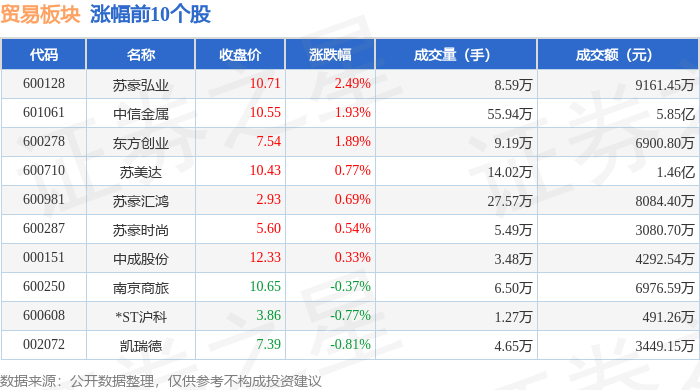
贸易板块10月10日跌0.65%,江苏国泰领跌,主力资金净流出1.57亿元
Zheng Xing Xing Ye Ri Bao· 2025-10-10 08:46
Market Overview - On October 10, the trade sector declined by 0.65%, with Jiangsu Guotai leading the drop [1] - The Shanghai Composite Index closed at 3897.03, down 0.94%, while the Shenzhen Component Index closed at 13355.42, down 2.7% [1] Stock Performance - Jiangsu Guotai (002091) saw a significant decline of 3.44%, closing at 86.8, with a trading volume of 370,600 shares and a turnover of 336 million yuan [2] - Other notable declines included Yiyaton (002183) down 2.20% and Wukuang Development (600058) down 1.59% [2] - In contrast, stocks like Shisuo 5 Xiaov (600128) and CITIC Metal (601061) experienced slight gains of 2.49% and 1.93% respectively [1][2] Capital Flow - The trade sector experienced a net outflow of 157 million yuan from institutional investors, while retail investors saw a net inflow of 137 million yuan [2] - The data indicates that speculative funds had a net inflow of approximately 19.86 million yuan [2] Individual Stock Capital Flow - CITIC Metal (601061) had a net outflow of 25.04 million yuan from institutional investors, while retail investors contributed a net inflow of 988,080 yuan [3] - Jiangsu Guotai (002091) faced a significant net outflow of 66.22 million yuan from institutional investors [3] - Stocks like Oriental Chuangye (600278) and Shisuo Huihong (600981) showed mixed capital flows, with retail investors contributing positively [3]


柬埔寨发布《国家战略发展计划》预计2025年经济增速为5%
Shang Wu Bu Wang Zhan· 2025-10-10 08:42
Core Insights - The Cambodian government has officially released the "National Strategic Development Plan," projecting a slowdown in economic growth to 5% in 2025, down from 6% in 2024 [1] - The primary reasons for this slowdown are external factors, including border conflicts with Thailand and increased tariffs from the United States, which imposed a 19% tariff on Cambodian exports starting August 1 [1] - Despite these challenges, Cambodia's per capita GDP is expected to rise steadily, from $2,520 in 2023 to nearly $3,000 in 2025 [1] Economic Growth Projections - The industrial sector, primarily driven by garment, non-garment manufacturing, and construction, is projected to grow by 7.1% [1] - The services sector, which includes tourism, transportation, telecommunications, trade, and real estate, is expected to grow by 3.8% [1] - The agricultural sector is anticipated to see a growth rate of 0.9% [1]
关税重压下出口受挫 日本第三季度经济或陷入萎缩
Zhi Tong Cai Jing· 2025-10-10 06:37
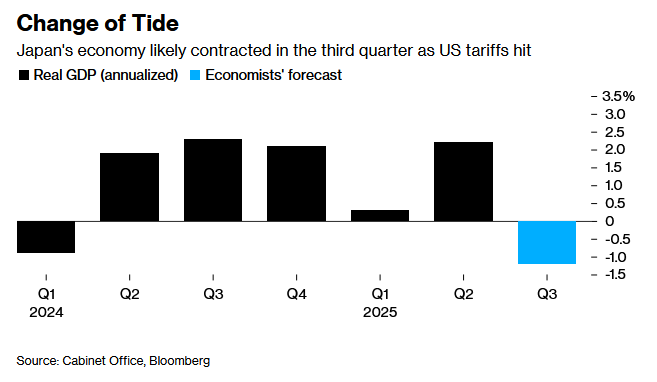
Group 1 - Japan's economy is expected to contract in the third quarter after five consecutive quarters of growth, primarily due to the impact of U.S. tariffs on exports [1][4] - Economists predict a year-on-year decline of 1.2% in Japan's GDP for the third quarter, a significant shift from previous expectations of a 0.1% increase [1][4] - The third quarter GDP data is scheduled to be released on November 17 [1] Group 2 - The potential economic downturn may provide support for the economic stimulus plan proposed by the new Liberal Democratic Party president, Sanae Takaichi [4] - Takaichi faces various economic challenges, including inflation pressures and trade tensions, with a focus on consolidating political support [4] - The Bank of Japan may slow down its interest rate hikes in response to the economic slowdown, with a monetary policy decision expected on October 30 [4] Group 3 - Economists forecast a 4% quarter-on-quarter decline in Japan's exports for the third quarter, worsening from a previous estimate of 3.1% [4] - Exports to the U.S. have seen significant declines, despite a trade agreement that fixed the tariff rate at 15%, which is still higher than before [4] - Many Japanese companies are reportedly lowering prices to absorb some of the tariff impacts and alleviate the burden on consumers [4] Group 4 - Private consumption in Japan is expected to grow by 0.5%, benefiting from wage increases resulting from spring labor negotiations [5] - However, core inflation remains significantly above the Bank of Japan's 2% target, continuing to erode household purchasing power [5]
德国政府预计2025年本国经济小幅回升
Xin Hua She· 2025-10-09 14:13
Group 1 - The German government forecasts a modest economic growth of 0.2% in 2025, with a potential acceleration starting in 2026, despite external uncertainties such as U.S. trade policies [1][2] - The current economic recovery in Germany is driven by domestic demand rather than foreign trade, particularly through consumption and public investment [1] - High government spending, including infrastructure and defense investments, will be crucial for economic growth, contingent upon the implementation of structural reforms [1] Group 2 - After two consecutive years of economic contraction in 2023 and 2024, Germany experienced a quarter-on-quarter growth of 0.3% in the first quarter of this year [2] - The imposition of tariffs by the U.S. on imported goods, effective from April, led to a quarter-on-quarter decline of 0.3% in the second quarter, with expectations of continued weak performance in the third quarter [2] - A joint forecast by five major German economic research institutions indicates that U.S. tariffs will severely impact the global economy, suppressing Germany's export growth and contributing to the projected 0.2% growth in 2025 [2]
【环球财经】德国政府预计2025年本国经济小幅回升
Xin Hua She· 2025-10-09 13:29
Core Viewpoint - The German government forecasts a modest economic growth of 0.2% in 2025, with potential acceleration starting in 2026, but faces external uncertainties, particularly from U.S. trade policies [1][2]. Economic Growth Projections - The German economy is expected to recover gradually, with growth driven by domestic demand rather than foreign trade, particularly through consumption and public investment [1]. - Economic growth is projected to strengthen from the end of this year into early next year, with a potential growth rate of 1.3% in 2026 [1]. Government Spending and Structural Reforms - Future economic growth will heavily rely on high government spending, including infrastructure and defense investments, contingent upon the implementation of structural reforms [1]. Impact of U.S. Trade Policies - The imposition of tariffs by the U.S. on imports, particularly on automobiles, has negatively impacted the German economy, leading to a contraction in the second quarter of this year [2]. - The joint forecast from five major German economic research institutions indicates that external demand weakness will suppress export growth, contributing to the anticipated 0.2% growth in 2025 [2].
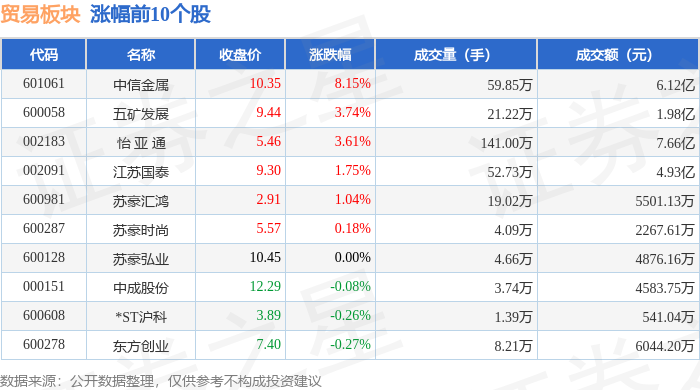
贸易板块10月9日涨1.38%,中信金属领涨,主力资金净流出2177.9万元
Zheng Xing Xing Ye Ri Bao· 2025-10-09 09:03
Market Overview - On October 9, the trade sector rose by 1.38%, with CITIC Metal leading the gains [1] - The Shanghai Composite Index closed at 3933.97, up 1.32%, while the Shenzhen Component Index closed at 13725.56, up 1.47% [1] Stock Performance - CITIC Metal (601061) closed at 10.35, with an increase of 8.15% and a trading volume of 598,500 shares, totaling a transaction value of 612 million yuan [1] - Other notable performers include: - Wukuang Development (600058) at 9.44, up 3.74% [1] - Yiyaton (002183) at 5.46, up 3.61% [1] - Jiangsu Guotai (002091) at 9.30, up 1.75% [1] - Conversely, stocks like Nanjing Commercial Travel (600250) and Kairuide (002072) saw declines of 3.69% and 2.23%, respectively [2] Capital Flow - The trade sector experienced a net outflow of 21.78 million yuan from institutional investors, while retail investors saw a net inflow of 17.51 million yuan [2] - The capital flow for key stocks includes: - Yiyaton (002183) with a net inflow of 27.76 million yuan from institutional investors [3] - Wukuang Development (600058) with a net inflow of 18.57 million yuan [3] - CITIC Metal (601061) had a net outflow of 2.33 million yuan from retail investors [3]


【涨知识】手续费企业所得税税前扣除知多少?
蓝色柳林财税室· 2025-10-09 01:35
欢迎扫描下方二维码关注: 申税小微有话说: 在企业日常经营中,手续费支出十分常见,小到银行转账手续费,大到中介服务佣金,这类支出能否在企业所得税税前扣除? 扣除限额多少?直接影响企业税务成本。 今天申税小微就结合最新政策,从" 常规行业扣除标准""特殊情形扣除规则""政策依据 "三方面,帮大家理清手续费税前扣除 的关键要点。 01 常规行业扣除标准(按行业分类) 扣除限额 :与合法中介机构/个人签订协议的, 按协议确认收入金额 的5%计算限额 , 超限额部分不得扣除。 举例 :某贸易公司委托中介促成1000万元合同,支付60万元手续费。扣除限额=1000×5%=50万元,超出的10万元无法税 前扣除。 注意 :需通过转账支付(委托个人除外), 现金支付不可扣除 ;发行股票支付的 承销手续费也不可扣除。 扣除限额: 按当年全部保费收入扣除退保金等后的18%计算限额, 超限额部分可结转以后年度扣除 (区别于一般企 业"当年不扣")。 举例 :某保险公司当年保费收入扣除退保金后余额5000万元,支付手续费950万元。扣除限额=5000×18%=900万元,超 出的50万元可结转次年扣除。 扣除 场景 :仅针对" 委 ...

8月智利国内贸易增长4.8%
Shang Wu Bu Wang Zhan· 2025-10-08 17:28
Core Insights - Chile's trade activity index (IAC) increased by 4.8% year-on-year in August, driven by a significant rise in online and mail-order shopping [1] Retail Trade - Retail trade excluding automobiles and motorcycles grew by 6% year-on-year [1] - Supermarket sales increased by 3%, with a cumulative growth of 1.9% from January to August this year [1] Wholesale Trade - Wholesale trade excluding automobiles and motorcycles saw a year-on-year growth of 3.4% [1] Automotive Sector - The automotive and motorcycle repair sector, along with retail and wholesale trade, experienced a year-on-year growth of 5.1% [1] E-commerce - Retail e-commerce grew by 16.1% year-on-year, with a cumulative growth of 13.4% from January to August this year [1]
美拿航权要稀土?中国狂抛1829亿美债后囤金,全球央行跟风调整
Sou Hu Cai Jing· 2025-10-05 04:28
Group 1: U.S.-China Relations and Rare Earths - U.S. Congress member threatens to restrict Chinese flights in the U.S. if China does not supply rare earths, highlighting U.S. reliance on China for 70% of global production and 90% of refining capacity [2] - In June, China suspended rare earth exports, increasing the risk of production line shutdowns in the U.S. and Europe [2] - U.S. legislative pressure increased in July, with the Biden administration banning Chinese rare earth magnets for defense applications by 2027 [2] Group 2: China's Financial Strategy - In July, China reduced its holdings of U.S. Treasury bonds by $25.7 billion, the largest monthly decrease in two years, bringing total holdings to $730.7 billion, the lowest since December 2008 [3] - From April 2022 to now, China has reduced its U.S. Treasury holdings by over $586 billion, a 45% decline [3] - China is diversifying its reserves away from the dollar, reducing its dollar share from 79% in 2015 to 58% by June 2025 [3] Group 3: Gold Reserves and Global Trends - China's gold reserves increased to 2,298 tons by August 2025, marking a continuous buying trend for 10 months [4] - The global trend of de-dollarization is accelerating, with countries like the EU and India increasing their use of alternative currencies for trade [5] - Central banks globally purchased 415 tons of gold in the first half of 2025, with 43% planning to continue buying [5] Group 4: U.S. Economic Impact - U.S. tariffs on rare earths have led to increased costs for American manufacturers, affecting electric vehicle production and consumer prices [8] - The U.S. is facing challenges in establishing alternative supply chains for rare earths, with experts suggesting it will take 5 to 10 years [2][8] - The U.S. Treasury's bond market is experiencing fluctuations, with the ten-year yield at 4.18% as of late September [10]

下一个“黑天鹅”会是11月5日吗?
Hua Er Jie Jian Wen· 2025-10-04 10:39
Core Viewpoint - The upcoming Supreme Court hearing on November 5 regarding the legality of tariffs imposed by the Trump administration could significantly reshape presidential power and economic policy in the U.S. [1] Group 1: Legal Basis and Implications - The core of the judicial confrontation revolves around the Trump administration's invocation of the International Emergency Economic Powers Act (IEEPA) from 1977, which grants the president broad powers in response to a "national emergency" [2] - The tariffs implemented on April 2 have raised the effective tariff rate on consumer goods in the U.S. to 17.9%, the highest level since 1934 [2] Group 2: Government's Position - The White House expresses confidence in the legality of the tariffs, with trade advisor Peter Navarro providing three main arguments: trade deficits represent an "unusual and extraordinary" external threat, the IEEPA does not explicitly exclude tariffs as a "emergency" tool, and these tariffs will undergo periodic congressional review [3] Group 3: Legal Community's Perspective - The mainstream legal opinion, including many conservative scholars, argues that the government's legal basis is weak, with a high likelihood of losing the case, primarily based on the "major-questions doctrine" which requires explicit congressional or constitutional authorization for significant economic and political actions [4][5] Group 4: Market Reactions and Economic Consequences - The outcome of the Supreme Court case is viewed as a "Damocles sword" over Wall Street, with potential for two drastically different futures depending on the ruling [6] - If the tariffs are deemed illegal, the White House may need to refund billions in tariffs, impacting fiscal policy, and the unilateral economic strategy of the Trump administration could be fundamentally undermined [7] - Conversely, a ruling in favor of the Trump administration would greatly expand presidential power, allowing for unilateral economic decisions without congressional approval, potentially leading to market volatility if negative economic indicators coincide with a loss [9]