
信息技术

Search documents
20cm速递|科创综指ETF国泰(589630)涨超1.5%,市场关注科技成长主线回归
Mei Ri Jing Ji Xin Wen· 2025-11-26 06:16
Group 1 - The core viewpoint is that the focus on technological innovation has been increasing, driven by policy guidance and technological breakthroughs, leading to significant expansion in the primary market for technology-related funds [1] - National-level guiding funds and market-oriented VC/PE are increasingly investing in hard technology and AI, with steady growth in fundraising scale and the number of funds [1] - Investment is shifting towards early and mid-stage projects, with exit channels being broadened through mechanisms like science and technology innovation bonds, S funds, and physical stock distribution, enhancing capital turnover efficiency [1] Group 2 - The Guotai ETF (589630) tracks the Science and Technology Innovation Index (000680), with a single-day fluctuation exceeding 20%, reflecting the overall performance of the Sci-Tech Innovation Board [1] - The index comprises stocks from technology innovation enterprises, covering high-growth emerging industries such as information technology, biomedicine, and high-end equipment manufacturing, highlighting the core characteristics of R&D intensity and high technical barriers [1]
北京“十五五”规划建议:完善未来产业投入增长和风险分担机制,培育第六代移动通信、量子科技、生物制造、脑机接口等新增长点
Zheng Quan Shi Bao Wang· 2025-11-25 23:35
Core Viewpoint - The Beijing Municipal Committee has proposed the development of high-precision and advanced industries as part of the 15th Five-Year Plan, emphasizing the enhancement of traditional industries and the growth of emerging sectors [1] Group 1: Industry Development - The plan aims to strengthen the foundation of the real economy by promoting the quality upgrade of key industries and expanding the advantages of clusters in new-generation information technology and healthcare [1] - New industries such as artificial intelligence, advanced green energy, and low-carbon environmental protection will be cultivated [1] Group 2: Innovation and Technology - The implementation of an industrial innovation project is proposed to facilitate the large-scale application of new technologies, products, and scenarios [1] - Strategic emerging industries like integrated circuits, robotics, smart manufacturing, and aerospace technology will be accelerated [1] Group 3: Future Industry and Risk Management - The plan includes mechanisms for increasing investment in future industries and sharing risks, focusing on new growth points such as sixth-generation mobile communication, quantum technology, biomanufacturing, and brain-computer interfaces [1] - A comprehensive safety risk assessment, early warning, and response mechanism will be established around key industrial chains to enhance the resilience and security of supply chains [1] Group 4: Quality and Brand Building - There is an emphasis on improving the domestic substitution of key equipment, software, processes, and materials to enhance the supply security of strategic resources [1] - Strengthening quality and brand construction is highlighted as a crucial aspect of the development strategy [1]

科技企业踊跃上市凸显创新活力
Zheng Quan Ri Bao· 2025-11-25 16:48
Core Insights - The technology attributes of China's capital market have been increasingly highlighted since November, with a surge in technology companies going public and preparing for IPOs [1] Group 1: Technology Companies Going Public - The A-share market has seen the emergence of a "domestic GPU first stock," Moer Thread Intelligent Technology, which opened for subscription on November 24 at a price of 114.28 yuan per share [2] - As of November 25, 96 companies have gone public in the A-share market this year, with 64 new stocks issued on the Sci-Tech Innovation Board, Growth Enterprise Market, and Beijing Stock Exchange, raising over 56.2 billion yuan [2] - Newly listed technology companies are focusing on strategic emerging industries such as new generation information technology, new materials, biotechnology, and high-end equipment manufacturing [2] Group 2: Unlisted Technology Leaders Preparing for IPOs - Unlisted technology leaders are actively advancing their IPO preparations, with Yushu Technology entering the counseling acceptance phase for its IPO [3] - The listing cases of leading technology companies set benchmarks for the industry, encouraging more firms to seek financing through technological innovation [3] Group 3: Policy Support for Technology Companies - The surge in technology company IPOs is supported by a continuous enhancement of the policy framework and institutional innovation, shifting the listing evaluation criteria from "profit-oriented" to "technology-oriented" [3][4] - The China Securities Regulatory Commission has introduced several policy documents aimed at providing a financial service system that aligns with the entire chain of technological innovation activities [4] - Local governments are also actively promoting the listing of technology companies, with Zhejiang Province setting a goal for over 80% of new listed companies to be in the technology sector by 2027 [4] Group 4: Market Narrative Shift - The policy tilt from central and local governments allows technology companies to access capital markets earlier, shifting the market narrative from "scale expansion" to "hardcore innovation and industrial upgrading" [5]
张斌:AI等高度市场化领域竞争力有望进一步释放
2 1 Shi Ji Jing Ji Bao Dao· 2025-11-25 07:56
Core Insights - The conference highlighted the importance of both supply and demand capabilities in driving China's macroeconomic growth, with a focus on industrial upgrades and market expansion [1][2] - The automotive industry has shown significant progress, indicating a qualitative improvement in China's overall industrial capacity, with domestic brands gaining market share both locally and internationally [2] - The service sector has also demonstrated impressive growth, supported by advanced logistics and technology infrastructure, showcasing China's unique service innovation [2] Supply Capability - China's supply-side improvements are characterized by high market competition and openness, which drive innovation and resource allocation [2] - Key factors contributing to supply capability enhancement include market competition, openness to global resources and technology, large-scale market advantages, and robust infrastructure [2] - The manufacturing, high-end agriculture, and modern service sectors are highlighted as areas where China has developed competitive advantages that continue to strengthen [2] Demand Capability - There is significant untapped growth potential in sectors such as education, healthcare, entertainment, and public services, which could enhance consumption and industrial upgrades [2] - Since the implementation of the "926" policy, there have been positive changes in domestic demand, with macro policies showing increased responsiveness and effectiveness [3] - Future economic growth is expected to be supported by sustained macro policies, stable international relations, and competitive advantages in highly marketized sectors like AI and new energy [3] Economic Outlook - The overall economic outlook for 2026 is optimistic, driven by advancements in AI commercialization, international expansion of manufacturing, and effective macroeconomic policy adjustments [3] - The combination of various positive signals, including new project construction and technological breakthroughs in sectors like electric vehicles, is expected to enhance China's global market competitiveness [3]
降息暂缓与AI泡沫担忧下全球普跌
Haitong Securities International· 2025-11-25 06:55
Market Performance - Global markets experienced a widespread decline, with MSCI Global down by 2.1%, MSCI Developed Markets down by 2.0%, and MSCI Emerging Markets down by 3.0% [3][7][30] - In the developed markets, the UK FTSE 100 showed the strongest performance with a decline of 1.6%, while the South Korean Composite Index was the weakest, down by 3.9% [7][30] - Among emerging markets, India's Sensex 30 was the best performer, up by 0.8%, while the ChiNext Index in China fell by 6.2% [7][30] Trading Sentiment - The short-selling ratio in Hong Kong continued to rise, reaching 17.7%, indicating a historical low in investor sentiment [18][22] - North American manager positions decreased, with the NAAIM manager exposure index dropping to 86.6%, reflecting a high historical sentiment [18][22] Earnings Expectations - Hong Kong's earnings expectations for 2025 were revised upward, with the Hang Seng Index's EPS forecast increasing from 2077 to 2085, particularly in the materials sector [61] - In the US, the S&P 500's EPS forecast for 2025 remained stable at 272, with the technology sector seeing the most significant upward revision [61] - European earnings expectations remained unchanged, with the STOXX 50's EPS forecast for 2025 holding steady at 333 [61] Economic Outlook - Economic sentiment in China and the US showed signs of marginal improvement, with the Citigroup Economic Surprise Index for the US rising due to mixed non-farm payroll data and Fed rate cut expectations [3][61] - The European Economic Surprise Index significantly declined, influenced by geopolitical risks and political instability [3][61] Fund Flows - The market is increasingly focused on the Fed's interest rate cut expectations, with futures indicating a 0.63 rate cut anticipated by the end of the year [48][50] - Global liquidity trends showed significant inflows into the US, China, India, Japan, and South Korea, with Hong Kong experiencing a net inflow of 56 billion HKD [57][60]
港股市场回购统计周报2025.11.17-2025.11.23-20251125
Zhe Shang Guo Ji Jin Rong Kong Gu· 2025-11-25 06:01
Group 1: Market Overview - The total number of companies repurchasing shares this week is 73, an increase of 17 from the previous week[10] - The total repurchase amount for the week is HKD 4.87 billion, up from HKD 3.96 billion last week[10] - Tencent Holdings (0700.HK) leads with a repurchase of HKD 2.54 billion, followed by Xiaomi Group (1810.HK) with HKD 811 million[10] Group 2: Industry Insights - The majority of repurchase amounts are concentrated in the Information Technology, Industrial, Consumer Discretionary, Consumer Staples, and Energy sectors[13] - The Information Technology sector has the highest number of repurchasing companies, with 21 firms participating[13] - The Healthcare sector ranks second with 18 companies engaging in share buybacks[13] Group 3: Individual Company Data - China Feihe (6186.HK) repurchased shares worth HKD 185 million, accounting for 0.48% of its total share capital[14] - Yum China (9987.HK) repurchased shares worth HKD 233 million, representing 0.17% of its total share capital[14] - Kuaishou Technology (1024.HK) repurchased shares worth HKD 105.98 million, which is 0.04% of its total share capital[14]
港股市场策略周报-20251125
Zhe Shang Guo Ji· 2025-11-25 05:54
Market Performance Review - The Hong Kong stock market experienced a "Beta-style" decline this week, with major indices and style indices falling together, indicating a significant contraction in market risk appetite. The Hang Seng Composite Index, Hang Seng Index, and Hang Seng Tech Index fell by -5.37%, -5.09%, and -7.18% respectively [3][15] - The market sentiment remains cautious, with a notable increase in funds adopting a wait-and-see approach, leading to a weak consolidation phase [3][15] Macroeconomic Environment - In October, fiscal revenue showed strong performance, while fiscal expenditure appeared weak, indicating a potential lack of momentum in fiscal policy towards the end of the year. The overall public budget revenue for the first ten months was 186,490 billion yuan, a year-on-year increase of 0.8% [4][46] - The expectation for a U.S. interest rate cut has increased, with the probability of a 25 basis point cut in December approaching 70%. Southbound capital continued to see net inflows, increasing by 55.8% compared to the previous week [4][45] Sector Outlook - The domestic economy is still in a bottoming phase, with weak economic data. Policy focus is expected to be on technological innovation and expanding domestic demand. The market sentiment is cautious, reflecting a phase of high-level corrections [5][46] - The report favors sectors that are relatively prosperous and benefit from policy support, such as new energy, innovative pharmaceuticals, and AI technology. Additionally, low-valuation state-owned enterprises and local Hong Kong banks, telecommunications, and utility dividend stocks are also seen as favorable due to their relative independence from the economic cycle and benefits from the interest rate cut [5][46] Buyback Statistics - The buyback market has shown significant activity this week, with 73 companies participating, an increase of 17 from the previous week. The total buyback amount reached 4.87 billion HKD, a substantial increase from the previous week [29][32] - Tencent Holdings led the buyback activity with 2.543 billion HKD, followed by Xiaomi Group with 811 million HKD [29][27] Southbound Capital Statistics - The top net buying companies this week included Xiaomi Group (40.31 billion HKD), China National Offshore Oil Corporation (31.73 billion HKD), and Industrial and Commercial Bank of China (20.45 billion HKD) [36] - Conversely, Alibaba (63.35 billion HKD) and other consumer-related stocks saw significant net selling [37]
谷歌VS英伟达!AI芯片战白热化,港股芯片强势跑赢
Xin Lang Ji Jin· 2025-11-25 03:50
Group 1: AI Chip Market Dynamics - The explosive growth in AI computing demand and Nvidia's dominance in the supply chain mark a more competitive phase in the AI chip war, with Google promoting its TPU as a customized chip offering cost, performance, and energy efficiency advantages [1] - Google's seventh-generation TPU, "Ironwood," has been tested with select customers since April and is set for commercial launch in the coming weeks [1] Group 2: Market Performance and Investment Opportunities - On November 25, the AI market surged, with the Hang Seng Technology Index rising nearly 2%, and A-share chip representatives like the Sci-Tech Innovation Board chip index increasing by 1.57% [1] - The first ETF focused on the Hong Kong chip industry, tracking a 70% hardware and 30% software index, saw its price rise nearly 4%, with a trading volume exceeding 700 million CNY [3] - Goldman Sachs indicates that the AI-driven rise in Chinese stocks is not a bubble, as tech companies have room to enhance valuations and profitability through AI applications, attracting global investors [3] Group 3: Emerging AI Applications - Ant Group's newly launched multimodal AI assistant "Lingguang" achieved over 2 million downloads within six days, reflecting the strong market demand for high-quality AI products and the accelerating pace of AI application development in China [2]




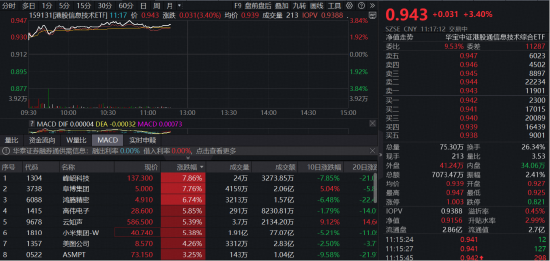
万通发展(600246.SH):数渡科技已与市场上多家主流CPU厂商和GPU厂商进行兼容性适配
Ge Long Hui· 2025-11-24 08:21
格隆汇11月24日丨万通发展(600246.SH)在互动平台表示,数渡科技已与市场上多家主流CPU厂商和 GPU厂商进行兼容性适配,目前暂未完成与昇腾的适配。 ...

挑起贸易战损人也伤己 美国自己也开始疼了
Ren Min Ri Bao Hai Wai Ban· 2025-11-24 04:09
Group 1: Tariff Increase and Industry Impact - The U.S. government is considering raising tariffs on $200 billion worth of Chinese imports from 10% to 25%, with public commentary extended to September 5 [1] - The technology and chemical industries are shocked by the proposed tariff increase, with the Information Technology Industry Council calling it "irresponsible and counterproductive" [2] - The American Retail Federation expressed anger, stating that the new tariffs are a reckless bet on a trade policy that is already causing harm [2] Group 2: Agricultural Sector Struggles - The trade war has led to a significant decrease in demand for U.S. meat products, resulting in a backlog of nearly 1.2 billion kilograms of meat in warehouses [2] - U.S. soybean prices have dropped approximately 15% due to trade concerns, impacting farmers' profits by 8% to 10% [2] - Goldman Sachs warned that the trade war could reduce earnings for several U.S. companies by 15% due to decreased export revenues and increased costs [2] Group 3: Consumer Impact and Price Increases - Tariffs are expected to raise costs for manufacturers, which will ultimately be passed on to consumers, leading to increased prices for various goods [4] - Companies like Polaris Industries have already raised prices to offset anticipated tariff costs, indicating a direct impact on consumer prices [5] - Analysts predict that the trade conflict could lead to a loss of 250,000 jobs and an average increase of $210 in expenses for American households [5] Group 4: Economic Outlook and Political Implications - Concerns are growing about the potential economic slowdown due to the trade war, which could pose a political challenge for the Republican Party ahead of the midterm elections [6][7] - Predictions indicate that a 10% increase in tariffs could result in a 2.5% decrease in U.S. GDP over three years, with a full-blown trade war potentially doubling this impact [7] - The ongoing trade tensions are disrupting global supply chains and increasing uncertainty, which could push the economy towards recession [7][8]