
乘用车

Search documents
平均燃料消耗量同比下降12.4%!2024年中国乘用车企业“双积分”成绩单出炉
中汽协会数据· 2025-07-08 08:41
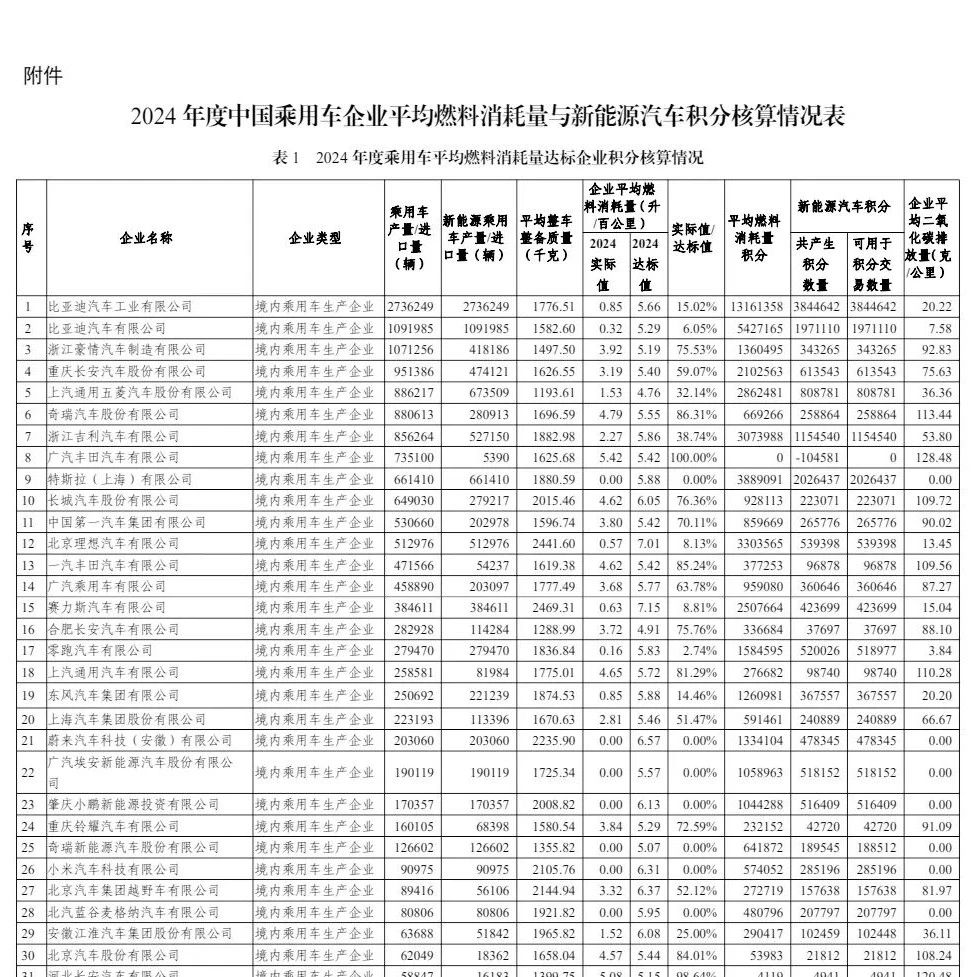
导 读 工业和信息化部近日公告2024年度中国乘用车企业平均燃料消耗量与新能源汽车积分情 况。2024年度,中国境内117家乘用车企业共生产/进口乘用车2318.9万辆(含新能源乘用 车,不含出口乘用车),WLTC工况下行业平均燃料消耗量为3.31升/100公里,同比下降 12.4%。 中华人民共和国工业和信息化部公告 附件:2024年度中国乘用车企业平均燃料消耗量与新能源汽车积分核算情况表 工业和信息化部 商务部 海关总署 市场监管总局 2025年6月30日 2025年 第14号 根据《乘用车企业平均燃料消耗量与新能源汽车积分并行管理办法》(工业和信息化部 财政部 商务部 海关总署 质检总局令 第44号)、《关于修改〈乘用车企业平均燃料消耗量与 新能源汽车积分并行管理办法〉的决定》(工业和信息化部 财政部 商务部 海关总署 市场监 管总局令 第53号)和《关于修改〈乘用车企业平均燃料消耗量与新能源汽车积分并行管理办 法〉的决定》(工业和信息化部 财政部 商务部 海关总署 市场监管总局令 第64号)要求, 现将2024年度中国乘用车企业平均燃料消耗量与新能源汽车积分情况予以公告。 2024年度,中国境内117 ...

乘联分会:6月新能源乘用车市场零售同比增长29.7%
Di Yi Cai Jing· 2025-07-08 08:36
6月新能源乘用车市场零售111.1万辆,同比增长29.7%,环比增长8.2%;1-6月累计零售546.8万辆,增长 33.3%。 六、6月新能源车国内零售渗透率升到53.3%,呈现出由报废更新、以旧换新叠加新能源免征购置税 等,普惠政策托底背景下的新能源强势增长; 七、2025年1-6月自主燃油乘用车出口129万下降13%,自主新能源出口81万增长109%,新能源占自主出 口38.6%。虽然年初自主品牌在俄罗斯主动去库存,对俄罗斯出口下降,但自主品牌的俄罗斯市场份额 依旧保持55%以上高位,考虑到俄罗斯汽车工业现状,中国汽车对俄出口还会恢复到一定水平。 7月8日,乘联分会发文,2025年6月全国乘用车市场零售208.4万辆,同比增长18.1%,环比增长7.6%。 今年累计零售1090.1万辆,同比增长10.8%。前几年国内车市零售呈现"前低后高"的走势,今年6月零售 较2022年6月194万的最高水平增长7%,呈现超强增长态势。 新能源汽车方面,6月新能源乘用车市场零售111.1万辆,同比增长29.7%,环比增长8.2%;1-6月累计零 售546.8万辆,增长33.3%。 三、今年直观的降价价格战稍显温和,但 ...
反内卷行业比较:谁卷?谁赢?
Huachuang Securities· 2025-07-08 08:30
Investment Rating - The report does not explicitly provide an investment rating for the industry analyzed [2]. Core Insights - The report emphasizes the focus on "supply-side optimization" and "anti-involution" competition, with potential policy implementations expected in the second half of the year [3][8]. - Key industries identified for "anti-involution" include those with high inventory, high CAPEX, low capacity utilization, and low price levels, particularly in sectors such as chemicals, non-ferrous metals, coal, steel, and various manufacturing and consumer goods [3][11][13]. - The report outlines five perspectives for identifying potential beneficiaries of the "anti-involution" policies, including state-owned enterprise (SOE) share, industry concentration, tax revenue impact, labor intensity, and price elasticity post-capacity reduction [5][6]. Summary by Relevant Sections Policy Focus - The report highlights that the Central Financial Committee meeting on July 1 emphasized supply-side optimization and "anti-involution" competition, referencing past supply-side reforms from 2015-2016 as a model for future policy actions [3][8]. Key Industry Characteristics - Industries with high inventory, high CAPEX, low capacity utilization, and low price levels are targeted for policy intervention. These include: - Cyclical industries: Chemicals (chemical products, rubber, non-metallic materials), non-ferrous metals (energy metals), coal, and steel (common steel, steel raw materials) [3][11]. - Manufacturing: Electric new (motors, grid equipment, batteries, photovoltaics), machinery (automation equipment), automotive (passenger vehicles), military electronics, and construction [3][11]. - Consumer goods: Home appliances (appliance components), food and beverage (food processing, liquor, snacks) [3][11]. Five Perspectives for Industry Selection - **State-Owned Enterprise (SOE) Share**: Industries with higher SOE shares are expected to have stronger policy execution efficiency, including coal, common steel, cement, glass, and consumer sectors like liquor [3][5]. - **Industry Concentration**: Higher concentration industries are more likely to achieve supply clearing through stronger pricing power and quicker policy response, particularly in energy metals, non-metallic materials, and consumer goods like liquor [3][5]. - **Tax Revenue Impact**: Industries with lower tax revenue contributions will have a smaller impact on local finances during capacity reduction, focusing on sectors like glass, energy metals, and common steel [3][5]. - **Labor Intensity**: Industries with lower labor intensity will have a reduced impact on employment during capacity reduction, including non-metallic materials, chemical products, and energy metals [3][5]. - **Price Elasticity Post-Capacity Reduction**: Industries with a strong correlation between asset turnover and gross margin are expected to see greater price and margin expansion post-capacity reduction, including glass, chemical products, and energy metals [3][5]. Potential Beneficiary Industries - The report identifies several industries as potential beneficiaries of the "anti-involution" policies based on the five perspectives, including: - Coal mining, common steel, precious metals, glass fiber, coke, energy metals, steel raw materials, cement, chemical products, non-metallic materials, and various manufacturing sectors [6][7].
乘联分会:6月乘用车出口48.0万辆 同比增长23.8%
news flash· 2025-07-08 08:14
乘联分会数据显示,6月 乘用车出口(含整车与CKD)48.0万辆,同比增长23.8%,环比增长7.3%,1-6 月乘用车厂商出口247.9万辆,同比增长6.8%。6月 新能源车占出口总量的41.1%,较同期增加17个百分 点。6月自主品牌出口达到41万辆,同比增长28%,环比增长10%;合资与豪华品牌出口6.2万辆,同比 下降9%。 ...
【周观点】6月第4周乘用车环比+3.9%,继续看好汽车板块
东吴汽车黄细里团队· 2025-07-08 08:10
Core Viewpoints - The automotive sector remains optimistic, focusing on three main lines: dividends, smart technology, and robotics [5][11][6] Weekly Review Summary - In the fourth week of June, 569,000 compulsory insurance policies were issued, representing a week-on-week increase of 3.9% and a month-on-month increase of 24.2% [9][46] - The performance of sub-sectors this week ranked as follows: SW motorcycles and others (+5.1%) > SW commercial passenger vehicles (+4.4%) > SW passenger vehicles (+0.4%) > SW automobiles (+0.1%) > SW commercial freight vehicles (0.1%) > SW auto parts (-0.7%) [9][21] Industry Core Changes - The Xiaopeng G7, a mid-size SUV, is positioned for family tech aesthetics, with pricing starting at 195,800 yuan for the 602 km Max version and 205,800 yuan for the 702 km Max version. It is the world's first electric vehicle with L3 computing power [4][10] - Baolong Technology and Weifu High-Tech's joint venture completed its business registration on July 1, 2025 [4][10] - Pony.ai announced the launch of Robotaxi road testing in Luxembourg [4][10] - WeRide's W5 autonomous logistics vehicle has been approved for road testing in Guangzhou [4][10] Market Focus - The market's attention this week was on several key events: Xiaopeng's G7 launch, Yutong Bus's production and sales data exceeding expectations, Pony.ai's Robotaxi testing, and the mass production of G1 by Junpu and Zhiyuan [5][11] Current Sector Configuration - The company suggests that "only by adhering to technological innovation can the automotive industry avoid internal competition and move towards healthy development." It recommends increasing the allocation weight of dividend-style stocks in the second half of the year [6][11] - Key stocks in the dividend and good pattern line include Yutong Bus, China National Heavy Duty Truck, and auto parts companies like Fuyao Glass and Xingyu Co [7][11] - For the AI smart line, preferred stocks include Xiaopeng Motors, Li Auto, and Xiaomi in Hong Kong, and companies like Seres and BYD in A-shares [7][11] - In the AI robotics line, preferred stocks include Top Group, Junsheng Electronics, and others [7][11] Weekly Stock Performance - The top-performing stocks this week included Chunfeng Power, Aima Technology, Yutong Bus, SAIC Motor, and China National Heavy Duty Truck [9][24]

中国乘联分会:6月狭义乘用车市场零售208.4万辆,同比增18.1%。
news flash· 2025-07-08 08:06
Group 1 - The core viewpoint of the article highlights that the retail sales of narrow passenger vehicles in China reached 2.084 million units in June, representing a year-on-year increase of 18.1% [1]
“价格战”明退暗进?上半年乘用车市场呈现“明稳暗促”新格局
Xin Hua Cai Jing· 2025-07-07 11:57
Core Viewpoint - The Chinese passenger car market has seen a significant reduction in the number of price cuts in the first half of 2025, indicating a shift from price wars to promotional strategies to maintain market share [1][2][3] Price Reduction Trends - In the first half of 2025, the overall price reduction in the passenger car market decreased from an average of 21,000 yuan (14.5% reduction) in January to 15,000 yuan (9.9% reduction) in June [1][2] - The total number of models that experienced price cuts dropped to 91, a 37% decrease compared to 144 models in the same period of 2024 [1][2] Market Segmentation - The price reduction landscape has shown a clear division, with new energy vehicles (NEVs) becoming the primary focus for price adjustments, while the scale of price cuts for traditional fuel vehicles has significantly shrunk [2][3] - In June, among the 14 models that reduced prices, 6 were pure electric vehicles, doubling from 3 in the same month last year [2] Promotional Strategies - Despite the reduction in official price cuts, competition remains intense, with promotional activities becoming the main strategy for car manufacturers to sustain market share [3][4] - In June 2025, the promotional intensity for new energy vehicles was maintained at a relatively high level of 10.2%, while traditional fuel vehicles saw a promotional intensity of 23.3%, indicating ongoing competitive pressure [3][4] High-End Market Dynamics - The luxury car segment experienced a promotional intensity of 26.8% in June, reflecting the significant sales pressure faced by traditional fuel vehicles, particularly among high-end and joint venture brands [4] - The market is expected to continue the trend of "stable overall volume with structural differentiation" in the second half of 2025, influenced by technological advancements, cost control, and stable supply chain and policy environments [4]
乘联分会:中国汽车流通协会乘用车市场信息联席分会秘书处现决定于2025年7月8日(星期二)下午16:00举行“2025年7月乘用车市场分析发布会”。
news flash· 2025-07-07 08:47
乘联分会:中国汽车流通协会乘用车市场信息联席分会秘书处现决定于2025年7月8日(星期二)下午 16:00举行"2025年7月乘用车市场分析发布会"。 相关链接 ...
【会讯】2025年7月乘用车市场分析发布会会议通知
乘联分会· 2025-07-07 08:36
点 击 蓝 字 关 注 我 们 本文全文共 685 字,阅读全文约需 2 分钟 为了便于大家进一步及时掌握全国乘用车市场产销动态,并了解行业政策、价格、二手车、新能源汽 车、商用车市场、上海汽车市场等情况,中国汽车流通协会乘用车市场信息联席分会秘书处现决定举行"2025 年7月乘用车市场分析发布会",本次会议以 网上发布 的形式举行。 会议相关信息如下: 主办方: 中国汽车流通协会乘用车市场信息联席分会 协办方: 搜狐·汽车事业部 上海市信息中心 益普索(中国)咨询有限公司 上海安路勤企业管理咨询有限公司 上海福蓝汽车技术有限公司 广州威尔森信息科技有限公司 科瑞卓信(北京)咨询有限公司 广州市佩升前研市场信息咨询股份有限公司 会议报告网上发布时间: 2025年7月8日(星期二)下午16:00 请大家关注微信订阅号:cpca2024和官网www.cpcaauto.com,届时报告将通过以上两种渠道发布。感谢各 位的支持! 会议报告内容: 1)2025年6月份上海汽车市场上牌情况 ——上海市信息中心; 2)2025年5月价格指数报告 ——福蓝汽车; 会议报告网上发布渠道: 微信订阅号(cpca2024) 官网( ...

华龙证券:智驾平权与人形机器人催化 维持乘用车行业“推荐”评级
智通财经网· 2025-07-07 04:04
Core Viewpoint - The automotive sector is expected to experience significant growth, with a projected increase of 8.91% in the Shenwan Automotive Index by the first half of 2025, outperforming the CSI 300 Index by 8.88 percentage points, driven by advancements in intelligent driving and humanoid robots [1] Group 1: Passenger Vehicle Market Dynamics - The passenger vehicle market is anticipated to accelerate convergence, supported by vehicle replacement policies, with growth in the first half of 2025 [1] - Domestic manufacturers are expected to dominate the mainstream market under 150,000 yuan, while high-end market share still has room for growth [1] - New models in the 200,000-300,000 yuan range, such as Xiaomi's YU7, XPeng's G7, and Li Auto's i6, are expected to have blockbuster potential [1] - The high-end luxury market is well-supplied with models like the AITO M8/9 and the ZunJie S800, indicating continued growth in domestic and new energy vehicle shares [1] - The focus of competition is shifting from price wars to product strength, suggesting a need to monitor efficient players with scale effects and cost control, as well as leading intelligent driving companies [1] Group 2: Export Growth of Domestic Automakers - From January to May 2025, passenger vehicle exports are expected to maintain double-digit growth, with plug-in hybrid models being a significant growth driver [2] - 2025 marks a period of intensive overseas capacity deployment for domestic automakers, focusing on markets like Southeast Asia (represented by Thailand) and Latin America (represented by Mexico and Brazil) [2] - New entrants like Leap Motor and XPeng are set to take their first steps in overseas markets in 2025, with domestic models having pricing advantages that could become a key profit source for automakers [2] Group 3: Intelligent Driving Technology Expansion - The L2 segment is expected to see growth due to domestic chip replacement and economies of scale in core components, with leading players moving from L2 to L3 upgrades [3] - By 2025, sales of mid-to-high-end intelligent driving models are projected to reach 5.5 million units, with a penetration rate of 22.9% [3] - The L4 segment, particularly Robotaxi, is set to expand rapidly due to policy changes and cost reductions in core components, with leading players like Waymo and RoboTaxi receiving substantial orders [3] - The profitability of Robotaxi platforms is anticipated as fleet sizes increase, with a focus on core hardware suppliers, leading intelligent driving companies, and Robotaxi operators [3] Group 4: Humanoid Robot Sector Developments - In 2025, leading humanoid robot manufacturers like Tesla, Figure AI, and UBTECH are actively deploying in industrial scenarios, which is expected to enhance robot capabilities through large-scale data collection [4] - Challenges remain in complex home scenarios regarding cognitive decision-making, endurance, precision operation, and motion control [4] - Attention is recommended on key incremental components such as dexterous hands, lead screws, and sensors [4]
