
奢侈品

Search documents
五年后,500万投哪类资产最值钱?
Sou Hu Cai Jing· 2025-09-12 12:05
Group 1 - The article discusses the performance of seven asset classes over a period of one and a half years, originally valued at 5 million [2][4] - The seven asset classes include stocks (Moutai, Nvidia, Microsoft), cryptocurrencies (Bitcoin), precious metals (gold), real estate (small apartment in Beijing), and luxury goods (LV bags) [2][3] - Nvidia has shown the highest return, with a price increase of 100.1%, while the real estate investment has suffered the most with a decline of 17.9% [5][6] Group 2 - Nvidia is highlighted as a leader in the AI sector, with expectations of a price increase of 50%-100% over the next 3-5 years, despite potential risks from competition and policy changes [10][12] - Bitcoin has experienced significant volatility, with a historical increase of 600% over the past decade, but it faces risks related to regulatory scrutiny and market consensus [13][15] - Microsoft benefits from its Azure cloud services and plans to increase subscription prices, although it faces intense competition from Amazon and Google [16] Group 3 - Gold prices have surged significantly, with a current price of 3644 USD per ounce, driven by factors such as increased money supply and central bank purchases [17][20][21] - Moutai, as a leading domestic liquor brand, has seen a decline in stock price and sales, but it retains a strong market position due to its brand value and cultural significance [23][27] - Luxury goods, particularly LV bags, are generally not good investments due to depreciation, but limited edition items may retain or increase in value [28] Group 4 - Real estate investments in core urban areas like Beijing have shown poor performance, with low rental yields and depreciation concerns [30][32] - The article suggests that each asset class has its own logic and cycle, emphasizing the importance of diversification in investment strategies [34]




国家有关部门正研究海南自贸港免税新政,这些行业有望受益
Di Yi Cai Jing· 2025-09-12 11:08
Group 1 - The Hainan Free Trade Port is set to officially start its full island closure operation in December 2025, attracting significant commercial interest [1] - The Chinese government is researching tax policies for duty-free consumption of certain imported goods by residents, aiming to enhance the attractiveness of the duty-free shopping policy [1][2] - Analysts suggest that the introduction of more favorable duty-free policies will primarily benefit industries with high import tariffs, such as luxury goods, cosmetics, and alcoholic beverages [1][2] Group 2 - Since the implementation of the new duty-free policy in Hainan in July 2020, the shopping amount has reached 195.82 billion yuan, with a significant increase in the number of shoppers and items purchased [2] - The overall tax burden on imported goods has been reduced by approximately 38% due to the duty-free policy, which has encouraged growth in the alcoholic beverage sector [2] - The introduction of new duty-free policies is expected to further stimulate consumption in the beverage market, despite competition from cross-border e-commerce [2][3] Group 3 - Additional favorable policies are anticipated to benefit not only consumer goods industries but also companies requiring large amounts of imported ecological and technological raw materials [3] - The tourism industry, low-altitude economy, and shipping sectors are also expected to gain from the evolving duty-free policies in Hainan [3]
金价,跌了!油价,大跌!
Sou Hu Cai Jing· 2025-09-12 01:47
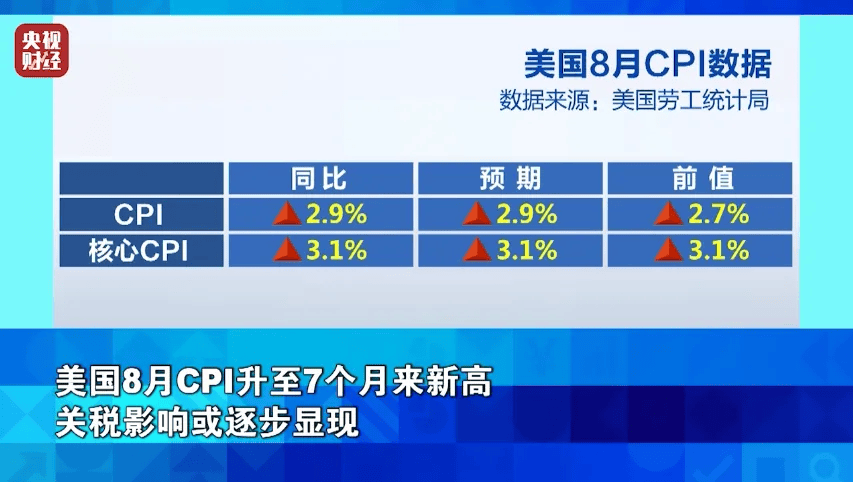
Group 1 - The U.S. inflation data for August met expectations, leading to increased bets on interest rate cuts by the Federal Reserve, with traders anticipating at least two cuts by the end of the year, and possibly three [1] - The U.S. Consumer Price Index (CPI) rose to 2.9% year-on-year in August, the highest level in seven months, while the core CPI remained stable at 3.1% [1] - The European Central Bank decided to keep interest rates unchanged for the second consecutive time, while raising the eurozone economic growth forecast to 1.2% [4] Group 2 - The increase in U.S. crude oil inventories by 3.9 million barrels, contrary to expectations of a decrease, raised concerns about weak demand [6] - International oil prices fell, with light crude futures closing at $62.37 per barrel, down 2.04%, and Brent crude at $66.37 per barrel, down 1.66% [7] - Gold prices experienced a slight decline, closing at $3673.6 per ounce, as investors believed the latest inflation data would not alter the Fed's decision on interest rates [9]
欧美股市:有机构分析称美联储今年至少还有两次降息
Sou Hu Cai Jing· 2025-09-12 00:35
Group 1 - The U.S. inflation data for August met expectations, easing market concerns, while initial jobless claims reached a four-year high, leading traders to increase bets on potential Fed rate cuts [1][2] - The Dow Jones Industrial Average closed above 46,000 for the first time, with all three major U.S. stock indices hitting record highs [1] - The European Central Bank decided to keep interest rates unchanged and raised its economic growth forecast for the Eurozone to 1.2%, indicating a more stable economic outlook [3] Group 2 - The U.S. Consumer Price Index (CPI) rose to 2.9% year-on-year in August, the highest in seven months, while the core CPI remained stable at 3.1% [2] - Concerns about U.S. oil demand emerged as crude oil inventories increased by 3.9 million barrels, contrary to expectations of a decrease [4] - International gold prices experienced a slight decline, closing at $3,673.6 per ounce, as investors anticipated no change in the Fed's decision regarding interest rates [5]
Tapestry预计关税冲击要到2028财年才完全缓解,拟回购30亿美元股份
Ge Long Hui A P P· 2025-09-11 09:12
Core Viewpoint - Tapestry, the parent company of Coach, anticipates fully mitigating the impact of U.S. tariffs by fiscal year 2028, with a projected loss of approximately $160 million due to tariffs in fiscal year 2026 [1] Group 1: Financial Projections - Tapestry expects Coach's sales to reach around $10 billion in the long term [1] - Kate Spade is projected to return to profitable revenue growth by fiscal year 2027 [1] - The company forecasts mid-single-digit revenue growth for fiscal years 2027 and 2028, with adjusted earnings per share expected to grow at a low double-digit rate annually [1] Group 2: Share Buyback Plan - Tapestry announced a $3 billion share repurchase plan to be executed through fiscal year 2028 [1]

消费分裂时代:年轻人买盲盒不买房,中年人囤黄金不投资
Sou Hu Cai Jing· 2025-09-10 20:39
Core Insights - The current Chinese consumer market reflects a split between rational and emotional spending, with high demand for emotional value products like LABUBU, while traditional luxury goods like high-end liquor are experiencing a decline [1][6][11] Macro Data - Retail sales of consumer goods reached 24.55 trillion yuan, with a year-on-year growth rate of 5%, indicating a recovery in domestic demand [3] - The contribution of consumption to GDP stands at 52%, and core CPI has expanded for three consecutive months, suggesting ongoing recovery in consumer spending [1] Consumer Behavior - There is a notable divergence in consumer behavior, with young consumers willing to spend 949 yuan on emotional value but reluctant to pay 300 yuan for a fine dining experience [1][8] - The phenomenon of "macro heat, micro cold" illustrates the contrast between positive macroeconomic indicators and individual consumer experiences, with many opting for lower-cost options [3][11] Emotional Consumption - Emotional consumption has become a significant trend, with a compound annual growth rate of 12% since 2013, and the market is expected to exceed 2 trillion yuan [3][6] - Over 90% of young consumers recognize the importance of emotional value, with nearly 60% willing to pay for it, reflecting a shift towards prioritizing personal satisfaction over traditional status symbols [13][17] Industry Performance - Pop Mart, a leading player in the emotional consumption sector, reported a revenue of 13.88 billion yuan in the first half of the year, a year-on-year increase of 204.4%, with net profit soaring by 396.5% [6] - In contrast, the high-end liquor industry is struggling, with 15 out of 21 listed companies reporting declines in revenue and profit, highlighting a shift away from "face consumption" [8][11] Market Trends - The high-end hotel sector is facing challenges, with occupancy rates for five-star hotels dropping to 52%, while budget hotels and homestays are seeing increased demand [9] - Fast food consumption is on the rise, with a 9.7% increase in low-cost dining options, contrasting with a 15.3% decline in high-end dining [11] Future Outlook - The consumer market is expected to continue evolving along the lines of "cost-performance" and "emotional value," requiring companies to adapt their strategies to meet diverse consumer needs [16][17] - The rise of younger consumers and their preference for emotional spending over traditional luxury goods presents both challenges and opportunities for businesses [17]
迪奥因数据泄露被处罚
Bei Jing Shang Bao· 2025-09-10 13:58
北京商报讯(记者 张君花)9月10日,北京商报记者从国家网络安全通报中心官方微信公众号获悉,迪 奥(上海)公司因存在多项违反《个人信息保护法》的行为,被属地公安机关依法处罚。国家网络安全 通报中心披露信息称,今年5月,多家媒体报道迪奥发生数据泄露事件,中国大陆地区用户也陆续收到 迪奥官方警示短信。对此,公安网安部门组织对迪奥(上海)公司依法开展行政调查。调查结果显示, 该公司存在三项违法事实:一是在未通过数据出境安全评估、未订立个人信息出境标准合同或通过个人 信息保护认证的情况下,擅自将用户个人信息传输至法国迪奥总部;二是在向境外提供个人信息前,未 向用户充分告知境外接收方的处理方式,亦未取得用户的"单独同意";三是未对已收集的个人信息采取 加密、去标识化等安全技术措施。 ...
阿玛尼,低调奢华会沦为“奢侈品”吗?
3 6 Ke· 2025-09-08 00:23
Core Insights - The passing of Giorgio Armani marks the end of an era, raising questions about the future direction of the Armani brand and its strategic choices between consumer engagement and maintaining its low-key luxury ethos [2][3][10] Company Overview - Giorgio Armani, who passed away at the age of 91, was a transformative figure in fashion, establishing a brand valued at $12.1 billion and embedding the philosophy of "low-key luxury" into global fashion [2][3] - The Armani Group reported a 5% decline in consolidated net income for the fiscal year 2024, amounting to €2.3 billion, with EBITDA down 24% to €398 million, primarily due to a slowdown in luxury consumption in China [3][4] Market Trends - The global luxury goods market is projected to see a decline in consumer spending, with an estimated market size of €1.48 trillion in 2024, reflecting a year-on-year decrease of 1%-3% [4] - The number of global luxury consumers is expected to shrink from 400 million in 2022 to 350 million by the end of 2024, indicating a loss of approximately 50 million customers [4][10] Leadership Transition - Armani's succession plan involves a governance framework established over a decade ago, distributing control among trusted family members and partners, with a prohibition on major corporate actions for five years to maintain brand stability [5][10] - Key successors include family members who hold significant roles within the company, as well as long-time partner Pantaleo Dell'Orco, who has been a crucial support since the brand's inception [5][10] Industry Challenges - The luxury sector is undergoing structural adjustments, with a projected organic growth decline of 1% by Q2 2025, influenced by a weakening tourism market [6] - The Chinese luxury market, once a growth engine, is facing significant challenges, with a projected 17% decline in sales in 2024, and a notable shift towards overseas luxury purchases [7][10] Strategic Considerations - The future success of the Armani Group hinges on balancing heritage with innovation, as the new governance principles emphasize cautious acquisition strategies and the need for digital transformation [11] - The brand must also address sustainability and transparency demands from younger consumers, which are critical for maintaining relevance in the evolving luxury market [11]
乔治·阿玛尼百亿遗产留给妹妹、侄子
阿尔法工场研究院· 2025-09-08 00:02
Core Viewpoint - The passing of Giorgio Armani marks a significant moment in the luxury fashion industry, raising questions about the future of the brand he built and its ability to maintain its legacy without its founder [4][21]. Group 1: Giorgio Armani's Legacy - Giorgio Armani passed away on September 4, 2023, at the age of 91, leaving behind a legacy as a pioneering figure in the fashion industry [4][5]. - He was known for his work ethic and dedication, stating that "work is my life" and expressing a desire to maintain control over his brand until his final days [12][10]. - Armani's brand, founded in 1975, became synonymous with Italian style and elegance, with iconic designs such as the Armani Power Suit [8][10]. Group 2: Business Structure and Succession - The Armani Group has a succession plan in place, with shares to be distributed among family members and a charitable foundation, ensuring the brand's continuity [19][20]. - Key family members involved in the succession include his sister Rosanna Armani and several nieces and nephews, all of whom hold positions within the company [19][20]. - The succession plan aims to minimize disputes among heirs and restrict the sale of shares for five years post-implementation [20]. Group 3: Financial Performance and Challenges - The Armani Group faced a decline in sales, with a 5.2% drop in 2016, marking the first decrease in a decade, and continued struggles in subsequent years [22]. - In 2024, the group's revenue was reported at €2.3 billion, a 5% decrease from the previous year, with operating profit down nearly 69% [22]. - The brand's performance in the Chinese market has also been affected, with a decrease in the Asia-Pacific revenue share from 21% to 19% [22][23]. Group 4: Market Position and Future Outlook - The luxury goods industry is currently facing challenges, and the loss of its founding figure raises concerns about the future direction of the Giorgio Armani brand [24]. - The brand has been adapting to a changing market, including closing flagship stores in Beijing while maintaining a presence in key locations [23][24]. - The ongoing competition from other luxury brands adds pressure on the Armani Group to innovate and redefine its market strategy [24].

可选消费W36周度趋势解析:关注消费各板块risk/reward占优的底部机会-20250907
Haitong Securities International· 2025-09-07 13:04
Investment Rating - The report assigns an "Outperform" rating to multiple companies in the discretionary sector, including Nike, Midea Group, JD Group, Haier Smart Home, Anta Sports, Gree Electric, and others [1]. Core Insights - The report emphasizes the focus on consumer sub-sectors with favorable risk/reward ratios, highlighting bottom opportunities in the market [1][4]. - The performance of various consumer sectors is analyzed, with gold and jewelry, overseas cosmetics, and domestic cosmetics showing positive growth, while luxury goods and overseas sportswear sectors experienced declines [4][12]. Sector Performance Review - Weekly performance rankings indicate that the gold and jewelry sector led with a 4.0% increase, followed by overseas cosmetics at 1.7% and domestic cosmetics at 1.4%. In contrast, overseas sportswear saw a significant decline of 4.2% [4][12]. - Monthly performance shows overseas cosmetics leading with an 8.8% increase, while overseas sportswear experienced a decline of 2.9% [12]. - Year-to-date performance highlights gold and jewelry with a remarkable 175.3% increase, while overseas sportswear faced a decline of 12.0% [12][13]. Sector Valuation Analysis - Most sectors are valued below their average over the past five years, with the overseas sportswear sector expected PE at 34.3 times, which is 61% of its historical average. The domestic sportswear sector is expected to have a PE of 14.1 times, 80% of its historical average [9][18]. - The gold and jewelry sector's expected PE is 27.1 times, 48% of its historical average, while the luxury goods sector is expected at 24.3 times, 44% of its historical average [9][18]. - The report indicates that all sectors' expected PE for 2025 is lower than their historical averages, with only the household goods sector's EV/EBITDA exceeding its historical average [18].