
建筑业

Search documents
波黑六月平均净薪环比下降0.2%,同比上涨14.3%
Shang Wu Bu Wang Zhan· 2025-08-22 04:27
Group 1 - The average net monthly salary for employees in Bosnia and Herzegovina in June 2025 is 1570 marks, showing a nominal decrease of 0.2% month-on-month and a real decrease of 0.5% [1] - Year-on-year, the nominal salary increased by 14.3% and the real salary increased by 9.2% [1] - The average gross monthly salary is 2435 marks, with a nominal decrease of 0.3% month-on-month and a real decrease of 0.6% [1] Group 2 - The average salary in the information and communication sector is 2154 marks, while the financial and insurance sector averages 2044 marks [1] - The wholesale and retail trade, as well as motor vehicle and motorcycle repair sector, has an average salary of 1293 marks, and the construction sector averages 1250 marks [1] - The accommodation and food service sector has the lowest average salary at 1140 marks [1]
上证早知道|国务院批复:原则同意!关于人工智能 安徽最新部署!又一大型页岩气田 诞生!
Shang Hai Zheng Quan Bao· 2025-08-21 23:02
Group 1 - The State Council approved the "Open Innovation Development Plan for the Entire Biopharmaceutical Industry Chain in the China (Jiangsu) Pilot Free Trade Zone" [1][2] - The Anhui Provincial Government issued the "Policies for Building an Innovation and Application High Ground for General Artificial Intelligence Industry (Version 2.0)" [2][3] - China Petroleum & Chemical Corporation (Sinopec) announced that the Hongxing shale gas field in the Jianghan Oilfield has confirmed reserves of 165.025 billion cubic meters of shale gas, marking the establishment of another large shale gas field in China [5][11] Group 2 - The Zhejiang Provincial Government released opinions to accelerate high-quality development in the construction industry, aiming to cultivate 50 influential leading construction enterprises by 2027 [2] - The Anhui Provincial Government's policies include establishing a financial support system to attract social capital into the general artificial intelligence industry, with a target of creating a provincial AI industry fund with a total scale of no less than 20 billion yuan [2][3] - The Henan Provincial Government's action plan focuses on promoting the integration and cluster development of strategic emerging industries, including biomedicine and new energy [3] Group 3 - The DeepSeek-V3.1 was officially released, featuring a mixed reasoning architecture and improved efficiency in providing answers [4] - TrendForce's latest research indicates that the penetration rate of liquid cooling technology in AI data centers is expected to rise from 14% in 2024 to 33% in 2025 [6] - The AI application in the chemical industry is accelerating, with a focus on "AI + robotics" for high-risk inspections and "AI + automation" for molecular discovery and process optimization [8] Group 4 - Greenme and Blue Lithium signed a strategic cooperation agreement to establish a comprehensive partnership in the ultra-high energy density battery sector [9] - Lanshi Heavy Industry plans to invest 207 million yuan in a project to enhance nuclear power equipment production capacity [10] - Sinopec plans to repurchase A-shares with a budget of 500 million to 1 billion yuan, with a maximum repurchase price of 8.72 yuan per share [13]
韩制造业低迷致就业率创近26年新低
Shang Wu Bu Wang Zhan· 2025-08-21 03:58
Group 1 - The South Korean manufacturing sector is experiencing a downturn, with the job-to-applicant ratio falling to 0.4 in July, the lowest since 1999 [1] - The number of new job postings on the "Employment 24" platform decreased by 16.9% year-on-year to 165,000 in July, while new job seekers increased by 5.5% to 411,000, leading to a drop in the recruitment ratio from 0.51 to 0.4 compared to the previous year [1] - Employment insurance participants in July reached 15.599 million, marking a 1.2% year-on-year increase, the lowest growth rate since 2003, and below levels seen during the pandemic in 2020 [1] Group 2 - The number of participants in manufacturing employment insurance decreased by 0.1% year-on-year to 3.846 million, marking two consecutive months of negative growth, indicating a significant decline in domestic employment [1] - The potential recruitment demand has also declined, with the total number of job vacancies across all industries decreasing by 18.1% year-on-year, and the manufacturing sector experiencing a 24.9% drop [1] - The construction industry is similarly struggling, with a reduction of 19,000 jobs in July, continuing a downward trend for 24 consecutive months, although the rate of decline has slowed [1]
1-7月阿塞拜疆GDP同比增长0.9%
Shang Wu Bu Wang Zhan· 2025-08-21 03:58
Core Insights - Azerbaijan's GDP reached 72.43 billion manats (approximately 42.61 billion USD) in the first seven months of this year, reflecting a year-on-year growth of 0.9% [1] Economic Structure - The oil and gas sector experienced a decline of 3.3%, while the non-oil sector grew by 7.3% [1] - The per capita GDP stood at 7,077 manats (around 4,162.9 USD) [1] Sector Contributions - Industrial sector accounts for 35% of GDP - Trade and automotive repair contribute 10.1% - Transportation and storage represent 7% - Agriculture, forestry, and fishing make up 6.3% - Construction sector holds 6% - Tourism, accommodation, and public catering contribute 2.8% - Information and communication sector accounts for 1.8% - Other industries collectively represent 21.1% [1] Taxation - Tax revenue constitutes 9.9% of GDP [1]
7月份普惠金融-景气指数上升
Zhong Guo Jing Ji Wang· 2025-08-20 08:20
Core Insights - The Inclusive Finance Prosperity Index for July reached 49.28 points, indicating a positive trend in enterprise operations and improved market supply-demand dynamics [1] - Financing conditions continue to improve, with the financing prosperity index at 54.88 points, reflecting a rise in financial institutions' support for the real economy [1] Financing Conditions - The balance of inclusive microloans reached 35.05 trillion yuan, showing a year-on-year growth of 11.8% [1] - The new corporate loan interest rate was approximately 3.2%, down about 45 basis points year-on-year, indicating a decrease in overall financing costs [1] Business Operations - The business prosperity index for July was 48.18 points, showing a slight increase, driven by improved consumer sentiment during the summer consumption peak [1] - The vitality index for small and micro enterprises rose by 0.40 points, suggesting enhanced development confidence among these businesses [1] Industry Performance - Among nine major industries, six saw an increase in their business prosperity index, while three experienced a decline [2] - The industrial sector showed growth, particularly in manufacturing, while the accommodation and catering sectors benefited from summer tourism [2] - The construction industry also saw an uptick due to policies stimulating the real estate market [2] Regional Performance - Out of seven major regions, four reported an increase in their business prosperity index, with notable improvements in North China, East China, Central China, and Northwest China [2] - Conversely, Northeast, South China, and Southwest regions experienced declines in their indices [2]
专家热议“好房子”“好建造”“好职教”互促互融
Xin Hua Cai Jing· 2025-08-19 08:00
Group 1 - The conference focused on the theme of "Good Houses, Good Construction, Good Vocational Education" and aimed to integrate various sectors for high-quality development in the construction industry [1][2] - Key points discussed included the need for vocational education to align with regional industry needs, optimize course systems, and enhance teacher training to support the construction sector [1][3] - The importance of deep collaboration between schools and enterprises was emphasized as essential for promoting industry-education integration and developing high-quality technical talent [3] Group 2 - The construction of "Good Houses" requires a shift in mindset, emphasizing personalized needs and sustainable development in product construction [2] - The rapid advancement of digital technology and artificial intelligence presents both opportunities and challenges for the construction industry, necessitating changes in vocational education to keep pace with industrial development [2] - The application of new technologies, such as drones, in various stages of construction is seen as a significant opportunity to enhance quality control and create new market demands [2]
经济数据点评:7月经济,弱复苏下的结构性压力
Tianfeng Securities· 2025-08-16 09:35
1. Report Industry Investment Rating - Not provided in the given content 2. Core Viewpoints of the Report - The economic data in July 2025 was generally below expectations, with the three major indicators declining in resonance, showing a weak recovery pattern of "stable industrial production, under - expected consumption, and intensified investment differentiation", indicating insufficient domestic effective demand [1][7] - The reasons for the under - expected economic data include seasonal factors, the weakening marginal effect of policy dividends, the failure of production - side repair to be effectively transmitted to the demand side, and the continued drag of the real estate sector on the economy [2][8] - For the bond market, the economic data in July confirmed the fundamental main line of "weak demand + low inflation", and the risk of a trend - based correction in the bond market was generally controllable. In the short term, attention should be paid to the changes in risk - preference assets such as equities and commodities, as well as the effect of policies like fiscal interest subsidies on private - sector financing demand [2][9] 3. Summary by Relevant Catalogs 3.1 7 - month Economic Data: Structural Pressures under Weak Recovery - In July, the year - on - year growth rate of industrial added value of large - scale industries was 5.7%, 1.1 percentage points lower than the previous month, and the cumulative growth from January to July was 6.3%. The year - on - year growth rate of social retail sales was 3.7%, and the cumulative year - on - year growth rate of fixed - asset investment was 1.6%. Among them, the cumulative year - on - year growth rate of real estate investment was - 12.0%, that of infrastructure investment (excluding electricity) was 3.2%, and that of manufacturing investment was 6.2% [3][7] - The reasons for the under - expected economic data are seasonal factors, the weakening marginal effect of policy dividends, the failure of production - side repair to be effectively transmitted to the demand side, and the continued drag of the real estate sector on the economy. The resilience of external demand in July exceeded expectations, but there was still uncertainty in external demand in the second half of the year [2][8][9] 3.2 Industrial Production Maintains Resilience, High - tech Chain Continues to Lead - In July, industrial production still had resilience. The year - on - year growth rate of added value of large - scale industries was 5.7%, 1.1 percentage points lower than the previous month, and the cumulative growth from January to July was 6.3%. The year - on - year growth rate of the service production index in July was 5.8%, slightly down 0.2 percentage points from the previous month [3][11] - In terms of industries, the year - on - year growth rates of the ferrous metal processing and transportation equipment industries in July increased significantly compared with the previous month, while those of the automobile, metal products, and food industries decreased. The added value of the equipment manufacturing industry increased by 8.4% year - on - year, and that of the high - tech manufacturing industry increased by 9.3% year - on - year, respectively 2.7 and 3.6 percentage points faster than the overall large - scale industrial added value [15] - In terms of specific products, the output growth rates of emerging products such as 3D printing equipment, industrial robots, and new energy vehicles were remarkable, with year - on - year growth rates of 24.2%, 24.0%, and 17.1% respectively [15] 3.3 Consumption Growth Slows, Policy Dividend Effect Weakens Marginally - In July, the growth rate of social retail sales slowed down. The total retail sales of social consumer goods were 387.8 billion yuan, with a year - on - year growth rate of 3.7%, 1.1 percentage points lower than the previous month, the lowest increase this year and lower than market expectations [17] - On one hand, the driving effect of subsidy policies weakened. The year - on - year growth rates of home appliances, automobiles, furniture, and cultural office supplies supported by policies declined significantly compared with the previous month, and the year - on - year growth rate of automobiles turned negative. On the other hand, the weak catering consumption reflected insufficient consumer confidence. The year - on - year growth rate of catering revenue above the quota increased slightly to 1.1%, still at a relatively low level this year [4][20] - Recently, the Ministry of Finance and other departments issued the "Implementation Plan for the Fiscal Interest Subsidy Policy for Personal Consumption Loans", with the central finance bearing 90%. The effect of this policy on credit scale and social retail sales growth remains to be observed [4][22] 3.4 Manufacturing Stabilizes, Infrastructure Supports, Real Estate Hits Bottom - From January to July, the year - on - year growth rate of fixed - asset investment was 1.6%, 1.2 percentage points lower than that from January to June. The investment structure showed a three - track operation pattern of "manufacturing stabilization, infrastructure support, and real estate drag" [23] - The cumulative year - on - year growth rate of manufacturing investment was 6.2%. The "Two New" work promoted the rapid growth of equipment purchase investment. From January to July, the year - on - year growth rate of investment in equipment, tools, and utensils was 15.2%, 13.6 percentage points higher than the overall investment. However, in the short term, corporate investment motivation might decline, and the demand for entity credit was still insufficient [25][26] - The cumulative year - on - year growth rate of infrastructure investment was 3.2%. The construction progress of major traditional infrastructure projects remained relatively fast, and the growth rate of infrastructure investment was expected to play a "ballast stone" role in the third quarter. However, the high - temperature and rainy weather in July affected outdoor construction and dragged down the growth rate of infrastructure investment [25][26] - The cumulative year - on - year growth rate of real estate investment was - 12.0%, continuing to be deeply adjusted. The decline in real estate sales area and sales volume widened. In the second half of the year, real estate relaxation policies still needed to be actively implemented, such as further relaxing purchase restrictions in core cities, lowering housing loan interest rates, reducing down - payment ratios, and increasing real estate acquisitions [26][27]
俄罗斯没钱了
Hu Xiu· 2025-08-16 00:09
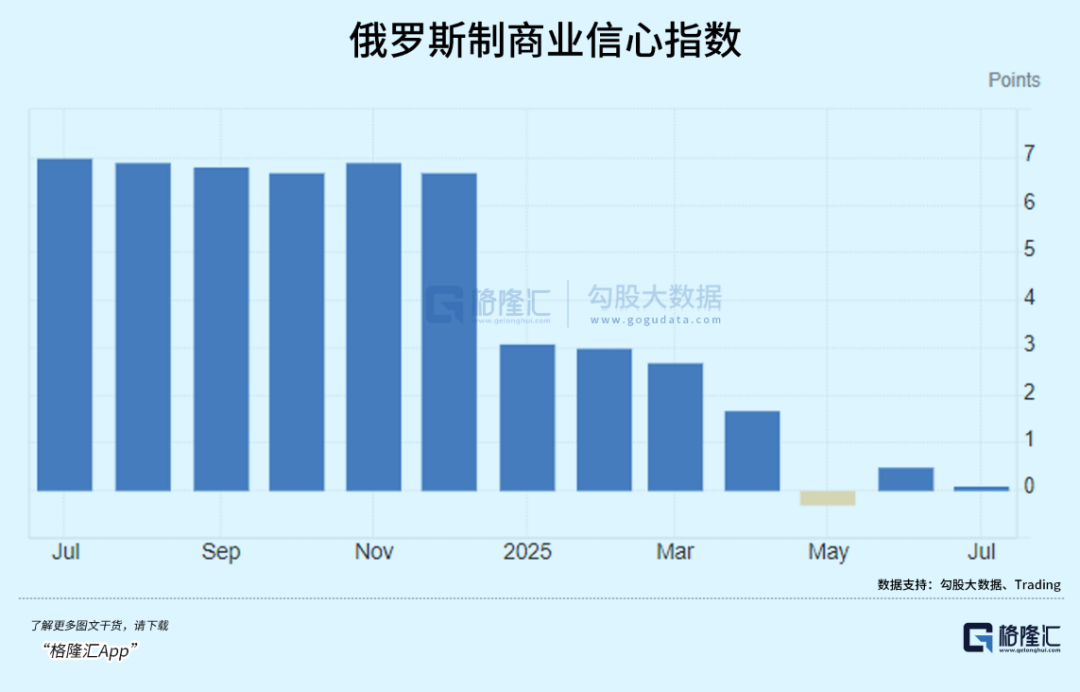
Core Viewpoint - The ongoing war in Russia has led to severe economic consequences, including widespread business bankruptcies, labor shortages, and increasing debt levels among the population, despite seemingly positive employment statistics. Group 1: Economic Impact - In the first half of 2024, 141,000 legal entities declared bankruptcy, with over 70% from manufacturing, construction, and trade sectors [6] - 43% of construction companies have halted operations due to funding chain disruptions caused by the lack of building materials from Austria and Germany [8] - By the end of 2024, 66% of the labor population had personal debts totaling 38.5 trillion rubles, with a 10.5% overdue loan rate in Q1 2025 [9] Group 2: Military Spending - In 2024, Russia's direct defense spending surged to 10.8 trillion rubles, tripling since 2021, with military industrial subsidies accounting for a significant portion of economic department expenditures [17] - The total military expenditure for 2025 is projected to be at least 16.55 trillion rubles, averaging over 453 billion rubles daily [20] - The military personnel costs alone for 2025 are estimated to exceed 19.7 trillion rubles, indicating a substantial financial commitment to sustaining military operations [27] Group 3: Casualties and Compensation - As of November 2024, confirmed soldier fatalities reached 77,143, with estimates suggesting actual numbers could exceed 90,000 due to reporting delays [34] - The average compensation for each deceased soldier's family is approximately 14.5 million rubles, leading to a projected expenditure of at least 1.044 trillion rubles in 2025 for compensations alone [39] Group 4: Inflation and Economic Stability - Despite a reported inflation rate of 8.8% in 2025, essential food prices have surged significantly, with bread and milk prices increasing by 12-15% and vegetables by over 20% [78] - The introduction of a "war tax" on businesses and individuals has been implemented to address government deficits, indicating a shift in fiscal policy to manage economic strain [82][84] Group 5: Future Economic Outlook - GDP growth predictions for 2025 range from 1% to 2%, with potential stagnation or contraction in subsequent years, significantly below global growth rates [92] - The prolonged conflict and its associated economic burdens are expected to diminish public morale and support for the war, potentially leading to a critical juncture in the conflict [95][97]

【环球财经】今年前七个月吉尔吉斯斯坦经济增长11.5%
Xin Hua Cai Jing· 2025-08-15 13:49
Core Insights - Kyrgyzstan's GDP for January to July is estimated at 865.2 billion som (approximately 9.9 billion USD), reflecting a year-on-year growth of 11.5% [1] Economic Structure - The service sector constitutes 51.1% of the economy, while goods production accounts for 32.8%, and product taxes make up 16.1% [1] Sector Performance - Industrial output increased by 11.3%, with mining growing by 14.6% and manufacturing by 11% [1] - The construction sector showed significant growth with a 37.8% increase in output [1] - Wholesale and retail trade grew by 13.2%, while the hotel and restaurant sector saw a 27.8% increase [1] - Agricultural, forestry, and fishing sectors experienced a modest growth of 2.3% [1] - Freight volume increased by 11.6%, and communication services grew by 6.3% compared to the same period last year [1] Inflation and Trade - Consumer prices and tax rates rose by 4.7% from December of the previous year [1] - External trade for January to June totaled 6.9987 billion USD, a decrease of 12.4% year-on-year, with exports down by 26.3% to 1.0488 billion USD and imports down by 9.4% to 5.9501 billion USD [1]
长春市2024年实现地区生产总值7632.19亿元,接待国内外游客人次同比增长17%
Zheng Quan Shi Bao Wang· 2025-08-14 02:43
Economic Overview - In 2024, Changchun's GDP reached 763.22 billion yuan, growing by 4.8% year-on-year [1] - The primary industry contributed 50.73 billion yuan (6.6% of GDP), the secondary industry contributed 269.92 billion yuan (35.4% of GDP), and the tertiary industry contributed 442.57 billion yuan (58.0% of GDP) [1] - The per capita GDP for the year was 83,930 yuan, an increase of 4.6% [1] Agricultural Sector - The value added by agriculture, forestry, animal husbandry, and fishery was 52.65 billion yuan, up by 4.5% from the previous year [2] - The total grain planting area was 1.5894 million hectares, with a total grain output of 12.996 million tons, reflecting a 2% increase [2] - The number of new green food products increased by 33, and the area monitored for organic environmental standards reached 7.644 million acres [2] Industrial Sector - The industrial added value was 221.14 billion yuan, growing by 4.3% [3] - Key industries included food processing (4.5% growth), chemical manufacturing (15.7% growth), and electronic equipment manufacturing (20.8% growth) [3] - The total profit of industrial enterprises was 52.71 billion yuan, a decrease of 27.9% year-on-year [3] Service Sector - The service sector's added value was 442.57 billion yuan, increasing by 5.1% [4] - Notable growth was seen in information technology services (14.6% growth) and financial services (5.5% growth) [4] - The total revenue of large-scale service enterprises grew by 3.5% [4] Tourism Industry - Changchun received 172.52 million domestic and international tourists, a 17% increase from the previous year [5] - Total tourism expenditure reached 302.61 billion yuan, reflecting a 25.5% growth [5] - The number of travel agencies in the city was 287, with 46 national A-level tourist attractions [5]