软件

Search documents
股票市场概览:资讯日报:中美元首通话讨论经贸及地缘政治热点问题-20260205
Guoxin Securities Hongkong· 2026-02-05 03:14
Market Overview - Hong Kong's Hang Seng Index closed at 26,847, down 0.05% for the day and down 4.01% year-to-date[3] - The Hang Seng Tech Index fell 1.84% daily and is down 8.13% year-to-date[3] - The Shanghai Composite Index rose 0.85% daily, with a year-to-date change of -0.38%[3] - The Nikkei 225 Index decreased by 0.78%, while the year-to-date performance is up 7.85%[3] Sector Performance - Major tech stocks in Hong Kong, including Tencent, saw declines, with Tencent down nearly 4% due to regulatory actions on marketing practices[9] - The coal sector outperformed, with Yancoal Australia and Yanzhou Coal Energy both rising over 10% due to supply constraints from Indonesia and increased domestic demand[9] - Airline stocks surged, with China Eastern Airlines up 6.72% and Air China up 6.20%, driven by strong travel demand during the Spring Festival[9] U.S. Market Dynamics - The Nasdaq index fell over 1% for the second consecutive day, pressured by major tech stocks like AMD, which dropped 17.31% after earnings[9] - The S&P 500 index also declined, but over 70% of its components recorded gains, indicating significant internal market divergence[9] - Notably, Enphase Energy surged 38.60% following positive news regarding the solar industry, contrasting with the overall tech sector's struggles[9] Global Economic Indicators - The U.S. ADP report indicated that January's job growth was significantly below expectations, suggesting a slowdown in the labor market[12] - The upcoming U.S. non-farm payroll report has been rescheduled to February 11, with the CPI report adjusted to February 13[12] - Discussions between U.S. and Chinese leaders focused on trade and geopolitical issues, with China emphasizing the Taiwan situation[12]
招财日报:每日投资策略-20260205
Zhao Yin Guo Ji· 2026-02-05 03:07
Market Performance - The Hang Seng Index closed at 26,847, with a slight increase of 0.05% for the day and a year-to-date increase of 4.75% [1] - The Hang Seng Technology Index decreased by 1.84% for the day and is down 2.71% year-to-date [1] - The US stock market saw the Dow Jones increase by 0.53%, while the S&P 500 and Nasdaq fell by 0.51% and 1.51%, respectively [1] Sector Performance - In the Hong Kong market, the financial sector increased by 0.66% and is up 8.51% year-to-date, while the industrial sector decreased by 0.48% [2] - The real estate sector in Hong Kong saw a significant increase of 1.99% for the day and is up 17.13% year-to-date [2] Capital Flows - Southbound funds recorded a net inflow of 13.373 billion HKD, with Tencent, Alibaba, and Xiaomi being the top net buyers [3] - In contrast, SMIC, Hua Hong Semiconductor, and Jun Da Co. were the most sold stocks [3] US Market Trends - The US stock market experienced a sell-off in technology stocks, particularly in software and semiconductor sectors, with AMD's weak guidance leading to a 17% drop [3] - The S&P 500 software sector has seen an average decline of 25% since reaching a historical high last October [3] Company Analysis: Pfizer (PFE US) - Pfizer reported strong Q4 2025 earnings with revenue of 17.6 billion USD, slightly below the expected 18.1 billion USD, but adjusted net income exceeded expectations at 3.8 billion USD [4] - The company anticipates 2026 revenue between 59.5 billion to 62.5 billion USD, with adjusted EPS guidance of 2.80 to 3.00 USD [4] - Key upcoming milestones include data readouts for long-acting GLP-1 and Amylin projects, which are expected to drive significant valuation re-evaluation [4] Clinical Developments - Pfizer's VESPER-3 study showed a 12.3% weight loss effect at the 28-week mark for its long-acting GLP-1 candidate, with a potential 15.8% weight loss projected for a higher dose [5] - The company plans to initiate a Phase 3 study for the higher dose later this year, with detailed data expected at the ADA conference in June [5] Oncology Pipeline - Pfizer is advancing its PD-1/VEGF and ADC combination therapies, with ongoing Phase 3 trials for PF'4404 in colorectal cancer and additional trials planned for 2026 [6] - The market narrative is shifting towards pipeline execution strength, with obesity products and PF'4404 clinical progress expected to drive stock price increases [6]

Anthropic一插件引发的“AI颠覆恐慌”OR“做空盛宴”?分析师警告:过度恐慌正错杀优质资产
Zhi Tong Cai Jing· 2026-02-05 02:52
Group 1 - A significant sell-off in software stocks has been triggered by the announcement of a new productivity tool by Anthropic PBC, leading to a $300 billion decline in the market [1] - Concerns about AI technology disrupting traditional software business models have resulted in a 20% drop in software and AI-related company stock prices this year [1] - Short sellers have profited significantly, with an estimated $24 billion in paper profits for those betting against the software sector [1] Group 2 - Short positions in major stocks like Microsoft, Oracle, Broadcom, and Amazon are increasing, indicating a shift in short-selling strategies [2] - Microsoft’s short positions have surged by 20% this year, while Oracle's have increased by 10% [2] - Analysts express that the current panic regarding the software sector is excessive, with some arguing that high-quality assets are being unfairly punished [2][3] Group 3 - NVIDIA's CEO argues that the market's panic overlooks the reality of enterprise technology applications, stating that advancements in AI do not equate to a reduced demand for specialized software [3] - The notion that AI will replace professional software companies is seen as misguided; instead, integrating AI into existing tools is viewed as a more viable path for profitability [3] - Examples like Canva and Replit illustrate how professional tools can incorporate AI as a feature rather than a core product [3] Group 4 - The market's overreaction to AI advancements is compared to past instances where tech companies' announcements led to significant stock declines in other sectors [4] - The software industry is susceptible to disruption, but historical patterns show that each disruption has both winners and losers [4] - The current fear-driven sentiment in the market is described as contagious, with similar reactions observed in the gaming sector following AI announcements [4] Group 5 - The fundamental issue is that Wall Street has not yet adapted to the AI era, leading to excessive fear over bad news and overexcitement over good news [5] - The overhyped nature of AI companies contributes to the irrational market behavior, with many believing that the "doomsday predictions" for software are unfounded [5]
中部第一城,这次要冲击“一线城市”
Mei Ri Jing Ji Xin Wen· 2026-02-05 02:52
Core Insights - Wuhan is set to implement the "Wuhan Smart Economy Development Action Plan (2026-2028)" aiming to achieve an artificial intelligence industry scale exceeding 200 billion yuan, with a target of producing high-performance computing capacity surpassing 15,000 PFlops, and a cumulative data circulation transaction volume reaching 3 billion yuan [1][6]. Group 1: Smart Economy Development - The concept of smart economy represents a new economic form arising from the deep integration of artificial intelligence with various industries, marking an advanced stage of digital economy development [3]. - The national strategy has elevated "Artificial Intelligence+" as a top-level initiative, emphasizing the importance of smart economy in the "14th Five-Year Plan" [4]. Group 2: Regional Competitiveness - Major cities like Beijing, Shanghai, and Shenzhen are leading in the smart economy sector, which has become a new benchmark for regional competitiveness [5]. - Wuhan's smart economy core industry scale is projected to reach 1.1 trillion yuan by 2025, with the electronic information manufacturing and software industries accounting for over 80% [6]. Group 3: Infrastructure and Resources - Wuhan boasts significant infrastructure advantages, including 40 5G base stations per 10,000 people, over 5,000 PFlops of high-performance computing, and nearly 3,900 kilometers of open smart connected vehicle testing roads [6]. - The city has 33 out of over 90 universities establishing artificial intelligence colleges, ranking sixth globally in the number of high-output and highly-cited AI scientists [6]. Group 4: Policy Initiatives - Wuhan has previously introduced several policies to promote the development of the artificial intelligence industry, aiming to create a top-tier innovation cluster and industrial development hub [6]. - The latest action plan outlines the establishment of three major root industries in the smart economy: sensor, optical communication, and integrated computing industries, alongside a software ecosystem and application service providers [6][7].
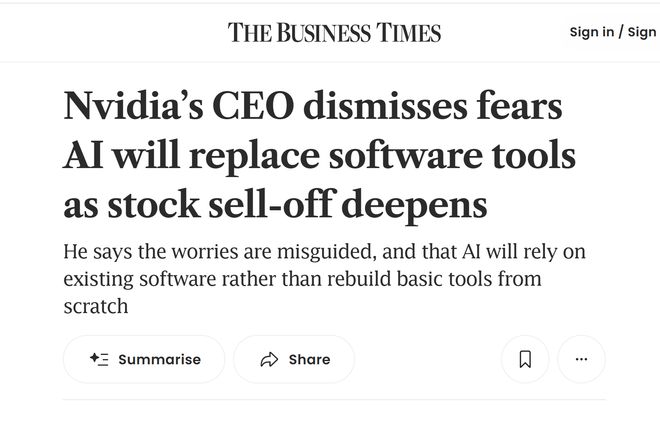
黄仁勋:AI不会取代软件,现有软件生态是发展基础
Huan Qiu Wang Zi Xun· 2026-02-05 02:24
Group 1 - The core viewpoint of the article is that concerns about AI replacing software and related tools are unfounded, as emphasized by NVIDIA CEO Jensen Huang [1][2] - Huang argues that the future development of AI relies on the existing software ecosystem rather than reinventing foundational tools from scratch [2] - He highlights that the current breakthroughs in AI are focused on "tool usage," supported by the clear characteristics of existing software tools [2]


全线大跌!美股科技股,突发利空!
Sou Hu Cai Jing· 2026-02-05 02:18
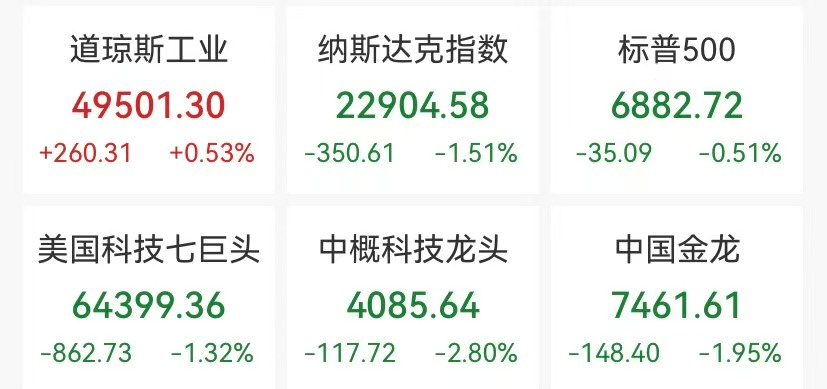
Market Performance - The three major U.S. stock indices closed mixed, with the Dow Jones Industrial Average slightly up, while the Nasdaq and S&P 500 indices, along with the Chinese concept stock index, all declined [1] - The Philadelphia Semiconductor Index experienced a significant drop, falling over 6%, with AMD plunging more than 17% [1][2] - Major tech stocks mostly fell, with Nvidia, Meta, Tesla, and Broadcom dropping over 3%, while Apple rose over 2% and Microsoft increased by 0.72% [2] Sector Analysis - The decline in semiconductor stocks was triggered by AMD's earnings guidance falling short of analysts' high expectations, exacerbated by ongoing sell-offs in the software sector [2] - AI application stocks such as AppLovin and Palantir also saw declines of over 10% [1] Chinese Concept Stocks - Most popular Chinese concept stocks fell, with the Nasdaq Golden Dragon China Index dropping nearly 2%, and companies like Kingsoft Cloud and WanGuo Data falling over 7% [3] - In contrast, Chinese renewable energy stocks performed well, with Yipeng Energy soaring nearly 58% and JinkoSolar rising over 8% [3] Commodity Market - Precious metals saw a rebound, with spot gold slightly up at $4963.59 per ounce and silver rising over 3.5% to $88 per ounce [4] - International oil prices increased, with NYMEX WTI crude oil rising nearly 2% to $64.47 per barrel and ICE Brent crude up over 2% to $68.71 per barrel [5] Market Trends - There is a noted market rotation, with growth stocks dominating for a long time while value stocks remain under pressure [7] - The probability of the Federal Reserve cutting rates by 25 basis points by March is 9.9%, with a 90.1% chance of maintaining current rates [7]

如果AI击溃了软件,“AI龙头”英伟达为何被软件股“拉下水”?
Hua Er Jie Jian Wen· 2026-02-05 01:45
AI对软件行业的冲击叙事正引发一轮"无差别"抛售,并把以英伟达为代表的AI芯片股一起卷入下跌,但 卖出的逻辑本身存在内在矛盾。 周三英伟达股价下跌3.41%,博通下跌3.83%,美光下跌10%,闪迪跌超15%。与此同时,软件板块抛压 仍在延续,iShares Expanded Tech-Software Sector ETF,IGV周三再跌1.8%。 周二,Anthropic为其Claude Cowork推出近十项工具,将AI应用推进到销售、数据分析等更多场景,市 场随即把"AI将击败软件"的叙事进一步内化为估值下调。但软件股的下跌引发了包括AI板块在内的,更 大范围的抛售。 Bank of America分析师Vivek Arya认为,芯片股跟随下挫说不通。他指出,芯片下跌暗示AI投资回报正 在恶化,而软件下跌又暗示AI采用将极度普及,两种结论难以同时成立,当前市场反应过度。 "AI击败软件"的叙事,为何反而拖累AI芯片 Vivek Arya指出,AI相关芯片股下跌隐含的市场判断是,AI投入正在恶化到难以产生理想回报,后续增 长空间受限;但软件股下跌又对应另一种判断,即AI采用将大范围普及且显著提升生产力, ...
软件股“入冬”而苹果(AAPL.US)“常青”!市值逆市涨破4万亿美元,成AI替代恐慌避风港
智通财经网· 2026-02-05 01:40
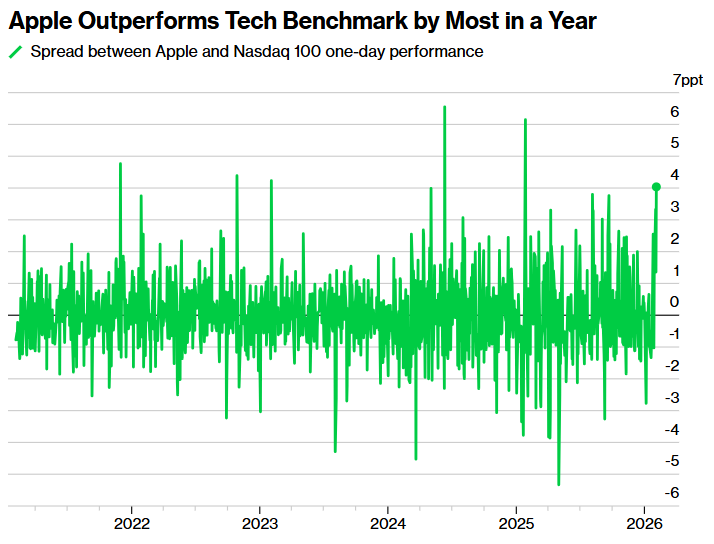
Core Viewpoint - Apple is perceived as a safe haven amid investor concerns over the disruptive impact of artificial intelligence, with its stock price rising contrary to the overall market trend [1][3]. Group 1: Stock Performance - Apple's stock rose by 2.6% on Wednesday, while the Nasdaq 100 index, which is tech-heavy, fell by 1.77% [1]. - This performance marks the largest outperformance of Apple against the market since early 2025, with Apple’s stock up nearly 6% this month, while the Nasdaq 100 has declined by 3.3% during the same period [1]. - Apple's market capitalization has slightly exceeded $4 trillion, making it the second-largest company globally, surpassing Alphabet [1]. Group 2: Financial Results and Market Sentiment - Apple's recent quarterly sales reached a historical high, and its earnings guidance exceeded expectations [3]. - In contrast, the launch of AI tools by Alphabet and startup Anthropic has led to widespread sell-offs in tech stocks, as investors fear that AI services may erode company growth [3]. - Software stocks are under pressure, with a popular ETF tracking this sector down 2.7%, marking a potential seventh consecutive day of declines, the longest losing streak in over two years [3]. Group 3: Strategic Positioning - Apple is not participating in the AI arms race, which is viewed as a wiser decision now compared to six months ago, allowing the company to benefit from AI without incurring massive debt and capital expenditures [4]. - Hardware devices like the iPhone are expected to become core platforms for users accessing AI services, positioning Apple favorably in the evolving tech landscape [3].

A股指数集体低开:创业板指跌超1%,贵金属、光伏等板块跌幅居前
Feng Huang Wang Cai Jing· 2026-02-05 01:35
Market Overview - Major indices opened lower, with the Shanghai Composite Index down 0.66%, Shenzhen Component down 0.96%, and ChiNext down 1.02% [1] - The decline was led by sectors such as precious metals, photovoltaic, and semiconductor chips [1] Index Performance - Shanghai Composite Index: 4075.03, down 0.66%, with 460 gainers and 1493 losers [2] - Shenzhen Component: 14020.84, down 0.96%, with 396 gainers and 2202 losers [2] - ChiNext Index: 3277.72, down 1.02%, with 182 gainers and 1099 losers [2] External Market Influence - U.S. stock markets continued to experience style rotation, with the Nasdaq down over 1% for the second consecutive day [3] - The S&P 500 Index fell by 0.51%, while the Dow Jones Industrial Average rose by 0.53% [3] - Chinese concept stocks were affected, with the Nasdaq Golden Dragon China Index down 1.95% [3] Sector Insights - CICC forecasts breakthroughs in large model technology in areas such as reinforcement learning and contextual engineering by 2026 [4] - Zhongtai Securities expresses a positive outlook on the raw material drug sector, highlighting the potential of innovative drug tracks like small nucleic acids and peptides [5] - CITIC Securities recommends focusing on automotive companies with strong cost transfer capabilities and global layouts due to rising raw material prices impacting profit margins [7]


美股软件“失火”、芯片“遭殃”、科技“跳水”
华尔街见闻· 2026-02-05 01:16
Core Viewpoint - Concerns in the software industry are rapidly evolving into a broader sell-off in the technology sector, with market panic spreading from the SaaS segment to semiconductors and AI infrastructure, significantly increasing pressure on tech stocks [2] Group 1: Market Reactions - The Nasdaq Composite Index experienced a decline, marking its first consecutive two-day drop of 1% since April of the previous year, primarily triggered by shaken investor confidence in the software industry's outlook [2] - Following the release of disappointing earnings, AMD's stock plummeted by 17%, marking its worst single-day performance since 2017 [8] - Palantir's stock fell by 12%, and SanDisk's stock dropped by 16%, with the sell-off also affecting major AI companies like Meta and Nvidia, which saw declines of 6.6% and 8.9% respectively [10] Group 2: Investor Sentiment and Valuation - There is growing concern that AI's impact on existing software business models may exceed expectations, leading to skepticism about whether tech giants can deliver on profit promises under high valuations [5] - High valuations have made the market extremely sensitive to any negative signals, prompting a rapid rotation of funds from tech stocks to traditional sectors [8][17] - The average price of loans for software companies has dropped from 94.71 cents at the end of last year to 91.27 cents, with approximately $25 billion in software loans classified as non-performing, representing nearly one-third of all bad loans [11] Group 3: AI Disruption and Overreaction - The market volatility reflects a reassessment by investors of companies facing potential disruption from AI, with analysts noting that the software industry is in a state of "pre-judgment" regarding AI risks [13] - Some industry executives and strategists argue that the sell-off may be overblown, with Nvidia's CEO stating that the pressure on software stocks is based on an illogical narrative that AI will replace them [14][15] - Baird's Antonelli suggests that enterprises are unlikely to abandon established enterprise software for untested alternatives, indicating that the market often reacts hastily to expensive stocks [16] Group 4: Fund Rotation Trends - Despite the turmoil in tech stocks, the market is not experiencing a broad retreat but rather a clear trend of fund rotation, with investors moving capital from chip stocks and large tech winners to more traditional sectors [17] - On a day when the S&P 500 index fell by 0.5%, 92 stocks reached new 52-week highs, the highest number of new highs in a single day since November 2024 [19] - This trading behavior is seen as a continuation of a trend, with recent news providing a catalyst for accelerating this shift [20]