高新技术

Search documents
2025年11月外贸数据点评
Ping An Securities· 2025-12-09 10:29
Export Performance - In November 2025, China's exports increased by 5.9% year-on-year, a rebound of 7.0 percentage points from the previous month[1] - Imports grew by 1.9% year-on-year, up 0.9 percentage points from the previous month[1] - The trade surplus reached $111.68 billion, compared to $90.07 billion in the previous month[1] Regional Analysis - The drag from exports to the United States expanded by 0.6 percentage points to 4.4 percentage points[3] - Exports to the EU, Hong Kong, Africa, ASEAN, and Latin America contributed 1.9, 1.6, 1.5, 1.4, and 1.0 percentage points respectively[3] - ASEAN remains the largest contributor to China's exports, with significant increases from Africa, the EU, Hong Kong, and India compared to 2024[3] Product Analysis - Mechanical and high-tech products were the main drivers of export growth, contributing 4.8 and 1.6 percentage points respectively[3] - Labor-intensive products continued to drag on exports, contributing a negative 0.6 percentage points[3] - Key products like automobiles, ships, and integrated circuits showed strong performance, collectively increasing their contribution to 2.0 percentage points[3] Import Dynamics - Mechanical and high-tech products maintained stable contributions to import growth at 1.8 and 2.5 percentage points respectively[3] - The drag from raw materials decreased to 2.5 percentage points, a reduction of 0.2 percentage points from the previous month[3] - Agricultural products' drag on import growth was 0.3 percentage points, down 0.1 percentage points from the previous month[3] Risk Factors - Potential risks include underwhelming implementation of growth policies, escalation of geopolitical conflicts, and unexpected severity of overseas economic downturns[3]
41.21万亿元,同比增长3.6%!
Jin Rong Shi Bao· 2025-12-09 02:20
Core Viewpoint - China's goods trade import and export value reached 41.21 trillion yuan in the first 11 months of 2025, showing a year-on-year growth of 3.6% [1] Group 1: Export Performance - In November, China's exports grew by 5.9% year-on-year, rebounding significantly from a decline of 1.1% in October, indicating a recovery to normal levels in the second half of the year [1][2] - The increase in exports is attributed to three main factors: a lower base from the previous year, a rebound in global trade, and accelerated growth in exports of chips and automobiles driven by domestic manufacturing upgrades and global AI investment [2][3] - Private enterprises have shown strong growth in imports and exports, with a total of 23.52 trillion yuan in trade, representing a 7.1% increase and accounting for 57.1% of China's total foreign trade [2] Group 2: Import Trends - In November, imports increased by 1.9%, with the growth rate accelerating by 0.9 percentage points compared to the previous month, supported by a lower base from last year [4] - The rebound in exports has a direct positive impact on import growth, reflecting China's "large import and export" characteristics [4] - Future import growth may be supported by domestic policies aimed at boosting internal demand, including the introduction of new financial tools and local government bond limits for project construction [4] Group 3: Sector Contributions - Mechanical and electrical products, along with high-tech products, continue to play a crucial role in China's export stability, with mechanical and electrical product exports reaching $205.9 billion in November, growing by 9.65% [3] - High-tech product exports exceeded $88.1 billion in November, with a growth rate of 7.68%, indicating a significant contribution to overall export performance [3]
11月出口超预期,谁的贡献
HUAXI Securities· 2025-12-08 15:25
Export Performance - In November 2025, total exports reached $330.4 billion, a year-on-year increase of 5.9%, exceeding market expectations of 3.0% and reversing the previous month's decline of -1.1%[1] - Exports to the EU, Africa, and Latin America improved significantly, contributing 1.9 percentage points, 1.5 percentage points, and 1.0 percentage points to overall export growth, respectively[1] - Exports to ASEAN, China's largest trading partner, saw a marginal slowdown, with year-on-year growth decreasing by 1.9 percentage points to 8.6%, marking the first single-digit growth since February of the same year[1] Trade with the United States - Exports to the U.S. fell by 3.2% month-on-month in November, with a year-on-year decline of 28.8%, the lowest in three months, remaining within the -25% to -30% range[2] - The decline in exports to the U.S. was influenced by high base effects from last year, where exports peaked at $47.3 billion in November 2024 due to anticipatory stockpiling ahead of tariff increases[2] Product Categories - The export growth rate for electromechanical products and high-tech products improved, with electromechanical exports rising by 9.8% and high-tech products by 7.8%, both nearing the average levels seen in the first nine months of the year[3] - Labor-intensive product exports saw a reduced decline from -14.8% to -8.2%, although this remains low compared to the average decline of around 5% in August and September[3] Import Trends - Total imports in November amounted to $218.7 billion, with a year-on-year increase of 1.9%, slightly above the previous month's 1.0%[4] - Imports of electromechanical and high-tech products improved, contributing 5.5 percentage points to overall import growth, while bulk commodity imports turned negative, declining by 1.0% year-on-year[5] Regional Economic Performance - Neighboring economies also showed strong export performance, with South Korea's exports rising by 8.4% year-on-year in November, up from 3.6% in October[6] - Vietnam's exports experienced a slight slowdown to 15.8% year-on-year but maintained double-digit growth[6] Future Outlook - Despite high base effects, November's export performance is expected to support a rebound in industrial value-added growth year-on-year[7] - The resilience of exports is anticipated to continue, bolstered by competitive pricing of manufactured goods, although fluctuations may occur in the coming months due to previous stockpiling effects[7]
“十四五”九城GDP占比全国约1/15 长三角G60科创走廊竞争力显著增强
Zhong Guo Jing Ying Bao· 2025-12-02 12:17
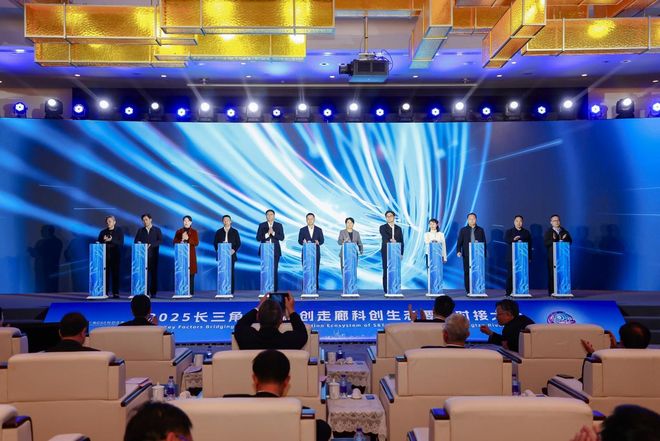
Core Insights - The G60 Science and Technology Innovation Corridor in the Yangtze River Delta is set to celebrate its seventh anniversary in 2025, coinciding with the conclusion of the 14th Five-Year Plan and the planning of the 15th Five-Year Plan [3] - The region has significantly enhanced its competitiveness during the 14th Five-Year Plan, contributing approximately 1/15 of the national GDP with a total GDP of around 9 trillion yuan in 2024, ranking 17th globally [3] - The R&D investment intensity in the nine cities of the corridor is 3.77%, exceeding the national average by 1.08 percentage points, with a notable presence of high-tech enterprises and specialized "little giant" companies [3] Economic Contribution - The nine cities, representing about 1/28 of the national population and 1/120 of the area, contribute significantly to the national economy [3] - In 2024, the GDP of the nine cities is projected to reach approximately 9 trillion yuan, placing it 17th in global economic rankings [3] Innovation and R&D - The region's R&D investment intensity stands at 3.77%, which is 1.08 percentage points higher than the national average [3] - High-tech enterprises in the area account for nearly 1/7 of the national total, while national-level specialized "little giant" companies make up 13.3% of the total [3] - The number of invention patents authorized and PCT patent applications from the nine cities each represent 10% of the national total, with globally highly cited scientists making up 9.5% of the national share [3] Government Initiatives - The governments of Shanghai, Jiangsu, Zhejiang, and Anhui have prioritized the development of the G60 Science and Technology Innovation Corridor [4] - Recent measures have been proposed to elevate the corridor to a "world-class" level, focusing on becoming a hub for industrial innovation and enhancing collaboration with major strategic initiatives [4]

中国制造向“新”突围 外贸“韧”劲十足超预期——2025年终经济观察
Zheng Quan Shi Bao Wang· 2025-12-01 23:36
Core Viewpoint - China's export resilience has provided a bright spot for economic growth despite adverse external conditions, with significant contributions from the manufacturing sector and diversified market strategies [1][7]. Group 1: Export Performance - In the first ten months of the year, China's export value increased by 6.2%, with exports to at least 177 trading partners growing faster than this average [4][5]. - The contribution of net exports to GDP growth was 29%, adding 1.5 percentage points to the overall GDP growth [1]. - Exports of mechanical and electrical products reached 13.43 trillion yuan, growing by 8.7% and accounting for 60.7% of total exports [2][3]. Group 2: Product Categories - High-tech products now represent 24.8% of total exports, with a year-on-year growth rate of 7.3% in the first ten months [3]. - Notable growth was observed in biotechnology, optoelectronics, electronics, computer integrated manufacturing, materials technology, and aerospace technology, all exceeding 12% growth [3]. Group 3: Market Diversification - The proportion of exports to countries involved in the Belt and Road Initiative has surpassed 50%, indicating a significant shift in trade relationships [6][5]. - The concentration of trade partners has decreased, with the combined export value to the top three partners dropping from 48.51% in 2018 to 43.9% in the current year [6]. Group 4: Future Outlook - Goldman Sachs predicts an 8% growth in actual exports for the year, driven by ongoing structural upgrades in manufacturing and market diversification [7][8]. - The "14th Five-Year Plan" emphasizes innovation and market diversification as key strategies for enhancing trade resilience and security [7][8].
广东“十五五”划重点:以改革拓空间,重仓“产业+科技”
2 1 Shi Ji Jing Ji Bao Dao· 2025-11-29 00:20
Core Insights - The Guangdong Provincial Committee has approved the suggestions for the 15th Five-Year Plan, emphasizing the integration of industry and technology to enhance regional innovation and economic growth [1][3][5] - The focus will be on optimizing traditional industries, nurturing emerging industries, and strategically planning future industries to build a modern industrial system with international competitiveness [3][5] - Artificial intelligence (AI) is identified as a key opportunity for driving systemic changes in research paradigms and enhancing productivity [2][4][6] Industry and Technology Integration - The meeting highlighted the need for a comprehensive push for the mutual promotion of industry and technology during the 15th Five-Year Plan, aiming for significant breakthroughs in productivity [3][5] - The high-tech manufacturing sector's added value is projected to reach 32.0% of the province's industrial output in 2024, an increase of 2.6 percentage points from the previous year [3] - By the first three quarters of 2025, the added value of high-tech manufacturing is expected to achieve a 6.4% growth, further increasing its share to 33.8% of total industrial output [3] AI as a Driving Force - AI is seen as a crucial engine for industrial development in Guangdong, with potential to transform research methodologies and organizational models [4][6] - The application of AI technologies is anticipated to facilitate breakthroughs in interdisciplinary research and improve the efficiency of scientific evaluation systems [4][6] Reform and Economic Growth - The plan emphasizes the need for comprehensive reform and opening up to enhance economic vitality and competitiveness [5][6] - Key reform directions include boosting innovation in both state-owned and private enterprises, optimizing the business environment, and fostering a healthy industrial ecosystem [6][7] - The establishment of risk compensation funds is suggested to encourage leading enterprises to provide opportunities for small and medium-sized enterprises to test innovative products [6][7] Strategic Development Mechanism - Guangdong aims to construct a three-dimensional industrial development mechanism that integrates foresight, strategy, and system [7] - The focus will be on aligning technological innovation with national needs and enhancing the development of specialized small and medium enterprises [7]
截至9月底,北京在营中小微企业较去年同期增加13.3万家
Xin Jing Bao· 2025-11-27 10:35
Group 1 - The core point of the report highlights the robust growth of small and medium-sized enterprises (SMEs) in Beijing, with a significant increase in new registrations and overall enterprise numbers [1][2] - In the first nine months of the year, Beijing saw the establishment of 235,000 new enterprises, a year-on-year increase of 22.3%, averaging over 850 new SMEs daily [1] - As of September, there were 2.212 million active SMEs in Beijing, reflecting a year-on-year growth of 6.4% [1] Group 2 - Beijing leads the nation with over 30,000 high-tech enterprises, having cultivated 16,451 innovative SMEs and over 1,200 national-level "little giant" enterprises [2] - The number of specialized and innovative SMEs has increased more than tenfold since the beginning of the 14th Five-Year Plan, with "little giant" enterprises growing by over 1,000 [2] - The specialized and innovative enterprises have achieved significant milestones, including exceeding 10,000 in number, revenue, and total market value, contributing to the modernization of the capital's industrial system [2] Group 3 - The government has implemented various policies to support SME development, including the release of guidelines for quality SME cultivation and financial support for agricultural processing SMEs [3][4] - A comprehensive service network for SMEs has been established, integrating government and social resources to provide effective support [3] - In the first nine months, the total government procurement amount for SMEs reached 52.13 billion yuan, accounting for over 70% of all contract amounts [4] Group 4 - Beijing has introduced tax and fee incentives for small-scale taxpayers and small micro-profit enterprises, streamlining tax processes with 97% of tax matters handled online [4] - The city has enhanced government procurement support for SMEs, allowing them to utilize procurement contracts for online financing [4] - A long-term regulatory mechanism for enterprise-related fees has been established, clarifying boundaries for fee-related behaviors and reducing unnecessary inspections [5][6]
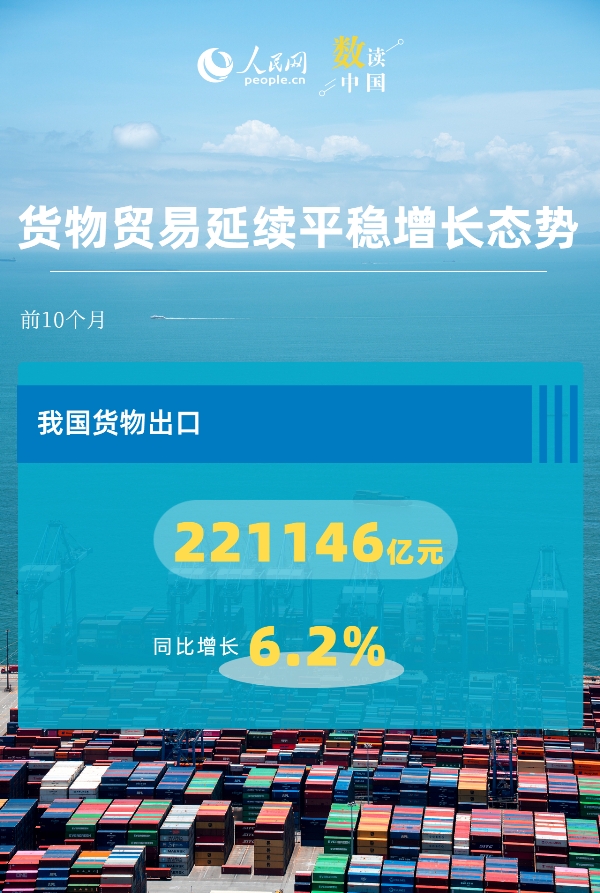
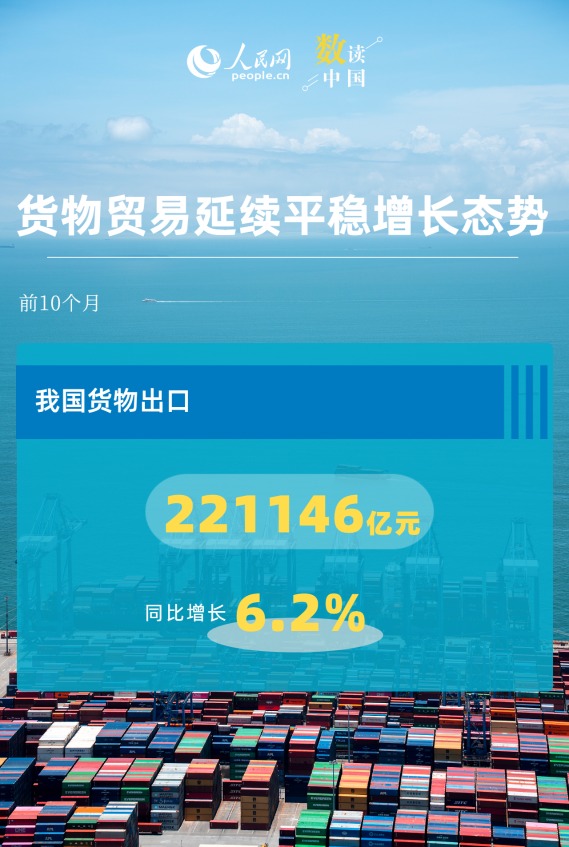
数读中国|6.2%!我国出口动能向优向新
Ren Min Wang· 2025-11-24 06:15
Group 1 - The core viewpoint of the articles highlights the steady growth of China's goods trade, driven by industrial upgrades and enhanced competitiveness of export products, particularly in the machinery and high-tech sectors [1][3][10] Group 2 - In the first ten months, the export value of machinery and electrical products increased by 27%, reaching 60.7% of the total export value [3] - Integrated circuit exports grew by 24.7%, while automobile exports also saw significant growth [3][10] Group 3 - High-tech product exports showed a remarkable increase of 73%, outpacing the overall export growth rate [7][8] Group 4 - The trade structure is continuously optimizing, with cross-border e-commerce exports reaching approximately 1.65 trillion yuan, marking a 66% increase [12][13] - The transition from traditional foreign trade to digital foreign trade is enhancing competitiveness [15] Group 5 - In the first three quarters, China exported holiday goods, dolls, and animal-shaped toys worth over 50 billion yuan to more than 200 countries and regions [17]
数读中国 6.2%!我国出口动能向优向新
Ren Min Wang· 2025-11-23 01:42
Group 1 - The core viewpoint of the articles indicates that China's goods trade has maintained steady growth this year, with an emphasis on the increasing competitiveness and technological advancement of export products [1] - The export of electromechanical products has expanded significantly, with a total export value of 60.7% in the first ten months, reflecting a year-on-year growth of 27% [3] - Integrated circuit exports grew by 24.7%, while automobile exports increased by 14.3%, highlighting the strong performance of key sectors [3] Group 2 - High-tech product exports have shown positive growth, with a total export value increase of 7.396 billion, outpacing the overall export growth rate [5][6] - The "Made in China" initiative is leading upgrades in manufacturing, with double-digit growth in exports of green products such as railway electric locomotives and wind power generators [9] - The trade structure is continuously optimizing, with cross-border e-commerce exports reaching approximately 7.063 trillion, marking a growth of 66% [11][13]
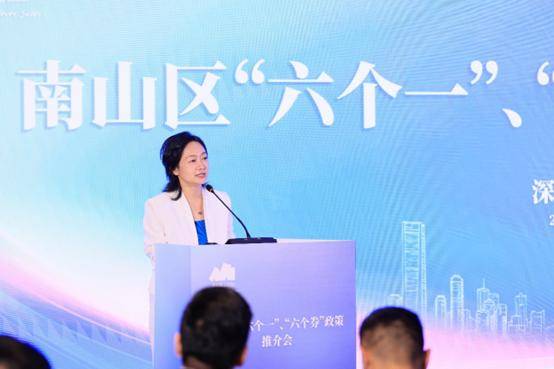
“券”力十足,“引”力更强,南山 “六个券”+“六个一 ”2.0双策齐发!
Sou Hu Cai Jing· 2025-11-19 04:55
Core Insights - The article discusses the launch of two new policy initiatives in Nanshan District, Shenzhen, aimed at supporting industrial development and innovation, namely the "Six Coupons" and the upgraded "Six Ones" 2.0 program. These initiatives are designed to address the needs of enterprises and enhance their capabilities in the face of structural opportunities in industrial upgrading, technological innovation, and green transformation [1][10]. Group 1: "Six Ones" 2.0 Program - The "Six Ones" 2.0 program focuses on three dimensions: policy continuity, enhanced services, and confidence building, providing tailored support for entrepreneurs in Nanshan [3]. - The program lowers entry barriers by relaxing requirements related to age, education, and company establishment for key industry talents and entrepreneurial teams, aiming to benefit more innovators [3][5]. - Previous data indicates that 13,515 university students received a 520 yuan experience coupon, while 1,351 graduates received up to 50,000 yuan in living subsidies, and 74 key industry talents received up to 400,000 yuan in funding [3]. Group 2: "Six Coupons" Initiative - The "Six Coupons" initiative offers six specialized subsidy tools: model coupons, interest subsidies, technology transformation coupons, traffic coupons, insurance coupons, and consumption coupons, designed to support enterprises throughout their development cycle [6][8]. - The model coupon provides up to 1 million yuan for AI innovation applications, covering 50% of the actual investment in AI products [6]. - Interest subsidies for technology companies can cover up to 50% of loan interest, with a maximum of 500,000 yuan per year for individual companies [6][8]. Group 3: Expanded Support and Services - The "Six Ones" 2.0 program now includes support for high-tech enterprises with subsidies up to 1 million yuan and increased backing for open-source ecosystem development, with comprehensive subsidies up to 10 million yuan [5]. - The "Moli Ying" AI ecosystem community has expanded from 50,000 square meters to 100,000 square meters, providing additional support for outstanding graduate enterprises [5]. - The "Ai Nanshan" platform offers a one-stop service for enterprises, integrating over 2,000 services to support businesses from establishment to growth [10][12]. Group 4: Consumer Engagement and Market Activation - The consumption coupon initiative collaborates with platforms like JD.com and Douyin to stimulate consumer spending across various sectors, benefiting over 3 million consumers this year [9]. - The ongoing "Nanshan Year-End Gift" campaign is expected to further boost sales in the automotive and retail sectors, enhancing market vitality [9]. Group 5: Policy Alignment and Strategic Goals - The policies are aligned with national strategies to enhance new productive forces and promote consumption, aiming to create a robust support system for enterprises during economic downturns [12]. - The initiatives are designed to stimulate market vitality and integrate innovation, industry, and talent development, contributing to Shenzhen's goal of becoming a leading modern innovation city [12][14].