航空

Search documents
伯恩斯坦:将美国联合航空(UAL.O)目标价从123美元上调至129美元。
Jin Rong Jie· 2026-01-07 11:53
本文源自:金融界AI电报 伯恩斯坦:将美国联合航空(UAL.O)目标价从123美元上调至129美元。 ...
工信部:实施工业互联网与重点产业链“链网协同”工程
Di Yi Cai Jing· 2026-01-07 07:51
Core Insights - The Ministry of Industry and Information Technology (MIIT) has issued an action plan to promote the integration of industrial internet and artificial intelligence across key industries [1] Group 1: Key Industry Promotion - The plan emphasizes accelerating the promotion of industrial internet in key sectors such as steel, aviation, shipbuilding, engineering machinery, agricultural machinery, electronic information manufacturing, electric power, petrochemicals, non-ferrous metals, textiles and apparel, pharmaceuticals, and light industry [1] - It aims to implement a "chain-network collaboration" project that strengthens the connection and coordination of digitalization and intelligence-related policies across various industries [1] Group 2: Digital Transformation and Intelligent Upgrading - The action plan focuses on addressing the digital transformation and intelligent upgrading needs and challenges of key industries by compiling and publishing reference guidelines for integrated applications [1] - It includes the identification of typical scenarios for the integration of industrial internet and artificial intelligence, along with a list of technical products, supplier directories, and standard indexes [1] Group 3: Resource Sharing and Solution Pool - The initiative aims to establish a resource pool for solutions, enhance precise matching of supply and demand, and promote the sharing of resources and interconnectivity among upstream and downstream elements of the industrial chain [1] - It will also collect and select exemplary cases of artificial intelligence and industrial internet "chain-network collaboration" projects that demonstrate high levels of system integration, broad connectivity, and significant transformation benefits [1]
李在明点赞“周五下班去中国”
第一财经· 2026-01-07 07:21
Core Viewpoint - The article highlights the increasing trend of young South Koreans traveling to China for short trips, particularly due to the visa-free entry policy implemented by China for South Korean citizens starting at the end of 2024, which has significantly boosted bilateral exchanges and tourism between the two countries [3][5]. Group 1: Travel Trends - The phrase "Friday after work to China" has become popular among young South Koreans, allowing them to enjoy a quick getaway without disrupting their work schedules [3][5]. - In the first eleven months of 2025, over 7.28 million people traveled between China and South Korea, marking a 24.7% year-on-year increase, indicating a strong recovery in mutual visits [3][5]. - Major South Korean airline Korean Air reported a significant increase in passengers on routes to China, with Shanghai seeing an increase of 128,000 passengers, Beijing 71,000, and Qingdao 63,000 compared to 2024 [5][6]. Group 2: Cultural and Commercial Appeal - The emergence of new cultural IPs in China has attracted many young South Koreans, with places like the 百联ZX创趣场 in Shanghai being referred to as a "real-life gacha pool" by Korean visitors [6]. - The Labubu blind box trend has gained popularity among Korean youth, with easy access to these products in various locations across China [6]. - The number of direct flights from South Korea to various Chinese cities is increasing, with new routes established to destinations like Guilin and Xi'an to meet the growing demand for travel [6]. Group 3: Innovation and Collaboration - The South Korean government is actively promoting innovation and collaboration between South Korean and Chinese companies, as evidenced by the attendance of nearly 300 representatives at the China-South Korea Innovation and Entrepreneurship Forum [8][9]. - The 创E谷 innovation industrial park in Shanghai has become a key entry point for South Korean startups looking to enter the Chinese market, facilitating cross-border roadshows and investment opportunities [8][9]. - The South Korean government is shifting its focus towards supporting startups and small to medium enterprises in the AI and high-tech sectors, aiming to enhance cooperation with China in these fields [10].


李在明点赞“周五下班去中国”:免签催热快闪游,创新氛围吸引韩国初创企业
Xin Lang Cai Jing· 2026-01-07 06:53
Group 1: Travel Trends - The trend of "Friday to China, Sunday back home" is gaining popularity among South Korean youth, driven by the upcoming visa-free entry policy for South Korean citizens to China by the end of 2024 [1][2] - In the first 11 months of 2025, bilateral travel exceeded 7.28 million trips, marking a 24.7% year-on-year increase, indicating a strong recovery in mutual visits [1] - Major South Korean airline Korean Air reported significant growth in passenger numbers on routes to China, with Shanghai seeing an increase of 128,000 passengers, and Beijing and Qingdao also experiencing notable growth [2] Group 2: Cultural and Economic Engagement - The rise of Chinese IP and cultural attractions is appealing to South Korean youth, with locations like the Bailing ZX Creative Space in Shanghai becoming popular among Korean visitors [3] - The Korean government is facilitating easier access to China by increasing direct flights to various Chinese cities, enhancing travel options for South Korean tourists [3] - The Korean Startup Forum (KOSFO) is actively promoting collaboration between South Korean startups and Chinese markets, emphasizing the importance of understanding consumer trends and technological advancements [5] Group 3: Innovation and Collaboration - The recent Korea-China Innovation and Entrepreneurship Forum in Shanghai attracted around 300 representatives from both countries, focusing on collaboration in sectors like smart manufacturing and AI [4] - The Shanghai Innovation Industry Park has become a key entry point for South Korean startups looking to enter the Chinese market, hosting multiple cross-border events since 2024 [4] - South Korea is increasingly looking to learn from China's advancements in AI and robotics, with trade associations organizing visits to understand developments in these fields [5][6]
【机构策略】预计A股市场牛市仍将延续
Zheng Quan Shi Bao Wang· 2026-01-07 02:44
Group 1 - The A-share market showed a strong upward trend on Tuesday, with sectors such as insurance, securities, non-ferrous metals, and automotive parts performing well, while beauty care, light industry, electric machinery, and banking sectors lagged behind [1] - Key factors supporting the market's positive performance include the increasing attractiveness of RMB assets, expectations for early-year credit issuance, and subsequent policies, along with a positive shift in corporate profit structures driven by advanced manufacturing and overseas enterprises [1] - The domestic monetary policy is expected to maintain a stance of "moderate easing," while the market anticipates that the Federal Reserve will continue its rate-cutting cycle into 2026, contributing to a more accommodative global liquidity environment [1] Group 2 - The A-share market continued to rise on Tuesday, with the Shanghai Composite Index breaking through previous highs, led by sectors such as non-ferrous metals, large financials, chemicals, commercial aerospace, and intelligent driving, while computing hardware lagged [2] - The market is experiencing a trend of volume and price increase, establishing a bullish sentiment, and investors are encouraged to increase their risk appetite to seize thematic investment opportunities during the "spring rally" [2] - The ongoing resilience of the overseas economy, likely continued dollar liquidity easing, and the domestic policy of "dual easing" are expected to sustain the bullish trend in the A-share market [2]
帮主郑重早间观察:降准降息在路上?A股十三连阳+开户爆增,中长线机会这样抓
Sou Hu Cai Jing· 2026-01-07 02:10
Market Overview - The Shanghai Composite Index has achieved its longest winning streak in 33 years with thirteen consecutive days of gains, and new account openings have surged to a nearly three-year high [1][3] - In 2025, over 27 million new accounts were opened, with institutional account openings increasing by 35% year-on-year, indicating a significant shift towards institutional investment [3] Monetary Policy and Economic Outlook - The People's Bank of China has included flexible use of reserve requirement ratio (RRR) cuts and interest rate reductions in its toolkit for 2026, alongside potential interest rate cuts from the Federal Reserve, which may lead to a mild appreciation of the RMB [3] - The market logic for 2026 is shifting from valuation-driven speculation to a focus on corporate earnings, providing a more solid foundation for medium to long-term investments [3] Investment Opportunities - Focus on medium to long-term investments rather than short-term speculative plays, avoiding sectors with low fundamental support [4] - Key sectors to watch include industrial resources aligned with AI and global manufacturing recovery, such as copper, aluminum, and lithium; equipment export chains like photovoltaics, lithium batteries, and engineering machinery; and consumer sectors benefiting from recovery, including aviation, hotels, and food and beverage [4] - The tightening of export controls on dual-use items to Japan and the potential tightening of rare earth export reviews highlight the strategic importance of these resources, making companies with core resources worth monitoring for long-term investment [4] Investment Strategy - Emphasize a long-term investment approach, akin to slow-cooking, rather than reacting to short-term market fluctuations [4] - Selecting the right sectors and holding fundamentally strong companies with growth potential is deemed more reliable than frequent trading based on market volatility [4]

1.7犀牛财经早报:碳酸锂“期现”价格开年大涨
Xi Niu Cai Jing· 2026-01-07 01:37
Group 1: Interest Rate Adjustments - The three-year fixed deposit product with an interest rate of 2.2% was officially removed on January 5, with all deposit rates decreasing by 20 basis points [1] - Multiple small and medium-sized banks, including Wuding Xingfu Village Bank and Xuwen Rural Commercial Bank, have recently announced adjustments to their deposit rates, indicating a trend of flexible management based on individual bank conditions [1] Group 2: Currency and Asset Trends - The offshore RMB exchange rate against the USD rose again on January 6, remaining above the 7 yuan mark, continuing a trend of appreciation that has lasted nearly nine months [1] - Analysts believe that the strengthening of the RMB is beneficial for foreign capital inflow, improving liquidity and risk appetite in the A-share market, with three asset categories highlighted for investment: aviation, paper manufacturing, and high-growth sectors like computing and electronics [1] Group 3: Company Performance Forecasts - Eleven companies are expected to achieve their highest net profits in the past decade by 2025, with Zijin Mining and Luxshare Precision leading with lower limits of 51 billion yuan and over 16.5 billion yuan, respectively [2] - The performance of the non-ferrous metals sector is expected to be strong due to supply constraints and structural demand growth, with companies like China Uranium Industry also anticipated to reach peak profits [2] Group 4: Lithium Carbonate Price Surge - Lithium carbonate prices have surged significantly, with a 7.74% increase on January 5 and an 8.99% increase on January 6, reaching 137,900 yuan per ton, driven by tightening supply expectations and rising demand [3] - The price increase is linked to uncertainties in lithium supply and growing demand for energy storage, with market analysts suggesting limited downside potential for lithium prices [3] Group 5: Corporate Developments - Yunnan Metallurgical Group is publicly offering a 3.18% stake in Cheng Tai Insurance for a base price of 184 million yuan, marking the third attempt to transfer this stake [6] - Four companies, including Suzhou Shangshun Technology, have initiated listing counseling as of January 6, indicating ongoing activity in the capital markets [6] Group 6: Stock Market Movements - The three major U.S. stock indices closed higher, with the Dow Jones up 0.99%, driven by AI-related demand, while the S&P 500 and Dow reached historical highs [17] - Commodity prices, particularly metals, have seen significant increases, with copper and nickel reaching record highs, reflecting strong market conditions [17]





霸王茶姬回应“徒手打奶茶”;李在镕在北京买了100个Labubu;马斯克旗下xAI公司完成200亿美元融资;微信辟谣好友太多会被封...
Sou Hu Cai Jing· 2026-01-07 01:30
Group 1: Market Regulation and Standards - The State Administration for Market Regulation is accelerating the update and upgrade of a batch of national standards for green consumption to create a favorable market environment and enhance public satisfaction [4] Group 2: Taxation on Cosmetic Surgery - Starting from January 1, 2026, cosmetic surgery will be subject to value-added tax, while medical services provided by medical institutions will remain exempt from this tax [5] Group 3: Corporate Responses and Actions - Bawang Tea responded to a viral video of a staff member preparing tea with bare hands, stating it was a staged act for social media and not for sale, leading to the indefinite closure of the store and disciplinary actions against involved staff [6][7][8] - Xiaomi announced disciplinary actions against employees involved in a KOL engagement incident, including termination and performance penalties for senior management [12] Group 4: Financial and Investment News - MiniMax's IPO was oversubscribed by 1209 times, with a total subscription amount of over 253.3 billion HKD, set to officially list on January 9 [25] - Qiang Brain Technology, a brain-computer interface company, completed a financing round of approximately 2 billion RMB, marking it as the second-largest financing in the sector after Neuralink [25] - Liko.ai announced the completion of its first round of financing, aimed at developing visual language models and AI-native hardware [26] Group 5: Technology Developments - AMD's CEO stated that AI computing power needs to increase by 100 times in the coming years to meet the growing demand, with active AI users rising from 1 million to 1 billion since the launch of ChatGPT [22] - ByteDance's AI glasses are planned for a production run of about 100,000 units, primarily targeting dedicated users rather than a public sale [27]
美国经济向好前景提振!美股运输类股摆脱关税及停摆阴霾,强势反弹创新高
Zhi Tong Cai Jing· 2026-01-06 23:58
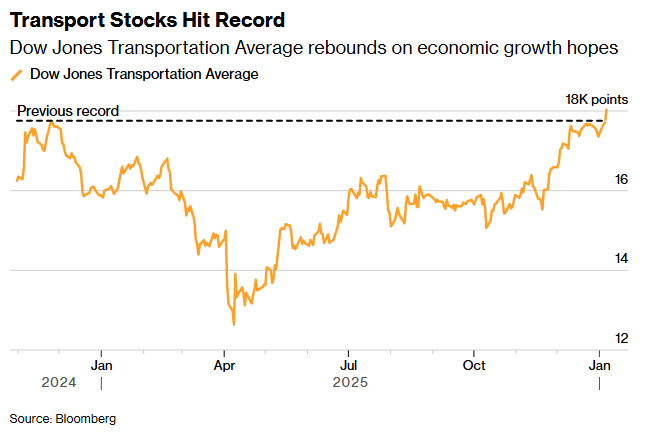
Group 1 - The core viewpoint of the articles highlights that U.S. transportation stocks reached a historical high driven by strong economic growth expectations for the year [1][2] - The Dow Jones Transportation Average Index rose by 1.7%, closing at 18,033.58 points, surpassing its previous historical high set in November 2024 [1] - The index tracks 20 U.S. transportation stocks across various sectors including airlines, trucking, shipping, and logistics, serving as an economic barometer [1] Group 2 - Transportation stocks faced several headwinds over the past 12 months, including trade wars, tariffs, and government shutdowns, which made investors cautious [2] - The sector continued to rise after a 1.2% increase on Monday, with gains attributed to expectations of lower fuel prices due to potential U.S. intervention in Venezuela [2] - As transportation stocks reached new highs, the overall U.S. stock market also strengthened, with major indices like the S&P 500 and Dow Jones hitting record levels [2]
美国经济向好前景提振!美股运输类股摆脱关税及停摆阴霾 强势反弹创新高
Zhi Tong Cai Jing· 2026-01-06 23:35
Group 1 - The Dow Jones Transportation Average Index reached a historical high of 18,033.58 points, driven by strong expectations for U.S. economic growth [1][3] - The index, which tracks 20 U.S. transportation stocks across various sectors including airlines, trucking, shipping, and logistics, is considered a barometer for the economy due to its insights into supply and demand across industries [3] - The rebound in transportation stocks follows a challenging year marked by trade wars, tariffs, and a prolonged government shutdown that negatively impacted the sector [3] Group 2 - Transportation stocks continued to rise after a 1.2% increase on the previous day, with airlines and logistics stocks benefiting from expectations of lower fuel prices due to potential U.S. intervention in Venezuela [3] - The overall U.S. stock market also performed well, with all three major indices closing higher, including the S&P 500 and the Dow Jones, which surpassed 49,000 points for the first time [3] - Market strategist Michael O'Rourke noted that transportation stocks are catching up to the overall market performance after facing several headwinds over the past year [3]