
美国经济增长预期

Search documents
AI颠覆担忧跨板块蔓延 下周聚焦美GDP初值、PCE指数 摩根士丹利上调2026美增长预期至2.6%
Sou Hu Cai Jing· 2026-02-14 22:43
Group 1 - The market is experiencing concerns that new AI tools may disrupt various industries, including insurance, wealth management, and transportation, with a shift in investor sentiment towards previously lagging sectors such as energy, consumer staples, materials, and industrials [1] - B Riley Wealth's chief market strategist Art Hogan likens the current market sentiment to a "whack-a-mole" game, where investors speculate on which industry AI will impact next, reflecting a broader anxiety about the technology's potential [1] - Nationwide's chief market strategist Mark Hackett notes that the shift in market leadership is becoming ingrained in investor psychology [1] Group 2 - Upcoming key economic indicators include the preliminary Q4 GDP, monthly consumer confidence survey, and the preferred inflation measure of the Federal Reserve, the Personal Consumption Expenditures (PCE) price index [1] - Morgan Stanley has raised its 2026 U.S. economic growth forecast to 2.6%, citing stronger capital expenditure assumptions, while warning that the biggest risk to the U.S. economy has shifted from trade protectionism to AI bubble risks [1] - The Federal Reserve's January monetary policy meeting minutes will be released next Wednesday, which may provide insights into the rationale behind the "wait-and-see" stance and arguments for potential rate cuts [2]
原油,大涨
Zhong Guo Ji Jin Bao· 2026-01-09 00:44
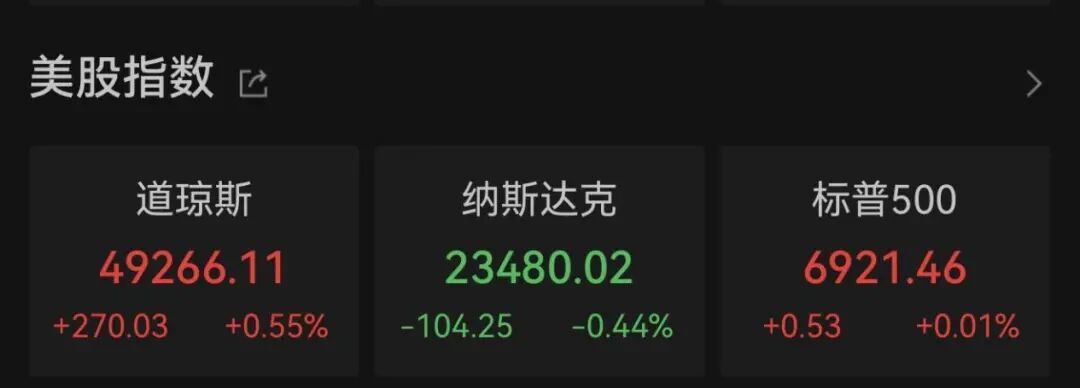
Market Performance - The Dow Jones Industrial Average rose by 270.03 points, an increase of 0.55%, closing at 49,266.11 points, while the Nasdaq Composite fell by 104.25 points, a decrease of 0.44%, closing at 23,480.02 points [2] - The S&P 500 index saw a marginal increase of 0.53 points, or 0.01%, closing at 6,921.46 points [2] Economic Outlook - Fitch Ratings has upgraded the U.S. GDP growth forecast for 2025 and 2026, incorporating delayed economic data due to the government shutdown [4] - The Federal Reserve is expected to lower the federal funds rate to 3.25% in the first half of 2026, with projections indicating a potential reduction of about 150 basis points [4] - Inflation expectations in the U.S. have risen, while consumer confidence in the job market has dropped to its lowest level in over 12 years [4] Energy Sector - Oil prices increased, with WTI crude for February rising by 3.2% to settle at $57.76 per barrel, and Brent crude for March up by 3.4% to $61.99 per barrel [5] - Energy stocks experienced a broad rally, with notable gains in companies such as ExxonMobil (up over 3%), Chevron (up over 2%), and ConocoPhillips (up over 5%) [5][6] Mining Industry - Glencore and Rio Tinto have resumed negotiations to potentially create the world's largest mining company, with a combined market value exceeding $260 billion [7] - The ongoing competition for copper resources is reshaping the mining landscape, prompting this merger discussion [7] Technology Sector - Major tech stocks showed mixed performance, with the U.S. Tech Seven Index declining by 0.27% [8] - Apple has seen a continuous decline for seven trading days, attributed to high interest rate expectations impacting growth stock valuations [8][10]


美国经济向好前景提振!美股运输类股摆脱关税及停摆阴霾,强势反弹创新高
Zhi Tong Cai Jing· 2026-01-06 23:58
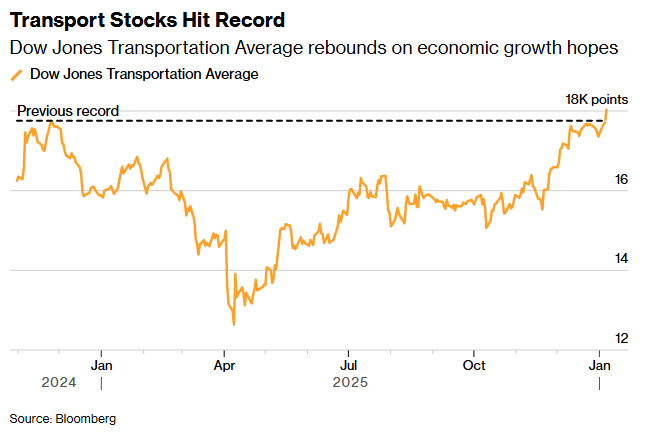
Group 1 - The core viewpoint of the articles highlights that U.S. transportation stocks reached a historical high driven by strong economic growth expectations for the year [1][2] - The Dow Jones Transportation Average Index rose by 1.7%, closing at 18,033.58 points, surpassing its previous historical high set in November 2024 [1] - The index tracks 20 U.S. transportation stocks across various sectors including airlines, trucking, shipping, and logistics, serving as an economic barometer [1] Group 2 - Transportation stocks faced several headwinds over the past 12 months, including trade wars, tariffs, and government shutdowns, which made investors cautious [2] - The sector continued to rise after a 1.2% increase on Monday, with gains attributed to expectations of lower fuel prices due to potential U.S. intervention in Venezuela [2] - As transportation stocks reached new highs, the overall U.S. stock market also strengthened, with major indices like the S&P 500 and Dow Jones hitting record levels [2]
美国经济向好前景提振!美股运输类股摆脱关税及停摆阴霾 强势反弹创新高
Zhi Tong Cai Jing· 2026-01-06 23:35
Group 1 - The Dow Jones Transportation Average Index reached a historical high of 18,033.58 points, driven by strong expectations for U.S. economic growth [1][3] - The index, which tracks 20 U.S. transportation stocks across various sectors including airlines, trucking, shipping, and logistics, is considered a barometer for the economy due to its insights into supply and demand across industries [3] - The rebound in transportation stocks follows a challenging year marked by trade wars, tariffs, and a prolonged government shutdown that negatively impacted the sector [3] Group 2 - Transportation stocks continued to rise after a 1.2% increase on the previous day, with airlines and logistics stocks benefiting from expectations of lower fuel prices due to potential U.S. intervention in Venezuela [3] - The overall U.S. stock market also performed well, with all three major indices closing higher, including the S&P 500 and the Dow Jones, which surpassed 49,000 points for the first time [3] - Market strategist Michael O'Rourke noted that transportation stocks are catching up to the overall market performance after facing several headwinds over the past year [3]
调查:经济学家上调 2026 年美国 GDP 增长预期
Sou Hu Cai Jing· 2025-12-19 14:08
Core Viewpoint - Economists have slightly raised their growth expectations for the US economy, indicating a more optimistic outlook for GDP growth in the coming years [1] Economic Growth - The projected GDP growth rate for the US in 2026 has been adjusted from 1.9% to 2% [1] - The growth expectation for 2025 has also been revised to 2% [1] Inflation Expectations - Inflation expectations have slightly decreased, with the Consumer Price Index (CPI) for 2026 anticipated to be 2.8%, suggesting that price pressures are gradually easing [1] Interest Rate Outlook - Market expectations for interest rates remain unchanged, with forecasts indicating that the Federal Reserve's policy rate will decline to 3.25% by the end of 2026, suggesting a potential gradual easing of monetary policy [1]
“金价杀手”可能是一场会议?美国经济预期因此被改写
Jin Shi Shu Ju· 2025-10-22 12:07
Core Viewpoint - The recent decline in gold prices, which saw a significant drop of 5.7% on the New York Commodity Exchange, is attributed to changing expectations regarding the U.S. economy following the IMF meeting, leading to a reassessment of the factors supporting gold investments [1][2]. Group 1: Price Movement and Market Analysis - Gold prices surged from $3000 to $4000 per ounce in less than two months, with an overall increase of over 60% this year, making a correction inevitable [1]. - The 5.7% drop in December gold futures represents the largest single-day percentage decline since June 20, 2013 [1]. - The IMF meeting in Washington likely led participants to raise their expectations for U.S. economic growth, which removed a key support for recent gold investment logic [1][2]. Group 2: Diverging Opinions on Price Drivers - Robin Brooks from Brookings Institution argues that the main driver of recent gold price movements is the state of the U.S. economy and the potential for recession, which influences Federal Reserve monetary policy [1][2]. - Carsten Stork from Stratcom Capital suggests that the gold price drop is a mechanical adjustment following market exuberance, driven by over-leveraged positions and algorithmic trading [2]. - Other analysts, such as Peter Perkins from MRB Partners, indicate that the strengthening dollar is a contributing factor, asserting that gold prices are historically high and overvalued relative to stock markets, money supply, and GDP [2].
全美商业经济协会调查显示,美国就业增长将依旧疲弱
Huan Qiu Wang· 2025-10-14 01:09
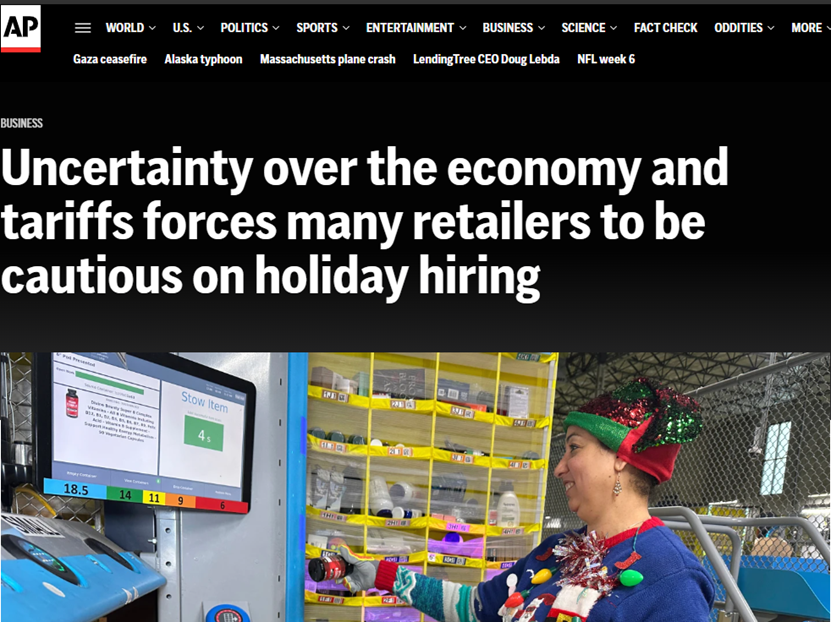
Group 1 - Economists have raised their growth forecasts for the US economy for the next two years, with a projected GDP growth of 1.8% for this year, up from the previous estimate of 1.3% [1] - Retailers are cutting or delaying hiring seasonal workers due to uncertainties related to the economy and tariffs, impacting their ability to prepare for the holiday shopping season [1][4] - The hiring plans of retailers indicate the first signs of the holiday shopping season, but the US job market is losing momentum, partly due to uncertainties from the trade war [4] Group 2 - A specific retailer plans to hire 220 temporary workers for the holiday season, which is a decrease from the 300 hired last year, and they have started recruitment nearly two months earlier than usual [1] - Analysts will closely monitor consumer reactions to price increases from retailers due to high tariff costs in the coming months [4]
9月美联储议息会议点评2025年第6期:兑现降息预期,否认降息周期
Huachuang Securities· 2025-09-18 04:42
Monetary Policy Changes - The Federal Reserve announced a rate cut of 25 basis points in September, lowering the federal funds rate range from 4.25%-4.5% to 4%-4.25%[4] - The updated dot plot indicates an increase in expected rate cuts for 2025 from 2 to 3 times, while maintaining 1 cut for both 2026 and 2027[3] Economic Forecast Adjustments - The Fed raised its 2025 GDP growth forecast by 0.2% to 1.6% and the core PCE inflation forecast for 2026 by 0.2% to 2.6%[2] - The unemployment rate forecast for 2026 was adjusted down from 4.5% to 4.4%[6] Risk Assessment - The Fed noted a weakening transmission of high tariffs to inflation levels and emphasized the softening labor market[2] - The risks to employment have increased, leading to the decision to cut rates[5] Market Implications - Post-rate cut, investor risk pricing may shift towards U.S. inflation risks and macroeconomic risks in the Eurozone[2] - The Fed's rate cut is characterized as a "risk management" cut, indicating no systemic economic downturn is anticipated[8] Consumer and Credit Data - U.S. household consumption remains better than expected, with the unemployment rate still low, suggesting a resilient economy[9] - As of August, corporate credit growth reached a 27-month high at 4%, indicating strong bank lending activity[9]
芦哲:联邦巡回法院裁定特朗普征收IEEPA对等关税违法——海外周报
Sou Hu Cai Jing· 2025-09-01 03:30
Core Viewpoint - The recent dismissal of Federal Reserve Governor Cook by Trump and the mild PCE data have heightened expectations for interest rate cuts, leading to a rise in U.S. stocks and a decline in bond yields. However, a sell-off in technology stocks caused a reversal in stock gains, with the S&P 500 and Nasdaq indices closing down by 0.10% and 0.19% respectively [1][2]. Group 1: Major Asset Movements - The announcement of Cook's dismissal raised concerns about the independence of the Federal Reserve, while the July PCE data met expectations, further increasing rate cut anticipations. The 10-year U.S. Treasury yield fell by 2.53 basis points to 4.228%, and the 2-year yield decreased by 7.96 basis points to 3.617%. The dollar index dropped by 0.06% to 97.77, while spot gold prices rose by 2.26% to $3447 per ounce [2][3]. Group 2: Economic Indicators - The U.S. Q2 GDP revision showed a seasonally adjusted annual rate of +3.3%, exceeding the expected +3.1%. Fixed asset investment's contribution was revised up from +0.08% to +0.59%, and consumption's contribution was adjusted from +0.98% to +1.07%. Analysts have slightly raised their Q3 growth expectations, with the Atlanta Fed's GDPNow model predicting +3.5% for Q3 [3][4]. Group 3: Political Developments - Trump's dismissal of Cook is unprecedented since the Federal Reserve's establishment in 1913, raising market concerns about the Fed's independence. Cook has filed a lawsuit against Trump, and the case is expected to reach the Supreme Court. Additionally, a federal appeals court ruled that Trump's use of the International Emergency Economic Powers Act (IEEPA) to impose tariffs was illegal, although tariffs will remain in effect until October 14 [4][5].
宏观经济深度研究:数字的修正与预期的转折
工银国际· 2025-08-13 05:54
Employment Data Revision - Since 2025, U.S. non-farm employment data has been revised down by a total of 461,000 jobs, indicating a more significant weakness in the labor market than initially reported[2] - Historical patterns show that significant downward revisions in non-farm data often precede economic slowdowns, as seen during the 2001 internet bubble and the 2008 financial crisis[3] - The downward trend in non-farm data has been consistent over the past three years, with revisions of 546,000, 577,000, and 461,000 jobs respectively[3] Labor Market Indicators - Job vacancies have decreased from a peak of 12.134 million in March 2022 to 7.437 million by June 2025, a decline of nearly 40%[10] - The unemployment rate has risen from 3.5% in late 2023 to 4.2% by July 2025, reflecting a gradual but persistent upward trend[10] - Initial claims for unemployment benefits have increased from around 200,000 in early 2023 to 250,000 by June 2025, indicating a rise in layoffs[10] Market Expectations and Federal Reserve Policy - Market expectations for Federal Reserve rate cuts have shifted significantly, with the probability of a 25 basis point cut in September rising from 38% to 80% within a few days[13] - The likelihood of cumulative rate cuts of 50 to 75 basis points by the end of the year has increased from less than 8% to 53.1%[13] - The focus of market speculation has transitioned from "whether to cut rates" to "how much to cut" as labor market data continues to weaken[13]