
工业资源品

Search documents
帮主郑重早间观察:降准降息在路上?A股十三连阳+开户爆增,中长线机会这样抓
Sou Hu Cai Jing· 2026-01-07 02:10
Market Overview - The Shanghai Composite Index has achieved its longest winning streak in 33 years with thirteen consecutive days of gains, and new account openings have surged to a nearly three-year high [1][3] - In 2025, over 27 million new accounts were opened, with institutional account openings increasing by 35% year-on-year, indicating a significant shift towards institutional investment [3] Monetary Policy and Economic Outlook - The People's Bank of China has included flexible use of reserve requirement ratio (RRR) cuts and interest rate reductions in its toolkit for 2026, alongside potential interest rate cuts from the Federal Reserve, which may lead to a mild appreciation of the RMB [3] - The market logic for 2026 is shifting from valuation-driven speculation to a focus on corporate earnings, providing a more solid foundation for medium to long-term investments [3] Investment Opportunities - Focus on medium to long-term investments rather than short-term speculative plays, avoiding sectors with low fundamental support [4] - Key sectors to watch include industrial resources aligned with AI and global manufacturing recovery, such as copper, aluminum, and lithium; equipment export chains like photovoltaics, lithium batteries, and engineering machinery; and consumer sectors benefiting from recovery, including aviation, hotels, and food and beverage [4] - The tightening of export controls on dual-use items to Japan and the potential tightening of rare earth export reviews highlight the strategic importance of these resources, making companies with core resources worth monitoring for long-term investment [4] Investment Strategy - Emphasize a long-term investment approach, akin to slow-cooking, rather than reacting to short-term market fluctuations [4] - Selecting the right sectors and holding fundamentally strong companies with growth potential is deemed more reliable than frequent trading based on market volatility [4]


国金证券:A股新的主线浮出水面 把握当下切换窗口期
智通财经网· 2025-12-28 11:49
Group 1 - The core viewpoint is that a new investment theme for 2026 is emerging in commodity markets, real industry chains, and foreign exchange markets, driven by a scenario where investment exceeds consumption [1] - The report recommends focusing on industrial resource products that resonate with AI investment and global manufacturing recovery, including copper, aluminum, tin, lithium, crude oil, and oil transportation [1] - It also highlights the Chinese equipment export chain with global comparative advantages, confirming a cyclical bottom, including sectors like power grid equipment, energy storage, lithium batteries, photovoltaics, engineering machinery, and commercial vehicles [1] Group 2 - The A-share market is experiencing a gradual upward trend, with the cross-year market rally starting, moving beyond a single narrative focused on AI to a broader range of themes including domestic demand and new industry topics [2] - The price increase chain has become a market focus, driven by rising raw material prices and the effects of anti-involution policies, leading some companies to reduce production and jointly raise prices [3] - The ongoing global manufacturing recovery is expected to continue with investment outpacing consumption, while the relationship between AI investment and metal prices is compared to past trends in coal and new energy [4] Group 3 - The new external circulation pattern is leading to a new cycle of RMB appreciation, primarily driven by the weakening dollar and seasonal capital inflows, with expectations of a recovery in China’s export resilience [5] - The RMB's appreciation is alleviating cost pressures from rising prices of commodities and integrated circuits, benefiting sectors such as communication equipment, environmental governance, aviation, electronics, and lithium batteries [6] - Historical trends indicate that during periods of RMB appreciation, the sales gross margin of companies exposed to high external demand typically experiences a slight increase followed by a decrease, suggesting a nuanced impact on export competitiveness [6]

国金证券:2026年新的投资主线正在慢慢浮出水面
Xin Lang Cai Jing· 2025-12-28 10:13
Core Viewpoint - The new investment theme for 2026 is emerging in the commodity market, real industry chain, and foreign exchange market, characterized by a scenario where investment exceeds consumption, leading to increased physical consumption across manufacturing sectors and extended trading ranges for bulk commodities, with China's manufacturing advantages becoming more evident and reflected in the foreign exchange market [1] Group 1: Investment Opportunities - Focus on AI investments and industrial resource products that resonate with the global manufacturing recovery, including copper, aluminum, tin, lithium, crude oil, and oil transportation [1] - Attention to China's equipment export chain, which has global comparative advantages and is confirmed at the cycle bottom, including power grid equipment, energy storage, lithium batteries, photovoltaics, engineering machinery, and commercial vehicles, as well as domestic manufacturing sectors showing signs of bottom reversal, such as chemicals (dyeing, coal chemicals, pesticides, polyurethane, titanium dioxide) and wafer manufacturing [1] - Capture the recovery in inbound tourism and the increase in residents' income, leading to a rebound in consumption in sectors like aviation, hotels, duty-free shops, and food and beverages [1] - Benefit from the expansion of the capital market and the bottoming out of long-term asset returns in non-bank sectors, including insurance and brokerage firms [1]
国金策略:单一产业叙事能够带来的收益已经越来越不稳定和难以把握 抓住行情的窄幅波动期布局2026年新主线
Sou Hu Cai Jing· 2025-12-21 12:44
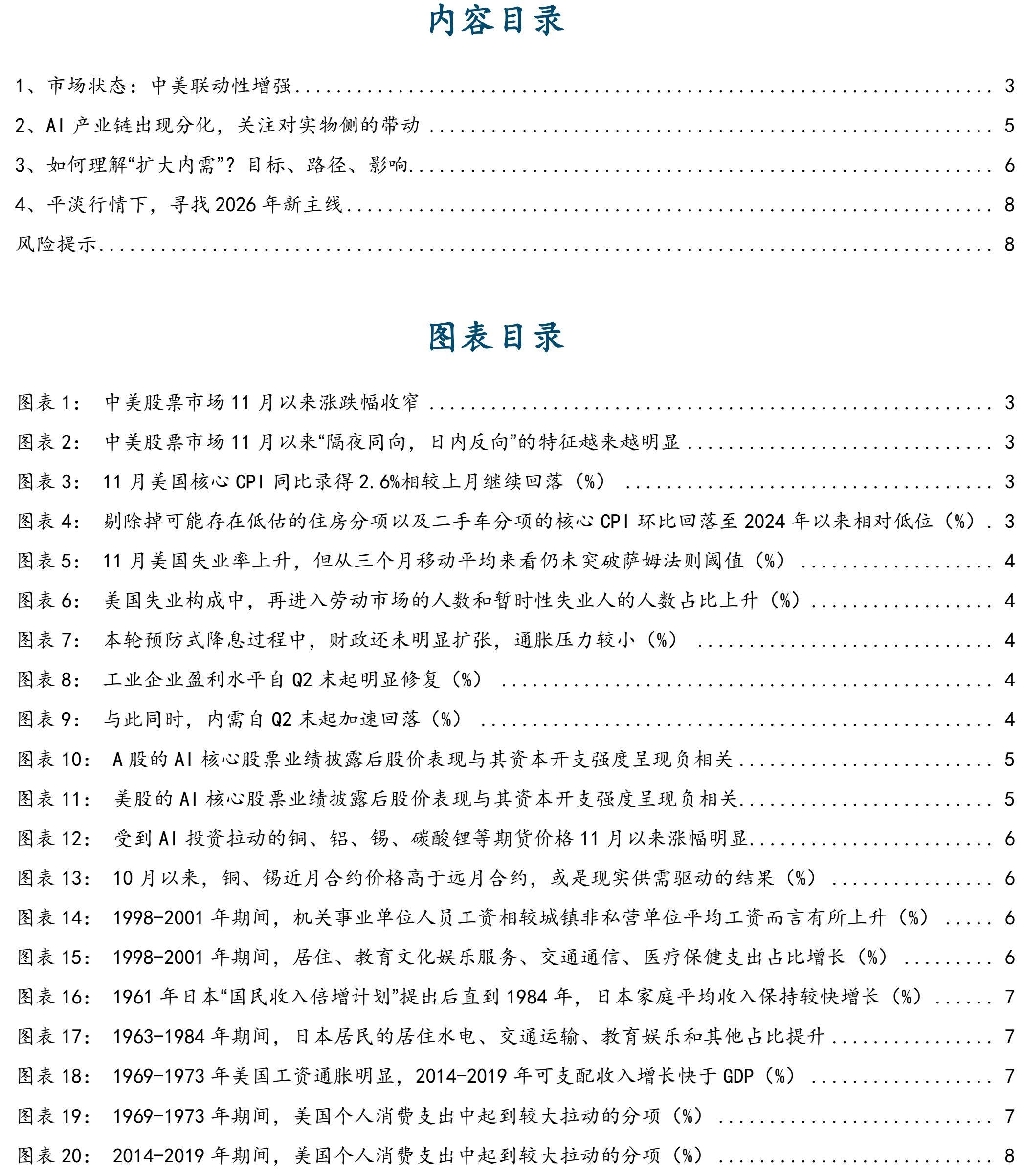
Group 1 - The market status indicates an increased correlation between the US and Chinese markets, with the 20-day rolling correlation of the CSI 300 and S&P 500 rising above the 90th percentile, reflecting a new normal of "overnight alignment and intraday reversal" [2][10][13] - The US core CPI has decreased to 2.6%, the lowest in three and a half years, while the unemployment rate has risen to 4.6%, primarily due to increased labor participation and temporary unemployment, indicating a stable economic environment without significant inflationary pressures [2][10][13] - China's economic fundamentals show a combination of corporate profit bottoming out and a decline in domestic demand, which opens a window for further policy support [2][10][13] Group 2 - The AI industry chain is experiencing a divergence, with broader AI-related assets (copper, lithium, aluminum, energy storage, and electrical equipment) performing better than core AI assets (computing chips, optical modules, PCB) [3][24][25] - Investors are becoming less tolerant of the contradiction between aggressive capital expenditures and the lack of revenue growth in companies within the AI industry chain, leading to a negative correlation between stock performance and capital expenditure as a percentage of revenue [3][24][25] - Commodity prices for copper, aluminum, tin, and lithium carbonate have been rising since late October, driven by demand from AI investments, with near-term contracts for copper and tin outperforming longer-term contracts [3][24][25] Group 3 - The concept of "expanding domestic demand" is emphasized as a strategic move, with a focus on increasing consumer demand supported by income growth and effective investment [4][31][32] - The government plans to enhance the second distribution of income by increasing minimum pension standards and implementing childcare subsidies, while future efforts may focus on optimizing the first distribution through wage reforms [4][31][32] - Historical examples from Japan and the US illustrate that income growth leads to increased service and new-type consumption, suggesting that China's current income growth initiatives could similarly boost consumer spending [4][31][32] Group 4 - The current market environment, characterized by limited macro elasticity and increased industry differentiation, suggests a shift in investment strategy towards tangible demand and domestic policy benefits as the new focus for 2026 [5][42][43] - Recommendations include investing in industrial resource products (copper, aluminum, tin, lithium, crude oil) that benefit from AI investment and global manufacturing recovery, as well as sectors poised for recovery in consumer spending (airlines, hotels, duty-free, food and beverages) [5][42][43] - Non-bank financial institutions (insurance, brokerage) are expected to benefit from capital market expansion and a rebound in long-term asset returns, alongside opportunities in China's equipment export chain and manufacturing sectors [5][42][43]
国金策略:国内中央经济工作会议定定调扩内需、反内卷,走出通缩路径明晰
Sou Hu Cai Jing· 2025-12-14 10:10
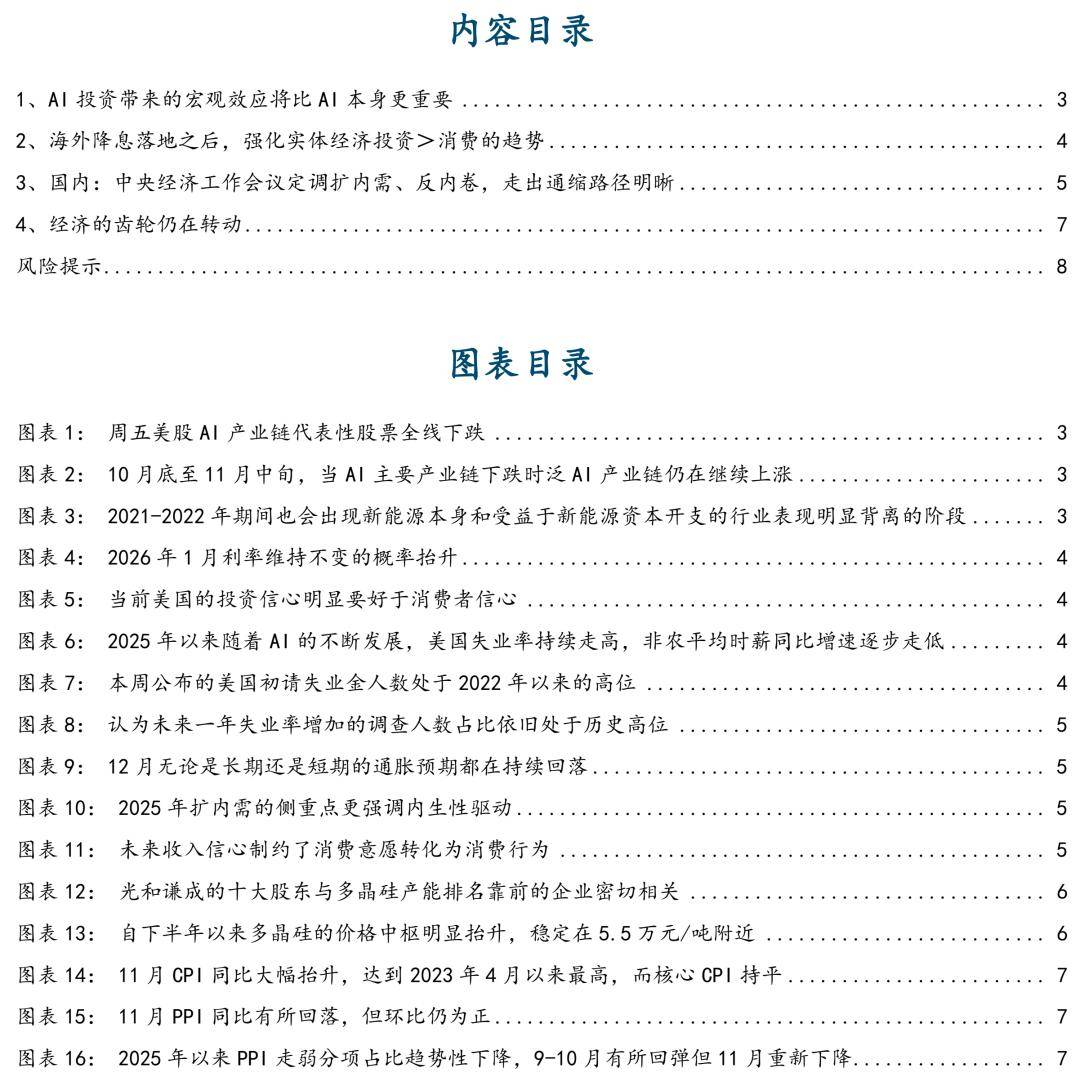
Group 1 - The macro effects brought by AI investment will be more important than AI itself, as evidenced by the significant drop in AI tech stocks like Oracle and Broadcom, which reflects market concerns about future performance despite increased capital expenditure guidance [2][12][13] - The recent drop in AI stocks does not affect the upward adjustment of AI investment guidance, indicating a divergence between AI stock performance and the broader macroeconomic benefits of AI investment [2][12][33] Group 2 - The recent interest rate cuts and the Federal Reserve's announcement to purchase short-term government bonds are expected to strengthen the trend of investment exceeding consumption in the real economy [3][15][17] - The rising unemployment rate and declining average hourly wages in the U.S. are likely to catalyze further interest rate cuts, with a potential path from AI investment to monetary policy and then to real economic demand recovery [3][17] Group 3 - The Central Economic Work Conference in China has set the tone for expanding domestic demand and addressing "involution," clarifying the path out of deflation [4][20][22] - The focus on expanding domestic demand has shifted from government-led initiatives to endogenous drivers, emphasizing income growth for a broader population and activating private capital [4][22][23] - The conference's emphasis on "anti-involution" in the manufacturing sector is crucial for corporate profit recovery, which historically leads to improvements in employment and wages [4][23][26] Group 4 - Despite market volatility related to AI stock performance and interest rate expectations, the actual impacts on the fundamentals should be the focus, as AI investment continues to be adjusted upwards and will stimulate manufacturing demand [5][33] - Recommendations include focusing on industrial resource chains benefiting from AI investment and the recovery of global manufacturing, as well as opportunities in China's equipment exports and consumer sectors [5][33]
A股开盘速递 | A股集体高开 沪指涨0.16% 商业航天等板块领涨
智通财经网· 2025-12-08 02:28
Market Overview - The A-share market opened higher with the Shanghai Composite Index rising by 0.16% and the ChiNext Index increasing by 0.32% [1] - Sectors such as commercial aerospace, military industry, and securities saw significant gains, while photovoltaic, consumer electronics, and coal sectors experienced declines [1] Institutional Insights - CITIC Securities suggests that the current market volatility is a normal state before potential fundamental changes, with a focus on resource revaluation and companies expanding overseas [1] - The firm anticipates that potential appreciation of the RMB may lead to unexpected monetary easing, which could disrupt the current volatility pattern [1] - Short-term risks include intensified US-China tensions in technology, trade, and finance, as well as domestic policy effectiveness and economic recovery falling short of expectations [1] Sector Focus - Everbright Securities emphasizes short-term attention on defensive and consumer sectors, while mid-term focus remains on TMT (Technology, Media, and Telecommunications) and advanced manufacturing sectors [2] - The firm notes that the market may lack strong catalysts in the short term, leading to a phase of consolidation [2] - High dividend and consumer sectors are expected to perform better during the current market fluctuations [2] Recommendations - Guojin Securities identifies a clearer mainline structure emerging in the market, recommending investments in industrial resource products and non-bank financials [3] - The firm highlights the positive feedback loop between the easing of constraints on non-bank financial institutions and the recovery of overall profitability in the A-share market [3] - Key investment areas include industrial resource chains (copper, aluminum, lithium, oil), non-bank financials (insurance, brokerage), and opportunities in China's equipment exports and manufacturing sectors [3]
2026年度策略系列电话会 - 宏观:短期答案在长期
2025-12-04 02:21
Summary of Conference Call on 2026 Strategy Industry Overview - The conference call focused on the macroeconomic outlook for China in 2026, emphasizing the stability of the economic fundamentals with limited fluctuations and a low probability of policy stimulus. The real estate market, particularly housing prices, is identified as a key macro variable [1][3]. Core Insights and Arguments - **Economic Stability**: The Chinese economy is expected to remain stable in 2026, with limited volatility unless strong policy stimulus occurs, which is deemed unlikely [3]. - **Real Estate Market**: The real estate sector may see a turning point, with investment growth potentially converging to around 7% in 2026, down from a 15% decline in 2025. However, risks related to construction intensity and housing price adjustments are highlighted [9][10]. - **Capital Expenditure**: There is a declining willingness for corporate capital expenditure, leading to increased liquidity in the A-share market. The consensus is forming around a slow bull market for A-shares due to ample liquidity and risk appetite [14][15]. - **Asset Allocation Recommendations**: It is advised to increase allocation to assets with low correlation to the domestic economy but high correlation to the overseas economy. Key sectors to focus on include technology growth, industrial chain restructuring, and sectors related to global economic recovery, such as chemicals [6][26]. Additional Important Points - **Structural and Cyclical Issues**: The Chinese economy faces both structural and cyclical challenges, with the disappearance of the demographic dividend being a fundamental issue. Structural adjustments are necessary rather than relying on strong stimulus [7]. - **Manufacturing Investment Challenges**: Manufacturing investment is currently facing challenges due to factors like overseas expansion and anti-competitive pressures, leading to a significant decline in capital expenditure since 2024 [11]. - **Inventory Cycle**: The inventory cycle has returned to bottom levels since mid-2023, with expectations of a rebound in 2026 as supply-demand dynamics shift [12]. - **Inflation Trends**: The impact of anti-competitive measures on PPI is significant, with expectations of a slight recovery in PPI by the end of 2026 due to external demand pressures [13]. - **Real Estate Valuation Risks**: The real estate market is facing high valuation risks, with mortgage loan-to-value (LTV) ratios indicating potential vulnerabilities as housing prices decline [21][22]. Conclusion - The macroeconomic outlook for 2026 suggests a cautious but stable environment, with specific focus areas for investment opportunities in technology, industrial restructuring, and sectors benefiting from global demand. The real estate market's dynamics will be crucial in shaping the overall economic landscape.