
私募

Search documents
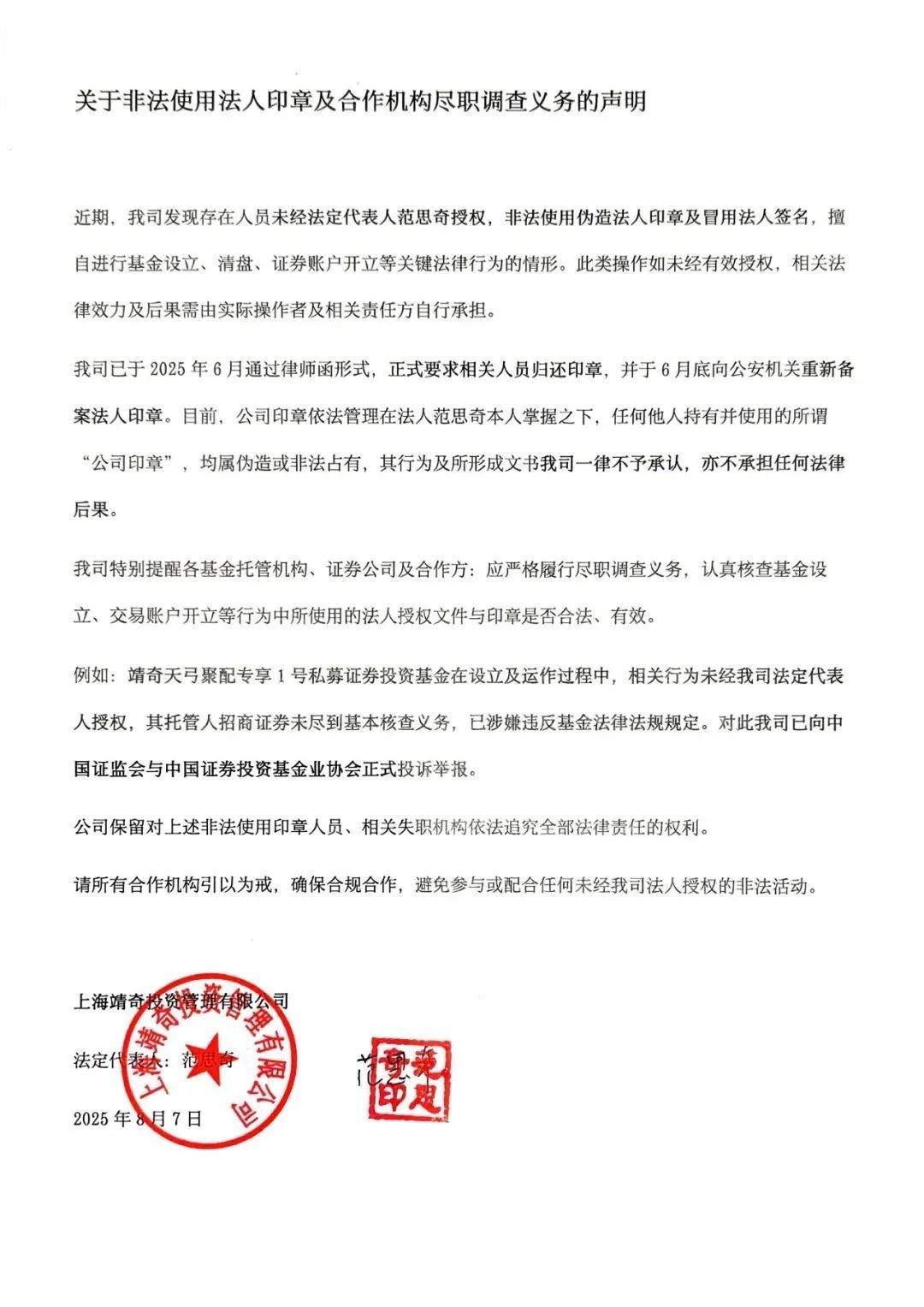
内斗升级,知名私募紧急声明!
中国基金报· 2025-08-07 16:13
Core Viewpoint - The article discusses the internal conflict within Jingqi Investment, highlighting the unauthorized use of a forged corporate seal and the subsequent legal actions taken by the company to address the issue [5][6][9]. Group 1: Company Statement and Actions - Jingqi Investment issued a statement regarding the illegal use of a forged corporate seal and unauthorized actions taken by certain individuals without the legal representative's consent [5][6]. - The company has formally requested the return of the seal through a lawyer's letter and has re-registered the seal with the police [6]. - Jingqi Investment emphasizes that any documents signed with the forged seal will not be recognized, and the legal consequences will fall on the actual perpetrators [6][7]. Group 2: Internal Conflict and Management Changes - The company has been experiencing internal strife since June, with significant changes in management, including the resignation of the founder, Fan Siqi, from his role as fund manager [9]. - Fan Siqi announced the liquidation of certain self-managed funds, which only represent a small portion of the company's total assets under management [9]. - The conflict escalated with accusations from both sides, with Fan Siqi claiming he was unfairly removed from the company, while the remaining partners accused him of unauthorized actions [9][10]. Group 3: Company Background and Financials - Jingqi Investment is a quantitative private equity firm established for 10 years, managing assets between 1 billion to 2 billion yuan [9]. - The ownership structure includes Fan Siqi holding 36.36% of the shares, while other partners hold 27.27% each, and a management partnership holds 9.09% [9].


靖奇投资“内斗大战”升级,创始人互撕,怒斥招商证券失职
Feng Huang Wang Cai Jing· 2025-08-07 14:03
Core Viewpoint - The internal conflict at Jingqi Investment has escalated from corporate governance issues to legal and regulatory matters, following the dismissal of co-founder and fund manager Fan Siqi and allegations of forgery and negligence against the custodian, China Merchants Securities [1][3]. Group 1: Company Governance and Management - Fan Siqi announced his resignation as fund manager and the liquidation of his self-managed products on June 11, citing immense pressure from market changes [3]. - Jingqi Investment emphasized that the company is operating stably with efficient collaboration and is confident about future development [5]. - A letter titled "Ten Years of Effort, One Morning of Betrayal" accused the company of sudden dismissal of all positions held by Fan Siqi during a shareholder meeting [5][7]. Group 2: Legal Actions and Complaints - Jingqi Investment has taken two actions regarding the alleged misuse of the company seal: filing a report with the police and formally complaining to the CSRC and the Asset Management Association of China about the custodian's duties [1]. - The company stated that the management of the company seal is under the control of Fan Siqi, and any other seals in possession are considered forged [1]. Group 3: Company Structure and Ownership - Jingqi Investment was established on March 9, 2015, and has a management scale ranging from 1 billion to 2 billion yuan, with 17 full-time employees [7]. - Fan Siqi holds approximately 42.73% of the shares, making him the largest shareholder, while partners Mao Noping and Tang Jingren each hold about 28.64% [9].

7月私募产品备案创近2年新高 前十均为百亿量化私募
Cai Jing Wang· 2025-08-07 08:08
Group 1 - The core viewpoint of the articles highlights the significant growth in the number of private equity securities products, particularly in quantitative strategies, driven by a favorable A-share market and increased investor confidence [1][2][3] - As of July 31, 2025, there were 1,298 private equity securities products registered in July, marking an 18.00% month-on-month increase and the highest level in nearly 27 months [1] - The total number of registered private equity securities products for the year reached 6,759, reflecting a year-on-year increase of 61.39% [1] Group 2 - In July, stock strategy products dominated the registration, accounting for 887 products, which is 68.34% of the total, with a month-on-month growth of 24.58% [2] - Multi-asset strategy products totaled 162, representing 12.48% of the total, with a month-on-month increase of 5.88% [2] - Quantitative products saw a significant month-on-month increase of 19.00%, with 620 products registered, making up 47.77% of the total [3] Group 3 - Among the registered quantitative products, stock strategies were the primary focus, with 478 stock strategy quantitative products registered in July, accounting for 77.10% of the total quantitative products [3] - The number of registered quantitative products for the year reached 3,081, representing a year-on-year increase of 77.68% [3] - The leading quantitative private equity firm, Kuande, registered 31 products in July, primarily in index enhancement strategies [4] Group 4 - The overall improvement in liquidity in the A-share market has created a favorable environment for quantitative models, enhancing their operational effectiveness [4] - Quantitative strategies, particularly data-driven stock selection strategies, are expected to show stronger advantages in the context of structural market trends and industry opportunities [4]
商品,要抄底吗?
雪球· 2025-08-07 08:02
Core Viewpoint - The article discusses the recent volatility in the commodity market, highlighting the impact of market sentiment and policy changes on investment strategies, particularly in the context of CTA (Commodity Trading Advisor) strategies [5][23]. Market Environment - The commodity market experienced a reversal due to various factors, including liquidity conditions and economic recovery expectations, leading to a significant price drop in some commodities, with weekly declines reaching up to 20% [5][6]. - The market's recent downturn is seen as a correction of expectations returning to reality, despite underlying support from liquidity and economic factors [5][6]. Investment Strategies - Several CTA strategies are analyzed, showcasing their diverse approaches to capturing market opportunities while managing risks [8][20]. - Strategy A employs a multi-strategy approach with a focus on traditional trend-following and fundamental analysis, maintaining a diversified portfolio across approximately 40 commodities, stock indices, and treasury futures [8][10]. - Strategy B utilizes high-frequency trading with a focus on short-term opportunities, achieving an annualized return of 14.68% since its inception, although it faced challenges in the current low-volatility environment [14][15][17]. - Strategy C, a well-established player, has shown resilience with a 10.2% annualized return since 2017, maintaining a diversified portfolio across over 60 trading instruments [20][21]. Performance Metrics - Strategy A reported an annualized return of 15.73% since March 2023, with a maximum drawdown of 11.52% [12]. - Strategy B's performance was impacted by market conditions, resulting in a return of less than 1% year-to-date, with a recent drawdown of 3.62% due to market reversals [17][18]. - Strategy C achieved an 8.06% return in the current year, demonstrating strong performance amidst market fluctuations [21]. Conclusion - The article concludes that the recent commodity market reversal was primarily driven by emotional trading rather than policy changes, emphasizing the importance of market sentiment in shaping investment outcomes [23].

三星DDR4停产时间延后至2026年底|首席资讯日报
首席商业评论· 2025-08-07 04:23
Group 1 - Samsung has decided to extend the production of DDR4 DRAM until December 2026, reversing its earlier plan to cease production this year due to a surge in demand for DDR4 [2] - The second batch of 718 counterfeit Pop Mart toys was seized by customs, indicating ongoing issues with intellectual property rights in the toy industry [3] - Xincheng Capital has successfully raised over 4.5 billion RMB for a new merger and acquisition fund, aiming to leverage the advantages of the Yangtze River Delta industrial cluster [4] Group 2 - The departure of Yan Weixin, co-founder of Zhiyuan Robotics, may highlight potential discrepancies in the company's technological direction and its alignment with market needs [5] - Recent agricultural policies in China, such as "one certificate, one product," are expected to enhance the quality and order of the pesticide market, benefiting leading companies with multiple registration certificates [6] - CITIC Securities maintains a positive outlook on the home appliance industry, driven by government subsidies and increased demand for air conditioning during summer [7] Group 3 - Infomedia has agreed to be acquired by TPG for approximately 421.4 million USD, with a 30% premium over its recent stock price [8] - A breakthrough in the development of a 6mm thick rare earth permanent magnet motor has been achieved, marking a significant advancement in high-end motor technology [9] - The film "Nanjing Photo Studio" has surpassed 1.7 billion RMB in box office revenue, indicating strong audience reception [10] Group 4 - Researchers have reduced the number of codons in E. coli from 64 to 57, potentially opening new avenues for drug and material development [11] - OpenAI has released two open-weight AI models capable of mimicking human reasoning, marking a significant step in AI accessibility [12] - JD Coin Chain is preparing to apply for a stablecoin license in Hong Kong, countering rumors of withdrawal from the market [13]
创27个月新高!私募产品备案量暴增,量化机构包揽前十
券商中国· 2025-08-07 02:22
Core Viewpoint - The A-share market's strong rebound has significantly boosted investor confidence, leading to explosive growth in the issuance of new private equity products [1][4]. Group 1: Private Equity Product Issuance - In July, the number of registered private equity securities products reached 1,298, a month-on-month increase of 18%, marking a 27-month high [2][3]. - The total number of registered private equity securities products this year has surged over 60% year-on-year, with quantitative strategies performing particularly well and attracting substantial capital inflows [2][4]. - The cumulative number of registered private equity securities products in the first half of the year reached 5,576, with a total registered scale of 184.13 billion yuan [4]. Group 2: Strategy Distribution - Stock strategies dominated the July registrations, accounting for 887 products, or 68.34% of the total, with a month-on-month growth of 24.58% [5][6]. - Multi-asset strategies and futures/derivatives strategies also showed steady growth, with 162 and 125 products registered in July, respectively [9]. Group 3: Market Dynamics - The strong performance of quantitative strategies has led to a rapid increase in management scale for many quantitative private equity firms, with the top ten registered products all belonging to billion-yuan quantitative institutions [2][6]. - The market's rebound and the outstanding performance of quantitative investments have driven significant capital inflows, reflecting a strong demand for asset allocation [4][7].
8.7犀牛财经早报:7月私募产品新备案数量创近两年月度新高 人保健康领115万元罚单
Xi Niu Cai Jing· 2025-08-07 01:35
Group 1: Private Equity Market - In July, the number of newly registered private equity securities investment funds increased by nearly 20% compared to June, reaching a two-year monthly high [1] - Nearly 70% of the new registered private equity products were stock strategy funds, totaling 887, which represents a month-on-month growth of 24.58% [1] - Year-to-date, the number of new registered private equity securities investment funds has increased by over 60% compared to the previous year, with a total of 6,759 funds registered by the end of July [1] Group 2: Quantitative Private Equity - The issuance of quantitative private equity products has surged, with July seeing a total of 1,298 registered securities products, an 18% increase month-on-month, marking a 27-month high [2] - The top ten registered funds in July were all from billion-dollar quantitative institutions, indicating a rapid growth in their management scale [2] Group 3: Disney's Financial Performance - Disney's third-quarter revenue exceeded expectations, with a 2.1% increase to $23.7 billion, driven by growth in theme parks and streaming services [3] - The theme park division saw a revenue increase of 13% to $2.52 billion, while streaming services achieved a quarterly profit of $346 million [3] - Traditional entertainment television revenue declined by 28%, and the film studio reported losses amid a broader industry contraction [3] Group 4: Gree Electric's Chip Development - Gree Electric has a chip team of nearly 1,000 people, with over 60% being technical personnel, indicating a strong focus on semiconductor development [9][10] - The company has been involved in the chip sector since 2015, establishing multiple research and development entities for various semiconductor products [10] Group 5: Market Trends - The U.S. stock market saw all three major indices rise, with the Dow Jones up 0.19%, the Nasdaq up 1.21%, and the S&P 500 up 0.73% [11] - Apple announced a significant investment plan in the U.S. to avoid potential tariffs, contributing to a surge in its stock price [11]

四大证券报精华摘要:8月7日
Zhong Guo Jin Rong Xin Xi Wang· 2025-08-07 00:07
Economic Outlook - Economic growth faces challenges, and the foundation for improvement needs further consolidation. Fiscal policy is expected to become "more proactive," focusing on key areas such as policy implementation, government bond issuance, expenditure optimization, and social welfare enhancement [1] A-Share Market Performance - The A-share market has shown strong performance, with margin financing and total margin balances rising. As of August 5, the total margin balance reached 2,000.26 billion yuan, and the financing balance was 1,986.31 billion yuan, both hitting over ten-year highs. On August 6, the market continued to rebound, with all three major indices rising, and over 3,300 stocks increasing in value [1] Private Equity Fund Recovery - Established private equity firms are experiencing a resurgence, with some reporting over 40% returns in the first half of the year. These firms are focusing on deep value exploration and growth sectors, showcasing a strategic vision aligned with market trends [2] Monetary Policy and External Factors - Experts believe that external monetary policy adjustments will have limited impact on China's monetary policy autonomy. The People's Bank of China emphasizes maintaining exchange rate flexibility and preventing excessive fluctuations [3] Banking Sector Performance - Six A-share listed banks reported positive half-year performance, attributed to improved net interest margins and non-interest income. Agricultural Bank of China has become the market leader in A-share market capitalization, surpassing Industrial and Commercial Bank of China [4][5] Power Sector Demand - High temperatures have led to record electricity demand, with the State Grid reporting a peak load of 1.233 billion kilowatts, an increase of 53 million kilowatts from the previous year's peak. This has heightened market interest in power sector companies [8][9] Share Buybacks - There has been an increase in share buybacks among listed companies, with 419 companies announcing 431 buyback plans this year. The proportion of buybacks aimed at capital reduction has risen to 18.33%, up from 15.19% last year, driven by policy guidance and valuation recovery needs [9]

量化私募产品发行火爆 7月备案量前十清一色为百亿量化机构
Zheng Quan Shi Bao Wang· 2025-08-06 23:29
Group 1 - The core viewpoint of the article highlights a significant increase in the issuance of private equity products in the A-share market, driven by improved investor confidence and favorable market conditions [1] - In July, the number of registered private equity securities products reached 1,298, marking an 18% month-on-month increase and the highest level in nearly 27 months [1] - The total number of registered private equity securities products this year has surged over 60% year-on-year, with quantitative strategies performing particularly well and attracting substantial capital [1] Group 2 - The top ten private equity firms by registration volume in July were all large quantitative institutions, indicating a trend towards rapid growth in management scale for many quantitative private equity firms [1]
业绩集体回暖老牌私募“王者归来”
Zhong Guo Zheng Quan Bao· 2025-08-06 21:09
Core Viewpoint - The resurgence of established private equity firms in China is highlighted, with many achieving significant performance recoveries and attracting renewed investment interest after a period of underperformance [1][2]. Group 1: Performance Recovery - Established private equity firms are experiencing a performance rebound, with some reporting year-to-date returns exceeding 40% [1]. - Notable firms like淡水泉投资 and 重阳投资 have reported year-to-date returns of 15.98% and over 15%, respectively, with近一年收益率 around 35% [1][2]. - 源乐晟 has also seen a turnaround, with year-to-date returns reaching 35.54% and over 40% in the last six months [2]. Group 2: Investment Strategies - Various strategies are being employed by established private equity firms, including deep value investing and growth-oriented investments, particularly in sectors like artificial intelligence [2]. - The adaptability of investment strategies to different market conditions is emphasized, with firms adjusting their approaches based on asset performance [2]. Group 3: Research and Organizational Reforms - Firms are actively reforming their research and investment frameworks to enhance adaptability and decision-making [3]. - For instance, 淡水泉投资 has restructured its research organization to improve its understanding of emerging industries and market dynamics [3]. - 星石投资 has implemented a multi-fund manager system to enhance decision-making and performance accountability [3]. Group 4: Market Outlook - The outlook for the market remains positive, with expectations of structural opportunities driven by policy support and active capital [4]. - Key areas of focus include the revaluation of high-quality Chinese assets, the globalization of competitive industries, and advancements in technology innovation [4]. - 源乐晟 anticipates favorable conditions in both Chinese and U.S. stock markets, driven by economic resilience and adjustments in investor sentiment [4].