传媒

Search documents
——策略周专题(2026年1月第2期):节前坚守稳健布局,静待节后新动能释放
EBSCN· 2026-01-18 09:27
Group 1 - The report suggests that investors should maintain a steady allocation strategy before the Spring Festival, anticipating the release of new momentum after the holiday [3][21] - The report highlights that the A-share market experienced a narrow fluctuation, with the Shanghai Composite Index slightly declining while the ChiNext and other indices showed gains [1][11] - The report indicates that the current valuation levels of the Sci-Tech 50 and the Wind All A indices are relatively high, with their PE(TTM) percentile ranks exceeding 90% as of January 16, 2026 [1][12] Group 2 - The report emphasizes the importance of monitoring the electronic, power equipment, and non-ferrous metals industries, which are expected to perform well in the upcoming market conditions [3][32] - The report notes that if the market style leans towards growth, the top-scoring industries in the five-dimensional industry comparison framework include electronics, power equipment, and communication [3][32] - In a defensive market style scenario, the top industries include non-bank financials, electronics, and power equipment, indicating a similarity in high-scoring industries across both growth and defensive styles [3][32] Group 3 - The report continues to focus on the commercial aerospace sector, which has shown signs of adjustment after a strong performance, suggesting that the sector may transition to a phase of consolidation [4][33] - The report warns of potential short-term profit-taking pressures in the commercial aerospace sector due to its previous high cumulative gains, but it remains optimistic about long-term growth driven by favorable industry policies [4][33]
申万宏源:真正将“行稳致远”纳入思考框架
Xin Lang Cai Jing· 2026-01-18 09:25
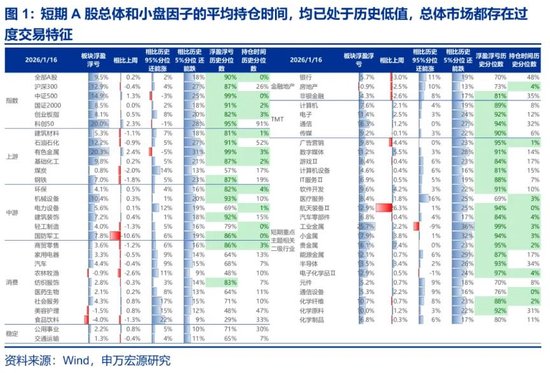
Group 1 - The 2026 market opening shows a clear characteristic of increased risk appetite driven by inflow of incremental funds, with commercial aerospace and AI application industries trending upwards [1][16] - The current market is experiencing strong momentum and excessive trading, which may lead to a short-term consolidation phase [1][16] - The average holding period for defense and military stocks is significantly lower than historical lows, indicating a decrease in stability for short-term momentum trades [1][19] Group 2 - The opening market is viewed as an extension of the strong structural technology market from 2025, which is now entering a high valuation adjustment phase [2][17] - Since September 2025, several high-momentum industries have entered a high-level consolidation phase, with notable examples including Nvidia's computing chain and Google's computing chain [2][17] - The market is expected to shift towards a consolidation phase after rapid valuation increases in new technology directions [2][17] Group 3 - The policy direction emphasizes a stable and long-term approach to avoid past investment pitfalls, such as the "deposit migration" of 2007 and the excessive trading of 2015 [10][26] - The A-share market has a mid-term upward basis, suggesting that a stable approach can balance short-term volatility with long-term goals [10][26] - The current market dynamics indicate a potential reduction in overall profit effects, with a need to wait for further economic and policy catalysts [10][28] Group 4 - The mid-term outlook for the A-share market suggests two phases of upward movement, with the first phase being driven by strong structural technology trends and the second phase potentially benefiting from cyclical improvements and increased asset allocation towards equities [12][28] - The characteristics of the two upward phases are interconnected, with the first phase led by cyclical alpha and AI computing, while the second phase may see a transition towards application-level AI trends [12][28]


策略周报:“春躁”行情面临短期压力-20260118
Bank of China Securities· 2026-01-18 09:18
Core Insights - The "Spring Rally" is facing short-term pressure, primarily due to a complex overseas macro environment, increased uncertainty in U.S. monetary policy, and domestic regulatory measures aimed at stabilizing the market [3][12][13] - The market sentiment is optimistic but cautious, with high equity risk premium (ERP) indicators suggesting that valuations are at a critical threshold [3][21][22] - The AI application sector is expected to continue its momentum, driven by macro liquidity, industry trends, and performance validation [3][37][39] Market Overview - The A-share market has experienced a rapid rise, but accumulated profit-taking and previous high valuations are creating resistance, necessitating a period of consolidation [12][13] - The market is currently in a phase of digestion and waiting for new catalysts, with a focus on managing trends and expectations along the "2X" line [23][37] Industry and Sector Performance - The computer and media sectors have benefited from AI application concepts, while the defense and military sectors have lagged due to cooling interest in commercial aerospace [31][34] - Semiconductor stocks are expected to benefit from strong performance in companies like TSMC, which reported a revenue of $33.67 billion, a 25.5% year-on-year increase, driven by AI chip demand [44] - The recent quarterly reports indicate a significant recovery in AI application revenue growth, with notable increases in sectors such as "AI + entertainment," "AI + office," and "AI + gaming" [42][44] Fund Flow and Investment Trends - Recent data shows a net outflow of 82.78 billion yuan from the A-share market, with significant inflows into the computer, electronics, and media sectors [46][47] - The stock market has seen a substantial net redemption of 114.83 billion yuan in equity ETFs, marking the largest weekly redemption in 13 months [46][50] - Structural adjustments in the stock market indicate a shift towards resource sectors and high-end manufacturing, with foreign capital increasing positions in new energy and semiconductor stocks [46][48]
本周热度变化最大行业为传媒、计算机:市场情绪监控周报(20260112-20260116)-20260118
Huachuang Securities· 2026-01-18 09:14
- The report introduces a "Total Heat Indicator" for monitoring market sentiment, which aggregates the heat indicators of individual stocks within broad-based indices, industries, and concepts[10][11] - The "Total Heat Indicator" is defined as the sum of the browsing, self-selection, and click counts of a stock, normalized by its market share on the same day, and then multiplied by 10,000, with a value range of [0,10000][10] - The report constructs a simple rotation strategy based on the weekly heat change rate (MA2) of broad-based indices, buying the index with the highest heat change rate at the end of each week, and staying out of the market if the "Others" group has the highest change rate[16][18] - The rotation strategy based on the heat change rate (MA2) of broad-based indices has an annualized return of 8.74% since 2017, with a maximum drawdown of 23.5%, and a return of 2.1% in 2026[19] - The report also constructs two simple portfolios based on the heat change rate of concepts, selecting the top 10 and bottom 10 stocks by total heat within the top 5 concepts with the highest heat change rate each week, and holding them equally[35] - The "BOTTOM" portfolio of low-heat stocks within high-heat concepts has historically achieved an annualized return of 15.71% with a maximum drawdown of 28.89%[37]
华金证券:春季行情未完 继续聚焦成长
Xin Lang Cai Jing· 2026-01-18 06:33
Group 1 - The core viewpoint is that the A-share market may continue to strengthen after a volume increase in the spring market, influenced by policies, external events, liquidity, and sentiment [1][8] - Historical data shows that in the past 16 spring markets since 2010, there were 11 instances where the total A-share trading volume increased by over 100% from the low to the high, and in 9 of those instances, the Shanghai Composite Index continued to rise [1][8] - Key factors affecting whether A-shares can continue to rise after a volume increase include policies and external events, liquidity, and sentiment of leading sectors prior to the volume increase [1][8] Group 2 - Currently, the A-share market is expected to continue a strong but volatile trend, with the spring market not yet over [2][9] - Short-term policies remain positive, with a dual easing of fiscal and monetary policies, and external risks are relatively limited, particularly in US-China relations and Middle Eastern geopolitical risks [2][9] - Short-term liquidity expectations are still loose, with the macro liquidity likely to remain accommodative, and the central bank has already implemented structural interest rate cuts [2][9] Group 3 - In the spring market, sectors that are likely to outperform include technology growth and certain cyclical industries, with historical trends indicating that sectors with low valuation sentiment may experience a rebound after a volume increase [3][10] - Current sectors expected to perform well include pharmaceuticals, machinery, and new energy, while media, military, and electronics may experience slight corrections before continuing to rise [3][10] - The ongoing trends in AI and commercial aerospace are expected to support the upward movement of related sectors such as TMT and military [3][10] Group 4 - Short-term recommendations suggest accumulating positions in technology growth and certain cyclical sectors that are currently undervalued [4][11] - Sectors such as machinery (robots), electronics (semiconductors, AI hardware), and pharmaceuticals (innovative drugs) are highlighted for their positive policy and industry trends [4][11] - Non-bank financials and consumer sectors (food, retail, and services) are also suggested for potential rebound and marginal improvement in fundamentals [4][11]
因子周报20260116:本周Beta和低杠杆风格显著定期报告-20260117
CMS· 2026-01-17 14:42
Group 1: Market Index and Style Performance Review - Major broad market indices mostly increased this week, with the CSI 500 rising by 2.18%, the Northbound 50 by 1.58%, and the CSI 1000 by 1.27%. However, the Shanghai Composite Index fell by 0.45% and the CSI 300 by 0.57% [2][10]. - Over the past month, all major broad market indices have risen, with the CSI 500 up by 17.59% and the CSI 1000 by 14.64% [10][11]. - In terms of industry performance, sectors such as computer, electronics, media, non-ferrous metals, and machinery performed well, while defense, agriculture, coal, real estate, and non-bank financials lagged behind [14][16]. Group 2: Factor Performance Tracking - In the CSI 300 stock pool, factors such as the 20-day volume variation coefficient, standardized unexpected earnings, and overnight momentum before earnings announcements performed well this week [3][24]. - In the CSI 500 stock pool, the 60-day specificity, 20-day specificity, and 60-day momentum factors showed strong performance [3][26]. - The overall market stock pool saw strong performance from quarterly ROA, quarterly ROE, and quarterly net profit margin factors [3][22]. Group 3: Quantitative Fund Performance - The average excess return for CSI 300 index-enhanced products was 0.58%, while the CSI 500 index-enhanced products had an average excess return of -0.26% [4][12]. - The best-performing active quantitative fund this week was Huian Quantitative Preferred A [4][12]. Group 4: Quantitative Index Enhancement Portfolio Tracking - The CSI 300 index enhancement portfolio achieved an excess return of 0.24% over the past week, while the CSI 500 index enhancement portfolio had an excess return of 0.27% [5][12]. - The CSI 800 index enhancement portfolio recorded an excess return of 0.59% [5].
港股投资周报:只周期股创一年新高,港股精选组合年内上涨6.17%-20260117
Guoxin Securities· 2026-01-17 11:02
Quantitative Models and Construction Methods 1. Model Name: Hong Kong Stock Selection Portfolio - **Model Construction Idea**: The model is based on a dual-layer selection process combining fundamental and technical analysis to identify outperforming stocks from an analyst-recommended stock pool[14][15] - **Model Construction Process**: 1. **Analyst Recommendation Pool**: Constructed using the following events: - Analyst upward earnings revisions - Analyst initial coverage - Analyst report titles indicating unexpected positive events[15] 2. **Dual-Layer Selection**: - **Fundamental Analysis**: Stocks with strong fundamental support are selected - **Technical Analysis**: Stocks with technical resonance are chosen 3. **Backtesting**: - Backtesting period: 2010-01-01 to 2025-12-31 - Full-investment strategy considering transaction costs[15] - **Formula**: Not explicitly provided in the report - **Model Evaluation**: The model demonstrates strong performance with significant annualized returns and excess returns over the Hang Seng Index[15] 2. Model Name: Stable New High Stock Screening - **Model Construction Idea**: The model leverages momentum and trend-following strategies, focusing on stocks that have recently reached 250-day highs and exhibit stable price paths[20][22] - **Model Construction Process**: 1. **250-Day High Distance Calculation**: - Formula: $ 250 \text{ Day High Distance} = 1 - \frac{\text{Close}_{t}}{\text{ts\_max(Close, 250)}} $ - $\text{Close}_{t}$: Latest closing price - $\text{ts\_max(Close, 250)}$: Maximum closing price over the past 250 trading days - If the latest closing price reaches a new high, the distance is 0; otherwise, it is a positive value indicating the fallback percentage[22] 2. **Screening Criteria**: - Stocks must meet the following conditions: - Analyst attention: At least 5 "Buy" or "Overweight" ratings in the past 6 months - Relative strength: Top 20% in 250-day price change within the sample pool - Price stability: Evaluated using metrics like price path smoothness and 250-day high distance averages over the past 120 days - Trend continuation: Top 50 stocks based on the 5-day average of 250-day high distance[23] - **Model Evaluation**: The model effectively identifies stocks with strong momentum and stable trends, aligning with established momentum theories[20][22] --- Model Backtesting Results 1. Hong Kong Stock Selection Portfolio - **Annualized Return**: 19.08% - **Excess Return over Hang Seng Index**: 18.06% - **Maximum Drawdown**: 23.73% - **Information Ratio (IR)**: 1.19 - **Tracking Error**: 14.60% - **Return-to-Drawdown Ratio**: 0.76[19] 2. Stable New High Stock Screening - **Sector Distribution**: - Cyclical: 13 stocks - Technology: 10 stocks - Financials: 5 stocks - Manufacturing: 4 stocks - Consumer: 4 stocks[22][23] - **Example Stocks**: - **China Eastern Airlines**: 250-day high distance: 6.6%, 250-day return: 116.6% - **Baidu Group-SW**: 250-day high distance: 0.4%, 250-day return: 87.4% - **China Gold International**: 250-day high distance: 0.0%, 250-day return: 304.4%[28] --- Quantitative Factors and Construction Methods 1. Factor Name: 250-Day High Distance - **Factor Construction Idea**: Measures the relative distance of the latest closing price from the 250-day high to capture momentum and trend-following signals[22] - **Factor Construction Process**: - Formula: $ 250 \text{ Day High Distance} = 1 - \frac{\text{Close}_{t}}{\text{ts\_max(Close, 250)}} $ - $\text{Close}_{t}$: Latest closing price - $\text{ts\_max(Close, 250)}$: Maximum closing price over the past 250 trading days - Interpretation: - A value of 0 indicates the stock is at its 250-day high - Positive values indicate the percentage fallback from the high[22] - **Factor Evaluation**: The factor effectively captures momentum and is supported by academic research and practical applications in trend-following strategies[20][22] --- Factor Backtesting Results 1. 250-Day High Distance Factor - **Example Stocks**: - **China Eastern Airlines**: 250-day high distance: 6.6%, 250-day return: 116.6% - **Baidu Group-SW**: 250-day high distance: 0.4%, 250-day return: 87.4% - **China Gold International**: 250-day high distance: 0.0%, 250-day return: 304.4%[28]
金融工程日报:a股高开低走,AI应用题材全线回落、存储器概念股爆发-20260117
Guoxin Securities· 2026-01-17 09:25
- The report does not contain any quantitative models or factors, so there are no specific models or factors to summarize - The report primarily focuses on market performance, market sentiment, capital flows, premium and discount rates, institutional attention, and leaderboard data - Market performance: The CSI 500 index performed well among scale indices, while the STAR 100 index performed well among sector indices, and the CSI 500 Growth index performed well among style indices[2][6][7] - Market sentiment: On January 16, 2026, 66 stocks hit the daily limit up, and 61 stocks hit the daily limit down. The closing return of stocks that hit the daily limit yesterday was -0.35%, and the closing return of stocks that hit the daily limit down yesterday was -6.30%. The sealing rate was 56%, and the continuous board rate was 12%[2][13][14][17] - Capital flows: As of January 15, 2026, the balance of margin trading and securities lending was 2.7188 trillion yuan, accounting for 2.6% of the market's circulating market value, and the proportion of margin trading and securities lending transactions in the market's transaction volume was 10.8%[2][19][22] - Premium and discount rates: On January 15, 2026, the ETF with the highest premium was the Semiconductor Equipment ETF Huaxia, with a premium of 1.88%, and the ETF with the highest discount was the Satellite Industry ETF, with a discount of 2.31%. The median annualized discount rates of the main contracts of the SSE 50, CSI 300, CSI 500, and CSI 1000 stock index futures over the past year were 0.70%, 3.79%, 11.11%, and 13.61%, respectively[3][23][26][28] - Institutional attention and leaderboard: The stocks with the most institutional research in the past week were Haitian Ruisheng, Dikang Holdings, Leo Group, Kaisheng Technology, Boying Special Welding, SF Express, Yunnan Germanium Industry, and Shengda Resources. The top ten stocks with net inflows from institutional seats on the leaderboard were Xue Ren Group, Tongyu Communications, Hongxiang Holdings, Yongxi Electronics, Shaanxi Tourism, Taili Technology, Jintaiyang, Hualing Cable, Shenguang Group, and Hengkun New Materials[4][30][32][36][37][39][41]
千问APP全面接入阿里生态,AI从聊天对话迈入办事时代
GUOTAI HAITONG SECURITIES· 2026-01-17 09:07
Investment Rating - The industry investment rating is "Overweight" [3] Core Insights - The integration of Qianwen APP into Alibaba's ecosystem marks a significant shift in AI applications from "chat dialogue" to "service execution," enhancing user experience by allowing seamless transactions across various services without switching applications [1][7][10] - The report emphasizes the importance of companies with technological reserves and customer resources in the marketing sector, as well as traditional media companies with editorial rights, in the evolving AI landscape [1][13] Summary by Sections Qianwen APP Integration - On January 15, Qianwen APP announced its integration with Alibaba's ecosystem, enabling AI-driven functionalities for ordering food, shopping, and travel planning, which significantly lowers user entry barriers [7][8] - The integration allows users to complete transactions through natural language commands, enhancing the overall user experience and operational efficiency [8][10] Industry Performance - The media index increased by 2.04%, ranking 4th among 31 industries, outperforming the Shanghai Composite Index, which decreased by 0.45% [6] - Recommendations for investment include companies like Wanda Film, Perfect World, and Mango Super Media, which are expected to maintain high growth in their respective niches [6][15] Marketing and Media Insights - The report highlights the shift from traditional SEO to GEO marketing strategies, where the focus is on real-time understanding and response to user queries, indicating a transformation in advertising dynamics [13][14] - The credibility and authority of training data for large models will become a core competitive advantage, emphasizing the unique value of mainstream media in the AI era [14]

今年市场的两条主线:AI和地缘、反内卷
Sou Hu Cai Jing· 2026-01-17 01:57
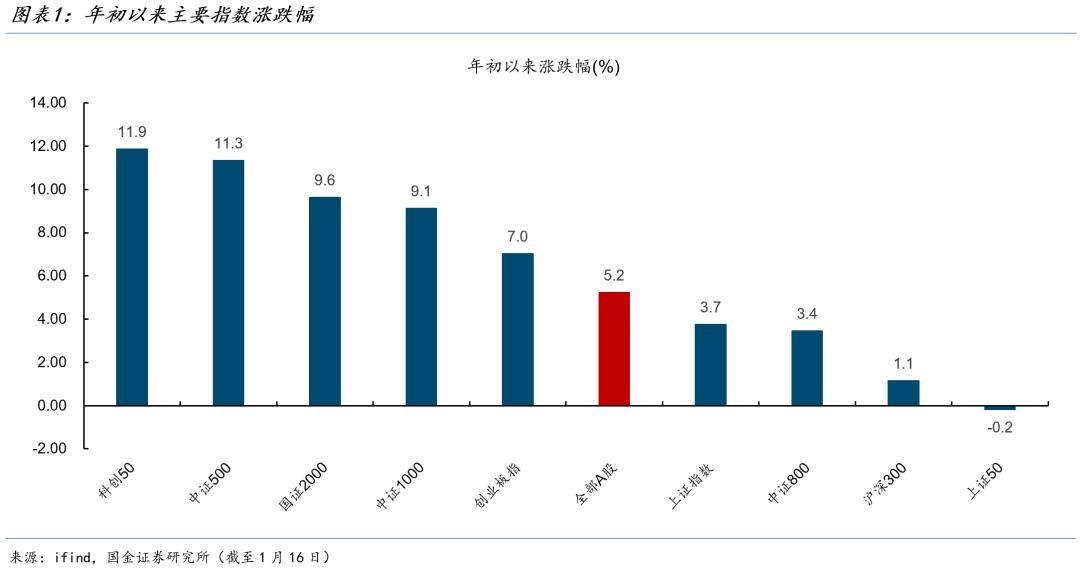
Group 1 - The core theme for A-share pricing in 2026 revolves around AI and geopolitical factors, reflecting the U.S. focus on technology for growth and geopolitical strategies for elections, while another underpriced theme is "anti-involution," corresponding to China's push for reform-driven momentum [1][8] - Since the beginning of 2026, the A-share market has shown a "good start" with a cumulative increase of 5.2% in the Wind All A index and an average daily trading volume exceeding 3 trillion yuan, with the Sci-Tech 50, CSI 500, and National 2000 indices leading the gains at 11.9%, 11.3%, and 9.6% respectively [2] - The leading sectors include media, computer, non-ferrous metals, and military industries, with year-to-date increases of 16.0%, 14.0%, 14.0%, and 9.0%, indicating that the current market focus is on "AI and geopolitical" themes [2] Group 2 - The impact of AI is evident not only in the A-share market but also in marginal changes in the macro economy, with the PPI in December 2025 rising by 0.2% month-on-month, marking the highest increase since 2024, driven in part by AI's contribution to price improvements in non-ferrous and technology sectors [5][8] - In December 2025, prices in the non-ferrous metal mining and smelting industries rose by 3.7% and 2.8% respectively, with AI-driven electricity demand significantly boosting prices for metals like copper, silver, lithium, and cobalt [5] - The prices of external storage devices and integrated circuits increased by 15.3% and 2.4% respectively in December 2025, with high-end AI chips occupying advanced process resources, leading to structural tensions in chip availability [7] Group 3 - The improvement in PPI reflects strategic choices made by China and the U.S. in the current global macro context, which are expected to become two main pricing themes for A-shares in 2026: "AI and geopolitics" and "anti-involution" [8] - The "anti-involution" theme is entering a new phase in 2026, with recent discussions emphasizing the need to address malicious low-price dumping and promote healthy competition [9] - Recent policy changes indicate a clearer execution strategy for "anti-involution," focusing on "quality over price" in industries like photovoltaics and energy storage, with regulatory bodies emphasizing quality standards and price monitoring [10][12] Group 4 - The cancellation of export tax rebates for photovoltaic products and the reduction of tax rates for battery products reflect the national-level implementation of "anti-involution," aimed at allowing competitive companies to raise prices and retain funds for domestic investment [11] - Local governments are shifting their competitive advantages from unsustainable policy incentives to sustainable business environments and professional service capabilities, indicating a broader commitment to "anti-involution" practices [12] - Strengthened regulatory enforcement against monopolistic and unfair competition behaviors signals an acceleration of "anti-involution," aiming to enhance market order and promote a virtuous cycle of quality and pricing in the industry [12]