可再生能源

Search documents
IEA下调美国可再生能源增幅预测50%,全球增长仍强劲
Zhi Tong Cai Jing· 2025-10-07 10:39
Group 1 - The International Energy Agency (IEA) has reduced the U.S. renewable energy growth forecast by 50% due to recent policy changes by the Trump administration, projecting an additional capacity of nearly 250 GW from 2025 to 2030, down from the previous estimate of 500 GW [1] - Key policy changes affecting the forecast include the gradual phase-out of federal tax credits, new import restrictions, a pause on offshore wind project leasing approvals, and limitations on permitting for onshore wind and solar projects on federal land [1] - The IEA emphasizes that since its introduction in 1992, tax credits have been a core driver of renewable energy development in the U.S. [1] Group 2 - The IEA has also lowered the global renewable energy growth forecast by 5%, primarily due to policy adjustments in the U.S. and China [2] - In China, the shift from a long-term fixed price subsidy policy to a market-based auction system introduces uncertainty, which may impact global renewable energy capacity growth [2] - The previous policy framework allowed wind and solar projects to benefit from stable returns based on coal price benchmarks for 15 to 20 years, while the new policy aims to promote market-driven growth and integration with the grid [2] Group 3 - The IEA predicts that the policy changes will slow the growth rate of wind and solar installations in China in the second half of 2025, but China is still expected to contribute nearly 60% of the global renewable energy capacity increase [3] - China's wind and solar installation targets are anticipated to be achieved five years ahead of the established timeline for 2035 [3]
IEA下调全球可再生能源增长预期
Xin Lang Cai Jing· 2025-10-07 07:07
Core Insights - The International Energy Agency (IEA) has revised down its forecast for global renewable energy generation capacity growth by 900 gigawatts (GW) for 2030, primarily due to changes in policy environments in the US and China [1] Group 1: Global Renewable Energy Capacity Forecast - By 2030, global renewable energy capacity is expected to increase by 4600 GW, a significant decrease from the previously predicted 5500 GW in 2024 [2] - The downward revision is largely attributed to the early expiration of federal tax incentives in the US and other regulatory changes, leading to a nearly 50% drop in the IEA's growth expectations for US capacity [3] - In China, the market-oriented transformation of new energy grid pricing has weakened the economic feasibility of projects [3] Group 2: Regional Developments - Despite the slowdown in the US and China, strong growth in India, Europe, and other emerging economies partially offsets this impact [2] - India is projected to become the second-largest growth market globally, following China, and is expected to easily meet its 2030 targets [3] - Europe is experiencing improved growth prospects due to proactive policies, expanded auction sizes, and streamlined approval processes [3] Group 3: Future Growth Drivers - IEA Director Birol emphasized that the growth of global renewable energy capacity in the coming years will be primarily driven by solar energy [2] - He urged policymakers to focus on supply chain security and grid upgrades to support the ongoing development of renewable energy [3] - Emerging economies in Asia, the Middle East, and Africa are accelerating clean energy initiatives, aided by declining costs and enhanced targets [3]
国际能源署:美国2030年可再生能源增长预期腰斩
Xin Lang Cai Jing· 2025-10-07 05:29
Core Viewpoint - The International Energy Agency (IEA) has halved its renewable energy growth forecast for the United States by 2030, despite a global push to double green power capacity during the same period [1] Group 1: Policy Impact - The downward revision of the U.S. renewable energy growth forecast is attributed to several policy changes implemented during the Trump administration [1] - Key policy adjustments include the gradual phase-out of federal tax credits for clean energy facilities, the implementation of import restrictions, the suspension of new offshore wind leasing projects, and the imposition of permitting restrictions on solar and wind projects on federal lands [1] Group 2: Global Renewable Energy Outlook - By the end of this decade (2030), global renewable energy generation capacity is expected to increase by 4,600 gigawatts, with solar energy accounting for nearly 80% of this growth [1]
专家解读!中国新一轮国家自主贡献目标意味着什么
Di Yi Cai Jing· 2025-10-07 03:00
Group 1 - The core viewpoint of the articles emphasizes China's new round of Nationally Determined Contributions (NDCs) announced at the recent UN Climate Change Summit, aiming for a 7%-10% reduction in greenhouse gas emissions by 2035 compared to peak levels, and a non-fossil energy consumption share of over 30% [1][5] - The new NDCs signify a comprehensive low-carbon resilient development journey for China, marking a shift towards absolute reduction targets across all sectors, including methane and nitrous oxide emissions [6][7] - China's renewable energy system is the largest and fastest-growing globally, contributing to 46% of jobs in the renewable energy sector, with significant reductions in the cost of wind and solar energy generation over the past decade [7][8] Group 2 - The announcement of the new NDCs is expected to enhance international confidence in global climate governance and strengthen international climate action [1][2] - China's proactive measures in climate change, including providing over 177 billion RMB in climate-related funding to developing countries since 2016, have garnered global recognition and praise [3][6] - The establishment of the largest carbon trading market in the world, which will cover approximately 80% of national CO2 emissions by 2035, is a significant step towards integrating carbon pricing into economic development [8]

Japan's conventional solar stocks tumble after Takaichi victory
Reuters· 2025-10-06 10:54
Shares in Japanese renewable energy company Renova plunged more than 11% on Monday, making it the biggest loser on the Tokyo Stock Exchange's prime market, after Sanae Takaichi looked set to become Ja... ...


如果电力是AI发展的瓶颈,中国是否在领先?
傅里叶的猫· 2025-10-03 15:07
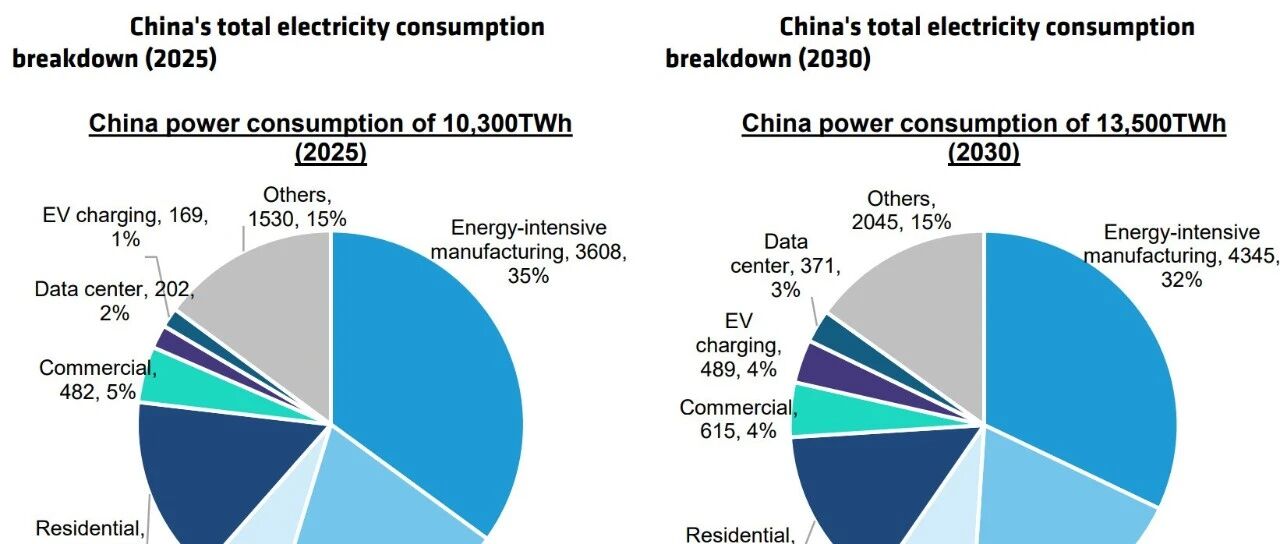
Core Viewpoint - The article emphasizes the critical role of electricity supply and energy storage in supporting the growing demand from AI data centers, highlighting that power availability has become a significant bottleneck for AI infrastructure development [1][7][9]. Electricity Demand and Supply - AI data centers are projected to significantly increase electricity demand, with the International Energy Agency estimating that annual electricity consumption from data centers will rise from 415 TWh in 2024 to 945 TWh by 2030, a growth of over 120% [7]. - In the U.S., data center electricity demand is expected to increase from 4% in 2023 to 12% by 2030, contributing nearly half of the new load [8]. - China is the world's largest electricity consumer, with annual consumption exceeding 9000 TWh, and is projected to reach 13500 TWh by 2030 [9][14]. Growth in Data Center Capacity - By 2030, China's data center capacity may reach 47 GW, with electricity consumption potentially exceeding 371 TWh, accounting for approximately 2.7% of national electricity demand [22]. - The compound annual growth rate (CAGR) for data center electricity demand in China is expected to be 13% from 2025 to 2030, reaching 400 TWh [20]. Renewable Energy and Infrastructure - China is leading in renewable energy, contributing 70% of global new power capacity additions, particularly in solar and wind energy [25]. - By 2050, solar and wind energy generation in China could increase tenfold to 18000 TWh, with these sources expected to account for 70% of total electricity generation [28]. - The expansion of the electricity grid is crucial, as solar and wind resources are primarily located in central and western regions, necessitating significant investment in infrastructure [32]. Energy Efficiency and Usage - The Power Usage Effectiveness (PUE) of data centers in China is expected to remain stable, with Beijing's data center cluster leading the industry at a PUE of 1.4 [23]. - The total electricity demand from data centers in China is projected to grow from 69 TWh in 2020 to 371 TWh by 2023, reflecting a significant increase in energy consumption [24]. Long-term Energy Strategy - Nuclear power is anticipated to play a role in China's energy mix, but its contribution is expected to be smaller compared to solar and wind energy by 2050 [35]. - The need for energy storage systems is highlighted, with an estimated requirement of approximately 3300 GW or 12000 GWh of storage capacity by 2050 to support renewable energy integration [29].
美国能源部宣布:终止近80亿美元新能源项目
Sou Hu Cai Jing· 2025-10-03 09:25
Core Points - The U.S. Department of Energy announced the termination of 223 energy projects, totaling approximately $7.56 billion, primarily affecting clean and renewable energy initiatives [1] - The terminated projects are seen as failing to meet federal investment standards based on economic benefits, national security, and energy security considerations [1] - The decision is perceived as politically motivated, particularly impacting states that voted for the Democratic Party in the last presidential election [1] Group 1 - The terminated projects will predominantly affect states such as California, Colorado, Connecticut, Delaware, Hawaii, Illinois, Maryland, Massachusetts, Minnesota, New Hampshire, New Jersey, New Mexico, New York, Oregon, Vermont, and Washington [1] - The announcement coincides with the federal government shutdown, during which $26 billion in federal funds aimed at "Democratic states" were frozen [1] - The White House budget office director described the funding cancellation as a removal of nearly $8 billion intended for a "green new deal" agenda [1] Group 2 - The Trump administration has been retracting renewable energy policies to appeal to conservative voters and traditional energy sector workers [2] - The U.S. formally exited the Paris Agreement on climate change and canceled $3.7 billion in funding for 24 emerging energy technology projects [2] - The government shutdown marks the first in nearly seven years, resulting from the Senate's failure to pass a temporary funding bill [2]

“能源答卷”展现发展底气
Jing Ji Ri Bao· 2025-10-01 22:13
Core Insights - China's energy sector has achieved significant breakthroughs and historical accomplishments during the "14th Five-Year Plan" period, ensuring energy security for over 1.4 billion people and showcasing resilience and confidence in development [1][2] Group 1: Energy Security and Supply - Energy security is a strategic issue related to national economic and social development, with China maintaining an energy self-sufficiency rate of over 80% during the "14th Five-Year Plan" [1] - The country has established a comprehensive energy production, supply, storage, and sales system, enhancing emergency support capabilities for coal, oil, and gas [1] - Measures taken have ensured stable energy supply and prices, demonstrating a high level of energy supply assurance and resilience [1] Group 2: Renewable Energy Development - China has built the world's largest and fastest-growing renewable energy system, with the share of renewable energy generation capacity increasing from 40% to approximately 60% [2] - The optimization of the energy supply structure has led to a greener energy consumption trend, with one-third of the total electricity consumption now coming from green energy [2] - Non-fossil energy's share in national energy consumption increases by 1 percentage point annually, while coal's share decreases by the same amount, enhancing the "green content" of economic development [2] Group 3: Market Reforms and Energy Transition - The energy sector reform has deepened, promoting market-oriented reforms that stimulate market development [2] - The energy pricing mechanism is being improved, allowing coal and renewable energy to enter the market fully [2] - A unified national electricity market system is being established, with comprehensive coverage of medium- and long-term trading and ancillary services, while the spot market is expanding nationwide [2]
太阳能成为欧盟电力主要来源,丹麦可再生能源占比最高
Shang Wu Bu Wang Zhan· 2025-09-30 17:00
Core Insights - Renewable energy accounted for 54.0% of the EU's net electricity generation in Q2 2025, an increase from 52.7% in the same period of 2024, primarily driven by solar energy [1] - In June 2025, solar energy became the leading source of electricity in the EU for the first time, contributing 22.0% of total generation, surpassing nuclear (21.6%), wind (15.8%), hydro (14.1%), and natural gas (13.8%) [1] Renewable Energy Breakdown - In Q2 2025, Denmark had the highest share of renewable energy in net electricity generation at 94.7%, followed by Latvia (93.4%), Austria (91.8%), Croatia (89.5%), and Portugal (85.6%) [1] - The lowest shares of renewable energy were recorded in Slovakia (19.9%), Malta (21.2%), and the Czech Republic (22.1%) [1] - The main sources of renewable energy in the EU were solar (36.8%), wind (29.5%), and hydro (26.0%), with biomass and renewable fuels at 7.3% and geothermal energy at 0.4% [1]

政策解读丨落实《能源规划管理办法》助推能源高质量发展
国家能源局· 2025-09-30 13:15
Core Viewpoint - The article emphasizes the importance of the newly issued "Energy Planning Management Measures" in enhancing the systematic, authoritative, scientific, and adaptive nature of energy planning, thereby promoting high-quality energy development in China [2][10]. Group 1: Systematic Enhancement of Energy Planning - The "Management Measures" clarify the scope of energy planning, which includes national comprehensive energy planning, sector-specific energy planning, regional energy planning, and provincial energy planning [4][5]. - It establishes a unified energy planning system by defining the relationships among various levels of energy planning, ensuring that they complement each other and adhere to national economic and social development plans [5][6]. Group 2: Authoritative Enhancement of Energy Planning - The "Management Measures" specify the entities responsible for energy planning and the approval processes, reinforcing the authority and seriousness of energy planning [6][7]. - It mandates that only approved provincial comprehensive energy plans can serve as the basis for energy development, ensuring consistency and coordination across different levels of planning [7][8]. Group 3: Scientific Enhancement of Energy Planning - The article highlights the need for scientific research in energy planning, advocating for a comprehensive approach that considers energy security and green transition [9]. - It stresses the importance of aligning energy planning with ecological and carbon emission policies, ensuring that projects meet legal and regulatory requirements [9][10]. Group 4: Adaptive Enhancement of Energy Planning - The "Management Measures" outline the need for dynamic monitoring and evaluation of energy planning implementation, allowing for timely adjustments based on changing external conditions [10][11]. - It emphasizes that any adjustments to energy plans must follow a formal approval process, maintaining the authority and integrity of the planning system [11].