
债券

Search documents
上交所:漳州市九龙江集团有限公司债券12月9日上市,代码244336
Sou Hu Cai Jing· 2025-12-08 02:10
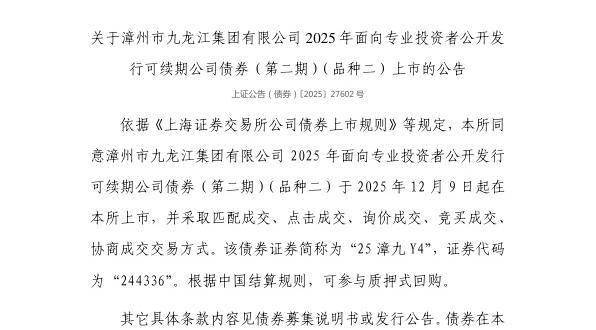
依据《上海证券交易所公司债券上市规则》等规定,上交所同意漳州市九龙江集团有限公司2025年面向 专业投资者公开发行可续期公司债券(第二期)(品种二)于2025年12月9日起在上交所上市,并采取 匹配成交、点击成交、询价成交、竞买成交、协商成交交易方式。该债券证券简称为"25漳九Y4",证 券代码为"244336"。根据中国结算规则,可参与质押式回购。 来源:市场资讯 12月8日,上交所发布关于漳州市九龙江集团有限公司2025年面向专业投资者公开发行可续期公司债券 (第二期)(品种二)上市的公告。 ...

A股市场关键时刻,最新研判
Zhong Guo Ji Jin Bao· 2025-12-08 01:37
Core Viewpoint - The investment outlook for 2026 suggests a focus on equity assets, particularly those with high price correlation, as the macroeconomic environment stabilizes and policy support continues [9][14][12]. Group 1: Macroeconomic Outlook - The macroeconomic environment is expected to maintain stability, with a key focus on whether the real estate market can stabilize and support further economic recovery [10][11]. - The A-share market may experience continued fluctuations in the first half of 2026, with potential upward movement in the second half driven by economic recovery expectations [3][10]. - The policy environment is anticipated to remain supportive, particularly as the "14th Five-Year Plan" begins [9][10]. Group 2: Asset Allocation Strategy - The preference for asset allocation in 2026 leans towards equities over fixed income, with a focus on sectors that are expected to perform well based on price dynamics [12][14]. - The ranking for asset allocation is suggested as commodities over Hong Kong stocks, which in turn are preferred over A-shares, followed by bonds [14][21]. - The equity market is expected to offer better value compared to fixed income assets, which may face challenges due to rising inflation and valuation constraints [13][14]. Group 3: Sector and Style Preferences - Growth styles are expected to outperform value styles in 2026, particularly in sectors related to AI and technology [15][16]. - There is a balanced outlook for both growth and value styles, with specific attention to sectors that are closely tied to price movements, such as new energy and consumer services for growth, and chemicals and construction materials for value [17][18]. - The cyclical sector is anticipated to perform well due to low price-to-book ratios and expected improvements in profit growth [12][18]. Group 4: Fixed Income Market Insights - The bond market is expected to experience fluctuations, with a focus on short to medium-duration bonds as the preferred investment choice [19][20]. - The current low yield environment for bonds suggests limited upside potential, making careful selection of bond funds crucial [20][21]. - The anticipated rise in inflation may impact the performance of long-duration bonds, leading to a preference for short-duration strategies [19][20]. Group 5: Commodity and Global Market Considerations - Commodities, particularly precious metals like gold and silver, are expected to remain attractive due to global liquidity conditions and potential price recovery [21][22]. - The performance of Hong Kong stocks, especially those of mainland companies, is likely to benefit from domestic economic growth and favorable global liquidity [5][21]. - The outlook for U.S. Treasuries is positive, especially in the context of a slowing U.S. economy, which may enhance their appeal as a safe-haven asset [23][24].

关键时刻,最新研判!
中国基金报· 2025-12-08 01:29
Core Viewpoint - The article discusses the investment outlook for 2026, highlighting a stable macroeconomic environment and potential upward movement in the A-share market, with various asset classes being evaluated for their investment value and risk mitigation strategies. Group 1: Macroeconomic Outlook - The macroeconomic environment in 2026 is expected to remain stable, with policies continuing to support growth, particularly in the real estate sector, which may drive further economic recovery [4][17]. - A-share market is anticipated to experience fluctuations in the first half of 2026, with a potential rise in the second half driven by economic recovery expectations [6][19]. - The domestic economy is projected to gradually stabilize, supported by a combination of monetary easing and fiscal policies aimed at stimulating demand [11][19]. Group 2: Asset Class Evaluation - Equity assets, particularly those related to domestic markets, are viewed as having higher investment value compared to fixed-income assets, which may face constraints due to rising inflation and valuation pressures [22][23]. - The preference for asset allocation is expected to prioritize commodities over Hong Kong stocks, which in turn are favored over A-shares, with bonds being the least favored [24]. - The investment sentiment towards domestic equities remains optimistic, especially in sectors with strong price correlation, while the bond market is expected to experience volatility [20][30]. Group 3: Investment Strategies - A balanced and diversified asset allocation strategy is recommended to mitigate risks associated with macroeconomic factors, with a focus on maintaining a hedge among different asset classes [36][37]. - The investment approach should adapt dynamically to market conditions, emphasizing the importance of monitoring economic indicators and adjusting positions accordingly [38][39]. - The strategy includes a mix of growth and value styles, with a focus on sectors that are expected to perform well based on macroeconomic trends and valuation metrics [25][27]. Group 4: Specific Asset Insights - Gold and other precious metals are expected to maintain their investment appeal due to ongoing geopolitical tensions and favorable monetary conditions [31][33]. - The performance of overseas equities, particularly those benefiting from AI advancements and liquidity conditions, is anticipated to present trading opportunities, while caution is advised regarding high valuations in mature markets [32][34]. - The bond market is expected to favor short-duration instruments due to limited upside in yields and potential inflationary pressures, with a focus on selecting high-quality credit funds [29][30].

2026年利率展望:稳中有变,结构为王
2025-12-08 00:41
2025 年债券市场呈现收益率曲线低位徘徊、横盘时间长、波动区间收 窄但波动率偏高的特征,极端定价现象明显,收益率波动区间仅约 31BP,但标准差较高。 2025 年价格驱动逻辑包括对基本面弱修复定价钝化,对向上修复定价 敏感;对外生冲击定价更快,学习效应更强;资产荒逻辑松动和股债跷 跷板效应延续时间拉长,股市与债市相关性增强。 预计 2026 年通胀温和回升,PPI 同比可能收窄至-1%,CPI 同比预计在 0.4%左右,受益于反内卷政策、重点行业供给优化和核心 CPI 正增长, 但部分行业产能过剩和居民端预期谨慎制约内生动能。 反内卷政策提升了汽车、电气设备、光伏、风电等政策敏感行业以及计 算机通信等强需求行业的产能利用率,但传统三高行业改善缓慢,仍徘 徊在低位。 当前沪深 300 ERP 指标显示纯债具备更高性价比,该指标在未来一个月 到一年具有约 80%的胜率提示效果,若后续有效突破上下两边调查,将 具备良好的提示作用。 Q&A 对于 2026 年债券市场的整体观点是什么? 2026 年债券市场的整体观点可以概括为"稳中有变,结构为王"。从基本面 和政策面的维度来看,明年的改变线索不多。然而,自下半年 ...
财政部持续十七年在香港发债有何深远影响
Zheng Quan Ri Bao· 2025-12-07 15:47
Core Viewpoint - The Ministry of Finance will issue the sixth tranche of RMB government bonds in Hong Kong on December 10, with a scale of 7 billion yuan, completing the plan to issue 68 billion yuan in RMB bonds in Hong Kong for the year. This marks the 17th consecutive year since 2009 that the Ministry has regularly issued sovereign bonds abroad [1][2]. Group 1 - The continuous issuance of RMB government bonds in Hong Kong enhances the offshore RMB yield curve, providing a pricing "cornerstone" for the market. The bonds, backed by national sovereign credit, are considered high-quality assets and stable investment tools. The issuance has diversified in terms of maturity, ranging from 2 years to 30 years, allowing for accurate reflection of offshore market supply and demand, thus serving as a core "benchmark anchor" for pricing other offshore RMB bonds [3][5]. - The issuance of high-credit government bonds supports the global reserve and allocation value of RMB assets, effectively promoting the internationalization of the RMB. The bonds issued in Hong Kong efficiently reach international investors, meeting their demand for RMB asset allocation. For instance, the average subscription multiple for the first five issuances this year was 3.27 times, with a peak of 3.96 times, indicating strong market interest and confidence in RMB assets [4][5]. - The regular issuance of RMB government bonds strengthens Hong Kong's status as an international financial center and supports the development of the real economy. This issuance promotes the improvement of the infrastructure for bond issuance, trading, settlement, and custody in Hong Kong, enhancing its international competitiveness. Additionally, funds raised from these bonds can support major national projects, contributing to the construction of the Guangdong-Hong Kong-Macao Greater Bay Area [5].
信用分析周报(2025/12/1-2025/12/5):信用债收益率延续低位调整-20251207
Hua Yuan Zheng Quan· 2025-12-07 14:20
1. Report Industry Investment Rating No relevant content provided. 2. Core Viewpoints of the Report - This week, the yield of credit bonds continued the adjustment trend of last week, with a slight upward adjustment from a low level. For example, the 3Y and 10Y yields of AA+ medium and short-term notes adjusted by 2BP and 5BP respectively within the week. From January to November 2025, there was a divergence in performance among different credit varieties and different terms. The short - end spread compression was generally greater than the long - end, and the spread compression of urban investment bonds and medium and short - term notes was generally better than that of secondary perpetual bonds. There is still strong logical support for going long on credit bonds around 3Y. The 3 - 5Y urban investment bond sinking strategy may still be the preferred strategy for credit bonds in the next stage [4][45]. - Overall, the credit spreads of the AA+ electronics and leisure services industries and the AAA electrical equipment industry compressed significantly compared with last week, while the credit spreads of other industries and ratings fluctuated within 5BP compared with last week. For urban investment bonds, the credit spreads of different terms fluctuated no more than 2BP compared with last week. For industrial bonds, most of the credit spreads widened slightly compared with last week, and a small number of terms and ratings of industrial bonds compressed slightly. For bank capital bonds, the credit spreads of bank secondary perpetual bonds of different terms and ratings widened to varying degrees compared with last week [4][44]. 3. Summary by Relevant Catalogs 3.1 This Week's Credit Hot Events - **Debt Risk Prevention and Control Ideas from the "15th Five - Year Plan" Proposals**: "Building a long - term government debt management mechanism" is the consensus among regions, and "activating stock resources and assets" is an important measure. Debt risk management may remain a key focus of local work in the future, and local asset activation may be the focus of the next stage [9]. - **Wu Qing's Speech**: On December 5th, Wu Qing, the chairman of the CSRC, proposed to improve the multi - level bond market system and vigorously develop science and technology innovation bonds and green bonds [11]. - **Optimization of Merger and Acquisition Notes**: On December 2nd, the National Association of Financial Market Institutional Investors issued a notice to optimize the relevant working mechanism of merger and acquisition notes, which is conducive to guiding funds to accurately support enterprise mergers and acquisitions and improving the quality and efficiency of the inter - bank bond market in serving the real economy [12]. 3.2 Primary Market - **Net Financing Scale**: This week, the net financing of credit bonds (excluding asset - backed securities) was 179.7 billion yuan, a decrease of 115.3 billion yuan compared with last week. The net financing of asset - backed securities was 22.6 billion yuan, an increase of 3.2 billion yuan compared with last week. By product type, the net financing of urban investment bonds, industrial bonds, and financial bonds decreased compared with last week [14]. - **Issuance Cost**: This week, the issuance interest rates of AA industrial bonds and financial bonds increased significantly compared with last week, while the issuance interest rates of other different ratings and bond types fluctuated no more than 20BP [16]. 3.3 Secondary Market - **Trading Volume and Turnover Rate**: This week, the trading volume of credit bonds (excluding asset - backed securities) decreased by 56.7 billion yuan compared with last week. The turnover rates of most credit bonds decreased compared with last week [22]. - **Yield**: This week, the yield of credit bonds continued the upward trend, with an upward adjustment of 0 - 5BP for credit bonds of different ratings and terms compared with last week [25]. - **Credit Spread**: Overall, the credit spreads of the AA+ electronics and leisure services industries and the AAA electrical equipment industry compressed significantly compared with last week, while the credit spreads of other industries and ratings fluctuated within 5BP compared with last week. For urban investment bonds, the credit spreads of different terms fluctuated no more than 2BP compared with last week. For industrial bonds, most of the credit spreads widened slightly compared with last week, and a small number of terms and ratings of industrial bonds compressed slightly. For bank capital bonds, the credit spreads of bank secondary perpetual bonds of different terms and ratings widened to varying degrees compared with last week [29][34][38][40]. 3.4 This Week's Bond Market Negative News This week, the implied rating of "21 Boxing 01" issued by Shandong Boxing Xinda Construction Investment and Development Co., Ltd. was downgraded [43]. 3.5 Investment Recommendations - The central bank achieved a net withdrawal of 848 billion yuan in the open market this week. As of Friday's close, DR001 closed at 1.31%. Overall, the credit spreads of the AA+ electronics and leisure services industries and the AAA electrical equipment industry compressed significantly compared with last week, while the credit spreads of other industries and ratings fluctuated within 5BP compared with last week. For urban investment bonds, the credit spreads of different terms fluctuated no more than 2BP compared with last week. For industrial bonds, most of the credit spreads widened slightly compared with last week, and a small number of terms and ratings of industrial bonds compressed slightly. For bank capital bonds, the credit spreads of bank secondary perpetual bonds of different terms and ratings widened to varying degrees compared with last week [44]. - There is still strong logical support for going long on credit bonds around 3Y, and the 3 - 5Y urban investment bond sinking strategy may still be the preferred strategy for credit bonds in the next stage [45].
周观:如何应对12月的债市调整以度过年末?(2025年第47期)
Soochow Securities· 2025-12-07 13:35
1. Report Industry Investment Rating - Not provided in the content 2. Report's Core View - In December, the bond market adjusted. The 10 - year Treasury active bond yield decreased by 0.05bp to 1.8285% from last Friday. The stock and bond markets have been weak, not showing a complete "stock - bond seesaw" effect, especially for ultra - long bonds with a significant interest rate increase. Due to factors like the "anti - involution" policy and the fund fee rate new regulation draft, institutions may sell in advance to avoid fluctuations. In the context of the "asset shortage," it is recommended to gradually increase bond allocation when the 10 - year Treasury active bond yield reaches 1.85%, but shorten the duration [1][14]. - Overseas, the market is pricing in the Fed's interest rate cut. The Bank of Japan's possible interest rate hike on December 19 is a focus. The US EIA Cushing crude oil inventory decreased, the manufacturing PMI continued to contract, and the Fed is focused on interest rate cut expectations and the change of the chairman. The probability of a 25bp interest rate cut in December 2025 is 86.20%, and the probability of another cut in January 2026 has decreased [15][24]. 3. Summary by Relevant Catalogs 3.1 One - Week View - **Domestic Bond Market**: The 10 - year Treasury active bond yield decreased by 0.05bp to 1.8285% from last Friday. The yield fluctuated throughout the week due to various factors such as market expectations of the central bank's bond - buying volume, policy expectations, and news from the Financial Times [1][10]. - **Overseas Market**: The market is pricing in the Fed's interest rate cut. The Bank of Japan's possible interest rate hike on December 19 is a focus. The US EIA Cushing crude oil inventory decreased by 457,000 barrels from the week of November 21 to November 28. The manufacturing PMI continued to contract, and the Fed is focused on interest rate cut expectations and the change of the chairman. The probability of a 25bp interest rate cut in December 2025 is 86.20%, and the probability of another cut in January 2026 has decreased [15][24]. 3.2 Domestic and Overseas Data Summary - **Liquidity Tracking**: In the open - market operations from December 1 to December 5, 2025, the net investment was - 84.8 billion yuan. The money market interest rates showed some changes, with some rates decreasing and others increasing slightly [30][31]. - **Domestic and Overseas Macroeconomic Data Tracking**: Steel prices showed mixed changes, and LME non - ferrous metal futures official prices also fluctuated. The prices of commodities such as coal, oil, and vegetables also changed to varying degrees [49]. 3.3 Local Bond One - Week Review - **Primary Market Issuance Overview**: In the primary market, 56 local bonds were issued with a total amount of 108.717 billion yuan, including 58.277 billion yuan of refinancing bonds, 39.049 billion yuan of new special bonds, and 11.392 billion yuan of new general bonds. The net financing amount was 60.493 billion yuan, mainly invested in comprehensive, strategic development, and shantytown renovation projects [75]. - **Secondary Market Overview**: The stock of local bonds was 54.01 trillion yuan, with a trading volume of 31.0134 billion yuan and a turnover rate of 0.57%. The top three provinces with the most active trading were Hubei, Guangdong, and Shandong. The top three active trading maturities were 30Y, 20Y, and 10Y. The local bond yields generally increased [91][93]. 3.4 Credit Bond Market One - Week Review - **Primary Market Issuance Overview**: A total of 291 credit bonds were issued in the primary market, with a total issuance of 232.914 billion yuan, a total repayment of 174.89 billion yuan, and a net financing of 58.024 billion yuan, a decrease of 31.825 billion yuan from last week. Among them, the net financing of urban investment bonds was - 14.491 billion yuan, and that of industrial bonds was 72.515 billion yuan [98][99]. - **Issuance Interest Rate**: The actual issuance interest rates of various bond types showed different changes, with some increasing and some decreasing [109]. - **Secondary Market Transaction Overview**: The total turnover of credit bonds was 531.676 billion yuan. The trading volume of each bond type varied, with medium - term notes having the largest trading volume [110]. - **Yield to Maturity**: The yields to maturity of various bonds, including national development bonds, short - term financing bills, medium - term notes, corporate bonds, and urban investment bonds, generally increased [110][111][112]. - **Credit Spread**: The credit spreads of short - term financing bills and medium - term notes showed a divergent trend, while the credit spreads of corporate bonds also showed a general divergent trend, and the credit spreads of urban investment bonds generally narrowed [114][119][122]. - **Rating Spread**: The rating spreads of short - term financing bills and medium - term notes showed a divergent trend, and the rating spreads of corporate bonds and urban investment bonds generally narrowed [125][127][129]. - **Trading Activity**: The top five most actively traded bonds of each type were listed, and the industrial sector had the largest weekly trading volume of bonds [133][134]. - **Subject Rating Change**: There were no bonds with rating or outlook upgrades or downgrades this week [135][136]
国债衍生品周报-20251207
Dong Ya Qi Huo· 2025-12-07 03:01
Report Summary Core View - The capital market maintains a loose pattern, and abundant liquidity supports the bond market. The economic fundamentals have no significant negative factors, and the market environment is relatively stable. However, there are potential risks of rising inflation expectations and geopolitical uncertainties, which may put pressure on the bond market. It is recommended to maintain a wait - and - see approach, control risks, and pay attention to policy signals and economic data trends [2] Data Analysis - **Yield to Maturity**: The report presents the yield - to - maturity data of 2Y, 5Y, 10Y, 30Y, and 7Y treasury bonds from 2024/04 to 2025/08 [3] - **Funding Rates**: It shows the funding rates including the deposit - type institutional pledged repurchase weighted average rate for 1 - day and 7 - day, and the 7 - day reverse repurchase rate from 2023/12 to 2025/06 [3] - **Treasury Bond Term Spreads**: The term spreads of 7Y - 2Y and 30Y - 7Y treasury bonds from 2024/04 to 2025/08 are provided [4][5] - **Treasury Bond Futures Positions**: The positions data of 2 - year, 5 - year, 10 - year, and 30 - year treasury bond futures from 2015/12 to 2023/12 are presented [7] - **Treasury Bond Futures Trading Volume**: The trading volume data of 2 - year, 5 - year, 10 - year, and 30 - year treasury bond futures from 2024/04 to 2025/08 are shown [8] - **Treasury Bond Futures Basis**: The basis data of 2 - year, 5 - year, 10 - year, and 30 - year treasury bond futures' current - quarter contracts are provided with different time ranges [9][10][11][13] - **Treasury Bond Futures Inter - Period Spreads**: The inter - period spreads of 2 - year, 5 - year, 10 - year, and 30 - year treasury bond futures (current - quarter minus next - quarter) are presented with different time ranges [14][15][16][18] - **Treasury Bond Futures Inter - Variety Spreads**: The inter - variety spreads of TS*4 - T from 2024/04 to 2025/08 and T*3 - TL from 2023/06 to 2025/06 are shown [19][20]
俄罗斯一招破局!豪掷4000亿卢布人民币债券,给人民币“站台”,急抱中国大腿
Sou Hu Cai Jing· 2025-12-06 13:13
Core Viewpoint - Russia's Ministry of Finance announced the issuance of its first sovereign bonds denominated in RMB, totaling 400 billion rubles, marking a significant step towards de-dollarization and reflecting the geopolitical dynamics at play [1][3]. Group 1: Issuance Details - The total amount of the bonds is 400 billion rubles, equivalent to over 30 billion RMB, with maturities of 3, 5, and 10 years, set to be issued in early December [1]. - This issuance represents a shift from traditional reliance on USD or EUR for sovereign bonds, as Russia opts for RMB instead [1]. Group 2: Motivations Behind the Move - The decision to issue bonds in RMB is largely driven by Western sanctions that have severely restricted Russia's access to USD and EUR, effectively cutting off its financial channels [3]. - Over 95% of trade between China and Russia is settled in RMB, creating a "RMB closed loop" that supports this financial decision [3]. Group 3: Implications for RMB and Global Finance - The RMB's share in global foreign exchange reserves has increased from 1.07% in 2016 to 3.85% in 2024, positioning it as the fifth-largest reserve currency globally [5]. - The issuance of RMB-denominated bonds by Russia is expected to encourage other emerging markets, such as Brazil and India, to follow suit, thereby enhancing the RMB's status in the global monetary system [5][9]. Group 4: Strategic Significance - This move signifies a deepening of financial ties between China and Russia, indicating a shift from mere trade cooperation to a more integrated financial partnership [9]. - The issuance is seen as a demonstration of Russia's commitment to de-dollarization and a challenge to the dominance of the USD in global finance [7][9]. Group 5: Market Reception - There is a strong likelihood that domestic Chinese institutional investors, as well as other emerging market countries, will be interested in purchasing these bonds, viewing them as a means to mitigate USD risk [9]. - Despite Western downgrades of Russia's sovereign credit rating, its ability to repay the bonds remains supported by stable energy export revenues [9].

记者手记|高市大肆发债难纾涨价困境
Xin Hua She· 2025-12-06 12:42
记者手记|高市大肆发债难纾涨价困境 日本东京大学名誉教授上野千鹤子在社交媒体表示,18.3万亿日元的补充预算中竟有11.7万亿日元 要靠新发国债筹措,真忍不住想把这届政府称作"亡国"内阁。 (新华社东京12月6日电) 新华社记者刘春燕 日本首相高市早苗日前推动内阁批准总规模达18.3万亿日元(1美元约合155日元)的补充预算 案。虽尚未获得国会批准,这一靠大规模发债筹款的补充预算已引发日本媒体和专家普遍忧虑。 日本舆论认为,高市以"落实物价对策"之名编制巨额补充预算、推出大规模经济刺激计划,"刷存 在感"是最大目的,无法让日本摆脱物价持续上涨的困境。对于债务余额占国内生产总值比重高达 240%的日本政府来说,减税、补贴等大规模财政支出计划,势必加重债务负担,加剧日元贬值, 进一步推高日本物价。 受日元贬值、进口商品价格上涨等因素影响,近年日本物价持续上涨。日本总务省报告显示,截 至今年10月,日本去除生鲜食品后的核心消费价格指数已连续50个月同比上升。日本企业信用调 查公司帝国数据库日前公布的调查结果显示,2025年日本累计有20609种食品价格上涨,较去年的 12520种大幅增加约65%。 高市多次强调,物 ...