油气

Search documents
A股三大指数均低开0.09%
第一财经· 2025-11-13 01:49
Group 1 - The core viewpoint of the article highlights the strong performance of lithium battery upstream material stocks, particularly in the electrolyte sector, with companies like Furi Shares achieving six consecutive trading limits and Lianhong Xinke hitting the daily limit, while Haike Xinyuan rose over 5% to set a new historical high [3][5]. - The A-share market opened with slight declines across the three major indices, with the Shanghai Composite Index down 0.09%, the Shenzhen Component Index down 0.09%, and the ChiNext Index also down 0.09% [4][5]. - In the market, photovoltaic glass, duty-free shops, and Hainan Free Trade Zone concepts saw the largest declines, while lithium battery electrolytes experienced strong gains. Additionally, international gold prices surged, boosting the precious metals sector, while the oil and gas sector faced a pullback [5]. Group 2 - The Hong Kong stock market opened lower, with the Hang Seng Index down 0.53% and the Hang Seng Tech Index down 0.82%. Notably, China Resources Mixc Lifestyle Holdings fell nearly 8% due to a proposed placement of 49.5 million shares by its controlling shareholder, and Juxing Legend dropped over 13% following a proposed discounted share placement [6][7].


A股早评:三大指数小幅低开,黄金、有机硅板块盘初活跃
Ge Long Hui· 2025-11-13 01:36
Core Viewpoint - The A-share market opened with slight declines across the three major indices, indicating a cautious market sentiment at the start of the trading day [1] Market Performance - The Shanghai Composite Index opened down by 0.09% - The Shenzhen Component Index also opened down by 0.09% - The ChiNext Index experienced a similar decline, opening down by 0.09% [1] Sector Performance - The gold sector opened higher, showing positive momentum - Industrial metals also opened with gains, reflecting strong demand or favorable market conditions - The organic silicon sector had a positive opening, indicating potential growth opportunities - Conversely, the oil and gas sector opened lower, suggesting potential challenges or market corrections - The Hainan Free Trade Zone sector also opened down, which may reflect broader economic concerns or specific regional issues [1]
滚动更新丨A股三大指数均低开0.09%,油气板块回调
Di Yi Cai Jing· 2025-11-13 01:33
Group 1 - The A-share market opened with three major indices slightly lower, with the Shanghai Composite Index down 0.09%, the Shenzhen Component Index down 0.09%, and the ChiNext Index down 0.09% [2][3] - In the market, photovoltaic glass, duty-free shops, and Hainan Free Trade Zone concepts saw significant declines, while lithium battery electrolyte stocks experienced strong gains, with companies like Fuzhi Co. achieving six consecutive trading limits and Lianhong Xinke hitting the daily limit [1][3] - The international gold price surged, leading to a strong performance in the precious metals sector, while the oil and gas sector experienced a pullback [3] Group 2 - The Hong Kong stock market opened lower, with the Hang Seng Index down 0.53% and the Hang Seng Tech Index down 0.82%, influenced by significant declines in companies like China Resources Mixc Lifestyle [4][5] - The People's Bank of China conducted a 190 billion yuan seven-day reverse repurchase operation at an interest rate of 1.4%, with 928 billion yuan of reverse repos maturing on the same day [5]

金十数据全球财经早餐 | 2025年11月13日
Jin Shi Shu Ju· 2025-11-12 23:03
Group 1 - The U.S. House of Representatives is set to vote on a bill to end the government shutdown on November 13 at 8:00 AM Beijing time [14] - The White House indicated that the non-farm payroll and inflation data for October may never be released [14] - The Atlanta Fed President Bostic unexpectedly announced his retirement, reaffirming a hawkish stance shortly after [14] Group 2 - The OPEC report suggests that global oil supply will balance with demand by 2026, leading to a decline in crude oil prices [3] - WTI crude oil fell by 4.14% to $58.44 per barrel, while Brent crude oil dropped by 3.79% to $62.43 per barrel [3][7] - The U.S. stock market saw the Dow Jones Industrial Average rise by 0.68%, while the Nasdaq Composite Index fell by 0.26% [3] Group 3 - European stock indices closed higher, with Germany's DAX30 up by 1.22% and the UK FTSE 100 up by 0.12% [4] - The Hong Kong Hang Seng Index rose by 0.85%, closing at 26,922.73 points, with a trading volume of 236.39 billion HKD [4] - In the A-share market, the Shanghai Composite Index fell by 0.07%, while the Shenzhen Component Index dropped by 0.36% [5] Group 4 - The China Securities Regulatory Commission reported that foreign investors hold over 3.5 trillion CNY in A-shares [14] - The China Photovoltaic Industry Association stated that circulating rumors online are false [14]

能源早新闻丨市场监管总局:撤销1557张!
中国能源报· 2025-11-12 22:32
Group 1: Energy Sector Developments - The National Energy Administration emphasizes that by 2030, integrated development will become a significant approach for renewable energy, enhancing reliability and market competitiveness, thus supporting a comprehensive green transformation of the economy [2] - Major energy state-owned enterprises are accelerating their relocation to Xiong'an New Area, with headquarters and subsidiaries establishing a collaborative development pattern that includes headquarters, research bases, and supporting enterprises [2] - In October, China's production of power and other batteries reached 170.6 GWh, marking a year-on-year increase of 50.5% and a month-on-month increase of 12.9% [4] - Two 500 kV substations in Sichuan have been put into operation, adding a total of 480 MVA capacity, which will support the electricity supply and high-quality development in the Chengdu-Chongqing economic circle [4] - A significant natural gas discovery in Daban City, Xinjiang, has been reported, with an estimated geological resource of over 200 billion cubic meters, indicating potential for a large oil and gas field [5] Group 2: Regulatory and Market Changes - The Market Supervision Administration has revoked 1,557 mandatory product certification certificates following a validity check on 3,001 batches of products, indicating a focus on compliance in the certification process [3] - The global largest 65-ton lithium battery counterbalance forklift has been launched, representing a technological benchmark in the heavy-duty electric vehicle sector [3] Group 3: International Energy Market Impact - Bulgaria faces a fuel supply crisis due to U.S. sanctions on Russian oil companies, with available gasoline stocks sufficient for only about 35 days [6] - Russian shareholders of Serbia's oil company are willing to transfer control to a third party in response to U.S. sanctions, indicating potential shifts in ownership and operational control in the energy sector [6] Group 4: Power Demand Trends - Xinjiang's power grid recorded a historical peak load of 49.6 million kilowatts, reflecting a stable operation and reliable power supply amidst increasing demand [7]
南向资金破五万亿港元,投资策略从科技“进攻”到高股息“防守”
2 1 Shi Ji Jing Ji Bao Dao· 2025-11-12 13:16
Core Insights - The Hong Kong stock market has reached a milestone with cumulative net purchases from southbound funds exceeding 50 billion HKD [1][3] - Southbound funds have shown record-breaking net inflows of 1.31 trillion HKD in 2023, marking a significant increase of over 60% compared to the previous record year [2][4] - There has been a notable shift in investment strategy from a growth-oriented "offensive" approach to a high-dividend "defensive" stance among southbound funds [6][8] Investment Trends - Southbound funds have been consistently net buying Hong Kong stocks for 16 consecutive trading days, with only 3 days of net outflows in the past 23 trading days [3] - The financial sector has been the primary focus for southbound funds, accounting for 39% of net purchases since 2025, with significant holdings in financial, information technology, and consumer discretionary sectors [6][8] - The shift in strategy is exemplified by the movement of funds from Alibaba to China National Offshore Oil Corporation, indicating a preference for stable, high-dividend stocks [7][8] Market Performance - Major indices in the Hong Kong market, such as the Hang Seng Index and Hang Seng Tech Index, have seen year-to-date gains exceeding 30%, with the Hong Kong Innovative Drug Index rising over 80% [1] - The overall valuation of Hong Kong stocks remains low, with the Hang Seng Index and the Hang Seng China Enterprises Index trading at price-to-book ratios below 1 [4][5] - High dividend yields in sectors like energy and finance are attracting long-term investors, including insurance and public funds [5][6] Sector Rotation - Recent trends show a reduction in holdings in high-growth sectors like pharmaceuticals and technology, while traditional industries such as banking, oil and gas, and telecommunications are experiencing increased investment [8] - The current market environment has led to a more conservative risk appetite among investors, favoring high-dividend stocks over high-growth, high-valuation stocks [8][9] - Analysts suggest that while the focus is on defensive assets, there may be future opportunities in undervalued growth stocks that have been overlooked [9]
雪佛龙(CVX.US)五年增长计划曝光:跨界AI打造数据中心电厂 目标2030年自由现金流30...
Xin Lang Cai Jing· 2025-11-12 12:58
来源:智通财经网 能源巨头雪佛龙(CVX.US)正开辟全新业务线,以把握人工智能(AI)蓬勃发展的机遇。其首项举措是启 动为数据中心供应天然气发电的项目,并选定西得克萨斯州作为项目基地。 这家总部位于休斯顿的能源巨头将在近三年来首次举办的投资者日上详细阐述其电力业务战略。演示文 件显示,若布伦特原油价格维持在每桶70美元,雪佛龙预计未来五年自由现金流年均增长14%,到2030 年达到300亿美元,每股收益年增长率将超过10%。 尽管公司将年度股票回购规模维持在略高于100亿美元的目标区间下限,但Bonner指出,若布伦特油价 稳定在每桶80美元水平,雪佛龙的现金生成能力足以支撑200亿美元的回购规模。目前,布伦特原油期 货价格徘徊在每桶65美元附近。 根据雪佛龙在周三投资者日活动前发布的声明及演示材料,公司正与数据中心终端用户进行独家谈判 (未透露具体名称),预计将于明年初做出最终投资决定。该设施计划于2027年投入运营,未来发电容量 有望高达5000兆瓦。 另外,据文件显示,雪佛龙计划在2030年前将年度资本预算从190亿-220亿美元下调至180亿-210亿美元; 假设布伦特油价为每桶50美元,公司预计产 ...

雪佛龙(CVX.US)五年增长计划曝光:跨界AI打造数据中心电厂 目标2030年自由现金流300亿美元
智通财经网· 2025-11-12 12:52
Group 1 - Chevron is entering a new business line focused on supplying natural gas power to data centers, with a project base in West Texas [1] - The project aims for a power generation capacity of up to 5,000 megawatts by 2027, with full operational capacity expected in the third year at approximately 2,500 megawatts [1] - Chevron's CFO stated the company has ample natural gas resources and is well-positioned to create a competitive project [1] Group 2 - Chevron has partnered with Engine No. 1, a key step in its AI initiative, and has secured orders for seven large gas turbines from GE Vernova [2] - The company plans to detail its power business strategy at its investor day, projecting an average annual free cash flow growth of 14% over the next five years, reaching $30 billion by 2030 [3] - Chevron aims to reduce its annual capital budget from $19-22 billion to $18-21 billion by 2030, while maintaining a stock buyback target slightly above $10 billion [3]
燃爆全球!cippe四展联动,解锁油气产业新动能
Sou Hu Cai Jing· 2025-11-12 12:45
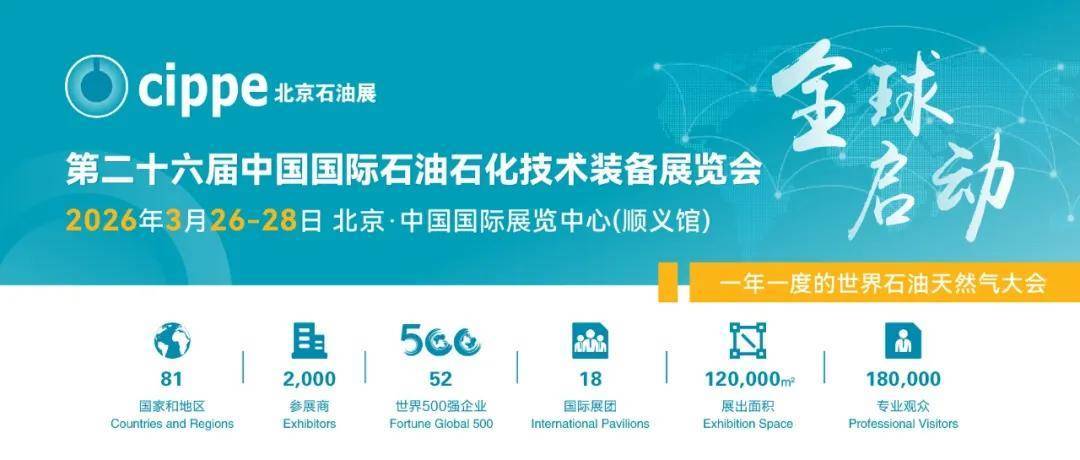
Core Insights - The cippe exhibition is positioned as a leading platform for the global oil and gas industry, focusing on high-quality upgrades and international collaboration in response to the dual pressures of carbon neutrality and energy structure adjustments [2][3][5]. Group 1: Exhibition Overview - The cippe Beijing Oil Exhibition will cover a total area of 120,000 square meters, attracting around 2,000 exhibitors, including 52 Fortune 500 companies and 18 international exhibition groups from over 30 oil and gas developed countries [3]. - The exhibition will focus on 16 core industry sectors, including oil and petrochemicals, natural gas, digital oil and gas, and hydrogen energy, showcasing advanced low-carbon extraction technologies and smart oilfield solutions [5][6]. Group 2: Regional Focus - The cippe Xinjiang Oil Exhibition aims to connect the Eurasian oil and gas markets, with an exhibition area of 40,000 square meters and an expected attendance of over 30,000 visitors from more than 500 companies [8]. - The cippe Chengdu Oil Exhibition will cover 30,000 square meters and attract 400 exhibitors, including international companies from South Asia and Southeast Asia, focusing on energy cooperation and technology exchange [10][12]. Group 3: Strategic Goals - The cippe exhibition series aims to build an international cooperation platform, facilitating resource sharing and deep collaboration among enterprises across different regions, thereby enhancing the global oil and gas industry's ecosystem [2][12]. - The exhibitions will serve as a bridge for domestic companies to access international markets while attracting high-quality international resources to participate in China's oil and gas industry development [12].
封单超9万手!1分钟,直线涨停
Zhong Guo Zheng Quan Bao· 2025-11-12 08:28
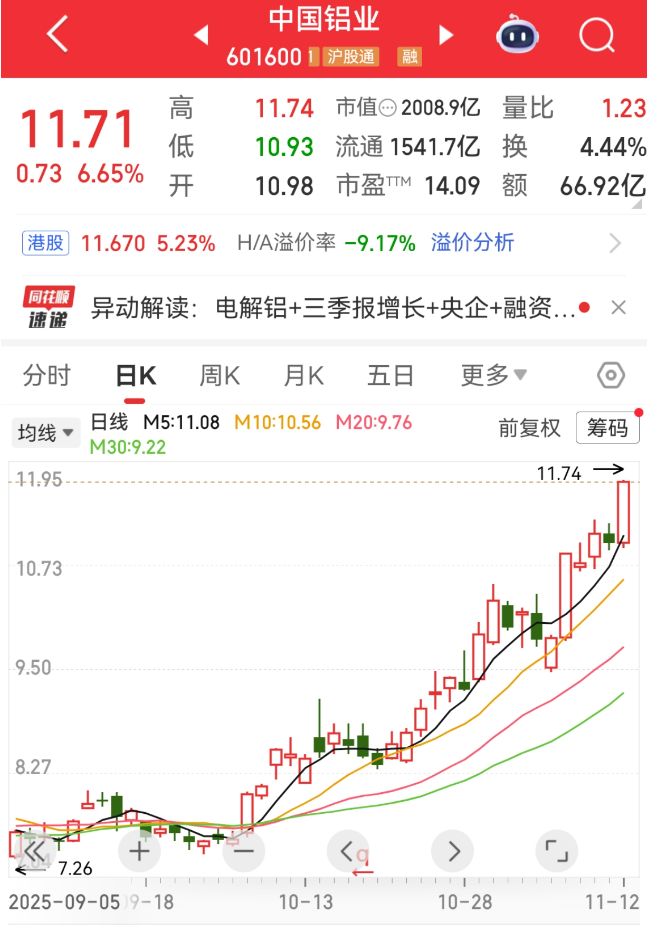
Group 1 - The A-share market shows a diverse performance with strengths in both technology and cyclical sectors, highlighted by significant gains in leading stocks such as China Aluminum, which rose over 6% to reach a market value of approximately 200.8 billion yuan [1] - AI hardware concepts are performing well, with major stocks like Zhongji Xuchuang increasing by 5.06% and achieving a trading volume of 19.891 billion yuan, leading the A-share market [3] - The banking sector is strong, with Agricultural Bank and Industrial and Commercial Bank reaching historical highs, while the oil and gas sector also sees significant gains [5] Group 2 - The storage chip sector is experiencing notable activity, with stocks like Dagang Co. hitting the daily limit within a minute, indicating strong market interest [6] - Companies are focusing on integrated circuits and environmental resource services to enhance core competitiveness and operational standards, with a total of 91,600 A-share shareholders reported as of October 31 [8] - The storage industry is expected to maintain a tight supply-demand balance due to rising storage prices and increasing demand driven by AI infrastructure development [8] Group 3 - Recent market trends suggest a potential style shift in the A-share market, with some analysts attributing this to a change in market dynamics [9] - As the year-end approaches, historical patterns indicate that small and medium themes often outperform, with potential style shifts observed in previous years [10] - Analysts predict that while technology stocks may experience volatility, traditional sectors like materials and banking are likely to continue providing excess returns until year-end [10]