
外卖

Search documents
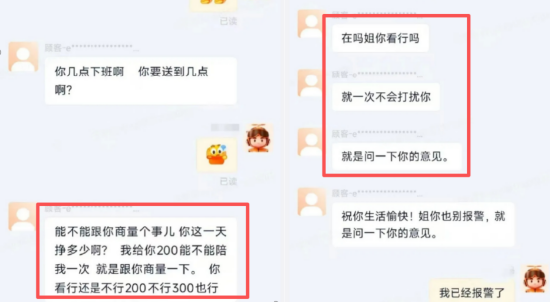
“200元陪我?”00后女外卖员连收57条骚扰信息后报警!专家:安全制度亟需完善
Xin Lang Cai Jing· 2026-02-27 09:25
Core Viewpoint - The incident involving a female delivery rider being harassed by a customer highlights the urgent need for improved safety measures and protective mechanisms within the food delivery industry, particularly for female riders [3][4][12]. Group 1: Incident Details - A female delivery rider in Shanghai received 57 harassing messages from a male customer within half an hour, including an offer of 200 yuan for companionship [3][11]. - The rider reported the harassment to the police, leading to the customer being fined 300 yuan and facing administrative detention [3][11]. - The rider expressed concern that without reporting, the customer might harass others in the future [5][12]. Group 2: Industry Implications - The incident reveals a broader issue of safety for female delivery riders, with 3.5 million female delivery workers reported in China as of July last year [4][12]. - Experts argue that harassment is not an isolated incident but a systemic issue that requires platforms to implement better governance and protective measures [4][12][16]. - The need for platforms to enhance privacy protection, chat monitoring, and emergency response features is emphasized to prevent harassment before it occurs [16][17]. Group 3: Community Response - The incident has sparked widespread discussion online, with many praising the rider's courage to report the harassment, while others lament the difficulties faced by female riders [6][12]. - Calls for improved safety regulations and institutional support for delivery workers have emerged from the public discourse [6][12][18]. Group 4: Future Outlook - Projections indicate that by July 2025, the number of delivery workers in China will exceed 14 million, with female workers making up 24.3% of this workforce, an increase of 2.6 percentage points [10][18]. - The need for platforms to protect the rights and safety of female delivery workers is becoming increasingly critical as their numbers grow [10][18].

违规重罚!“幽灵外卖”藏不住了 点外卖避坑指南赶紧收藏
Yang Shi Xin Wen· 2026-02-27 06:51
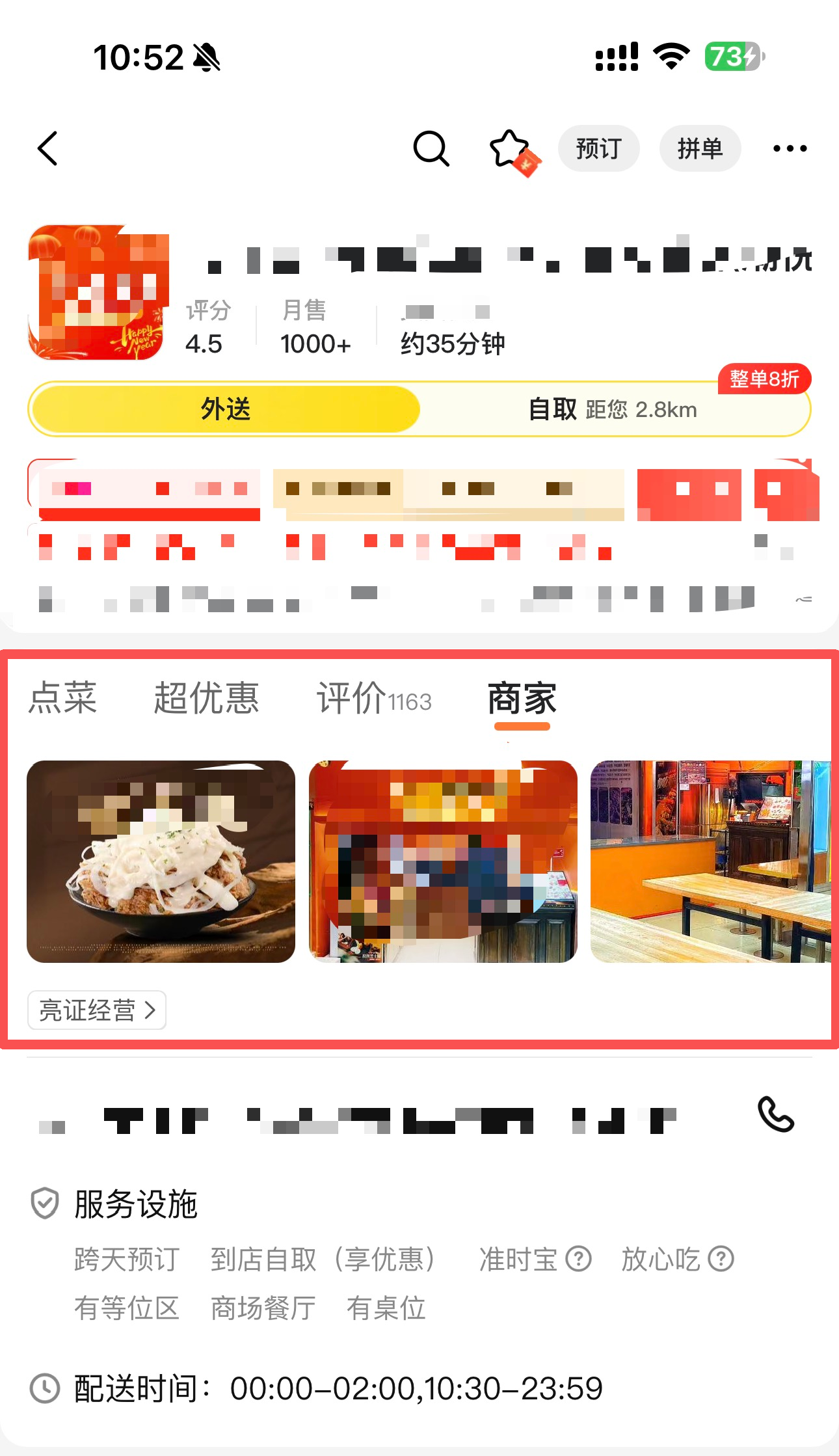
Core Viewpoint - The newly released regulations by the State Administration for Market Regulation aim to eliminate "ghost restaurants" by imposing strict requirements on food delivery platforms and merchants, ensuring transparency and accountability in food safety [1][2]. Group 1: New Requirements for Food Delivery - The name of the online restaurant must match the name displayed on the physical storefront [2]. - Actual operating addresses must align with those listed on the business license to address the "fake address" issue [3]. - Delivery platforms are required to verify and update the registered operating addresses and business qualifications of merchants at least every six months [4]. Group 2: Transparency and Consumer Protection - Merchants that only provide delivery services must clearly indicate "no dine-in" on their main page [5]. - The regulations encourage merchants to adopt "Internet + Bright Kitchen" practices to publicly share the food preparation process [6]. - Platforms must provide necessary technical support for merchants to fulfill information disclosure obligations and cannot hide or create barriers to accessing this information [7]. Group 3: Penalties for Non-Compliance - Violations can result in fines up to 200,000 yuan for platforms and merchants [9]. - Platform leaders may face fines ranging from one to ten times their previous year's income for serious violations [10]. - The regulations also address cross-regional supervision challenges by granting provincial market regulation departments direct jurisdiction over violations [11]. Group 4: Consumer Guidelines - Consumers are advised to verify the restaurant's name against the storefront and check for consistency in the business license address [12][17]. - It is recommended to look for "dine-in" labels and check for live streaming of food preparation to ensure authenticity [27][37].
外卖平台须担食安“守门员”责任
Xin Lang Cai Jing· 2026-02-27 06:02
Core Viewpoint - The new regulations emphasize that food delivery platforms must take responsibility for food safety and cannot solely focus on commission and traffic without ensuring quality [1] Group 1: Regulatory Changes - The State Administration for Market Regulation (SAMR) has introduced new regulations requiring food delivery platforms to conduct substantial reviews of merchants' food business licenses and operating qualifications, including real-name registration and on-site verification [4] - Platforms are mandated to verify merchants' actual operating addresses and business qualifications at least every six months to prevent "ghost deliveries" [4] - The new rules also require that the names of online stores must match the names of their physical storefronts, and essential information such as operating qualifications and actual addresses must be prominently displayed [2] Group 2: Transparency and Accountability - The regulations aim to enhance transparency by requiring food delivery merchants to publicly disclose their food processing procedures through an "Internet + Open Kitchen" system [3] - Platforms are held accountable for the food safety of products sold on their sites, necessitating the establishment of dedicated food safety management teams and comprehensive risk management systems [5] - Penalties for non-compliance have been significantly increased, with fines reaching up to 200,000 yuan, and personal fines for platform executives can be up to ten times their annual income if severe violations occur [3] Group 3: Market Insights - China's food delivery market is projected to exceed 1.4 trillion yuan, accounting for approximately 24% of the total revenue in the restaurant industry, highlighting its importance as a growth driver [2]
市场监管总局对幽灵外卖出重拳
Xin Lang Cai Jing· 2026-02-27 04:58
【#市场监管总局对幽灵外卖出重拳# 】#外卖平台审核商家不能只在网上# 有没有想过,你点的那份外 卖,可能根本没有厨房?地址是假的,照片是假的,进嘴里的东西来自哪里、谁做的,全是问号。这不 是危言耸听,而是时而出现的"幽灵外卖"。近些年,相关部门和外卖平台都在整治,而最新消息显示, 市场监管总局也要出重拳了。比如,新规要求,外卖平台应当对外卖商家进行实名登记,并通过实地核 查等方式,对外卖商家的食品经营许可证等经营资质证书进行实质性审查。新规还要求,外卖平台应当 至少每六个月对外卖商家登记的实际经营地址、经营资质等信息核验更新一次,保证上述信息与实际情 况相符。说白了,外卖平台以后对商家的审核不能网来网去,更不能走个形式。实地去看,严格地查, 让每一份外卖都有据可查,让每一个厨房都经得起看,这不是苛求,而是一份确保舌尖上的安全的底 线。数据显示,我国外卖市场规模预计突破1.4万亿元,占了餐饮业小半壁江山。外卖行业不是小打小 闹,这是咱们的日常,是无数人的生计,也是实体经济的毛细血管。只有消费者吃得放心,这个行业才 能真正跑得远,跑得稳。(@北京日报 记者 海杨 评论员 邱凌 美编 温辉) ...
28年有金融危机?我倒觉得你躺平拿钱的年代要来了
3 6 Ke· 2026-02-27 02:33
Core Viewpoint - The report titled "2028 Global Intelligence Crisis" suggests that if AI continues to advance, it could lead to an economic crisis where human consumption declines despite rising corporate revenues, creating a paradoxical "ghost GDP" [1][9][10]. Group 1: Impact on Companies - Companies like Visa, DoorDash, and ServiceNow have seen significant stock price drops following the report's release, indicating the immediate market reaction to the potential implications of AI [2][3]. - The report highlights that as AI becomes more capable, it will replace human roles in various sectors, leading to cost reductions for companies but also resulting in widespread job losses and reduced consumer spending [7][9]. - SaaS companies, traditionally benefiting from subscription models, may face challenges as clients explore AI alternatives, leading to price negotiations that could undercut their profitability [12][14]. Group 2: Economic Implications - The report outlines a cycle where increased corporate efficiency through AI leads to job cuts, reduced consumer spending, and ultimately a contraction in economic activity, which could spiral into a financial crisis [9][10][19]. - The concept of "ghost GDP" is introduced, where corporate revenues appear healthy while actual economic activity declines, creating a disconnect that could destabilize the financial system [9][10]. - The report suggests that the concentration of wealth and resources in the hands of a few could exacerbate economic inequality, leading to a stagnant economy where the majority lack purchasing power [15][30]. Group 3: Potential Solutions and Human Adaptation - The report discusses the idea of implementing an "AI tax" to redistribute wealth generated by AI, ensuring that the benefits of increased productivity are shared among the population [17][19]. - Historical perspectives, such as Jevons Paradox, suggest that increased efficiency from AI could lead to greater overall consumption rather than a decline, indicating that human adaptability may mitigate some negative impacts [21][23]. - The report emphasizes that the future economic landscape will depend not solely on AI's capabilities but also on the rules governing wealth distribution and responsibility in the face of technological advancement [30][31].
针对“幽灵外卖”等顽疾 两部新规提出哪些新举措?
Xin Hua Wang· 2026-02-27 02:26
Core Viewpoint - The new regulations emphasize that food delivery platforms must take responsibility for food safety and cannot solely focus on collecting commissions and traffic without ensuring quality [1] Group 1: Regulatory Framework - The State Administration for Market Regulation (SAMR) has introduced two new regulations aimed at addressing issues such as lack of transparency, "ghost kitchens," and difficulties in accountability in online food delivery [2][3] - The regulations require platforms to ensure that the names of online food service providers match their physical storefronts and that they display their operating qualifications and actual addresses prominently [2] Group 2: Addressing "Ghost Kitchens" - "Ghost kitchens" refer to unlicensed operators who misrepresent themselves as legitimate businesses on food delivery platforms [3] - The new regulations mandate platforms to conduct substantive reviews of the food business licenses of online food service providers and to verify their actual operating addresses at least every six months [3] Group 3: Consumer Accountability - The regulations aim to ensure that consumers can easily find and report issues related to food safety by requiring platforms to provide visible complaint links on the main pages of food sellers [4] Group 4: Penalties for Non-compliance - The new rules significantly increase penalties for platforms and merchants, with fines reaching up to 200,000 yuan, and personal fines for responsible individuals can be up to ten times their previous year's income in severe cases [5] Group 5: Compliance in Online Sales - The regulations stipulate that online food sellers must provide accurate information regarding the origin, ingredients, and quality of their products, prohibiting false advertising and claims related to disease prevention or treatment [6]
外卖行业新规:外卖店名须与实体招牌一致,“无堂食”商家须标明
2 1 Shi Ji Jing Ji Bao Dao· 2026-02-27 01:02
Core Viewpoint - The rapid development of the online food delivery industry has prompted the State Administration for Market Regulation to implement new regulations aimed at enhancing food safety standards in this sector [2][3]. Group 1: Regulatory Framework - The newly established regulations detail the responsibilities of food delivery platforms regarding merchant qualification audits, information disclosure, process control, and issue resolution throughout the entire management chain [2]. - Platforms are required to take responsibility for food safety at every operational stage, ensuring that they are accountable for the quality of food delivered, not just for generating revenue [2]. Group 2: Consumer Protection Measures - The regulations mandate that the names of online food stores must match the names displayed at their physical locations, and essential information such as operating qualifications and actual addresses must be prominently displayed on the main page [2]. - To address the issue of "fake addresses," the actual operating address must align with the address listed on the business qualification certificate [2]. Group 3: Compliance and Penalties - Delivery platforms that exclusively provide takeaway services must clearly indicate "no dine-in" on their main page, with this information also displayed on the platform's merchant list [3]. - The authorities plan to significantly increase penalties for violations, with fines reaching up to 200,000 yuan, and in severe cases, personal fines for platform executives could be imposed based on their previous year's income, ranging from one to ten times [3].
为整治“幽灵外卖”,新规要求外卖平台至少每半年核验商家信息
2 1 Shi Ji Jing Ji Bao Dao· 2026-02-27 01:02
Core Viewpoint - The article discusses the issue of "ghost takeout" in the online food delivery service sector, highlighting the recent regulations introduced by the State Administration for Market Regulation to combat this problem [2] Group 1: Regulatory Measures - The new regulations require food delivery platforms to conduct real-name registration of merchants and perform substantive reviews of their food business licenses and operating qualifications [2] - Platforms must verify the information on merchants' food business licenses against data held by provincial market regulation departments, and those with discrepancies will not be allowed to use the platform [2] - Food delivery platforms are mandated to update and verify the actual operating addresses and qualifications of merchants at least every six months to ensure compliance with the regulations [2] Group 2: Objectives of the Regulations - The regulations aim to establish a comprehensive governance system through three strategies: "correct source, clear flow, and solid foundation" [2] - The goal is to eliminate the breeding ground for "ghost takeout" and transition merchants from "paper compliance" to "visible authenticity" [2]
新华解码丨针对“幽灵外卖”、虚假宣传等顽疾 两部新规提出哪些新举措?
Xin Hua Wang· 2026-02-27 00:50
Core Viewpoint - The new regulations aim to address issues such as "ghost takeout," false advertising, and the lack of accountability in online food delivery services, emphasizing the responsibility of platforms to ensure food safety and transparency [1]. Group 1: Regulatory Measures - The newly released regulations require online food delivery platforms to ensure that the names of online food service providers match their physical storefronts and to display their operating qualifications and actual addresses prominently [2]. - Platforms must also indicate "no dine-in" status for providers that do not offer this service, ensuring that consumers are aware of the service limitations [2]. Group 2: Addressing "Ghost Takeout" - "Ghost takeout" refers to unlicensed operators who misrepresent themselves as legitimate businesses through fraudulent means [3]. - The regulations mandate that platforms conduct substantive reviews of the food business licenses of their listed providers and verify that the information matches reality, preventing the use of false or borrowed credentials [3]. - Platforms are required to verify the actual operating addresses and qualifications of food vendors at least every six months to ensure compliance [3]. Group 3: Consumer Accountability - To enhance consumer protection, the regulations require platforms to provide visible links for complaints and reports on the main pages of food sellers, ensuring that consumer issues are addressed promptly [4]. Group 4: Penalties and Compliance - The new regulations significantly increase penalties for violations, with fines reaching up to 200,000 yuan, and personal fines for platform leaders can be imposed based on their previous year's income if intentional violations occur [5]. - Online food sellers must provide accurate information regarding product origins, ingredients, and certifications, prohibiting misleading advertising and claims related to disease prevention or treatment [5].
【聚焦新就业形态劳动者】从试点扩围到全面覆盖,“新职伤”哪些方面还需发力?
Xin Lang Cai Jing· 2026-02-26 19:41
Core Viewpoint - The "New Occupational Injury" (新职伤) program is set to expand nationwide by 2026, providing essential support for new employment groups and addressing their concerns regarding occupational safety and insurance coverage [1][2]. Group 1: Program Expansion and Implementation - The "New Occupational Injury" program began as a pilot in July 2022 across seven provinces and cities, with plans to expand to ten more provinces and four additional platform companies by July 2025 [1]. - By 2026, the program will cover all provinces and all platform companies in the ride-hailing, instant delivery, and local freight industries [1]. - The program aims to enhance the occupational safety net for new employment forms, encouraging platform companies to diversify their insurance offerings [1][8]. Group 2: Challenges and Legal Issues - Issues have arisen regarding the recognition of occupational injuries and the payment of benefits, highlighted by a case where an insurance claim was denied due to the location of the incident [2][4]. - The concept of "work time" and "work position" is evolving, with legal interpretations suggesting a need for flexibility in recognizing injuries that occur during or as a result of work-related activities [2][4]. - Disputes between the "New Occupational Injury" program and other insurance types have been noted, with courts emphasizing the complementary nature of social security and commercial insurance [4][6]. Group 3: Innovations and Best Practices - Various provinces have implemented innovative practices to streamline the claims process, such as Beijing's "small injury quick compensation" mechanism, which simplifies the claims process for minor injuries [6]. - Guangdong has introduced fast-track procedures for small claims, enhancing the efficiency of the compensation system [6]. - The integration of occupational injury prevention and rehabilitation into the "New Occupational Injury" program is being emphasized, with initiatives aimed at reducing injury occurrences and improving recovery processes [7]. Group 4: Future Directions - The program is expected to extend beyond current industries to include sectors like online streaming, domestic services, and other emerging employment forms [8]. - There is a call for mandatory insurance coverage in industries with frequent claims to ensure comprehensive protection for workers [8]. - Continuous refinement of the "New Occupational Injury" system is recommended, focusing on injury recognition, processing efficiency, and operational models [8].