
债券

Search documents
信用债2026年投资策略—主线重塑(PPT)
2025-12-04 04:47
Summary of Key Points from the Conference Call on Credit Bonds Investment Strategy for 2026 Industry Overview - The focus is on the credit bond market, particularly the transformation and opportunities within the sector for 2026, driven by technological advancements and market dynamics [4][8]. Core Insights - **Restructuring of Credit Market**: The emergence of technology bonds is expected to inject new vitality into the credit market, with a significant expansion of the tech bond market anticipated in 2026 [4][8]. - **Debt Reduction Progress**: The debt reduction efforts are nearing completion, and the market-oriented transformation of local government financing platforms is accelerating. Upgraded industrial companies are expected to explore the bond market more in 2026, presenting notable investment opportunities [4][8]. - **Pricing Trends**: State-owned real estate and mixed-ownership enterprises are increasingly being priced similarly to local government financing, while private enterprises should focus on core asset reserves and de-risking [4][8]. - **Risk Premiums**: Despite a gradual recovery in the industry and the exit of high-risk entities, the risk premium for real estate bonds remains high, suggesting a favorable cost-benefit ratio for investments in this sector [4][8]. - **Market Dynamics**: The pricing in the market is heavily influenced by the attributes of real estate companies, with state-owned and mixed-ownership enterprises showing a trend towards "local government financing" pricing [4][8]. - **Investment Recommendations**: It is advised to focus on leading state-owned real estate companies and high-quality private real estate firms with sufficient core assets, as the volatility in the broader private sector remains significant [4][8]. Financial Data and Trends - **Credit Market Financing**: Since 2025, the credit market has experienced a tightening trend, with industrial bonds performing better than local government bonds. In the first three quarters of 2025, local government financing platforms saw a net outflow of 551.2 billion yuan, while the industrial sector had a net inflow of 2.09 trillion yuan [8][9]. - **Bond Issuance and Maturity**: As of October 20, 2025, a total of 1.68 trillion yuan in tech bonds have been issued, supported by ongoing policy backing for technological innovation [8][9]. - **Credit Spread Trends**: The credit spreads for AAA-rated bonds have shown significant differentiation across maturities, with a notable tightening observed in the short-term bonds [12][13]. Risk Factors - **Monetary Policy Risks**: Potential unexpected changes in the central bank's monetary policy and the Federal Reserve's actions could adversely affect the financing environment [4][6]. - **Regulatory Environment**: Tightening regulatory policies may lead to a deterioration in the financing landscape, posing risks to market stability [4][6]. - **Economic Recovery**: The pace of macroeconomic recovery may not meet expectations, which could impact credit market performance [4][6]. - **Credit Events**: Isolated credit events could disrupt market conditions, necessitating vigilance among investors [4][6]. Additional Insights - **Non-Bank Financial Institutions**: The expansion of non-bank financial institutions in the southbound market is expected to bring in incremental capital, enhancing the supply-demand dynamics in the offshore bond market [4][8]. - **Investment Opportunities**: Focus on liquid AT1 bonds, central enterprise asset management companies, and high-quality private TMT bonds is recommended, as the market supply remains relatively ample [4][8]. - **Long-Term Investment Strategy**: Emphasis on capturing yield value in the dim sum bond market, particularly in mid-to-long-term financial bonds and key regional local government bonds [4][8]. This summary encapsulates the critical insights and data from the conference call, providing a comprehensive overview of the credit bond market's outlook for 2026.
日本30年国债需求创六年新高 释放积极信号
Sou Hu Cai Jing· 2025-12-04 04:02
Core Viewpoint - Japan's recent government bond auction indicates strong demand for long-term bonds, providing some relief amid recent yield fluctuations [1] Group 1: Auction Results - The 30-year government bond auction attracted the strongest demand in six years, showing sustained investor interest despite long-term yields being at multi-decade highs [1] - The bid-to-cover ratio was 4.04, significantly higher than the 3.12 from the last auction in November, marking the highest level since 2019 [1] - The auction produced a smaller tail of 0.09 compared to 0.27 in the previous month, indicating that investors are willing to accept yields closer to market clearing levels, suggesting a smoother price discovery process [1] Group 2: Market Implications - The strong results reflect a rebound in demand from both domestic institutions and overseas buyers, who still see value in the long end of the Japanese yield curve despite ongoing discussions about policy normalization by the Bank of Japan [1] - Following recent volatility triggered by speculation about the Bank of Japan tightening its policy, the robust demand may help stabilize long-term interest rates [1]
从“点心”到“主菜”--人民币点心债市场面临大发展机遇
Hua Er Jie Jian Wen· 2025-12-04 03:15
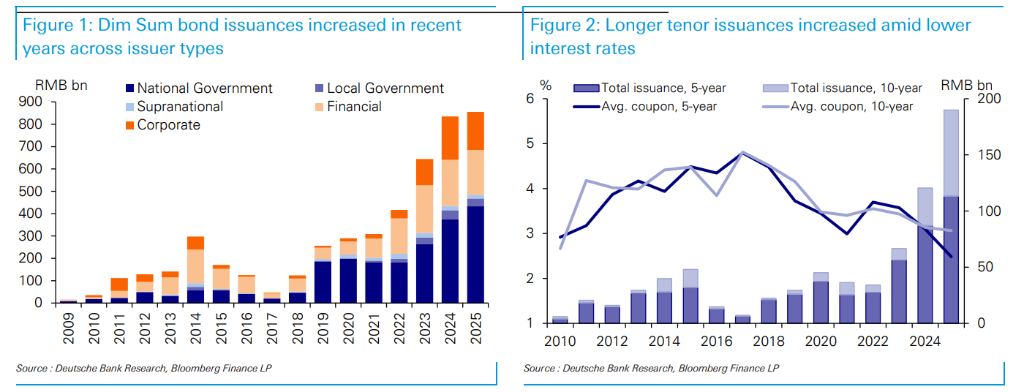
Core Viewpoint - The renminbi dim sum bond market is evolving from a marginalized niche to a mainstream asset with significant allocation value, marking a historic opportunity window [1] Group 1: Market Growth and Expansion - The dim sum bond market has shown remarkable growth, with annual issuance in renminbi terms skyrocketing from 300 billion yuan in 2021 to an estimated 850 billion yuan in 2024, and projected to reach between 900 billion to 1 trillion yuan in 2025 [2] - The current market size has reached 1.8 trillion yuan, driven by the strong appeal of renminbi as a financing currency, particularly in a low interest rate environment [2] - Notable issuers include major Chinese tech companies like Alibaba, Baidu, and Tencent, as well as international entities such as the Kazakhstan Development Bank and the Indonesian government, indicating a broadening issuer base [2] Group 2: Demand Dynamics - Historically, insufficient investor demand has been a major bottleneck for the dim sum bond market, but recent resilience has been observed despite depreciation pressures on the renminbi [4] - The nature of offshore renminbi deposits has fundamentally changed, with growth closely linked to cross-border renminbi payment volumes, indicating a shift from speculative to transactional demand [4] - The share of renminbi in current account payments has increased from 18% in 2021 to 28% in the first half of 2025, providing a more stable liquidity foundation for the dim sum bond market [4] Group 3: Supply and Policy Support - The low interest rate environment has led to unprecedented enthusiasm from various issuers, including Chinese tech giants and entities along the Belt and Road Initiative, to enter the dim sum bond market [6] - The demand side has transformed, with stable growth in offshore renminbi funds driven by real cross-border trade and capital settlement needs, supported by policy tools like the "Southbound Bond Connect" [6] - The Chinese government's commitment to accelerating renminbi internationalization, as indicated in the upcoming 14th Five-Year Plan, is providing strong support for the dim sum bond market [8] Group 4: Global Investment Opportunities - A favorable opportunity window has emerged as high dollar interest rates suppress demand for dollar-denominated bonds, with the share of dollar-denominated bonds in Asian international issuance dropping from 83% in 2020 to 67% in 2024, while renminbi-denominated bonds have increased to 11% [11] - The renminbi is expected to strengthen further, having appreciated approximately 4% against the dollar since 2025, enhancing the attractiveness of renminbi assets, including dim sum bonds, for global investors [11] - The dim sum bond market is poised to enter a self-reinforcing virtuous cycle, where increased market size and liquidity attract more issuers, ultimately solidifying the renminbi's status as a value storage tool [12]

【申万固收|地方债周报】发行提速但下周再降速,5000亿结存限额发行或已过半——地方债周度跟踪20251128
申万宏源证券上海北京西路营业部· 2025-12-04 02:11
Core Viewpoint - The article discusses the acceleration in local government bond issuance, indicating that the issuance limit of 500 billion may have already been exceeded halfway through the period [2] Group 1: Issuance Trends - Local government bond issuance has accelerated, with a notable increase in the volume compared to previous weeks [2] - The article suggests that the issuance pace may slow down in the upcoming week, indicating a potential shift in market dynamics [2] Group 2: Financial Implications - The current issuance limit of 500 billion is highlighted, with the implication that the remaining capacity may be limited as more bonds are issued [2] - The article emphasizes the importance of monitoring the issuance trends closely, as they can impact liquidity and investment opportunities in the market [2]

每日资讯-20251204
Lian He Zi Xin· 2025-12-04 01:45
Core Insights - The report highlights a collaborative initiative by six departments to enhance the adaptability of supply and demand in consumer goods, aiming to create a long-term mechanism that drives industrial upgrades through consumption upgrades [2][3] - The focus is on breaking down barriers in the entire chain from demand identification to supply response, financial support, and market environment, marking a shift from short-term measures to a systematic approach [2] Group 1: Policy Intent and Focus Areas - The core policy intent is to establish a dynamic matching mechanism by simultaneously addressing both supply and demand sides, utilizing big data analysis and consumption trend forecasting to identify and create new demands, particularly in green, smart, and health-oriented consumption [2] - On the supply side, the initiative encourages enterprises to shift from "producing what is sold" to "producing based on demand" and even "creating demand through intelligent production," promoting personalized customization and scenario-based solutions [2] Group 2: Impact on Industries and Credit Fundamentals - The implementation of this initiative is expected to accelerate credit differentiation among consumer goods-related industries, benefiting companies that can quickly respond to policy directions and possess strong product innovation capabilities, particularly in smart home, national trend culture, and green consumption sectors [3] - Conversely, companies that are slow to transform and have serious product homogeneity will face greater market pressure, while the emphasis on quality standards and consumer rights protection will raise compliance thresholds, favoring leading companies that meet regulatory and technical standards [3] Group 3: Bond Market Insights - In the bond market, a total of 632 credit bonds were issued this week, with an average interest rate of 2.09%, reflecting a year-on-year increase of 4 basis points [5] - The average interest rate for one-year AA+ rated bonds saw a significant year-on-year increase of 48 basis points, while AAA rated bonds experienced a decrease of 9.36 basis points [5][6]
日本长债风暴继续
Hua Er Jie Jian Wen· 2025-12-04 00:41
Group 1 - The yield on Japan's 30-year government bonds increased by 2.5 basis points to 3.445%, marking a historical high [1] - The yield on Japan's 20-year government bonds rose by 3 basis points to 2.94%, the highest level since June 1999 [1] - The yield on Japan's 10-year government bonds increased by 1.5 basis points to 1.905%, the first time it has reached this level since 2007 [1]
日本10年期国债收益率触及1.905% 创2007年以来最高水平
Xin Lang Cai Jing· 2025-12-04 00:13
Core Viewpoint - Japan's 10-year government bond yield has reached its highest level since 2007, indicating a significant shift in the bond market [1] Group 1: Yield Movement - The yield increased by 1.5 basis points to 1.905% [1] - This marks a notable rise in interest rates, reflecting changing economic conditions [1] Group 2: Futures Market Reaction - The price of 10-year Japanese government bond futures dropped by 14 points, reaching 134.31 [1] - This decline in futures prices suggests a bearish sentiment in the bond market following the yield increase [1]
资产配置模型系列:基于周期理论的改进BL资产配置模型与应用展望
Bank of China Securities· 2025-12-04 00:08
Core Insights - The report emphasizes the improvement of the Black-Litterman (BL) model through the integration of nested cycle theory, which enhances the Sharpe ratio and win rate of asset portfolios, recommending an increase in A-shares and US Treasuries while gradually reducing US stock positions for 2026 [2][3][10]. Group 1: BL Model Overview - The BL model combines market implied equilibrium returns with investor subjective views weighted by confidence levels, resulting in more robust expected returns for asset allocation [8][10]. - The model addresses the high sensitivity of traditional mean-variance models to parameters and incorporates subjective investor views, making it more practical [10][11]. Group 2: Impact of Nested Cycle Theory - The improvement of the BL model is primarily based on subjective views derived from nested cycle theory, which assesses the performance of major asset classes under different cycle phases [10][11]. - The model outputs significantly enhance the Sharpe ratio of portfolios, allowing for better risk-adjusted returns [10][12]. Group 3: Asset Class Outlook for 2026 - The report forecasts a gradual shift to a de-stocking phase for major economies in 2026, suggesting an increase in allocations to A-shares and US Treasuries while reducing US stock positions [2][3][10]. - The model's asset return predictions will be based on historical average data from the transition from passive to active de-stocking phases [25][26]. Group 4: Performance of Asset Classes - Historical data indicates that during the passive de-stocking phase, equities outperform other asset classes with an average annual return of 27.74% and a win rate of 60% [17][18]. - In the active re-stocking phase, equities and commodities show strong performance, with equities achieving an average return of 40.01% and a win rate of 83% [17][18]. - Bonds perform best during the active de-stocking and passive re-stocking phases, with average returns of 10.28% and 3.61%, respectively [17][18]. Group 5: Model Implementation Steps - The BL model involves several steps: calculating prior expected returns, inputting subjective views, calculating posterior expected returns, and optimizing the asset allocation [21][22][23]. - The model's implementation requires historical return data and subjective forecasts from investment managers, with constraints on asset allocation ratios [30][31].
欧债收益率多数下跌,英国10年期国债收益率跌2.2个基点
Mei Ri Jing Ji Xin Wen· 2025-12-03 21:58
Core Viewpoint - European bond yields mostly declined on December 3, with varying changes across different countries' 10-year government bonds [1] Group 1: Yield Changes - The UK 10-year government bond yield decreased by 2.2 basis points to 4.446% [1] - The French 10-year government bond yield increased slightly by 0.1 basis points to 3.490% [1] - The German 10-year government bond yield fell by 0.2 basis points to 2.745% [1] - The Italian 10-year government bond yield dropped by 1.8 basis points to 3.444% [1] - The Spanish 10-year government bond yield decreased by 0.4 basis points to 3.217% [1]
美国债市:国债上涨 ADP就业数据强化美联储降息预期
Xin Lang Cai Jing· 2025-12-03 21:25
美国国债周三走高,受美国早间发布的弱于预期的11月ADP私营部门就业数据推动。尽管随后遭遇阻 力,但收盘仍接近日间最佳水平。市场对美联储下周降息的预期依然完好,消化的12月10日美联储政策 会议降息25个基点的可能性约为90%。 纽约时间下午3点刚过,收益率全线下跌2-3个基点。中期国债领涨美债,5s30s利差扩大1个基点, 2s5s30s利差收窄1.5个基点。 ADP数据公布后几分钟内,收益率触及盘中低点,该数据使得合约押注的到明年年中美联储政策利率下 降几个基点,而预期的中性利率朝着3%小幅走低。 在国债期权方面,值得注意的资金流动包括对押注30年期国债收益率到下周五升至约4.8%的期权的大 笔买入。 截至纽约时间下午3:37,美国2年期国债收益率报3.4835%; 美国5年期国债收益率报3.6225%; 美国10年期国债收益率报4.0575%; 美国30年期国债收益率报4.7268%; 美国2年和10年国债收益率差报57.198个基点; 美国5年和30年国债收益率差报110.263个基点。 新浪合作大平台期货开户 安全快捷有保障 责任编辑:丁文武 美国国债周三走高,受美国早间发布的弱于预期的11月ADP ...