
农产品

Search documents
云南昭通年货节在沪揭幕
Xin Lang Cai Jing· 2026-01-17 07:27
Core Insights - The 2026 Yunnan Zhaotong New Year Goods Festival was launched in Shanghai, showcasing over a hundred high-quality local products from Zhaotong, including apples, bamboo shoots, and specialty sauces, aimed at promoting "Zhao brand" products beyond the mountains and into urban markets [1][2] - Zhaotong is recognized as a significant production base for apples, Tianma, bamboo shoots, and beef, with geographical indication products like "Zhaotong Apples" and "Yiliang Tianma" gaining popularity both domestically and internationally [1] - The festival integrates local intangible cultural heritage with food products, creating a unique culinary experience that highlights the flavors of Zhaotong [1] Sales and Marketing Strategy - Following the three-day festival, Zhaotong products will continue to be featured in Shanghai through "pop-up stores and physical stores" throughout the Spring Festival, with activities such as live streaming sales and consumer tastings planned [2] - The initiative is expected to generate over 10 million yuan in online and offline sales, benefiting more than 10,000 local farmers in Zhaotong [2] Future Plans - Zhaotong will return to Shanghai during the "Five-Five Shopping Festival" in May with new products, continuing the dialogue between mountain and sea flavors [3]
【环球财经】2025年荷兰农产品出口增长8.4%
Xin Hua Cai Jing· 2026-01-17 06:34
Core Insights - The Netherlands' agricultural exports are projected to reach €137.5 billion in 2025, marking an 8.4% year-on-year increase, and this will be the tenth consecutive year of growth in agricultural exports [1] Export Market Analysis - The European Union remains the largest market for Dutch agricultural exports, with exports to Belgium expected to grow by 9% to €17.1 billion and exports to Germany projected to reach €34.6 billion, reflecting a 12% increase [1] Product Category Breakdown - Key export categories include: - Dairy products and eggs: €13.3 billion - Cocoa and cocoa products: €12.4 billion (fastest growth) - Horticultural products: €12.3 billion - Meat products: €12.1 billion - Fruits: €9.6 billion [1] Import Trends - Agricultural imports to the Netherlands are anticipated to be €95.1 billion in 2025, representing an 11.3% increase compared to 2024 [1] Price Influence - The growth in both agricultural exports and imports is primarily driven by rising prices [1]

郑丽文直言:觉得非常痛心
Xin Lang Cai Jing· 2026-01-17 06:24
Core Points - The U.S. has finalized a tariff agreement with Taiwan, reducing the tariff rate from 20% to 15% for Taiwanese goods, while requiring Taiwan to provide $250 billion in investment and $250 billion in credit guarantees [1][2][3] - The agreement is seen as a strategic move to bolster the U.S. semiconductor industry and is characterized by U.S. officials as essential for maintaining Taiwan's favor with the U.S. administration [1][3][5] - The deal mandates TSMC to build at least four additional semiconductor fabs in Arizona, extending previous commitments [1][3] Summary by Sections Tariff Agreement Details - The tariff rate for Taiwanese goods is set at 15%, which is the lowest among U.S. trading partners with similar agreements [2][7] - Taiwan has secured "most favored nation" treatment for semiconductors and related products, which includes a commitment to invest $250 billion in the U.S. semiconductor sector [1][2] Economic Implications - The investment commitments from Taiwan are substantial, with $500 billion representing 56.8% of Taiwan's GDP, compared to 12.8% for Japan and 18.8% for South Korea [2][7] - The agreement is designed to tie tariff benefits to Taiwan's investment and production capabilities in the U.S., which could lead to significant shifts in Taiwan's semiconductor industry [3][7] Political Reactions - The Taiwanese government, particularly the DPP, has framed the agreement as a victory, while opposition parties express concern over the potential risks and economic burdens [2][4][5] - Critics argue that the deal may lead to a significant outflow of Taiwan's semiconductor industry to the U.S., raising concerns about the long-term viability of Taiwan's local industry [3][4][8]


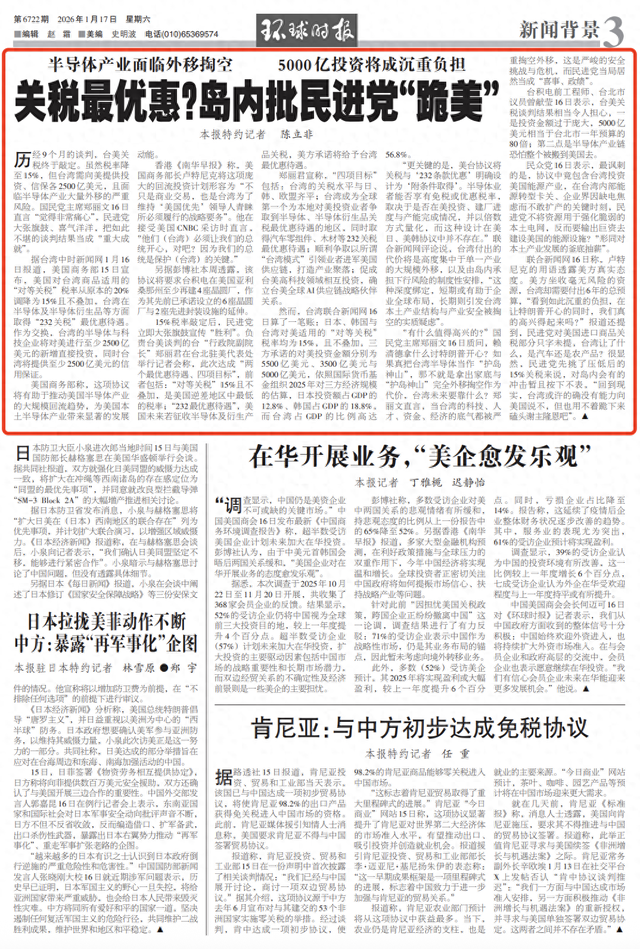
加拿大总理送豪礼!访华第三天宣布:将进口4.9万辆中国电动汽车
Sou Hu Cai Jing· 2026-01-17 05:13
Core Insights - Canada has significantly reduced tariffs on Chinese electric vehicles from 100% to 6.1%, allowing the import of up to 49,000 units, marking a return to pre-trade conflict conditions [3][5] - This policy shift is seen as a rational correction to previous trade policies that failed to protect local industries effectively while increasing consumer costs [5][10] - The adjustment reflects Canada's recognition of the competitive advantages of the Chinese electric vehicle industry, which has established a comprehensive supply chain and technological leadership [7][8] External Factors - The Chinese electric vehicle industry has developed a strong global presence, with advantages in core component development, vehicle manufacturing, and after-sales service [7] - Chinese automakers are expanding their market share not only in Asia but also in Europe, Southeast Asia, and Latin America, becoming essential players in the global new energy supply chain [8] Internal Considerations - Canada’s previous reliance on the U.S. for trade has exposed it to risks, as seen in recent trade disputes that have affected its manufacturing and agricultural sectors [10] - The decision to allow Chinese electric vehicles is a strategic move to diversify trade relationships and enhance domestic supply options while supporting energy transition goals [10] Broader Implications - The tariff reduction is part of a larger effort to improve Canada-China relations, with both countries seeking to enhance cooperation in various sectors, including clean energy and agriculture [12][14] - The joint statement from both nations emphasizes a commitment to resolving trade differences through dialogue and collaboration, moving towards a more integrated economic partnership [14] Market Dynamics - The entry of Chinese electric vehicles is expected to increase competition in the Canadian market, potentially benefiting consumers with more choices and lower prices [18][20] - While some local companies express concerns about increased competition, the overall market dynamics may drive innovation and efficiency within the domestic industry [20] Future Outlook - The successful implementation of this policy and the potential for ongoing cooperation between Canada and China will depend on various factors, including political dynamics and market responses [22] - This policy shift signifies a new phase in Canada’s trade strategy, moving away from a singular focus on the U.S. and towards a more independent and balanced approach [22]
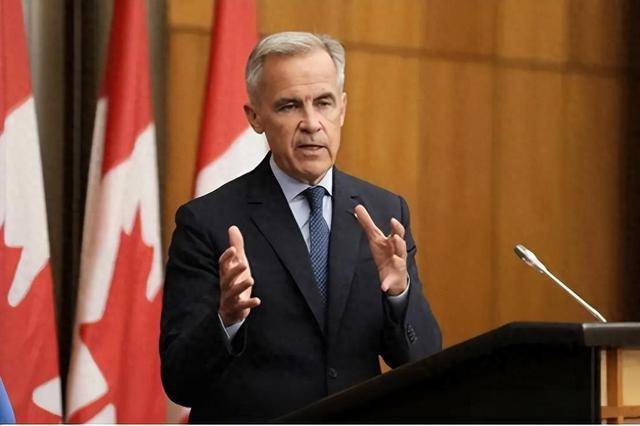
特朗普通报全球,带领美国完赢了中国!话音刚落,中方对美征税
Sou Hu Cai Jing· 2026-01-17 04:16
Group 1 - Trump claims that the U.S. has "won" against China through tariffs, suggesting that China is now the largest taxpayer to the U.S. [1][3] - The assertion that tariffs are a form of revenue from China is a misrepresentation, as it ignores the costs incurred by U.S. consumers and businesses for imported Chinese goods [3] - Trump's recent actions, such as promoting the export of Nvidia's H20 chips to China, come with strict conditions that reflect a lack of genuine goodwill [5] Group 2 - China's response to Trump's claims indicates a shift in its trade strategy, showing that it is no longer willing to passively accept U.S. actions [19] - The announcement of anti-dumping duties on U.S. solar-grade polysilicon products, with rates between 53.3% and 57%, highlights China's ability to retaliate effectively [12][15] - The evolving dynamics of U.S.-China trade relations suggest that China is transitioning from a defensive to an offensive posture, ready to respond to U.S. pressures [21] Group 3 - The global supply chain is undergoing significant changes, with China maintaining an irreplaceable position that U.S. policymakers may underestimate [21] - Major U.S. companies like Nvidia, Apple, and Boeing continue to thrive in the Chinese market, indicating that a complete decoupling is not feasible for them [17] - The ongoing trade conflict is unlikely to resolve easily, as U.S. high-pressure policies face increasing challenges from domestic businesses and market reactions [21]
2025年荷兰农产品出口增长8.4%,进口增长11.3%
Shang Wu Bu Wang Zhan· 2026-01-17 03:37
Core Insights - The Netherlands' agricultural exports are projected to reach €137.5 billion in 2025, marking an 8.4% year-on-year increase, while imports are expected to total €95.1 billion, reflecting an 11.3% growth [1] Export and Import Overview - Agricultural products will account for 20.7% of total exports, the highest level in five years, and 16.5% of total imports, a record high [1] - The increase in agricultural trade is attributed to rising prices of agricultural products and food [1] Key Product Performance - Dairy products and eggs lead exports at €13.3 billion, up 10% year-on-year; meat exports follow at €12.1 billion, also growing by 10%; ornamental horticulture products, including flowers and plants, reached €12.3 billion, a 4% increase [1] - Cocoa and cocoa products saw a significant increase of 35%, reaching €12.4 billion, driven by price hikes, crop failures in West Africa, and rising production costs [1] Export Destinations - Germany remains the largest market for Dutch agricultural exports, with an export value of €34.6 billion, a 12% increase, accounting for 25% of total agricultural exports [1] - Exports to Belgium and France grew at a lower rate of 7%, while exports to Poland experienced the highest growth at 24% [1] - Growth in exports to non-EU regions has slowed, with exports to China at €3 billion, a 3.4% increase, partly due to a decline in pork exports but an increase in infant formula exports [1] - Exports to the United States saw only a 3% increase, impacted by higher import tariffs [1]
Canada cuts tariff on Chinese EVs in exchange for lower tariffs on Canadian farm products
Fastcompany· 2026-01-16 20:19
Core Viewpoint - Canada has decided to eliminate its 100% tariff on Chinese electric cars in exchange for reduced tariffs on Canadian agricultural products, as stated by Prime Minister Mark Carney [1] Group 1 - The agreement marks a significant shift in Canada's trade policy towards China, moving away from alignment with U.S. tariffs [1] - The reduction in tariffs on Chinese electric cars is expected to enhance competition in the Canadian automotive market [1] - The deal aims to benefit Canadian farmers by lowering tariffs on their products, potentially increasing their market access [1]


拉美金融市场成为2026年全球表现最佳市场之一
Shang Wu Bu Wang Zhan· 2026-01-16 16:10
Core Insights - Latin America's financial markets are experiencing strong performance, driven by rising commodity prices, a weakening dollar, favorable political conditions, and ongoing reforms, positioning the region as one of the best-performing markets globally by 2026 [1][2] Group 1: Market Performance - The stock markets and currency exchange rates in Latin America have outperformed developed markets, reversing years of sluggish performance [1] - Countries reliant on metal exports, such as Chile and Peru, have seen significant increases in their stock markets and currencies, with Chile's stock market leading globally [1] - Argentina's stock market has performed well following President Milei's market-oriented reforms, receiving positive evaluations from the International Monetary Fund [1] Group 2: Economic Factors - The strong performance of Latin American markets is attributed to several factors, including commodity prices, reduced geopolitical risks, dollar trends, deepening internal reforms, and breakthroughs in trade relations with Europe [2] - The recent trade agreement between the European Union and the Southern Common Market is expected to boost market confidence, benefiting agricultural exports and promoting long-term growth for manufacturing economies like Brazil and Argentina [1] - The agreement aims to lower industrial tariffs and enhance supply chain integration, which is anticipated to significantly increase bilateral trade and investment levels [1]
加美全面评估双边关系 确定2026年合作优先领域
Shang Wu Bu Wang Zhan· 2026-01-16 16:10
Core Insights - Ghana and the United States held a high-level meeting to assess bilateral relations and set priorities for cooperation in 2026, focusing on deepening economic ties and long-term strategic alignment [1] Group 1: Review of 2025 Cooperation Progress - Ghana acknowledged significant achievements in bilateral relations in 2025, indicating a positive development trend based on mutual respect and collaborative growth [2] Group 2: Visa Facilitation and Tariff Reductions - Ghana has maintained its exemption from U.S. visa sanctions and related bond requirements, facilitating travel, study, and business for its citizens [3] - The U.S. has eliminated a 15% tariff on various unprocessed and semi-processed agricultural products from Ghana, which is expected to enhance the competitiveness of Ghanaian agricultural products [3] Group 3: AGOA Extension and Industrial Development - The U.S. House of Representatives has passed a bill to extend the African Growth and Opportunity Act (AGOA) for three years, awaiting Senate approval, which is anticipated to boost Ghana's garment manufacturing sector and create more jobs in export-oriented light industries [4] Group 4: World Cup Visa Arrangements and Judicial Cooperation - The U.S. has committed to optimizing the visa application process for the 2026 World Cup, with specific measures to be announced soon [5] - Both countries reviewed progress in law enforcement and judicial cooperation, including extradition cases, and expressed intentions to continue enhancing collaboration [5] Group 5: Trade Environment and Future Cooperation Outlook - Ghana emphasized the improving business environment, which is conducive to expanding bilateral trade [6] - Ghana plans to officially initiate trade agreement negotiations with the U.S. in 2026 and is set to launch a new major public health cooperation project [6]
商务部美大司负责人解读中国加拿大经贸磋商成果
Hua Er Jie Jian Wen· 2026-01-16 15:00
Group 1 - The core viewpoint of the article highlights the cooperative spirit between China and Canada in addressing trade issues, particularly concerning canola seed and agricultural products exports to China [1] - Both parties have reached a preliminary consensus on adjusting anti-dumping measures related to canola seeds, indicating a willingness to negotiate and resolve trade disputes [1] - Canada is expected to make positive adjustments regarding unilateral measures on Chinese electric vehicles and steel and aluminum products, while China will respond by adjusting anti-dumping measures on canola seeds and anti-discrimination measures on certain agricultural products from Canada [1] Group 2 - The arrangements are anticipated to enhance industrial cooperation between China and Canada and improve the welfare of citizens in both countries [1]