
玩具

Search documents
迪士尼全年IP授权消费品零售额 620 亿美元,秘诀是“它不只是一家IP公司”
3 6 Ke· 2025-09-13 02:15
Core Insights - Disney has achieved a global licensing revenue of $62 billion, ranking first in the industry, significantly ahead of its competitors such as Authentic Brands Group ($32 billion) and Hasbro ($16.1 billion) [1][4] - The company emphasizes its ability to generate new consumer products through a continuous stream of new movie IPs, maintaining a stable profit from film IP licensing [1][4] - Disney positions itself not just as an IP company but as a consulting firm that provides comprehensive support to its partners, including market insights and operational assistance [5][8] Group 1: Licensing Revenue and Market Position - Disney's licensing revenue of $62 billion is substantially higher than its closest competitor, Authentic Brands Group, which generated $32 billion [1] - The company has maintained a strong market position by leveraging its extensive portfolio of movie IPs to create a variety of consumer products [1][4] Group 2: Consulting and Support for Partners - Disney's approach includes offering consulting services to partners, helping them navigate market challenges and optimize product launches [5][8] - The company provides a one-stop service that includes product development, marketing, and retail channel support, which enhances the commercial value of its IPs [5][8] Group 3: Focus on Emerging Markets - Disney's cross-border business in the Asia-Pacific region has seen a year-on-year growth of approximately 45%, indicating strong market potential [8] - The company aims to leverage its understanding of the Chinese market to expand its presence in Southeast Asia and beyond [9][8] Group 4: Trends in Consumer Products - Disney is closely monitoring the rapid growth of popular toy categories in China, such as trading cards, blind boxes, and plush toys, which are increasingly appealing to younger consumers [17][18] - The company has recognized the shift in the target demographic from children to young adults, indicating a strategic pivot in its product offerings [17][18] Group 5: Collaboration with Local Brands - Disney has praised local Chinese companies like Miniso and Pop Mart for their understanding of Disney's brand DNA and their ability to create global trends [16] - The company is actively working with over 70 partners in cross-border business development, exceeding its initial growth expectations [16]


首届广东优品展览会在广州开幕
Sou Hu Cai Jing· 2025-09-12 22:26
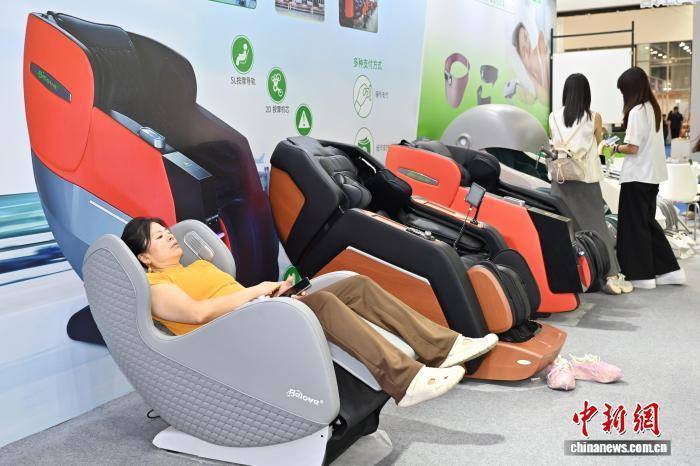
Group 1 - The first Guangdong Quality Products Exhibition opened on September 12 in Guangzhou, attracting over 1,000 Guangdong enterprises and more than 2,100 domestic and international buyers [2][8] - The exhibition features five major themed pavilions: home appliances and electronics, fashion and beauty, toys and cultural creativity, health food, and furniture and home [2] - Various products, including massage chairs and plush toys made from traditional Chinese medicine, were showcased to engage attendees [3][5] Group 2 - Live streaming sales were utilized for products such as mooncakes, indicating a trend towards digital marketing strategies in the food sector [7] - The exhibition provided opportunities for buyers to consult on various home appliances, such as washing machines, highlighting the interest in consumer electronics [7]
迪士尼全年IP授权消费品零售额 620 亿美元,秘诀是“它不只是一家IP公司”
36氪未来消费· 2025-09-12 14:49
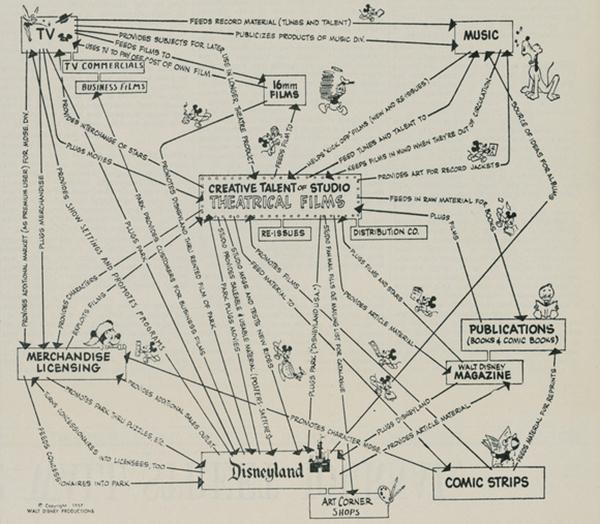
Core Viewpoint - Disney has established itself as a leader in the global licensing business, achieving an annual retail revenue of $62 billion, significantly surpassing its competitors [3][4]. Group 1: Licensing Business Performance - Disney's licensing revenue of $62 billion is the highest globally, compared to Authentic Brands Group at $32 billion, Hasbro at $16.1 billion, Warner Bros at $15 billion, and Pokémon at $12 billion [3]. - The company continues to benefit from its strong movie IP licensing, despite discussions in the toy industry about the potential for original IPs to thrive independently of content licensing [4]. Group 2: Business Model and Strategy - Disney's business model, established by Walt Disney in 1957, centers around leveraging successful movie IPs to generate a wide range of related products and services [5]. - The company maintains a consistent approach by showcasing new movie trailers followed by related consumer products at events, emphasizing the continuous flow of new films to drive consumer interest [6][7]. Group 3: Consulting Services - Disney positions itself not just as an IP company but as a consulting firm, providing comprehensive support to partners, including product development, marketing, and retail channel strategies [7][9]. - The company offers insights and forecasts to partners, sharing market trends and consumer preferences up to 18 months in advance, which enhances its collaborative efforts [9][11]. Group 4: Market Expansion and Cross-Border Business - Disney's cross-border business in the Asia-Pacific region has seen a year-on-year growth of approximately 45%, with a focus on leveraging local market knowledge for expansion [11][12]. - The company aims to capitalize on the large population base in the Asia-Pacific region, which is crucial for its growth strategy [11]. Group 5: Focus on Emerging Trends - Disney is actively monitoring and investing in popular toy categories in China, such as trading cards, blind boxes, and plush toys, which have seen significant growth [17]. - The trading card market in China has grown from 2.8 billion yuan in 2019 to an estimated 26.3 billion yuan by 2024, with a compound annual growth rate of 56.5% [17]. Group 6: Collaborations and Innovations - Disney has collaborated with various brands, including F1, to create exclusive products, tapping into the growing market of high-net-worth consumers [19]. - The company is committed to innovation in product design, as seen in the development of toys that blend traditional concepts with modern consumer interests [19][21].

资金动向 | 北水连续16日加仓阿里巴巴,抛售美团近17亿港元
Ge Long Hui A P P· 2025-09-12 12:29
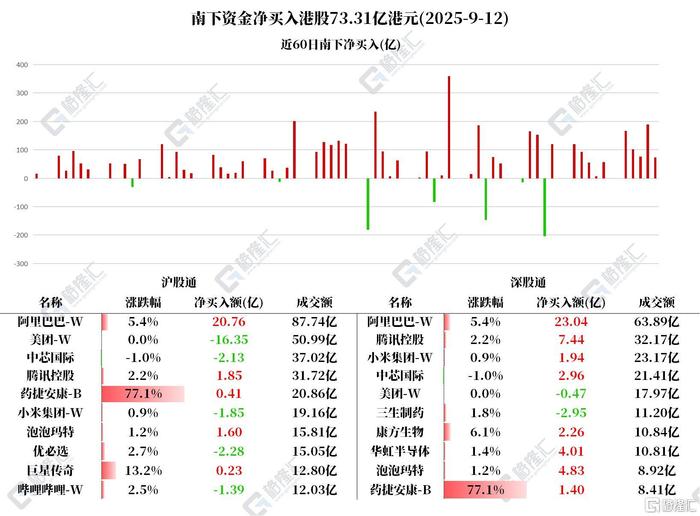
Group 1 - The net buying of stocks by southbound funds includes Alibaba-W at 4.38 billion, Tencent Holdings at 0.929 billion, Pop Mart at 0.642 billion, Hua Hong Semiconductor at 0.401 billion, Kangfang Biotech at 0.225 billion, and Yaojie Ankang-B at 0.18 billion, while net selling includes Meituan-W at 1.682 billion, 3SBio at 0.294 billion, UBTECH at 0.228 billion, and Bilibili-W at 0.138 billion [1] - Southbound funds have continuously net bought Alibaba for 16 days, totaling 41.52389 billion HKD, while net selling Meituan for 4 days, totaling 2.70959 billion HKD [3] Group 2 - Alibaba and Baidu have started using self-designed chips to train their AI models, partially replacing chips produced by Nvidia. Alibaba's Tongyi Qianwen has released the next-generation foundational model architecture Qwen3-Next and open-sourced the Qwen3-Next-80B-A3B series model based on this architecture [4] - Pop Mart has launched its first gold series products under its jewelry brand popop, with the most expensive item being a gold ornament weighing approximately 41 grams, priced over 56,000 RMB. The price of the gold series products will not fluctuate with gold prices but will vary based on craftsmanship, with prices per gram mainly concentrated between 1,300 to 1,700 RMB [4] - Yaojie Ankang's stock price has surged over 18 times since its IPO price of 13.15 HKD in less than three months. The company announced that its core product, Tengrutin combined with Fulvestrant, has received clinical implied approval from the National Medical Products Administration of China for a Phase II clinical trial for recurrent or metastatic breast cancer [4] Group 3 - Meituan is considering issuing dim sum bonds, with multiple investment banks gauging fixed-income investors' interest in potential offshore RMB bonds. Discussions are still in the preliminary stages regarding details such as term, scale, and issuance timing [5] - If successfully priced, this will be Meituan's first issuance of dim sum bonds. Meituan has a 750 million USD bond with a 2.125% coupon maturing on October 28. Last September, Meituan raised a total of 2.5 billion USD through the issuance of two USD bonds [6]

AI+潮玩,是超级风口还是概念泡沫?
3 6 Ke· 2025-09-12 10:54
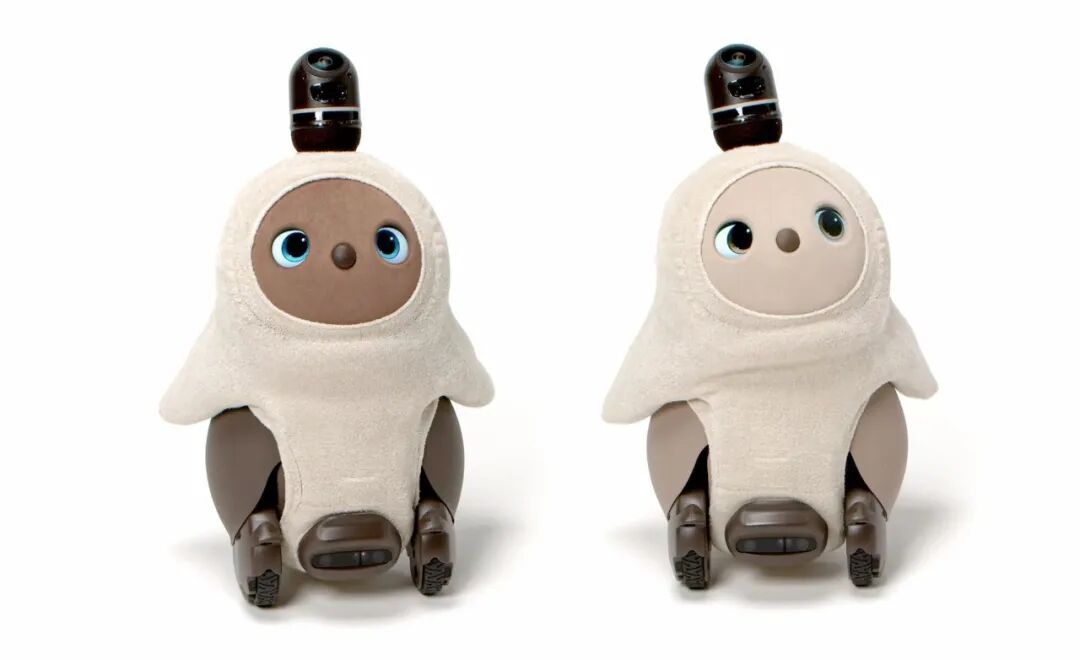
Core Insights - The article discusses the rise of AI toys in the market, highlighting the significant growth potential and investment activity in this sector, particularly in China [1][12][21] - AI toys are designed to provide emotional companionship and interactive experiences, targeting various demographics including children and young adults [2][13][21] Industry Overview - The AI toy market in China is projected to exceed 10 billion yuan by 2030, with a compound annual growth rate (CAGR) of over 70% [1][21] - The traditional toy industry is experiencing a transformation due to the integration of AI technologies, leading to the emergence of new interactive products [2][12] Investment Activity - Since 2025, there have been at least 10 financing events in the AI toy sector, with notable investments including 200 million yuan for Haivivi and 100 million yuan for X-ORIGIN-AI [10][11] - Major tech companies are also entering the AI toy market, with initiatives from Baidu, JD.com, and ByteDance to develop AI-driven products [10][21] Product Development - AI toys are categorized into two types: original IP products and AI versions of existing IPs, with examples including LOVOT and Fuzozo [10][21] - Products like LOVOT and Ropet utilize advanced interaction features, while others like Fuzozo and BubblePal focus on affordability and accessibility [4][6][8] Consumer Demand - A significant portion of consumers (99.9%) are willing to pay for emotional value, indicating a strong market demand for AI toys that provide companionship [13][21] - Sales data shows rapid growth, with LOVOT selling over 15,000 units globally and BubblePal exceeding 250,000 units [13][21] Market Challenges - Despite the enthusiasm, there are concerns regarding product quality, pricing, and the authenticity of emotional connections provided by AI toys [19][21] - Many consumers express skepticism about the ability of AI toys to replace real emotional interactions, highlighting a gap between expectations and reality [19][21] Future Outlook - The article suggests that while AI toys represent a significant market opportunity, their long-term success will depend on enhancing user experience and service capabilities [22][21] - The potential for AI toys to extend the lifecycle of existing IPs and serve as innovative marketing tools is also noted [22][21]
中方:希望墨西哥慎之又慎
Huan Qiu Shi Bao· 2025-09-12 10:30
Group 1 - Mexico plans to increase import tariffs on approximately 1,400 products, including automobiles, toys, steel, textiles, and plastic products, to a range of 10%-50% for countries that have not signed free trade agreements with Mexico, including China [1] - The Chinese government expresses concern that Mexico's tariff increase aligns with the U.S.'s long-standing strategy to contain China and may affect future trade negotiations between Mexico and its North American partners [1] - The Chinese Ministry of Commerce emphasizes the importance of maintaining free trade and multilateralism, stating that unilateral tariff increases by Mexico could harm the interests of relevant trade partners, including China, and negatively impact the business environment in Mexico [1][2] Group 2 - The Chinese government advocates for resolving trade disputes through equal dialogue and negotiation, opposing unilateralism, protectionism, and discriminatory measures [2] - The Chinese Foreign Ministry highlights the mutual benefits of China-Mexico economic cooperation and expresses hope for Mexico to act cautiously and collaboratively with China to promote global economic recovery and trade development [3]
新力量NewForce总第4858期
First Shanghai Securities· 2025-09-12 09:05
Group 1: Company Research - Blokko (0325) - Blokko's revenue for H1 2025 reached HKD 1.348 billion, a year-on-year increase of 27.9%[7] - Net profit for H1 2025 was HKD 297 million, with adjusted net profit at HKD 320 million, reflecting a 9.6% increase year-on-year[7] - The gross profit margin decreased to 48.4%, down 4.5 percentage points year-on-year, primarily due to a higher proportion of lower-margin new products[12] - The target price for Blokko is set at HKD 123.6, indicating a potential upside of 30.1% from the current price[13] Group 2: Company Research - Shenzhou International (2313) - Shenzhou International reported a revenue of RMB 14.97 billion for H1 2025, a year-on-year growth of 15.3%[20] - The gross profit margin decreased by 1.9 percentage points to 27.1%, influenced by increased employee compensation[20] - The net profit for H1 2025 was RMB 3.18 billion, reflecting an 8.4% increase year-on-year[20] - The target price for Shenzhou International is set at HKD 79.80, representing a potential upside of 31.1% from the current price[23]
第一上海:维持布鲁可(00325)“买入”评级 海外市场收入高增
智通财经网· 2025-09-12 06:59
Core Viewpoint - The report maintains a "Buy" rating for Bruker (00325), projecting Non-GAAP net profits of 725 million, 998 million, and 1.268 billion yuan for 2025-2027, with a target price of 123.6 HKD, indicating a potential upside of 30.1% from the current stock price [1] Revenue Performance - In the first half of 2025, the company achieved revenue of 1.348 billion yuan, a year-on-year increase of 27.9%, with a net profit of 297 million yuan, returning to profitability [1] - Adjusted net profit reached 320 million yuan, up 9.6% year-on-year, with an adjusted net profit margin of 23.9%, down 4.0 percentage points [1] Product Category Growth - The sales revenue of building block role-playing toys was 1.325 billion yuan, up 29.5% year-on-year, with sales volume increasing by 96.8% to 111 million units, while the average price decreased by 33.5% to 12.0 yuan [1] - The sales of building block toys declined by 45.5% year-on-year, with sales volume down 42.9% to 100 thousand units [1] - Other products generated revenue of 330 thousand yuan, a year-on-year increase of 111.5% [1] Channel Performance - Offline sales through distributors reached 1.212 billion yuan, up 26.5% year-on-year, accounting for 90.6% of total sales [2] - Online sales amounted to 108 million yuan, a year-on-year increase of 44.6%, representing 8.1% of total sales, driven by increased sales among consumers aged 16 and above [2] Geographic Revenue Growth - Domestic revenue was 1.226 billion yuan, up 18.5% year-on-year, while overseas revenue surged to 111 million yuan, a staggering increase of 898.6%, accounting for 8.3% of total revenue [3] - Revenue from Asia (excluding China), North America, and other overseas regions grew by 652.5%, 2135.9%, and 594.7% respectively [3] IP Structure and User Demographics - The company is diversifying its IP matrix to reduce reliance on single IPs, with the top four IPs contributing over 10% each, totaling 83.1% of revenue, compared to 92.3% for the top three IPs last year [4] - The revenue contribution from products targeting consumers aged 16 and above increased to 14.8%, up 4.4 percentage points year-on-year, while the core revenue source remains products for ages 6-16, accounting for 82.6% [4] Profitability and Investment - The gross profit margin for the first half of 2025 was 48.4%, down 4.5 percentage points year-on-year, attributed to a higher proportion of lower-margin new products and increased depreciation from more molds [5] - Sales, R&D, and management expense ratios were 13.2%, 9.6%, and 3.5% respectively, with sales expenses rising due to increased marketing for new products and a growing sales team [5] - R&D expenses increased significantly due to a rise in personnel, with the R&D team growing by 81.0% to 599 members [5]
第一上海:维持布鲁可“买入”评级 海外市场收入高增
Zhi Tong Cai Jing· 2025-09-12 06:57
Core Viewpoint - The company maintains a "buy" rating for Bruker (00325) with a target price of HKD 123.6, indicating a potential upside of 30.1% from the current stock price, based on projected Non-GAAP net profits of 725 million, 998 million, and 1.268 billion for the years 2025-2027 [1] Revenue and Profitability - In the first half of 2025, the company achieved revenue of 1.348 billion, a year-on-year increase of 27.9%, with a net profit of 297 million, turning positive compared to the previous year [1] - Adjusted net profit reached 320 million, reflecting a 9.6% increase year-on-year, with an adjusted net profit margin of 23.9%, down 4.0 percentage points from the previous year [1] Product Performance - The sales revenue for building block toys decreased by 45.5% to 13 million, with a volume drop of 42.9% to 100,000 units, while the sales of character-based toys increased by 29.5% to 1.325 billion, with a significant volume increase of 96.8% to 111 million units [2] - The average price of character-based toys fell by 33.5% to 12.0, primarily due to the introduction of a new budget product priced at 9.9, which contributed 216 million in revenue [2] Sales Channels - Offline sales accounted for 90.6% of total sales, reaching 1.212 billion, a 26.5% increase year-on-year, while online sales grew by 44.6% to 108 million, representing 8.1% of total sales [3] Geographic Performance - Domestic revenue was 1.226 billion, up 18.5% year-on-year, while overseas revenue surged by 898.6% to 111 million, now accounting for 8.3% of total revenue [4] - Revenue from Asia (excluding China), North America, and other overseas regions saw significant growth, with increases of 652.5%, 2135.9%, and 594.7% respectively [4] IP and User Demographics - The company has diversified its IP structure, reducing reliance on single IPs, with the top four IPs contributing over 10% each, totaling 83.1% of revenue [5] - The revenue share from products targeting consumers aged 16 and above increased to 14.8%, while the core revenue source remains products for ages 6-16, accounting for 82.6% [5] Cost Structure and Investment - The gross margin for the first half of 2025 was 48.4%, down 4.5 percentage points, attributed to changes in product mix and increased depreciation from new molds [6] - Sales, R&D, and management expense ratios were 13.2%, 9.6%, and 3.5% respectively, with increases in sales and R&D expenses due to new product promotions and a growing R&D team [6]
新疆乌苏市市场监管局开展知识产权保护专项执法检查
Zhong Guo Shi Pin Wang· 2025-09-12 04:16
Core Viewpoint - The Xinjiang Uygur Autonomous Region's Urumqi Market Supervision Bureau has intensified its enforcement actions against intellectual property rights violations, focusing on various sectors and locations to enhance legal awareness among market operators and businesses [1] Group 1: Enforcement Actions - The bureau conducted special enforcement inspections, checking 60 business entities and sampling over 30 products, resulting in the investigation of 3 cases of suspected intellectual property violations [1] - Key areas of focus included food and drug products, household goods, clothing, children's toys, and electronic products, with inspections carried out in large supermarkets, specialized markets, areas around schools, and offline experience stores of e-commerce [1] Group 2: Methods and Strategies - The enforcement methods included on-site inspections, sampling for testing, verifying sales records, and checking patent and trademark markings to identify violations such as trademark infringement, patent counterfeiting, false advertising, and geographical indication infringement [1] - The bureau also engaged in public education by distributing promotional materials and providing on-site guidance to enhance the legal knowledge of market operators regarding patents, trademarks, and geographical indications [1] Group 3: Encouragement of Compliance - The initiative aims to encourage market operators to establish a system for verifying intellectual property rights of products and to strengthen the awareness of intellectual property laws among businesses [1]