
稀土

Search documents
渤海证券研究所晨会纪要(2025.12.04)-20251204
BOHAI SECURITIES· 2025-12-04 00:25
Macro and Strategy Research - The US economy in 2026 may be more fragile than it appears, with growth driven mainly by AI-related investments and high-income consumer spending, while other contributions remain minimal [3] - The Federal Reserve is expected to continue lowering interest rates due to concerns about the labor market, but the space for cuts is limited, aiming slightly below the nominal neutral rate [3] - In Europe, external risks are skewed to the downside, with challenges arising from the recovery of internal economic momentum, while defense spending supported by fiscal measures may revitalize investment in the Eurozone [3] Domestic Policy Environment - The "14th Five-Year Plan" framework will be adjusted to focus on solidifying development foundations while promoting a unified national market and expanding autonomous openness [4] - Fiscal policy is expected to maintain a more proactive stance, with an emphasis on early deployment and investment in human capital [4] - Monetary policy will continue to be accommodative but with a focus on credit quality and more precise liquidity management [4] Domestic Economic Environment - China's economic growth in 2026 is projected to remain around 5%, with investment stabilizing first while consumption requires systematic policy support [5] - Industrial value-added growth is expected to remain stable due to good external demand, while the ability of high-tech industries to break through will be crucial for improving operational efficiency [5] - Inflation is anticipated to rebound slightly, with a key focus on whether PPI growth can significantly recover [5] Fund Research - In November, the market saw a decline, with the average drop for equity funds being 2.43%, while the mini funds (500 million to 1 billion) had the smallest average drop of 2.26% [9] - The number of new individual investor accounts decreased significantly after several months of growth, indicating a potential shift in market sentiment [8] - The private equity market continued to recover, with the total scale reaching a three-year high of 22.05 trillion yuan [8] Financial Engineering Research - The A-share market experienced a broad adjustment in November, with the ChiNext index dropping 4.23% and the Shanghai Composite Index down 1.67% [12] - The margin trading balance decreased slightly to 24,660.50 billion yuan, with a notable drop in the number of investors participating in margin trading [13] Industry Research: Metals - The steel industry may see weakened demand in December due to weather factors, leading to reduced production and fluctuating prices [15] - Copper prices are expected to remain high due to tight supply and low domestic inventory, supported by the Fed's interest rate cut expectations [15] - The aluminum sector is anticipated to experience stable profits due to low alumina prices, despite a potential decline in downstream demand [15] Industry Research: Pharmaceuticals - The National Healthcare Security Administration is conducting negotiations for the 2025 National Basic Medical Insurance Drug List, which may impact pharmaceutical companies [20] - The medical manufacturing industry is facing pressure, with cumulative revenue declining by 2.9% year-on-year [21] - The upcoming release of the new basic medical insurance drug list and the first commercial insurance innovative drug list is expected to create investment opportunities in the pharmaceutical sector [22]
操作:注意!撤退,紧急撤退一个基金!同时抄底3个方向
Ge Long Hui· 2025-12-03 13:03
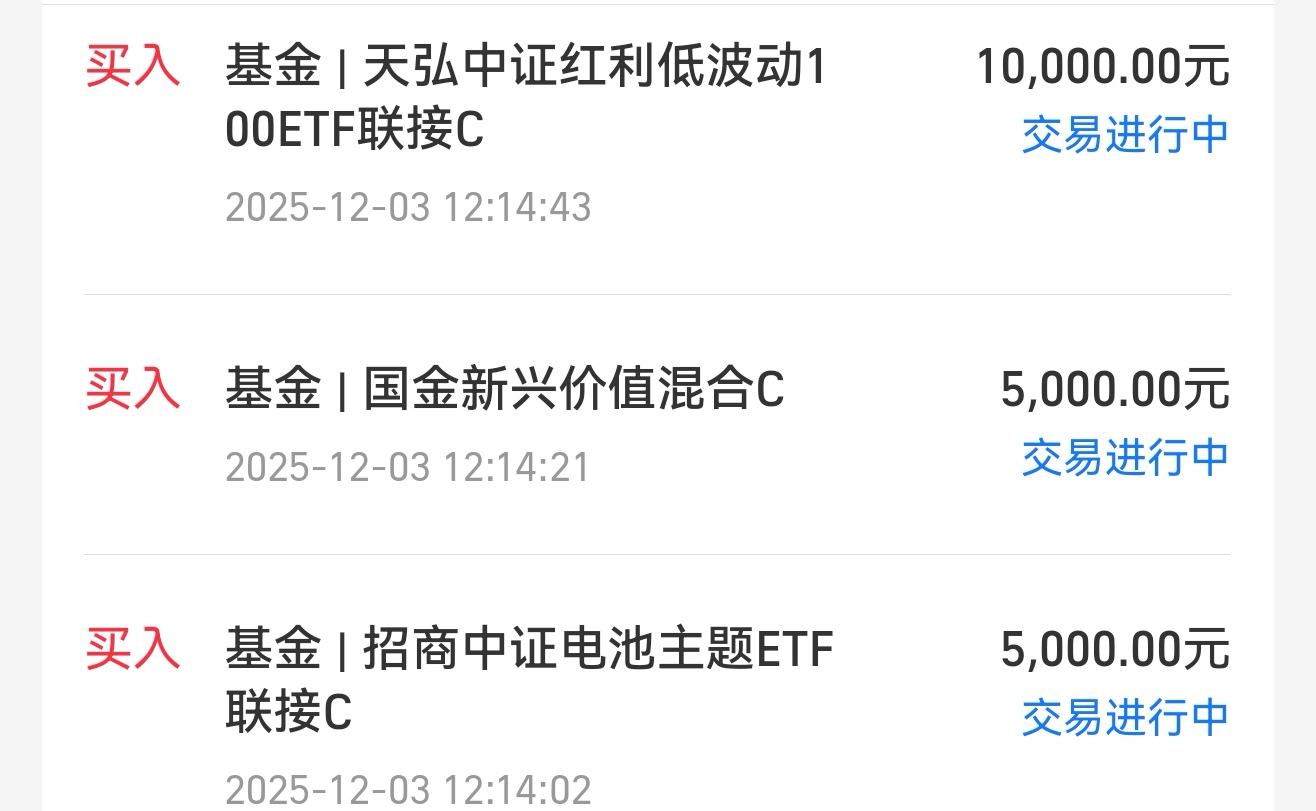
Market Overview - The market attempted to continue its upward trend but faced resistance and retreated, indicating a likely short-term consolidation phase before a potential upward movement [1] Investment Strategy - The company has increased its position in the battery sector by investing 5000 yuan in the $招商中证电池主题ETF联接C, citing a significant upward potential as the sector shows a 68% increase over the past six months [2][3] - A further investment of 10000 yuan was made in the $天弘中证红利低波动100ETF联接C, which offers a dividend yield of around 5%, appealing to risk-averse investors in a declining interest rate environment [2] - An additional 5000 yuan was allocated to the $国金新兴价值混合C, which focuses on both A-share and Hong Kong tech leaders, capitalizing on the recent tech sector rebound with a 43.9% increase over the last six months, outperforming the industry benchmark [3] Sector Analysis - The gold sector remains under pressure near previous resistance levels, requiring a breakthrough for further gains [6] - The chip industry is currently experiencing a pullback, with positions already established and awaiting upward movement [6] - The rare earth sector saw a recent increase, but further upward movement is contingent on breaking through moving average resistance [6]

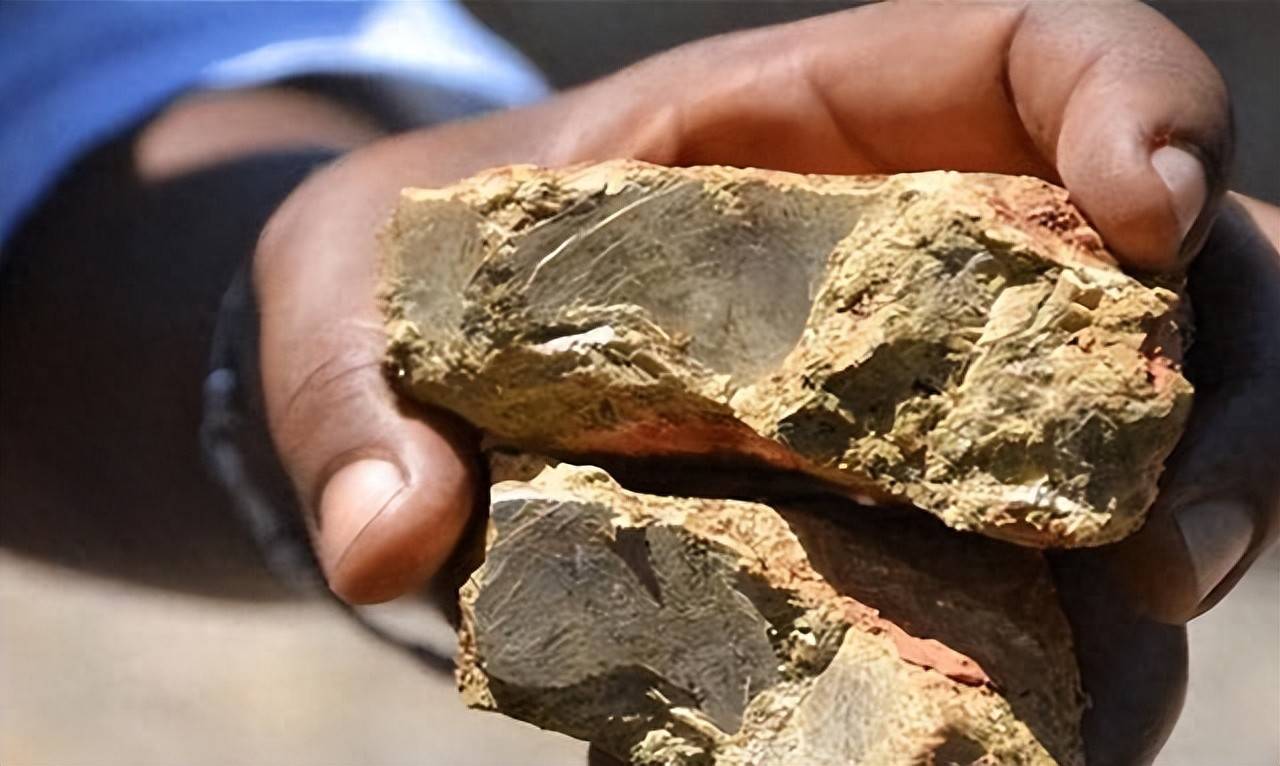
2025年12月3日稀土市场主流产品价格偏弱 氧化镨钕均价58.88万元/吨下跌0.62万元/吨
Jin Rong Jie· 2025-12-03 11:19
Group 1 - The rare earth market is experiencing a weak overall price trend, with prices for praseodymium and neodymium products rising and then falling, leading to a slight decrease in both transaction volume and price [1] - The average price of praseodymium and neodymium oxide is 588,800 CNY/ton, down by 6,200 CNY/ton; the average price of metallic praseodymium and neodymium is 712,300 CNY/ton, down by 9,000 CNY/ton; the average price of dysprosium oxide is 1,435,000 CNY/ton, down by 27,100 CNY/ton; and the average price of terbium oxide is 6,443,800 CNY/ton, down by 12,600 CNY/ton [1] - Market sentiment is generally cautious, with metal companies holding limited spot inventory and primarily focusing on long-term contracts, putting pressure on price transactions [1] Group 2 - New orders from neodymium-iron-boron companies are progressing slowly, with weak demand and low enthusiasm for end-user stocking, leading to only essential purchases [1] - The recycling prices in the scrap market are declining, increasing the willingness of holders to sell [1] - In the short term, mainstream product prices are expected to continue adjusting, showing a narrow fluctuation and weak operational trend [1] Group 3 - A-share market performance for some rare earth permanent magnet concept stocks includes: China Aluminum (11.03 CNY, +4.25%, 4.404 billion CNY), Jinchao Wanfang (10.00 CNY, +3.09%, 594 million CNY), Huaxin Environmental Protection (13.29 CNY, +2.94%, 312 million CNY), Northern Rare Earth (47.22 CNY, +1.77%, 6.853 billion CNY), and Guangsheng Nonferrous (53.73 CNY, +1.38%, 589 million CNY) [1]
特朗普之子入股三个月后,这家初创公司拿到了五角大楼6.2亿美元融资支持
Hua Er Jie Jian Wen· 2025-12-03 09:57
Core Insights - Vulcan Elements, a rare earth startup supported by Donald Trump Jr.'s venture capital firm, received a significant loan commitment of up to $620 million from the U.S. Department of Defense to expand industrial magnet supply [1][4] - This loan represents the largest ever issued by the Pentagon's Strategic Capital Office and is part of a broader financing agreement valued at $1.4 billion, which includes over $550 million in private financing and other federal incentives [1][4] - The transaction has raised concerns about potential conflicts of interest, given the connections to Trump Jr. and the timing of the loan [1][2] Government Contracts and Investment Landscape - Since Trump Jr. joined 1789 Capital in 2024, the firm has invested in at least four companies that collectively secured over $735 million in government contracts this year [2] - 1789 Capital, founded by Trump-supporting donors, has a portfolio that has expanded from initially focusing on anti-"woke culture" businesses to include industries likely to benefit from Trump administration regulations [2] - Other companies in the 1789 Capital portfolio that received government contracts include Firehawk Aerospace, PsiQuantum, and Cerebras Systems, with contracts exceeding $10 million each [2] Denials of Political Influence - All parties involved have denied any political interference in the loan process, with Vulcan Elements' CEO stating no contact with Trump Jr. and emphasizing the value-based nature of the loan [3] - A Pentagon spokesperson confirmed that neither Trump Jr. nor 1789 Capital participated in discussions regarding the loan commitment [3] - Despite these denials, Trump Jr. previously indicated his deep involvement in strategic decisions at 1789 Capital [3] Financing Structure Analysis - The $620 million financing for Vulcan Elements is strategically significant, aimed at supporting the production of critical materials for defense equipment such as drones and nuclear submarines [4] - As part of the deal, the U.S. Department of Commerce will acquire a $50 million equity stake in Vulcan, and the Pentagon will receive warrants for Vulcan Elements and its partner ReElement Technologies [5] - Vulcan expects to increase its workforce from approximately 30 to 50 employees by the end of the year [5]
中美俄稀土储量对比:俄1000万吨,美180万吨,中国是多少
Sou Hu Cai Jing· 2025-12-03 08:28
Group 1 - The global competition for rare earth elements (REE) is intensifying, with significant reliance on these materials in technology products such as smartphones, electric vehicles, and wind turbines [1] - By 2025, the struggle for rare earth resources will continue, with the U.S. feeling urgent pressure, while China maintains a stronghold on the supply chain [1][13] Group 2 - China holds approximately 44 million tons of rare earth reserves, accounting for nearly half of the world's proven reserves, supported by the U.S. Geological Survey [3] - China's strength lies not only in its abundant resources but also in its complete rare earth industry chain, from mining to high-purity oxide refining and manufacturing of magnetic materials [3][9] Group 3 - The U.S. has about 1.8 million tons of rare earth reserves, primarily from the Mountain Pass mine, which is nearing depletion. The U.S. has outsourced processing to China due to high environmental costs and market challenges [5] - Despite significant investments to rebuild its rare earth industry, the U.S. will still rely on China for high-end processing by 2025 due to a lack of skilled labor and outdated equipment [5][11] Group 4 - Russia has 10 million tons of rare earth reserves, but economically viable resources are limited. The Tomtor mine, despite its large resource volume, faces significant extraction challenges due to its location in the Arctic [7] - Infrastructure development for rare earth extraction in Russia is lagging, with small-scale production not expected until after 2030 [7][11] Group 5 - China's early recognition of the importance of rare earths in the 1980s allowed it to build a robust industry, leading to a dominant position in global rare earth separation technology by the 1990s [9] - China's production capacity accounts for over 80% of global rare earth separation, enabling it to control supply and pricing effectively [9][13] Group 6 - The complete industry chain and technological barriers are crucial for success in the rare earth sector, with China's reserves and separation technology remaining unmatched in the short term [13][15] - The global landscape for rare earths is unlikely to change fundamentally by 2025 or even 2030, with the U.S. and Russia unable to significantly challenge China's dominance in the near future [15]
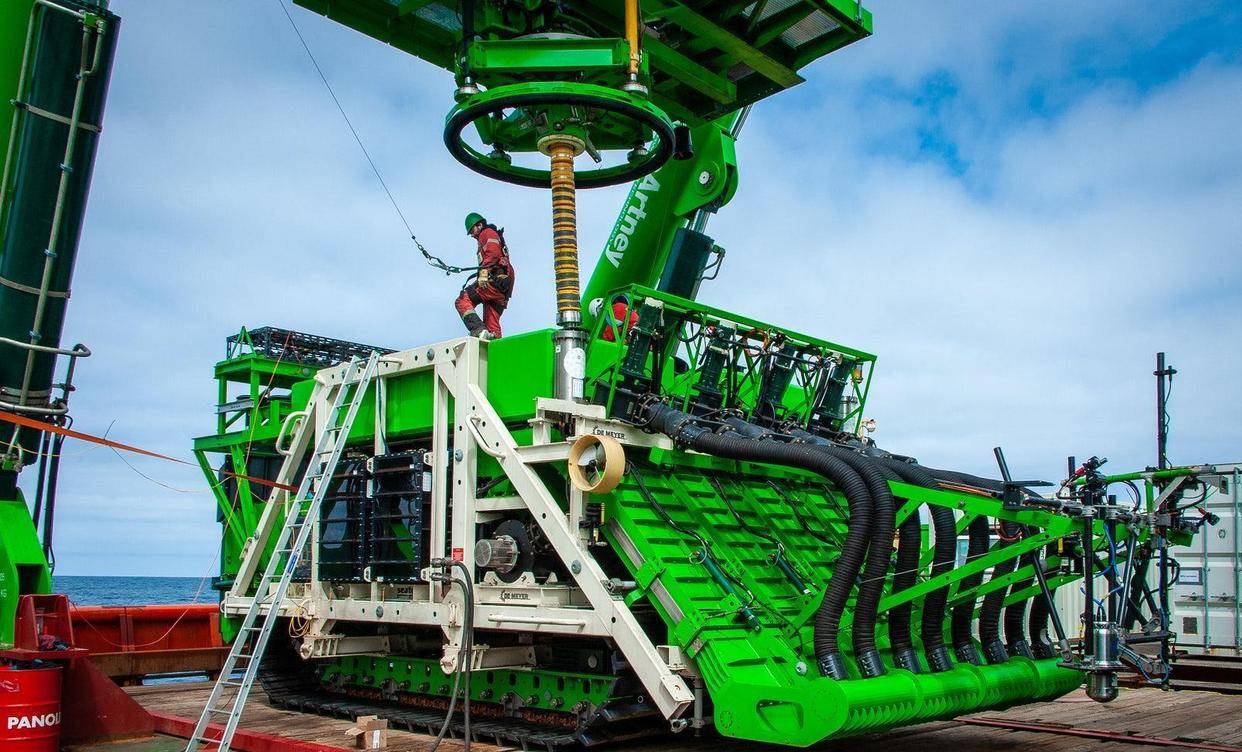
日本吹了15年的深海稀土神话,为什么成为每吨倒贴3000美元的尴尬局面?
Sou Hu Cai Jing· 2025-12-03 04:54
Core Viewpoint - Japan's deep-sea rare earth mining plan is facing significant economic challenges despite claims of superior resource quality compared to China, with high extraction costs leading to substantial financial losses [1][3][5]. Group 1: Resource Quality and Extraction Challenges - Japan's rare earth purity is claimed to be 20 times that of China, with reserves estimated to last for hundreds of years [1]. - The South Bird Island area contains approximately 16 million tons of rare earth resources, with heavy rare earth elements like dysprosium and terbium being 20 to 35 times more abundant than in southern China [3]. - The extraction process is extremely difficult, with mining occurring at depths of 5,500 meters, where water pressure is equivalent to 550 atmospheres, and equipment lifespan is significantly reduced [3]. Group 2: Economic Viability and Market Dynamics - The cost of extracting one ton of deep-sea rare earth is estimated at $15,000, while the current market price is only $12,000, resulting in a loss of $3,000 per ton [1][3]. - Japan plans to start trial mining in 2026, aiming to extract 70 kilograms of rare earth from 35 tons of mud, but the extracted materials will still need to be sent to China for refining, where 93% of global refining capacity is controlled [5]. - Japan's attempts to establish recycling technologies have not met demand, with annual recovery rates falling short of 1.2% of the required amount [5]. Group 3: Strategic and Political Implications - Japan's deep-sea mining initiative is described as a "political project," aimed at ensuring national security rather than profitability [7]. - Despite efforts to reduce reliance on China, Japan's dependency on Chinese rare earths has increased from 82% in 2009 to 83% in 2025, highlighting the ineffectiveness of previous strategies [9]. - The Japanese government acknowledges that even with significant investment, the current technology can only process 20,000 tons of mud annually, far below the target of 1 million tons by 2028 [7].
美国想给稀土设价格下限,英国大臣:先不跟
Guan Cha Zhe Wang· 2025-12-03 00:29
但英国这回决定先不跟了。 【文/观察者网 柳白】 近年来鼓吹"自由市场"的西方彻底卸下了伪装。昔日给俄罗斯能源强加价格上限的他们,如今又试图给稀土划定底价为本国产业输 血,以摆脱对华依赖。 据路透社12月2日报道,英国工业大臣克里斯·麦克唐纳接受该媒体采访时表示,目前英国在关键矿产领域已吸引足够投资以发展本土 供应链,因此不打算效仿美方为本国稀土企业提供价格下限支持,但会持续监测局势,以便在需要时启用其他政策机制。 麦克唐纳透露,他12月1日在伦敦会见了美国国防部官员,对方详细介绍了美国针对关键矿产的支持政策,其中包括价格下限机制。 "我们正在推行其中大部分政策,但并非全部,价格下限目前不在我们的政策清单中。不过我会持续关注其实施效果,"他在采访中 表示,"对我而言,核心问题是我们能否吸引到相关投资,而目前我们正成功吸引着投资。" 路透社9月援引消息人士报道称,七国集团(G7)成员国及欧盟正考虑设立价格下限以促进稀土生产,同时计划对部分中国出口产品 征税,以此激励本土相关领域投资。 今年7月,美国已向稀土企业MP材料公司提供最低价格保障,这是美国国防部数十亿美元投资计划的一部分。 消息人士此前表示,该价格保障 ...

出口宽松预期下,抢出口+供需改善有望推动稀土供需共振
Xuan Gu Bao· 2025-12-02 23:30
Industry Overview - The domestic market prices for gadolinium and europium remain stable, with gadolinium oxide priced at 185,000 yuan/ton, europium oxide at 180,000 yuan/ton, gadolinium iron alloy at 180,000 yuan/ton, and yttrium oxide at 49,000 yuan/ton [1] - The light rare earth market is experiencing price increases, but downstream demand is still in a stage of on-demand procurement, indicating that prices are likely to fluctuate in the short term [1] Global Market Dynamics - Global production of rare earth permanent magnets is still highly concentrated in China, and the release of overseas production capacity will take time. China remains the only country with a complete rare earth industrial chain [1] - The overall scale of the rare earth industry chain in the West is significantly lower than that of China, with notable shortcomings in their industrial chains [1] Supply and Demand Outlook - As of December, smelting plants may face mass shutdowns due to policy and raw material issues. In October, China's magnetic material exports increased by 16% year-on-year but decreased by 5% month-on-month [1] - Expectations for more relaxed export conditions in the future lead to a more optimistic outlook on demand. The combination of external export competition and ongoing supply-side reforms suggests a potential resonance in rare earth supply and demand, with expectations for continued valuation and performance growth in the rare earth sector [1] Company Insights - Jinli Permanent Magnet is identified as a leading supplier of high-performance rare earth permanent magnet materials [1] - Inlohua primarily engages in the production and sales of neodymium-iron-boron magnetic materials, micro-special motors, health equipment, and electronic acoustic products. Currently, the company's motors and reducers have limited applications in industrial robots [1]

欧盟计划投资27亿欧元,欲摆脱对中国关键原材料的依赖
Sou Hu Cai Jing· 2025-12-02 17:19
这项计划设立的新关键原材料中心将于2026年启动,其模式参考的是一个由日本政府监管、负责监测能源和金属的独立机构。日本长达10年致 力降低对中国供应依赖的行动,成为欧盟的重要借镜。 除了资金和协调之外,欧盟委员会表示,将在明年提出限制钢铁废料和磁铁废料出口的计划,力图将更多供应留在欧盟境内。 欧盟执委会发言人拒绝就这份草案文件发表评论。欧洲投资银行的发言人没有立即响应置评请求。 此举反映欧盟对于中国持续收紧对于稀土等关键原材料的出口管制的不安,希望摆脱对于中国关键原材料过度依赖的问题。 欧盟执委会主席冯德莱恩(Ursula von der Leyen)在今年10月预告这项即将推出的计划时表示:"我们的应对措施必须与我们在这一领域面临的 风险相符。欧洲不能再依循以往的做法。我们在能源问题上痛苦地吸取了教训,不会在关键原材料问题上重蹈覆辙。" 报道称,这项计划正式发布时,欧洲投资银行(European Investment Bank)以及各成员国将同时做出承诺,为4个项目提供资金支持,协助稳定 欧盟获取原材料的渠道。其中包括格陵兰一座为国防工业供应原材料的矿场,以及捷克的锂开采项目。 这项计划还承诺,欧洲投资银行 ...

2025年12月2日稀土主流产品价格分化 氧化铽均价645.64万元/吨下跌1.86万元/吨
Jin Rong Jie· 2025-12-02 15:20
Core Insights - The rare earth market is experiencing a mixed price trend for mainstream products, with prices for praseodymium and neodymium oxide averaging 595,000 CNY/ton, down 1,200 CNY/ton, and praseodymium and neodymium metal averaging 721,300 CNY/ton, down 1,600 CNY/ton [1][1][1] - The overall supply of rare earths remains tight, leading to a stalemate in market transactions despite a decline in downstream purchasing volumes [1][1][1] - The A-share market shows positive performance for some rare earth permanent magnet concept stocks, with notable increases in stock prices and trading volumes [1][1][1] Price Trends - Praseodymium and neodymium oxide: 595,000 CNY/ton, down 1,200 CNY/ton - Praseodymium and neodymium metal: 721,300 CNY/ton, down 1,600 CNY/ton - Dysprosium oxide: 1,462,100 CNY/ton, down 7,500 CNY/ton - Terbium oxide: 6,456,400 CNY/ton, down 18,600 CNY/ton [1][1][1] Market Activity - Downstream acceptance of current prices is low, leading to reduced purchasing activity [1][1][1] - The mid-heavy rare earth market is underperforming with low activity levels and stable prices [1][1][1] - Recent rapid price increases for praseodymium and neodymium products have made merchants cautious about purchasing high-priced goods [1][1][1] A-share Market Performance - 华新环保 (Hua Xin Environmental Protection): Latest price 12.91 CNY, increase 6.78%, trading volume 285 million CNY - 彤程新材 (Tong Cheng New Materials): Latest price 45.35 CNY, increase 6.31%, trading volume 2.47 billion CNY - 金风科技 (Goldwind Technology): Latest price 15.67 CNY, increase 4.19%, trading volume 2.1 billion CNY - 德宏股份 (Dehong Co.): Latest price 18.5 CNY, increase 3.64%, trading volume 87.16 million CNY - 卧龙新能 (Wolong New Energy): Latest price 8.12 CNY, increase 2.92%, trading volume 399 million CNY [1][1][1]