
啤酒

Search documents
英大证券晨会纪要-20251203
British Securities· 2025-12-03 01:44
Core Viewpoints - The A-share market is likely to remain in a fluctuating but strong pattern in the short term, with pressures above and support below [2][10][13] - Key pressures include weak domestic economic recovery, uncertainties in overseas markets, potential profit-locking by institutions, insufficient willingness of incremental capital to enter, and significant selling pressure near the 4000-point mark [2][10][11] - Support factors include marginal improvements in the domestic economy, expectations for important policy meetings, and a continued loose monetary policy [3][11][12] Market Overview - On the previous Tuesday, the three major indices in Shanghai and Shenzhen experienced a downward trend, failing to continue the recovery from the previous week, with a general decline across the market and reduced trading volume [2][5][10] - The total trading volume on that day was approximately 1.6 trillion yuan, indicating a lack of effective market entry momentum [2][10][12] Sector Analysis - The shipbuilding and military sectors showed strong activity, with previous recommendations highlighting investment opportunities in this area, which has outperformed the broader market in recent years [7][10] - Consumer stocks, including tourism, food and beverage, and retail, also saw gains, supported by government initiatives to boost consumption [8][9] Future Market Outlook - The market is expected to maintain a "sector rotation, fluctuating but strong" characteristic, with the need for more effective stimulus to break the current deadlock [3][11][12] - Investors are advised to focus on individual stocks rather than indices, adopting strategies such as balanced allocation and high sell-low buy, particularly in sectors with strong performance support [4][12]
中国必选消费12月投资策略:市场风格继续有利
Haitong Securities International· 2025-12-03 00:41
Investment Focus - The report highlights a favorable market style for essential consumer goods in China, with several companies rated as "Outperform," including Guizhou Moutai, Wuliangye, and Yili [1]. Industry Overview - In November 2025, four out of eight tracked essential consumer sectors showed positive growth, including condiments, frozen foods, soft drinks, and dining, while four sectors, such as high-end and below-average baijiu, dairy products, and beer, experienced negative growth [3][8]. - The overall growth rate across all sectors has weakened compared to the previous month, attributed to macroeconomic conditions, structural industry conflicts, and seasonal factors [3][8]. Price Trends - In November, wholesale prices for most baijiu brands declined, with Guizhou Moutai's prices dropping by 110 to 90 yuan compared to the previous month [4][20]. - The average price for Wuliangye remained stable, while the market for high-end baijiu showed a decline in both volume and price [9][10]. Cost Analysis - The cost index for six categories of consumer goods mostly increased in November, with soft drinks and dairy products rising by 2.50% and 0.74%, respectively [4][48]. - The prices of raw materials such as paper and plastic have shown significant year-on-year changes, with paper prices increasing by 17.5% [4]. Fund Flow - As of the end of November, net inflows into Hong Kong Stock Connect reached 111.58 billion yuan, with the essential consumer sector's market capitalization share increasing by 0.32 percentage points [5]. Valuation Metrics - By the end of November, the PE historical percentile for A-share food and beverage was at 21%, with the beer sector at a low of 1% [5]. - The median valuation for leading A-share food and beverage companies remained stable at 22x, while H-share essential consumer sector PE historical percentile was at 24% [5]. Recommendations - The report suggests focusing on high-dividend stocks as a long-term strategy, particularly in the dairy sector, which is expected to recover first, and regional leaders in the baijiu market [6].





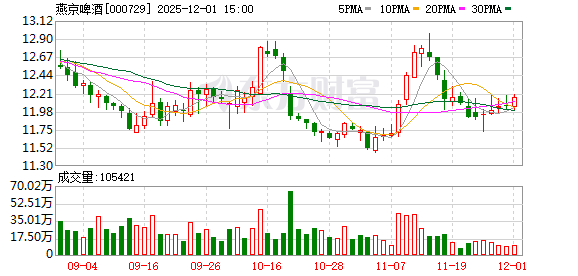
燕京啤酒:截至11月28日公司股东总户数为44334户
Zheng Quan Ri Bao· 2025-12-01 11:37
Core Insights - Yanjing Beer reported that as of November 28, 2025, the total number of shareholders is 44,334 [2] Company Summary - Yanjing Beer is actively engaging with investors through interactive platforms [2] - The company is providing transparency regarding its shareholder structure by disclosing the total number of shareholders [2]


中国必选消费品11月需求报告:所有品类增速均放缓
Haitong Securities International· 2025-12-01 11:31
Investment Rating - The investment rating for the essential consumer goods sector is "Outperform" for multiple companies including Kweichow Moutai, Wuliangye, and Yili [1] Core Insights - In November 2025, four out of eight monitored essential consumer sectors showed positive growth, while four experienced negative growth, with the growth sectors being condiments, frozen foods, soft drinks, and catering services [29] - The overall growth rates across all sectors have slowed compared to the previous month, attributed to macroeconomic conditions, structural industry challenges, and seasonal factors [29] Subsector Summaries Mid-to-High-End and Above Baijiu - Revenue for the mid-to-high-end and premium baijiu sector in November was RMB 24 billion, down 13.0% year-on-year, with cumulative revenue from January to November at RMB 349.2 billion, a decline of 6.2% [30] - The market is experiencing simultaneous declines in both volume and price, with a conservative consumer spending trend [30] Mass-Market and Below Baijiu - Revenue for the mass-market and lower-tier baijiu industry reached RMB 18.9 billion in November, marking a 3.3% year-on-year decline, with cumulative revenue from January to November totaling RMB 180.9 billion, down 8.5% [30] - The production of baijiu in October was 276,000 kiloliters, down 18.3% year-on-year, indicating a challenging market environment [30] Beer - The domestic beer industry generated revenue of RMB 9.9 billion in November, a 2.0% year-on-year decline, with cumulative revenue from January to November at RMB 162.6 billion, representing a 0.2% year-on-year increase [31] - Seasonal demand has decreased due to a nationwide temperature drop, leading to subdued overall demand [31] Condiments - The condiments sector reported revenue of RMB 418 billion in November, a year-on-year increase of 0.8%, with cumulative revenue from January to November at RMB 4,129 billion, up 1.3% [18] Frozen Foods - The frozen foods sector achieved revenue of RMB 81.6 billion in November, a year-on-year increase of 4.0%, with cumulative revenue from January to November at RMB 964 billion, up 2.2% [22] Soft Drinks - Revenue for the soft drinks sector was RMB 388 billion in November, a year-on-year increase of 2.1%, with cumulative revenue from January to November at RMB 6,583 billion, up 4.1% [24] Catering - The catering industry reported revenue of RMB 130.4 billion in November, a year-on-year increase of 0.3%, with cumulative revenue from January to November at RMB 1,607 billion, down 0.7% [26]


食品饮料周报(25年第44周):基本面左侧寻底,关注下游消费场景恢复-20251201
Guoxin Securities· 2025-12-01 09:11
Investment Rating - The report maintains an "Outperform the Market" rating for the food and beverage sector [4][5][15]. Core Views - The food and beverage sector is expected to see a recovery in consumer demand as the year-end approaches, with a positive outlook for 2026 [3][10]. - The report highlights a differentiation in the performance of various sub-sectors, with beverages outperforming food and alcoholic beverages [2][10]. - Key investment opportunities are identified in leading companies within the sector, particularly those with strong growth potential and market positioning [3][10][15]. Summary by Relevant Sections 1. Sector Overview - The food and beverage sector has shown a slight increase of 0.03% this week, with A-shares remaining flat and H-shares up by 0.47% [1]. - The top performers in the sector include Hai Xin Food, Jia Long Co., and Yan Tang Dairy, with significant weekly gains [1]. 2. Sub-sector Analysis - **Alcoholic Beverages**: The report indicates that the liquor sector is in a bottoming phase, with premium brands like Moutai and Luzhou Laojiao expected to gain market share [2][10]. - **Beverages**: The beverage sector is experiencing stable demand recovery, with leading companies like Nongfu Spring and Dongpeng Beverage recommended for investment [2][14]. - **Food**: The snack segment is highlighted for its growth potential, particularly in konjac products, with companies like Wei Long and Yan Jin Pu Zi recommended [2][11]. 3. Investment Recommendations - The recommended investment portfolio includes Moutai, Baba Foods, Dongpeng Beverage, Wei Long, and Luzhou Laojiao, reflecting a diverse range of opportunities across the sector [3][15]. - The report emphasizes the importance of focusing on companies with strong fundamentals and growth trajectories, particularly in the context of changing consumer preferences and market dynamics [2][10][15]. 4. Earnings Forecasts - Earnings forecasts for key companies indicate a positive growth trajectory, with Moutai expected to achieve revenues of approximately 183.5 billion yuan by 2027, reflecting a compound annual growth rate [4][15]. - Other companies like Dongpeng Beverage and Baba Foods are also projected to see significant revenue growth, driven by market expansion and product innovation [15][17].


非白酒板块12月1日涨0.81%,ST西发领涨,主力资金净流出2610.67万元
Zheng Xing Xing Ye Ri Bao· 2025-12-01 09:03
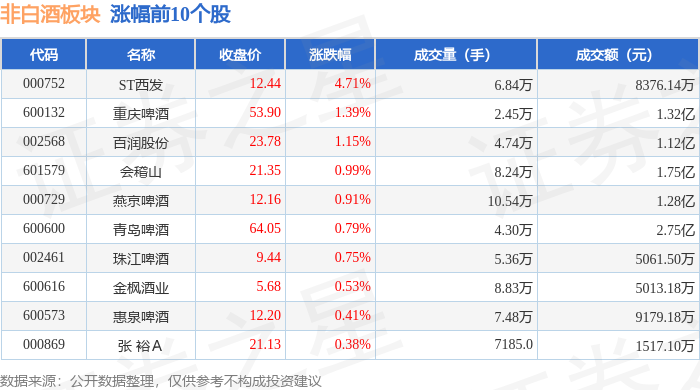
Market Performance - The non-liquor sector increased by 0.81% compared to the previous trading day, with ST Xifa leading the gains [1] - The Shanghai Composite Index closed at 3914.01, up 0.65%, while the Shenzhen Component Index closed at 13146.72, up 1.25% [1] Stock Performance - ST Xifa (000752) closed at 12.44, rising by 4.71% with a trading volume of 68,400 shares and a transaction value of 83.76 million yuan [1] - Other notable stocks include Chongqing Beer (600132) at 53.90, up 1.39%, and Baijiu Co. (002568) at 23.78, up 1.15% [1] Capital Flow - The non-liquor sector experienced a net outflow of 26.11 million yuan from institutional investors, while retail investors saw a net inflow of 40.03 million yuan [2] - The detailed capital flow indicates that ST Xifa had a net inflow of 8.10 million yuan from institutional investors, despite a net outflow from retail investors [3]


国泰海通证券訾猛团队荣获第七届金麒麟食品饮料行业最佳分析师第一名 最新研究观点:周期筑底,期待反转
Xin Lang Zheng Quan· 2025-12-01 08:13
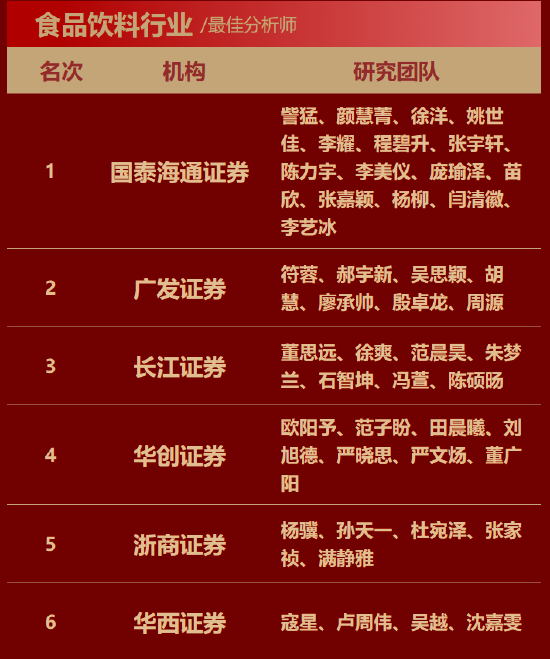
Core Viewpoint - The Guotai Junan Zimeng team has achieved significant recognition in the food and beverage research sector, winning the title of "Best Analyst in the Food and Beverage Industry" at the 2025 Analyst Conference and the 7th Sina Finance "Golden Unicorn" Awards, reflecting their deep understanding of consumer trends and a mature research framework [1][2]. Group 1: Team Performance - The Guotai Junan Zimeng team moved from second place in the 2024 awards to first place in 2025, indicating a strong competitive potential and improvement in research capabilities [2]. - The competition landscape changed significantly, with the GF Securities team ranking second and Huachuang Securities team dropping to fourth place [2]. Group 2: Award Details - The Guotai Junan team members include Zimeng, Yan Huijing, Xu Yang, Yao Shijia, Li Yao, Cheng Biheng, Zhang Yuxuan, Chen Liyu, Li Meiyi, Pang Yuze, Miao Xin, Zhang Jiaying, Yang Liu, Yan Qinghui, and Li Yibing [1]. - The awards highlighted the top teams in the food and beverage sector, with Guotai Junan taking first place, GF Securities second, and Changjiang Securities third [3]. Group 3: Industry Insights - The Zimeng team believes that the liquor industry is currently undergoing a rapid clearing adjustment phase, with inventory levels decreasing and stock prices potentially rising amidst market pessimism [9]. - The beer industry is expected to clear earlier than the liquor sector, with increasing differentiation within the industry, suggesting investors should focus on regionally competitive beer leaders [9].

食品饮料行业周报:茅台反馈定海神针,关注年底子板块行情-20251201
Huaxin Securities· 2025-12-01 06:35
Investment Rating - The report maintains a "Recommended" investment rating for the food and beverage & commercial sectors [6][52]. Core Insights - The liquor sector shows clear signs of bottoming out, with Kweichow Moutai's shareholder meeting reinforcing market confidence and presenting a good opportunity for low valuation positioning [51]. - The consumer goods sector is experiencing structural differentiation, with the snack food segment remaining strong while soft drinks enter the off-season [52]. - The restaurant supply chain industry is at a clearing point, with key stocks leading the recovery [52]. Summary by Sections 1. Weekly News Summary - Industry news includes a 2.6% increase in liquor production in Luliang from January to October and a 9.6% increase in the added value of the liquor and tea industry in Bozhou during the same period [14]. - Company news highlights Kweichow Moutai's focus on five key areas and the appointment of new leadership at various liquor companies [14]. 2. Key Company Feedback - The report provides insights into the performance of key companies, with a focus on their stock price movements and market strategies [25][26]. 3. Industry Rating and Investment Strategy - The liquor sector is advised for long-term investment in high-dividend leaders such as Kweichow Moutai, Wuliangye, and Luzhou Laojiao, while also considering flexible stocks that have corrected to appropriate levels [51][52]. - The consumer goods sector is recommended for companies like Anjuke Food and Baidu Food, which are adapting to market changes and consumer preferences [52]. 4. Key Companies and Earnings Forecast - The report lists several companies with their respective earnings per share (EPS) and price-to-earnings (PE) ratios, recommending a "Buy" rating for all listed companies [54].
华润啤酒20251128
2025-12-01 00:49
Summary of China Resources Beer Conference Call Company Overview - **Company**: China Resources Beer - **Industry**: Beer and Liquor Key Points Financial Performance and Projections - **2025 Revenue Growth**: Expected to achieve low single-digit growth, with profits projected to grow in the high single to double-digit range [2][10] - **Dividend Policy**: Targeting a dividend payout ratio of 60% for 2025, with plans to increase it to over 70% in the next two years [2][10] - **Cost Control**: Benefiting from the use of cheaper Australian raw materials and effective expense management, leading to an improvement in gross margin, although the increase is expected to be smaller in the second half of the year [2][7] Beer Market Dynamics - **Competitive Environment**: The beer industry is characterized by rational competition with no large-scale price wars. Most companies are under manageable operational and profit pressures [5][19] - **Product Performance**: The Heineken brand is expected to grow by approximately 20% for the year, while other brands like Super Dry are projected to have single-digit growth, and Full Beer is expected to decline [12][2] - **Price Range Potential**: The 8-10 RMB price range for beer products shows significant growth potential, with plans to develop differentiated products to meet diverse consumer needs [13][15] Liquor Business Challenges - **White Liquor Business**: Facing challenges with high-end product sales and a shift from business banquets to personal home consumption. The company aims to expand sales channels and control expenses [8][9] - **Impairment Considerations**: The company maintains a long-term view on its liquor business but may consider impairment adjustments based on future developments [9][23] - **Intangible Asset Amortization**: Annual amortization of approximately 700 million RMB is putting pressure on profits [8][23] Market Trends and Consumer Behavior - **Consumer Preferences**: There is a noted shift in consumer preferences, with a willingness to choose high-end products within certain price ranges. The industry is expected to see increased differentiation [4][21] - **New Restaurant Trends**: The turnover and replacement rate of trendy restaurants and popular stores are high, indicating a rapidly changing market landscape [11] Management and Strategic Adjustments - **Management Changes**: Recent adjustments in the management team aim to balance experience and youth to better adapt to industry changes [22] - **Operational Environment**: The overall operational environment has not changed significantly compared to the previous year, although there are ongoing adjustments to market strategies [20] Future Outlook - **2026 Projections**: If economic conditions remain stable, revenue and order volume are expected to grow, with slight improvements in gross margin and profit growth outpacing revenue growth [15][17] - **Government Subsidies**: Anticipated decline in government subsidies for 2026, with one-time income from land sales in Shenzhen not expected to recur at the same level [27] Inventory and Supply Chain - **White Liquor Inventory**: Current inventory levels for white liquor are approximately four months, showing a slight decrease from the beginning of the year [24] - **Cost Pressures**: Limited pressure from aluminum can price increases, with overall procurement costs remaining manageable [17][5] This summary encapsulates the key insights from the conference call, highlighting the company's financial outlook, market dynamics, challenges in the liquor segment, and strategic management adjustments.
重庆啤酒20251128
2025-12-01 00:49
Summary of the Conference Call for Chongqing Beer Industry Overview - In the first ten months of 2025, China's beer sales remained flat compared to the previous year, with expectations to maintain this level for the entire year due to a contraction in on-premise dining and entertainment channels [2][4][17] - The beer industry exhibits distinct seasonal characteristics, with peak consumption typically starting in March for southern markets and April for northern markets [4] Company Performance - As of Q3 2025, Chongqing Beer reported that on-premise sales accounted for approximately 44% of total sales, while off-premise sales made up 56%, indicating a shift towards non-on-premise channels [2][6] - The overall market share (冠化率) of Chongqing Beer exceeded 29% in Q3 2025, up from 18% in 2019, although still below the national average [2][9] - The company has seen significant growth in its Uusu beer brand, driven by brand reinforcement and increased market investment, with new products like Uusu White Beer and 1-liter cans contributing to this growth [2][10] Strategic Focus - Chongqing Beer is focusing on enhancing its non-on-premise channel strategies to adapt to the slow recovery of on-premise consumption [2][7] - The company plans to launch 8 new 1-liter canned products in 2025, aiming to capture the 8-10 RMB price range to improve average selling price (ASP) and consumer demographics [2][12] - The company is also exploring new beverage lines, such as water and tea drinks, to improve capacity utilization and gross margins [18] Financial Outlook - Cost savings are expected in 2026, but the contribution to gross margin is anticipated to be less significant than in 2025 [3][15] - The company maintains a conservative outlook for Q2 2026, expecting sales volume and pricing to be on par with 2025 or slightly improved [3][17] Market Strategy - Chongqing Beer aims to implement different strategies in high-share markets to enhance profitability while being flexible in competitive markets to optimize resource allocation [8] - The company is committed to increasing its presence in the mid-to-high-end beer market, with plans to introduce more premium products in 2026 [21] Challenges and Opportunities - The company acknowledges the challenges posed by the fragmented market and the need for distributors to focus on non-on-premise channel development [7] - Chongqing Beer is leveraging channel transformation and product innovation to find growth opportunities in a stagnant market, including the introduction of new demand-driven products [19] Conclusion - Chongqing Beer is navigating a challenging market environment with a focus on strategic channel shifts, product innovation, and cost management to sustain growth and profitability in the coming years [20]