
证券业

Search documents
本币市场:资金面整体均衡
Jin Rong Shi Bao· 2025-09-25 02:05
Core Insights - The overall liquidity in the interbank market remained balanced in August 2025, with a decrease in trading volume and balances in the money market, while major repo rates declined [1][2] - The Shanghai Composite Index reached a nearly 10-year high, and the recovery of VAT on government bond interest income contributed to a decrease in bond issuance and trading [1][4] - Long-term bond yields continued to rise, with the yield curve steepening, and the interest rate swap curve shifted upward [1][6] Group 1: Liquidity and Market Operations - The central bank maintained a supportive liquidity stance, with significant net injections in the open market, totaling 446.6 billion yuan for the month [2] - The central bank's MLF and reverse repos saw substantial net injections, with MLF at 300 billion yuan and reverse repos at 300 billion yuan [2] - Major repo rates, including overnight repo rates, saw slight declines, with DR001 and R001 down to 1.35% and 1.40% respectively [2][3] Group 2: Bond Market Dynamics - In August, the interbank market issued bonds totaling 4.72 trillion yuan, a decrease of 10.8% month-on-month and 13% year-on-year [4] - The net financing from bonds was 1.87 trillion yuan, reflecting a month-on-month decrease of 18.7% and a year-on-year decrease of 19.2% [4] - The yields on long-term government bonds fluctuated, with the 10-year bond yield ranging from 1.69% to 1.85%, and the yield curve steepening [4][5] Group 3: Interest Rate Swaps and Trading Activity - The interest rate swap curve shifted upward, with significant increases in long-term swap rates, particularly for 5-year and 10-year swaps [6] - The average daily trading volume for RMB interest rate swaps decreased, with a total nominal principal of 4.1 trillion yuan, reflecting a 3% decline [6][7] - Standard bond futures and interest rate options also saw a decrease in daily trading volume, indicating reduced market activity [7]
每日债市速递 | 央行今日开展6000亿元MLF操作
Wind万得· 2025-09-24 22:38
1. 公开市场操作 央行公告称,9月24日以固定利率、数量招标方式开展了4015亿元7天期逆回购操作,操作利率1.40%,投标量4015亿元,中标量4015亿元。Wind数据显 示,当日4185亿元逆回购到期,据此计算,单日净回笼170亿元。 (*数据来源:Wind-央行动态PBOC) 2. 资金面 央行继周一重启14天期逆回购操作后,该期限近两日连续隐身。银行间市场周三资金面收敛态势愈发明显,资金价格亦随之上涨,跨季的七天期资金价格 涨幅偏大。存款类机构七天回购加权利率大涨约11bp,来到1.58%附近,创两个月新高。非银机构押信用债和存单融入七天资金价格则亦来到 1.92%-1.96%。匿名点击(X-repo)系统上,隔夜报价也是大涨至1.68%,且几无供给。非银机构质押存单和信用债融入隔夜资金的报价基本还在 1.62%-1.65%区间,较昨日水准亦明显上涨。 (*数据来源:Wind-国际货币资金情绪指数、资金综合屏) | (*数据来源:Wind-成交统计BMW) | | --- | 海外方面,最新美国隔夜融资担保利率为4.14%。 (IMM) // 债市综述 // 3. 同业存单 全国和主要股份制银行一 ...


固定收益定期:商业银行增配国债政金债,广义基金增持地方债:2025年8月中债登和上清所托管数据
Tianfeng Securities· 2025-09-24 15:19
Report Summary 1. Report Industry Investment Rating The document does not provide the industry investment rating. 2. Core View of the Report In August 2025, the leverage ratio of the inter - bank bond market increased slightly month - on - month and was lower than the same period in previous years. The total bond custody scale of China Central Depository & Clearing Co., Ltd. (CCDC) and Shanghai Clearing House increased. Different institutions had different investment preferences for various bonds, with commercial banks increasing their allocation of treasury bonds and policy - financial bonds, and broad - based funds increasing their holdings of local government bonds [1][2][50]. 3. Summary by Relevant Catalogs 3.1 Bank - Inter Leverage Ratio In late August, the inter - bank bond market leverage ratio was 106.88%, up 0.07 pct from the end of the previous month, and generally lower than the leverage ratio in the same period of previous years [1]. 3.2 Custody Data Overview In August 2025, the total bond custody scale of CCDC and Shanghai Clearing House was 174.54 trillion yuan, a month - on - month increase of 1.506 trillion yuan. Among them, CCDC's custody scale increased by 1.5382 trillion yuan, and Shanghai Clearing House's decreased by 32.2 billion yuan. Treasury bonds, local government bonds, policy - bank bonds, and medium - term notes contributed to the increase, while enterprise bonds, short - term financing bills, ultra - short - term financing bills, directional instruments, and inter - bank certificates of deposit contributed to the decrease [2][12]. 3.3 By Bond Type - **Interest - rate Bonds**: In August 2025, the total custody scale of major interest - rate bonds was 116.60 trillion yuan, a month - on - month increase of 1.7871 trillion yuan. Commercial banks were the main buyers, increasing their holdings by 1.2979 trillion yuan. Broad - based funds, insurance institutions, etc. also increased their holdings, while overseas institutions reduced their holdings [3][49]. - **Credit Bonds**: The total custody scale of major credit bonds was 16.06 trillion yuan, a month - on - month increase of 23 billion yuan. Commercial banks were the main buyers, increasing their holdings by 54.4 billion yuan. Broad - based funds and securities companies were the main sellers, reducing their holdings by 18.1 billion yuan and 14.8 billion yuan respectively. Insurance institutions and overseas institutions also reduced their holdings [3][49]. - **Inter - bank Certificates of Deposit**: The custody scale was 20.38 trillion yuan, a month - on - month decrease of 355.6 billion yuan. Broad - based funds and commercial banks were the main sellers [3][49]. 3.4 By Institution - **Commercial Banks**: The custody scale of major bonds was 85.29 trillion yuan, a month - on - month increase of 1.153 trillion yuan. They increased their holdings of interest - rate bonds and credit bonds by 1.2979 trillion yuan and 54.4 billion yuan respectively, and reduced their holdings of inter - bank certificates of deposit by 199.3 billion yuan [4][50]. - **Broad - based Funds**: The custody scale of major bonds was 37.38 trillion yuan, a month - on - month decrease of 172.3 billion yuan. They increased their holdings of interest - rate bonds by 120.7 billion yuan and reduced their holdings of credit bonds and inter - bank certificates of deposit by 18.1 billion yuan and 274.9 billion yuan respectively [4][50]. - **Overseas Institutions**: The custody scale of major bonds was 3.69 trillion yuan, a month - on - month decrease of 98.8 billion yuan. They reduced their holdings of interest - rate bonds, credit bonds, and inter - bank certificates of deposit by 27.5 billion yuan, 3.5 billion yuan, and 67.8 billion yuan respectively [4][54]. - **Insurance Institutions**: The custody scale of major bonds was 4.26 trillion yuan, a month - on - month increase of 43.2 billion yuan. They increased their holdings of interest - rate bonds by 49.5 billion yuan and reduced their holdings of credit bonds and inter - bank certificates of deposit by 5.9 billion yuan and 0.4 billion yuan respectively [4][54]. - **Securities Companies**: The custody scale of major bonds was 2.64 trillion yuan, a month - on - month decrease of 2 billion yuan. They increased their holdings of interest - rate bonds by 13.4 billion yuan and reduced their holdings of credit bonds and inter - bank certificates of deposit by 14.8 billion yuan and 0.6 billion yuan respectively [4][54]. - **Credit Unions**: The custody scale of major bonds was 2 trillion yuan, a month - on - month increase of 11.9 billion yuan. They increased their holdings of interest - rate bonds and credit bonds by 22.1 billion yuan and 0.7 billion yuan respectively, and reduced their holdings of inter - bank certificates of deposit by 10.8 billion yuan [5][55].

政策与大类资产配置周观察:风险平衡式降息落地
Tianfeng Securities· 2025-09-24 11:14
Group 1: Domestic Policy Developments - The article published in "Qiushi" emphasizes the importance of building a unified national market as a major decision by the central government, necessary for constructing a new development pattern and enhancing international competitiveness [9][10] - The State Council meeting led by Premier Li Qiang discussed the implementation of the national ecological environment protection conference, highlighting that the construction of a beautiful China is a long-term systematic project requiring sustained efforts [11][12] - The People's Bank of China adjusted the 14-day reverse repurchase operation to a multi-price bidding system to maintain liquidity in the banking system [22][25] Group 2: Economic Indicators and Market Analysis - In the A-share market, major indices remained stable in the third week of September, with the CSI 100 and ChiNext indices rising by 1.08% and 2.34% respectively, while the Shanghai Composite Index fell by 1.3% [23] - The central bank's net fund injection was 11,923 billion yuan, indicating a slight tightening of liquidity in the market [3][26] - Economic data for August showed a year-on-year industrial value-added growth of 5.2%, while retail sales increased by 3.4%, suggesting a need for counter-cyclical policy adjustments [26][30] Group 3: International Policy Developments - President Xi Jinping's phone call with President Trump focused on stabilizing Sino-US relations and addressing mutual concerns, indicating a constructive dialogue [14][15] - The Federal Reserve's decision to lower interest rates by 25 basis points after nine months reflects a shift in monetary policy, with the target range now at 4.00%-4.25% [16][19] - The Fed's updated economic growth forecast for 2025 was raised by 0.2 percentage points to 1.6%, indicating a more optimistic outlook [19][21]
6000亿元!央行,明日操作!
证券时报· 2025-09-24 10:58
Core Viewpoint - The People's Bank of China (PBOC) is maintaining a supportive monetary policy stance by continuously injecting liquidity into the banking system, as evidenced by the recent MLF operations and reverse repos, aimed at stabilizing market expectations and supporting government bond issuance [1][2][3]. Group 1: MLF Operations - On September 25, the PBOC announced a 600 billion yuan Medium-term Lending Facility (MLF) operation, marking the seventh consecutive month of increased MLF issuance [1]. - In September, the PBOC conducted two reverse repo operations, resulting in a total net liquidity injection of 300 billion yuan, maintaining the same scale as August [2]. - The MLF operations have shifted to a multi-price bidding mechanism, allowing financial institutions to better manage their liquidity needs and enabling the PBOC to monitor liquidity conditions more effectively [3]. Group 2: Monetary Policy Coordination - The PBOC's actions are seen as a coordinated effort with fiscal policy, particularly during a peak period for government bond issuance, to ensure smooth market operations [2]. - Analysts expect that the PBOC will continue to utilize various monetary policy tools, including MLF and reverse repos, to inject liquidity into the market, with potential for further quantitative easing in the fourth quarter [3]. - There is an increasing market demand for the PBOC to resume government bond trading operations, which could provide more flexible and effective monetary easing compared to monthly reverse repo operations [3].
配置盘续增,交易盘境外机构续减:——2025年8月份债券托管量数据点评
EBSCN· 2025-09-24 06:42
1. Report Industry Investment Rating No information provided in the content. 2. Core View of the Report The report analyzes the bond custody data for August 2025, showing that the total bond custody increased less month - on - month. The custody of interest - rate bonds and financial bonds increased, while that of credit bonds and inter - bank certificates of deposit decreased. The custody of major bond types by different institutions showed a differentiated pattern, with allocators increasing and traders and overseas institutions decreasing. The bond market leverage ratio increased month - on - month but decreased year - on - year [1][2][50]. 3. Summary by Relevant Catalogs 3.1 Bond Custody Total and Structure - The total bond custody increased less month - on - month. As of the end of August 2025, the total bond custody of CCDC and SHCH was 174.54 trillion yuan, with a net increase of 1.51 trillion yuan month - on - month, 0.24 trillion yuan less than the increase at the end of July [1][11]. - The custody of interest - rate bonds and financial bonds increased, while that of credit bonds and inter - bank certificates of deposit decreased. In August 2025, the interest - rate bond custody was 120.72 trillion yuan, accounting for 68.72% of the inter - bank bond market custody, with a net increase of 1.80 trillion yuan; the credit bond custody was 18.69 trillion yuan, accounting for 10.80%, with a net decrease of 1424 million yuan; the non - policy financial bond custody was 12.81 trillion yuan, accounting for 7.39%, with a net increase of 2.875 billion yuan; the inter - bank certificate of deposit custody was 20.38 trillion yuan, accounting for 11.99%, with a net decrease of 0.36 trillion yuan [1][11]. 3.2 Bond Holder Structure and Changes 3.2.1 Month - on - Month Changes in Custody by Institution - Allocators' custody of major bond types continued to increase month - on - month, while traders and overseas institutions' custody continued to decrease. Policy banks continued to increase their holdings of interest - rate bonds, inter - bank certificates of deposit, and credit bonds; commercial banks and credit unions increased their holdings of interest - rate bonds and credit bonds but decreased their holdings of inter - bank certificates of deposit; insurance institutions, securities companies, and non - legal entity products increased their holdings of interest - rate bonds but decreased their holdings of inter - bank certificates of deposit and credit bonds; overseas institutions continued to reduce their holdings of interest - rate bonds, inter - bank certificates of deposit, and credit bonds [2][27]. 3.2.2 Month - on - Month Changes in Custody by Bond Type - Treasury bond custody continued to increase month - on - month. Commercial banks continued to significantly increase their holdings, while non - legal entity products continued to reduce their holdings. - Local government bond custody continued to increase month - on - month. Policy banks continued to increase their holdings, while commercial banks changed from increasing to reducing their holdings. - Policy financial bond custody continued to increase month - on - month. Commercial banks continued to increase their holdings, while policy banks changed from increasing to reducing their holdings. - Inter - bank certificate of deposit custody continued to decrease month - on - month. Except for policy banks increasing their holdings, other major institutions reduced their holdings. - Enterprise bond custody continued to decrease month - on - month, and major institutions all reduced their holdings. - Medium - term note custody continued to increase month - on - month. Commercial banks continued to significantly increase their holdings, while securities companies continued to reduce their holdings. - Short - term financing and super - short - term financing custody changed to a decrease, with commercial banks being the main reducing entity. - Non - publicly - oriented debt instrument custody continued to decrease month - on - month, with non - legal entity products being the main reducing entity [3][29][30]. 3.2.3 Holder Structure of Major Bond Types - As of the end of August 2025, the holder structure of treasury bonds: commercial banks accounted for 69.23%, overseas institutions 5.53%, policy banks 10.77%, non - legal entity products 8.13%, securities companies 2.63%, insurance institutions 2.55%, and credit unions 1.16% [34]. - The holder structure of policy financial bonds: commercial banks accounted for 55.07%, non - legal entity products 31.86%, overseas institutions 2.87%, credit unions 3.30%, insurance institutions 2.04%, securities companies 1.13%, and policy banks 3.74% [36]. - The holder structure of local government bonds: commercial banks accounted for 74.22%, non - legal entity products 9.42%, policy banks 9.98%, insurance institutions 4.89%, securities companies 0.93%, credit unions 0.54%, and overseas institutions 0.02% [38]. - The holder structure of enterprise bonds: non - legal entity products accounted for 54.74%, commercial banks 32.20%, securities companies 9.12%, insurance institutions 3.02%, policy banks 0.56%, credit unions 0.28%, and overseas institutions 0.08% [40]. - The holder structure of medium - term notes: non - legal entity products accounted for 61.57%, commercial banks 23.62%, securities companies 4.88%, nominal holder accounts (domestic) 3.40%, policy banks 3.14%, insurance institutions 2.35%, overseas institutions 0.22%, others 0.55%, and credit unions 0.27% [42]. - The holder structure of short - term financing and super - short - term financing: non - legal entity products accounted for 62.19%, commercial banks 20.57%, nominal holder accounts (domestic) 7.53%, policy banks 5.01%, securities companies 4.20%, others 0.28%, credit unions 0.17%, overseas institutions 0.05%, and insurance institutions 0.00% [45]. - The holder structure of non - publicly - oriented debt instruments: non - legal entity products accounted for 59.93%, commercial banks 23.84%, policy banks 2.30%, credit unions 2.15%, others 4.06%, nominal holder accounts (domestic) 2.00%, securities companies 1.11%, overseas institutions 4.49%, and insurance institutions 0.12% [47]. - The holder structure of inter - bank certificates of deposit: non - legal entity products accounted for 65.50%, commercial banks 28.44%, nominal holder accounts (domestic) 3.11%, securities companies 1.02%, policy banks 1.08%, others 0.31%, insurance institutions 0.07%, credit unions 0.03%, and overseas institutions 0.44% [49]. 3.3 Bond Market Leverage Ratio Observation As of the end of August 2025, the estimated balance of repurchase - to - be - bought pledged repurchase was 11.23 trillion yuan, an increase of 0.2 trillion yuan month - on - month. The leverage ratio was 106.88%, up 0.07 percentage points month - on - month and down 0.65 percentage points year - on - year [50].
债券通“南向通”四周年:铸就机构出海活力动脉 赋能债券市场双向开放
Xin Hua Cai Jing· 2025-09-24 06:21
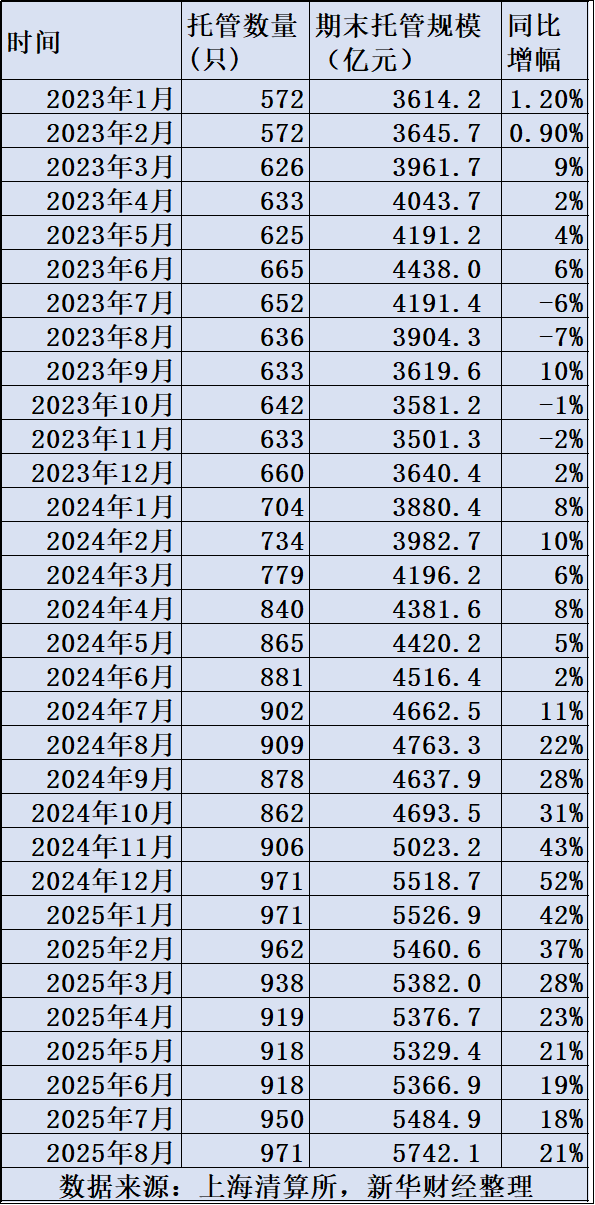
Core Insights - The "Southbound Bond Connect" has significantly enhanced the accessibility of global asset allocation for domestic investors since its launch four years ago, marking a key milestone in China's bond market opening [1][2][8]. Group 1: Market Growth and Performance - As of August 2025, the Shanghai Clearing House has hosted 35,000 bonds with a total custody balance of 48.6 trillion yuan, reflecting a year-on-year growth of 19% [2]. - The scale of the "Southbound Bond Connect" has expanded dramatically, with the current custody size being over six times that of May 2022 and more than a hundred times that of its first month in September 2021 [2][3]. - The monthly custody data shows fluctuations in the number of bonds and custody scale, with notable growth in the latter half of 2024, peaking at 5,518.7 billion yuan in December 2024 [3][4]. Group 2: Institutional Participation and Strategy Diversification - The participant base for the "Southbound Bond Connect" has diversified, now including state-owned banks, joint-stock banks, insurance asset management, public funds, and private institutions, which has led to more refined investment strategies [5]. - The introduction of products linked to the "Southbound Bond Connect" by public funds has lowered the entry barriers for individual investors, promoting financial inclusivity [5]. Group 3: Policy Support and Infrastructure Development - Continuous policy support and infrastructure improvements have been crucial for the growth of the "Southbound Bond Connect," with measures introduced to enhance transaction convenience and risk management [8][10]. - The expansion of participant categories to include securities firms and insurance companies in July 2023 is a significant policy move aimed at broadening global asset allocation channels [8]. Group 4: Green Finance and Regional Cooperation - The "Southbound Bond Connect" has become a vital channel for domestic institutions to invest in international green bonds, with a 60% year-on-year increase in green bond investments [9]. - The deepening financial cooperation in the Guangdong-Hong Kong-Macao Greater Bay Area has amplified the impact of the "Southbound Bond Connect," facilitating cross-border financial rule alignment [9]. Group 5: Future Outlook - Experts suggest that the "Southbound Bond Connect" will continue to evolve, with potential breakthroughs in asset class expansion and digital currency settlement as the internationalization of the yuan accelerates [10]. - The initiative is seen as a pivotal step towards transforming China from a major bond market to a strong bond market, emphasizing the importance of cross-border regulatory collaboration [10].
面对超强台风,投行家挤爆香港中环酒店,紫金黄金国际、西普尼香港上市延至9月30日
Xin Lang Cai Jing· 2025-09-24 06:15
Group 1 - Typhoon Hagupit (Ragasa) has posed the biggest test for the Hong Kong Stock Exchange since the implementation of the "no trading during typhoons" rule last year, with the stock market opening for trading under a signal 10 warning for the first time [4] - Despite many functions being able to work remotely, some IT systems and trading personnel are required to work in the office, leading to a surge in hotel bookings in Central and Admiralty, with luxury hotels like Mandarin Oriental and Four Seasons fully booked [4] - Some banks have opted to hold meetings online due to the typhoon, including the Hong Kong Fixed Income and Currency Forum 2025, which was originally scheduled to be held in person [4] Group 2 - Zijin Gold International plans to globally offer approximately 348.99 million shares, accounting for 13.30% of total shares post-issue, with a maximum fundraising target of about HKD 24.98 billion, potentially reaching HKD 28.73 billion if the over-allotment option is fully exercised [5] - Xipuni plans to globally offer 10.6 million H-shares, accounting for 18.02% of total shares post-issue, with a maximum fundraising target of approximately HKD 314 million [5]

宝城期货资讯早班车-20250924
Bao Cheng Qi Huo· 2025-09-24 02:04
Macroeconomic Data Overview - The GDP growth rate for the second quarter of 2025 is reported at 5.20%, a decrease from 5.40% in the previous quarter and an increase from 4.70% in the same period last year [1] - The Manufacturing PMI for August 2025 is at 49.40, slightly up from 49.30 in July and up from 49.10 year-on-year [1] - The Non-Manufacturing PMI for August 2025 is at 50.30, showing a slight increase from 50.10 in July and unchanged from the previous year [1] - The total social financing scale for August 2025 is reported at 25,668 billion yuan, a significant increase from 11,307 million yuan in July and a decrease from 30,323 million yuan year-on-year [1] - The CPI for August 2025 shows a year-on-year decrease of 0.40%, compared to 0.00% in July and 0.60% last year [1] - The PPI for August 2025 shows a year-on-year decrease of 2.90%, an improvement from a decrease of 3.60% in July and a decrease of 1.80% last year [1] Commodity Investment Reference - Federal Reserve Chairman Jerome Powell indicated that stock prices are currently overvalued but stated that financial stability risks are not high at this time [2] - The U.S. White House's cryptocurrency committee executive director expects the cryptocurrency market structure bill to pass by the end of the year, which aims to consolidate various legislative efforts [2] - The SEC chairman expressed hopes for a new "innovation exemption" rule to be introduced by the end of the year, allowing cryptocurrency companies to launch products more easily [2] Metals - As of September 23, the SPDR Gold Trust holds 32,169,273.34 ounces (1,000.57 tons) of gold, unchanged from the previous trading day [4] - International precious metal futures saw a general increase, with COMEX gold futures rising by 0.58% to $3,796.9 per ounce and COMEX silver futures increasing by 0.12% to $44.265 per ounce [4] Steel Industry - A notice from five departments outlines a growth stabilization plan for the steel industry for 2025-2026, emphasizing the acceleration of key iron ore projects and supporting compliant mining enterprises [6] - The steel industry aims for an average annual growth rate of 4% over the next two years, with a strict prohibition on new capacity [7] Energy and Chemicals - International oil prices have risen sharply, with U.S. crude oil main contract up by 2.20% to $63.65 per barrel and Brent crude oil main contract up by 1.85% to $67.19 per barrel [8] - The Russian government is discussing extending the export ban on gasoline producers until October and is considering a possible ban on diesel exports [8] - Kuwait's oil minister noted a recovery in global oil demand as oil inventories fall below the five-year average [8] Agricultural Products - The Malaysian Palm Oil Council indicates that upward price potential is limited due to weak demand, while uncertainties in export supply provide some support [10] - Brazil's agriculture ministry announced the reopening of the EU market for Brazilian chicken following an outbreak of avian influenza [10] Financial Market Overview - The central bank conducted a reverse repurchase operation of 276.1 billion yuan on September 23, with a net withdrawal of 10.9 billion yuan for the day [11] - The People's Bank of China governor met with Ray Dalio to discuss international economic conditions and financial market dynamics [12] - Concerns over local government special bond risks have drawn attention from the National People's Congress, highlighting the rapid growth of government debt [13] Stock Market News - The A-share market experienced wide fluctuations, with major banks showing stability and significant gains in semiconductor equipment and photolithography concepts [27] - The Hong Kong Hang Seng Index closed down 0.7%, with declines in consumer, real estate, and healthcare sectors [27] - Since the release of the "merger and acquisition six guidelines," over 2,800 A-share companies have disclosed M&A activities, with a notable increase in transactions in the semiconductor sector [27]
7、8月份增幅均超过5% 今年以来税收收入稳中有升
Ren Min Ri Bao· 2025-09-24 00:44
Core Insights - The national general public budget revenue for the first eight months of this year reached 14.82 trillion yuan, a year-on-year increase of 0.3%, with the growth rate improving by 0.2 percentage points compared to the first seven months [1] - Tax revenue amounted to 12.11 trillion yuan, showing a slight increase of 0.02% year-on-year, marking the first positive cumulative growth [1] Tax Revenue Growth - Major tax categories maintained positive growth, with total tax revenue (excluding export tax rebates) increasing by 2% in the first eight months [2] - Key tax types included domestic value-added tax at 47,389 billion yuan (up 3.2%), domestic consumption tax at 11,523 billion yuan (up 2%), corporate income tax at 31,477 billion yuan (up 0.3%), and personal income tax at 10,547 billion yuan (up 8.9%) [2] - Manufacturing and financial sectors showed rapid tax revenue growth, with manufacturing accounting for over 30% of total tax revenue and experiencing a growth rate exceeding 5% [2] Economic Factors Supporting Tax Revenue - The increase in tax revenue is attributed to a series of effective policies and a stable economic environment, leading to high-quality development [4] - The capital market's active trading contributed significantly, with the Shanghai Composite Index surpassing 3,800 points and A-share total market value exceeding 100 trillion yuan [4] - Tax revenue from the securities industry grew over 70%, while insurance industry tax revenue increased by more than 10% [4] Compliance and Taxpayer Awareness - There has been a noticeable enhancement in taxpayers' awareness of lawful and honest tax payment, supported by tax authorities' efforts in promoting compliance and fair taxation [5] - The increase in tax revenue in recent months is also influenced by a lower base of tax revenue from the previous year [5] Fiscal Expenditure and Policy Outlook - National general public budget expenditure has been growing, with social security and employment spending increasing by 10% and education spending by 5.6% in the first eight months [8] - The overall fiscal situation is improving, indicating a positive economic outlook, with expectations for continued favorable trends in fiscal revenue and expenditure [8]