通信

Search documents
主动型公募基金2025年四季报分析:资金流向混债二级基金,周期和大金融占比提升
Hua Yuan Zheng Quan· 2026-01-27 00:41
- The report analyzes the changes in public fund configurations and scales in Q4 2025, focusing on active equity funds, mixed bond funds, hybrid bond funds, and pure bond funds[1][2][3] - Active equity funds saw a significant reduction in scale, with a decrease of 182.3 billion yuan, while hybrid bond funds experienced a notable increase in scale, growing by 239.8 billion yuan[1][2][3] - The report highlights the shift in investor preference towards hybrid bond funds due to their moderate risk profile, as opposed to the higher volatility of active equity funds and the lower risk of pure bond funds[1][2][3] - The report provides detailed data on the performance and configuration changes of different types of funds, including the top holdings and sector allocations[1][2][3] - The report also includes information on the issuance of new funds, noting that the issuance of hybrid bond funds reached a new high since 2020[1][2][3]
中金:哪些领域正为公募集中持仓?
中金点睛· 2026-01-27 00:09
Core Viewpoint - The article discusses the increasing concentration of public fund holdings in specific sectors, particularly technology and advanced manufacturing, driven by a consensus on macroeconomic conditions and industry trends [2][4][6]. Group 1: Measurement of Fund Concentration - Public fund concentration is typically assessed through metrics such as the proportion of top holdings (top 10, 50, 100) relative to the fund's net value, indicating a high concentration in certain stocks [1]. - Industry allocation or overweight ratios are also used; a concentration exceeding 30% in a single industry or deviating from historical averages by more than 10% signals increased concentration [1]. - Fund inflows and trading behaviors, such as new funds heavily investing in the same stocks, provide additional insights into concentration trends [1]. Group 2: Reasons for Concentration - The convergence of macroeconomic and industry trend assessments among institutional investors leads to increased fund concentration [2]. - A positive feedback mechanism exists where concentrated holdings attract more capital, enhancing fund size and potentially driving asset prices higher, reinforcing market narratives [2]. Group 3: Global Perspective - Institutional concentration in holdings is common globally, with examples from the U.S. market where significant funds are allocated to major tech stocks, reflecting a similar trend [3]. - The S&P 500's top 10 stocks account for approximately 40% of the index, marking the highest concentration since 2000 [3]. Group 4: Characteristics of Current Fund Concentration - Recent fund concentration trends show a strong focus on technology and advanced manufacturing sectors, with historical patterns indicating that concentration often correlates with industry profitability expectations [4][6]. - The current concentration is characterized by a significant increase in holdings in the semiconductor sector and a notable rise in the electronic industry from 12% in Q4 2023 to 26% in Q3 2025 [6][7]. Group 5: Future Outlook - The outlook for fund concentration remains contingent on corporate fundamentals, with ongoing trends in artificial intelligence and domestic self-sufficiency expected to drive long-term investment strategies [7]. - Market conditions, including liquidity, external interest rates, and institutional investment patterns, will influence future fund allocation and concentration [7][8].


智通港股通资金流向统计(T+2)|1月27日
智通财经网· 2026-01-26 23:33
智通财经APP获悉,1月22日,阿里巴巴-W(09988)、中国海洋石油(00883)、中国人寿(02628)南 向资金净流入金额位列市场前三,分别净流入14.11 亿、5.90 亿、5.08 亿 中国移动(00941)、腾讯控股(00700)、中国宏桥(01378)南向资金净流出金额位列市场前三,分 别净流出-8.48 亿、-6.71 亿、-4.32 亿 在净流入比方面,长江基建集团(01038)、优然牧业(09858)、海天味业(03288)以56.47%、 56.41%、51.11%位列市场前三。 在净流出比方面,中教控股(00839)、中国中药(00570)、碧桂园服务(06098) 以-62.38%、-57.48%、-55.30%位列市场前三。 前10大资金净流入榜 | 股票名称 | 净流入(元)↓ | 净流入比 | 收盘价 | | --- | --- | --- | --- | | 阿里巴巴-W(09988) | 14.11 亿 | 14.34% | 164.800(+0.98%) | | 中国海洋石油(00883) | 5.90 亿 | 21.89% | 22.740(+2.52%) | | 中 ...





2025年中国和世界“双十大”科技进展新闻揭晓
Xin Lang Cai Jing· 2026-01-26 23:11
Core Insights - The announcement of the "Top Ten" technological advancements in China and the world for 2025 highlights significant breakthroughs that can rapidly be industrialized and lay the groundwork for future developments [1][2][4]. Group 1: China's Top Ten Technological Advancements - The advancements include the "artificial sun" EAST achieving a world record of "one billion degrees for a thousand seconds" [2]. - DeepSeek's introduction of Chinese AI represents a novel approach in the field [2]. - The completion of thorium-based molten salt reactors marks a new breakthrough in China's nuclear energy technology [2]. - A liver cancer prediction system developed in China has been featured on the cover of "Nature," indicating its global service potential [2]. - The "North Brain No. 1" has successfully completed its first batch of wireless full-body implants [2]. - The discovery of original innovative targets and candidate new drugs for Parkinson's disease represents a significant advancement [2]. - The prototype of a superconducting quantum computer named "Zu Chongzhi No. 3" has been unveiled [2]. - Chinese scientists have successfully developed a new hydrogen production technology [2]. - Major breakthroughs in black soil protection technology have been achieved through the "Black Soil Granary" technology campaign [2]. - New advancements in 6G wireless communication have been made by Chinese scientists [2]. Group 2: World's Top Ten Technological Advancements - Brain-machine interfaces have enabled patients to express emotions through speech and song, translating thoughts into language in real-time [3]. - The birth of an integrated "electronic-photonic-quantum" chip system represents a significant technological milestone [3]. - The detection of the largest black hole merger event challenges existing models of black hole formation [3]. - Scientists have discovered the highest energy neutrino to date, which is 20 times more energetic than previous detections [3]. - The first visible "time crystal" has been created, marking a significant achievement in physics [3]. - Transgenic pig organ transplants have set a record for survival time [3]. - Ground-based telescopes have detected signals from the universe dating back 13 billion years [3]. - The largest cosmic map to date has been published, providing new insights into the universe [3]. - A comprehensive brain map detailing numerous neurons and their activities has been created [3]. - "Deep Thinking" has announced that its artificial intelligence testing scores have reached the level of an international mathematics Olympiad gold medal [3]. Group 3: Characteristics of the Selected Advancements - The selected advancements reflect three main characteristics: alignment with global scientific frontiers, addressing national major needs, and focusing on public health and well-being [3][4]. - The advancements demonstrate originality and practical utility, showcasing the strong development of Chinese science and technology [4]. - The annual selection of the "Top Ten" technological advancements has been conducted for 32 years, enhancing public understanding of domestic and international scientific developments [4].
北京市:推动全国重点实验室集群式发展
Xin Lang Cai Jing· 2026-01-26 19:00
Group 1 - Beijing aims to activate technological innovation through multi-dimensional measures during the "14th Five-Year Plan" period, focusing on regional innovation development and enhancing efficiency [1] - The city will support the development of national key laboratories and integrate innovation resources across regions, with a focus on major scientific infrastructure and research institutions [1] - High-level research universities will be encouraged to undertake significant national and regional technological challenges, with continued implementation of special projects [1] Group 2 - Beijing plans to establish itself as a global hub for artificial intelligence innovation, focusing on foundational technologies such as chips, algorithms, and large model architectures [2] - The city will develop a comprehensive innovation system in the pharmaceutical and medical device sectors, aiming to cultivate a world-class health industry cluster [2] - Efforts will be made to enhance the integrated network technology for satellite internet and 6G, as well as to advance the development of autonomous driving and robotics industries [2] Group 3 - Talent is identified as a core support for technological innovation, with initiatives to attract strategic scientists, leading technology talents, and young professionals [3] - The city will promote the construction of "new engineering" disciplines and encourage universities to expand enrollment in critical fields [3] - Collaborative education efforts will be strengthened through the establishment of innovation joint bodies and engineering colleges [3]
资金动向 | 北水增持腾讯超10亿港元,中国移动、紫金矿业遭抛售
Ge Long Hui A P P· 2026-01-26 13:00
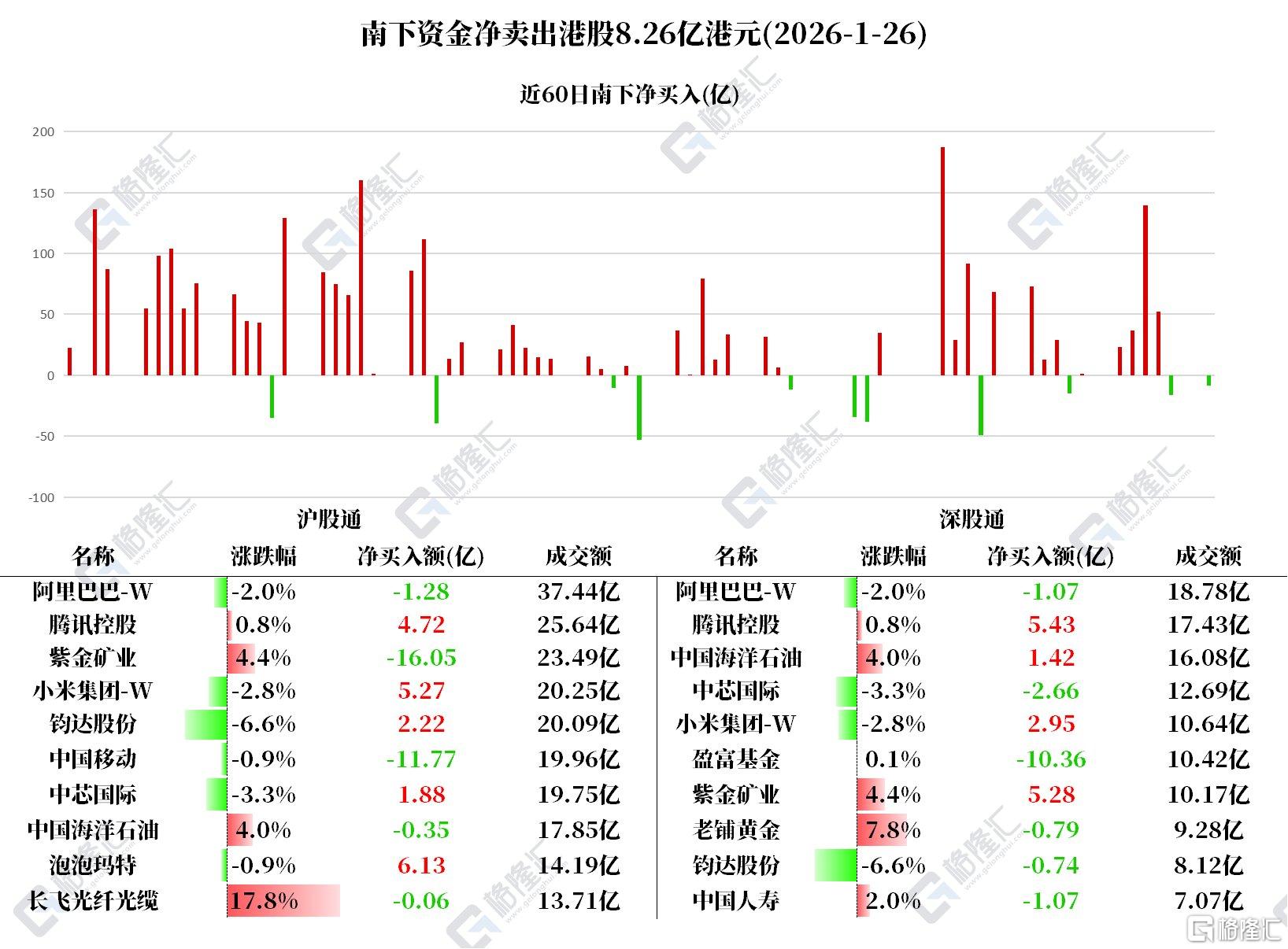
Group 1 - Southbound funds recorded a net sell of HKD 826 million in Hong Kong stocks for the second consecutive day, with notable net purchases in Tencent Holdings (HKD 1.015 billion), Xiaomi Group (HKD 822 million), and Pop Mart (HKD 613 million) [1] - Continuous net buying trends were observed for Xiaomi over the past 7 days, totaling HKD 3.89621 billion, and for CNOOC over 4 days, totaling HKD 1.09627 billion [1] - Significant net selling was noted for China Mobile over 16 days, amounting to HKD 12.89303 billion [1] Group 2 - Haitong International maintained a "Outperform" rating for Tencent Holdings with a target price of HKD 700, expecting total revenue of HKD 195 billion for Q4, a 13% year-on-year increase [5] - Xiaomi Group repurchased 4 million B shares for HKD 14.04 million on January 26 [5] - Citigroup reiterated a "Buy" rating for Pop Mart, forecasting growth driven by IP diversification and product innovation, with a target price of HKD 415 [6]
中信集团举办第三届“绽放杯”大赛,标杆应用赋能产业转型升级
Cai Jing Wang· 2026-01-26 12:34
2026年1月9日,中信集团第三届"绽放杯"数字化应用大赛总决赛在北京中信大厦圆满落幕。中信集团党 委书记、董事长奚国华,党委副书记、副董事长、总经理张文武,党委副书记张世昕,党委委员、副总 经理王国权、曾琪出席并为获奖项目团队颁奖。北京市科协副主席王美艳受邀出席。 "绽放杯"大赛是中信集团数字化发展"应用绽放"行动的重要组成部分。连续三届比赛挖掘培育了一批在 不同业务领域中示范效应强、综合效益好、发展潜力大的数字化应用,为以数字化推动传统产业转型升 级提供了借鉴和引领。 本届大赛设置了"人工智能+"、安全信创、开放创新、智能体四个赛道,旨在引导各单位贯彻落实"人工 智能+"行动、深化数字技术融合应用、筑牢网络安全防线。大赛自2025年10月启动以来,共计64家单 位153个项目参赛,应用案例覆盖金融、制造、生物育种、电力等多个领域。来自中国科学院、北京大 学、北京航空航天大学、中央财经大学、中国移动(600941)等产学研知名机构的35名外部专家评委, 围绕技术创新、应用成效、推广价值等维度对参赛项目进行专业评审。经过层层选拔,"中信天盾智能 防控项目"等3个项目荣获一等奖,"场外柜台交易(OTC)系统国产 ...
公募基金2025四季报调仓图谱:科技制造主线强化 传统蓝筹获回流布局 新能源内部分化(附加减仓TOP50榜单)
Xin Lang Cai Jing· 2026-01-26 12:17
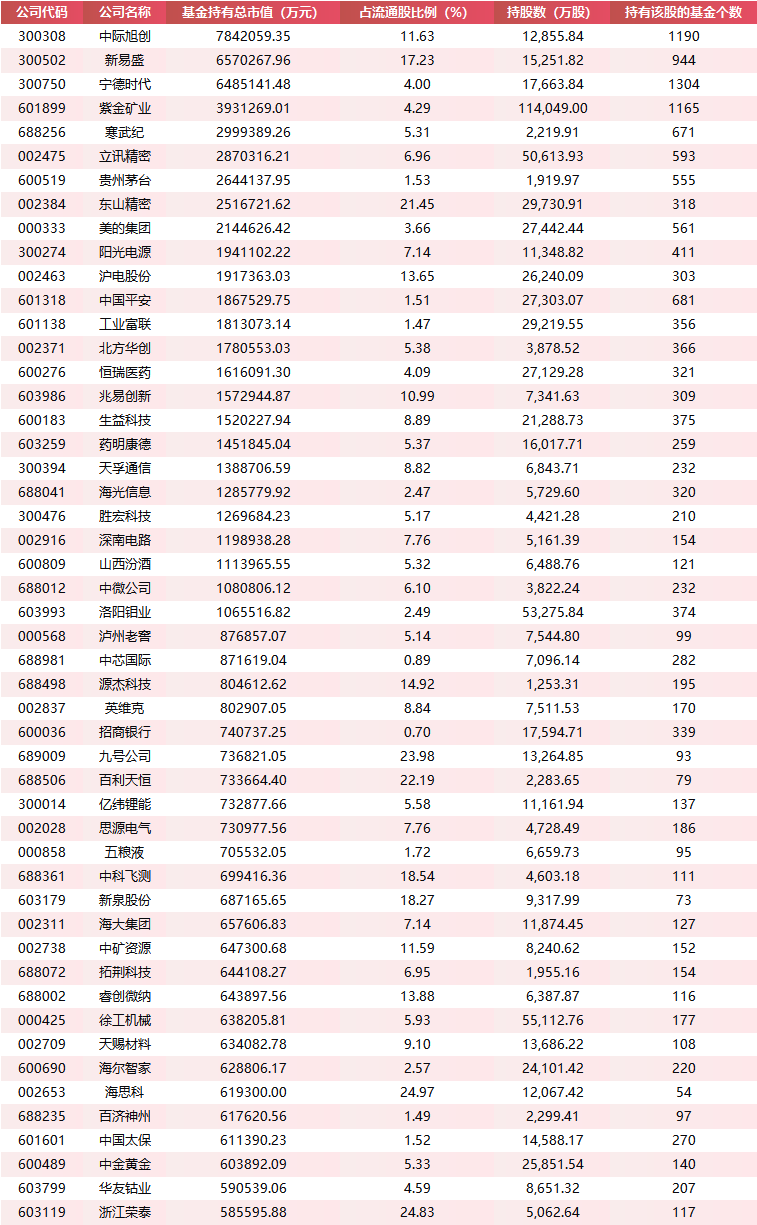
Core Insights - Public funds continue to focus on technology growth and high-end manufacturing, while also reallocating to consumer and financial leaders with returning valuations [1][14] - The structure of holdings indicates a significant increase in positions in AI computing, semiconductor equipment, and resource sectors, while reducing exposure to batteries, consumer electronics, and pharmaceuticals [14] Group 1: Fund Holdings Overview - As of Q4 2025, public fund holdings data shows that technology growth and high-end manufacturing remain core investment directions, with traditional industry leaders and some cyclical stocks also maintaining high allocation levels [1] - The top 50 heavy stocks include major players in technology sectors such as communication, AI, and electronics, reflecting institutional confidence in technological innovation and industrial upgrades [2][3] - Notable stocks like Ningde Times, Zhongji Xuchuang, and Zijin Mining are held by over a thousand funds, indicating strong consensus among institutions on these targets [4] Group 2: Increases in Holdings - The increase in holdings is prominently seen in technology stocks, with Zhongji Xuchuang receiving over 22.6 billion yuan in fund increases, ranking first, followed by Xinyi Sheng with approximately 9.6 billion yuan [5][6] - Traditional sectors also saw significant increases, with China Ping An gaining over 10.5 billion yuan, and other blue-chip stocks like Midea Group and Haier Smart Home returning to substantial increase lists [5] - Resource stocks such as Zijin Mining and Luoyang Molybdenum also experienced collective increases, reflecting high enthusiasm for non-ferrous and energy metal sectors amid global manufacturing recovery expectations [5] Group 3: Decreases in Holdings - Certain stocks in the consumer electronics and OEM sectors, including Industrial Fulian and Lixun Precision, faced collective reductions, indicating a cautious stance on their growth prospects [8] - The internal structure of the new energy vehicle supply chain showed differentiation, with battery leaders like Ningde Times and Yiwei Lithium Energy being reduced [8] - Pharmaceutical stocks like Heng Rui Medicine and WuXi AppTec also saw significant reductions due to industry policy uncertainties and valuation pressures [8] Group 4: New Entrants in Holdings - A number of new stocks have entered the fund's heavy holdings, characterized by small to mid-cap sizes and high growth expectations, covering advanced manufacturing and industrial upgrade sectors [11][12] - Notable new entrants include Chaojie Co. and Guocheng Mining, which have garnered attention from multiple funds, indicating potential focus areas for institutional investment [11][12]





【太平洋科技-每日观点&资讯】(2026-01-27)
远峰电子· 2026-01-26 12:12
Core Viewpoint - The article discusses the performance of various sectors in the TMT (Technology, Media, and Telecommunications) industry, highlighting both the leading and lagging segments, as well as significant developments in the semiconductor and AI sectors. Domestic News / Part 02 - The semiconductor investment alliance, Fuman Micro, announced a price adjustment for LED display products, increasing prices by no less than 10% starting January 19, 2026 [1] - MCA Mobile Alliance reported that Kangxi Communication and its subsidiaries did not violate U.S. patent laws regarding Skyworks Solutions, Inc. [1] - SEMI noted that Fujian Jingxu Semiconductor's second-phase project is nearing completion with a total investment of 1.68 billion yuan, establishing the world's first production line for ultra-wide bandgap semiconductor high-frequency filter chips, expected to achieve an annual capacity of 400kk and generate around 1 billion yuan in output value [1] - Nanya Technology announced two equipment acquisition deals totaling over 3.3 billion New Taiwan dollars, marking a significant step in its expansion plans [1] Overseas News / Part 03 - According to South Korean customs data, the country's semiconductor imports reached $77.5 billion last year, a 4.9% increase year-on-year, driven by surging demand from artificial intelligence [2] - Omdia reported that global telecom operators are increasing capital investments in AI infrastructure to meet rising AI computing demands and local sovereignty requirements [2] - TrendForce projected a 14.8% decline in global laptop shipments in Q1 2026 due to a temporary CPU supply shortage and rising component costs [2] - Intel showcased a "Thick Core" glass substrate design aimed at the high-performance computing and AI server markets, marking a significant innovation in chiplet interconnect technology [2] AI News / Part 04 - Tencent launched a new feature "Yuanbao Pai" for its AI assistant "Yuanbao," focusing on AI social interactions [3] - MiniMax released the M2-her large language model designed for immersive role-playing and expressive multi-turn dialogues [3] - Yingmou Technology introduced the Rodin Gen-2 "Edit" model for 3D asset modification, claiming to be the first true 3D AI generation editing platform [3] - Tencent's mixed Yuan team released the mixed image model 3.0, featuring 80 billion parameters and supporting various visual creation functions [3] Industry Tracking / Part 05 - Blue Origin announced its large-scale satellite communication constellation plan "TeraWave," which includes 5,280 LEO satellites and 128 MEO satellites [4] - The first domestic humanoid diagnostic robot integrating non-invasive brain-computer interface technology was unveiled, suitable for rehabilitation scenarios [4] - By 2025, over 35,000 basic-level and 15 leading smart factories are expected to be established as part of the digital transformation of the manufacturing industry [4] - Midea Weiling launched a new generation of high-precision joint module products, focusing on core types for humanoid robots [4] High-Frequency Data Updates / Part 07 - The international DRAM spot prices for January 26 showed no significant changes in DDR5 and DDR4 memory prices, with DDR5 16G averaging $36.667 and DDR4 16Gb averaging $78.750 [6] - Semiconductor material prices from Baichuan Yingfu indicated stable pricing for various high-purity metals and substrates, with no daily changes reported [7]

主力资金 | 10股尾盘遭资金大幅出逃!
Zheng Quan Shi Bao Wang· 2026-01-26 11:24
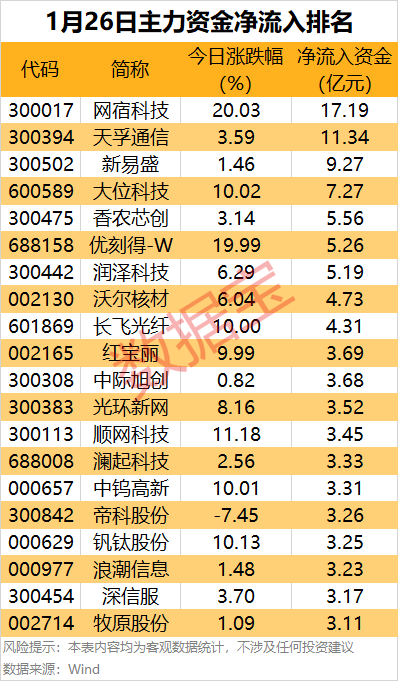
Group 1: Market Overview - On January 26, the main funds in the Shanghai and Shenzhen markets experienced a net outflow of 757.1 billion yuan, with the ChiNext index seeing a net outflow of 281.49 billion yuan and the CSI 300 index a net outflow of 95.23 billion yuan [1] - Among the 10 primary industry sectors, the non-ferrous metals sector had the highest increase at 4.57%, followed by the petroleum and petrochemical sector at 3.18% and the coal sector at 2.07% [1] - In contrast, the defense and military industry saw the largest decline at 4.47%, with the automotive, social services, electronics, real estate, and computer sectors also experiencing declines exceeding 2% [1] Group 2: Fund Inflows and Outflows by Industry - Six industries saw net inflows of main funds, with the pharmaceutical and biotechnology sector leading at 3.29 billion yuan, followed by the communication sector at 2.519 billion yuan, and both the non-bank financial and banking sectors exceeding 1.4 billion yuan [1] - Conversely, 25 industries experienced net outflows, with the electronics, power equipment, and defense industries each seeing outflows exceeding 11 billion yuan [1] Group 3: Individual Stock Performance - Two stocks, Wangsu Science & Technology and Tianfu Communication, had significant net inflows exceeding 1.1 billion yuan, with Wangsu Science & Technology seeing a net inflow of 1.719 billion yuan and a price increase of 20.03% [2][3] - A total of 120 stocks had net inflows exceeding 100 million yuan, with 23 stocks exceeding 300 million yuan [2] - On the other hand, over 270 stocks had net outflows exceeding 1 billion yuan, with the leading outflow from Xunwei Communication at 1.946 billion yuan, followed by Goldwind Technology at 1.864 billion yuan [4][5] Group 4: End-of-Day Fund Flows - At the end of the trading day, the main funds saw a net outflow of 15.61 billion yuan, with the ChiNext index experiencing a net outflow of 6.76 billion yuan [6] - Four stocks had net inflows exceeding 1 billion yuan at the end of the day, with Hikvision leading at 1.471 billion yuan and a price increase of 1.13% [6][7] - Conversely, 25 stocks had net outflows exceeding 700 million yuan, with CATL, Weichai Power, and Tongfu Microelectronics each seeing outflows exceeding 2 billion yuan [8][9]