服务业

Search documents
伯克希尔Q2净利润暴跌59%,现金储备接近历史高位,警告关税将打击业绩 | 财报见闻
Sou Hu Cai Jing· 2025-08-02 23:32
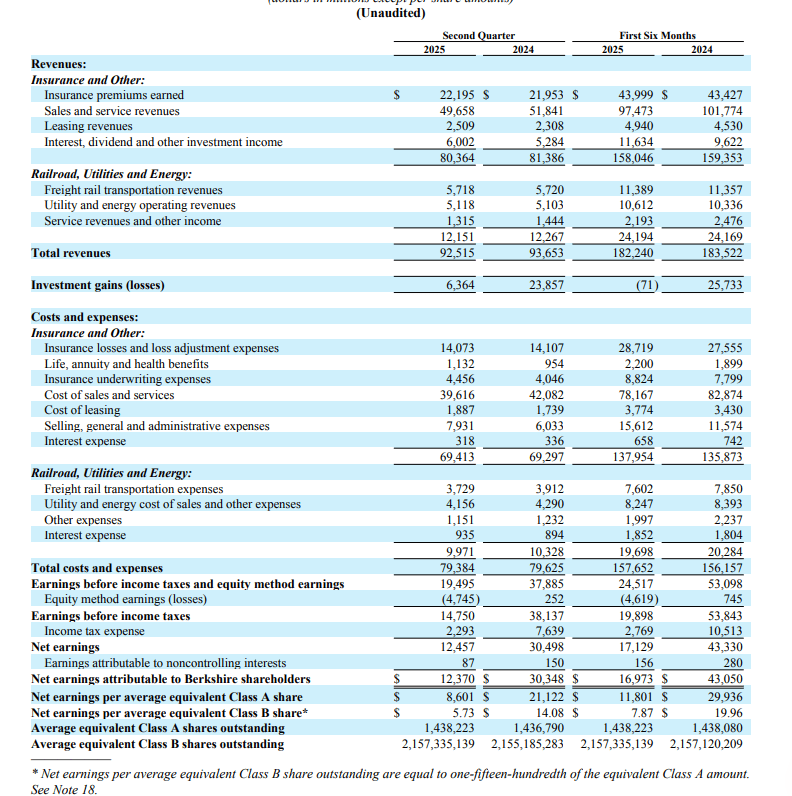
Core Insights - Berkshire Hathaway reported mixed results for Q2, with operating profit declining by 3.8% year-over-year to $11.16 billion, while net profit plummeted by 59% to $12.37 billion, largely due to changes in investment portfolio valuations [1][2] - The company warned that international trade policy tensions, particularly tariffs, pose a significant threat to its diversified business operations, potentially impacting future performance [1][2] - Cash reserves reached $344 billion, marking the first decline in three years, as the company adopted a more cautious stance in the stock market [1][10] Financial Performance - Q2 revenue was $92.515 billion, slightly above market expectations of $91.963 billion but down from $93.653 billion in the same period last year [2][3] - Investment income for Q2 was $4.97 billion, a significant drop from $18.75 billion year-over-year [2][5] - Earnings per share (EPS) for Q2 was $8,601, exceeding market expectations of $7,443 but down from $21,122 in the previous year [2][3] Business Segment Analysis - BNSF Railway reported a strong performance with operating income of $1.47 billion, up 19% year-over-year, reflecting improved demand for goods transportation [5][11] - Insurance underwriting showed mixed results, with underwriting profit of $2.5 billion impacted by $1.2 billion in losses from wildfires in Southern California [6][8] - The manufacturing, service, and retail sectors saw operating profit increase by 6.5% to $3.6 billion, although performance varied significantly across sub-sectors [11][12] Investment Portfolio Changes - The company experienced a significant decline in investment gains, reporting $6.4 billion in Q2 compared to $23.86 billion in the same period last year [9] - Berkshire recognized a $3.8 billion impairment loss on its investment in Kraft Heinz, attributing it to ongoing declines in fair value and economic uncertainties [9][10] - The company has been a net seller of stocks for 11 consecutive quarters, selling approximately $3 billion worth of stocks in Q2 [10] Trade Policy Impact - The company's consumer brands faced notable declines, with Fruit of the Loom's revenue down 11.7%, Garan down 10.1%, and Jazwares down 38.5%, attributed to uncertainties from international trade policies and tariffs [13]

伯克希尔二季度净利润同比下滑59%!巴菲特连续11季度净卖股票
Sou Hu Cai Jing· 2025-08-02 15:39
Core Insights - Berkshire Hathaway's Q2 2025 financial report shows significant changes in key metrics, with revenue at $92.515 billion, slightly above market expectations but down from $93.653 billion year-over-year. Net profit fell 59% to $12.37 billion, exceeding market expectations of $10.703 billion [1][3]. Financial Performance - The operating profit for Q2 was $11.16 billion, a 3.8% decrease from $11.6 billion in the same period last year. The performance across business segments varied, with BNSF Railway showing strong growth, achieving operating income of $1.47 billion, up 19% year-over-year, reflecting a recovery in U.S. goods transportation demand [3]. - The energy sector also performed well, contributing an operating profit of $702 million, a 7.2% increase year-over-year. Manufacturing, service, and retail sectors reported operating profits of $3.6 billion, up 6.5% [3]. - The insurance underwriting business faced challenges, with underwriting profit at $2.5 billion impacted by approximately $1.2 billion in losses from Southern California wildfires. Insurance underwriting revenue decreased by 12% to $1.99 billion, while insurance investment income slightly increased by 1.4% to $3.37 billion. The float remained at $174 billion, providing low-cost investment capital [3]. Investment Strategy - The company maintained a cautious approach to stock investments, selling approximately $3 billion in stocks during Q2, marking the 11th consecutive quarter of net stock sales. No stock buybacks were conducted during this period [4]. - As of the end of Q2, the top five holdings included American Express, Apple, Bank of America, Coca-Cola, and Chevron, accounting for 67% of the fair value of the portfolio [4]. - Cash and cash equivalents stood at $344.1 billion, a slight decrease from $347 billion at the end of Q1, marking the first decline in cash reserves in three years, yet remaining near historical highs [4]. - The company recognized a $3.8 billion impairment loss on its investment in Kraft Heinz, attributing it to a continuous decline in fair value and current economic uncertainties. The book value of its Kraft Heinz holdings was reduced to $8.4 billion, with the company still holding a 27.4% stake [4].

深夜!伯克希尔,重大突发!
券商中国· 2025-08-02 14:03
Core Viewpoint - Berkshire Hathaway's Q2 financial results show a mixed performance with strong revenue but significant declines in net profit and investment income, highlighting challenges in certain business segments and investment decisions [2][4][5]. Financial Performance - Q2 revenue reached $92.515 billion, exceeding market expectations of $91.963 billion, but down from $93.653 billion year-on-year [4]. - Net profit was $12.37 billion, a 59% year-on-year decline, yet above market expectations of $10.703 billion [4]. - Investment income fell to $4.97 billion, down over 73% year-on-year [2][4]. - Cash reserves slightly decreased from $347 billion to $344.1 billion, marking the first decline in three years [2][4]. Business Segment Analysis - BNSF Railway reported operating income of $1.47 billion, a 19% increase year-on-year, reflecting a recovery in U.S. goods transportation demand [4]. - Berkshire's energy segment contributed $702 million in operating profit, up 7.2% year-on-year [4]. - Manufacturing, service, and retail sectors generated $3.6 billion in profit, a 6.5% increase year-on-year [4]. - Insurance underwriting profit was $2.5 billion, impacted by $1.2 billion in losses from Southern California wildfires, with insurance revenue down 12% year-on-year [5]. Investment Decisions - A significant impairment loss of $3.8 billion was recognized on the investment in Kraft Heinz, marking it as one of Buffett's few investment missteps [7][8]. - Berkshire's stake in Kraft Heinz has seen a 62% decline since the merger in 2015, while the S&P 500 has risen over 200% in the same period [7][8]. - Berkshire has been net selling stocks for 11 consecutive quarters, with $3 billion in stock sales in Q2, and did not engage in stock buybacks during this period [11]. Market Sentiment and Future Outlook - Concerns over the transition of leadership as Buffett plans to step down as CEO by the end of 2025 have led to a decline in stock price, with a drop of over 12% since the announcement [12][13]. - Analysts express worries about the "Buffett premium" diminishing, alongside fears of a peak in the property casualty insurance cycle and a lack of new investment activities [14].


格林大华期货中国宏观经济7月报:观察变化、相机决策-20250802
Ge Lin Qi Huo· 2025-08-02 08:17
Report Industry Investment Rating No relevant content provided. Core Viewpoints of the Report - The GDP growth in Q2 2025 met market expectations, but the fixed - asset investment, social consumption, and real estate sectors faced challenges. The export and industrial added - value in June exceeded expectations. The domestic real estate market continued to decline, and the Chinese economy may face challenges in maintaining rapid growth in the second half of the year, requiring continuous efforts to expand domestic demand. The "anti - involution" policies may have a more moderate and long - term impact. Policy decisions may be made based on economic changes, and new policies may be introduced at the end of the third quarter or the beginning of the fourth quarter [84]. Summary by Related Content GDP and Industry Contribution - In Q2 2025, China's GDP grew 5.2% year - on - year, meeting market expectations. The GDP grew 5.3% year - on - year in the first half of the year. The primary, secondary, and tertiary industries grew 3.8%, 4.8%, and 5.7% year - on - year respectively in Q2. The contributions of the three industries to GDP in Q2 were 4.6%, 34.2%, and 61.2% respectively [4][6]. GDP Growth Contribution Factors - In Q2 2025, the contributions of final consumption expenditure, capital formation, and net exports of goods and services to GDP growth were 52.3%, 24.7%, and 23.0% respectively [9]. GDP Deflator - The GDP deflator in Q2 2025 decreased 1.20% year - on - year, showing a negative growth for nine consecutive quarters since Q2 2023 [12]. Fixed - Asset Investment - In the first half of 2025, the national fixed - asset investment grew 2.8% year - on - year, lower than the market expectation of 3.7%. General infrastructure investment (including power) grew 8.9% year - on - year, while narrow infrastructure investment (excluding power) grew 4.6% year - on - year. Manufacturing investment grew 7.5% year - on - year, and real estate development investment decreased 11.2% year - on - year [15]. Real Estate Market - In the first half of 2025, the sales area of new commercial housing decreased 3.5% year - on - year, and the sales volume decreased 5.5% year - on - year. In June, the second - hand housing prices in first - tier cities decreased 0.7% month - on - month, and those in second - and third - tier cities decreased 0.6% month - on - month. In July, the decline rate of national new housing sales area accelerated [18][21][23]. Social Consumption - In June 2025, the total retail sales of consumer goods grew 4.8% year - on - year, lower than the market expectation of 5.6%. The growth rates of most categories of consumer goods in units above the designated size decreased compared with May [26][28]. Service Industry - In June 2025, the service industry production index grew 6.0% year - on - year. The growth rates of information transmission, software and information technology services, leasing and business services, and wholesale and retail industries were relatively high [30]. Foreign Trade - In June 2025, China's exports in US dollars grew 5.8% year - on - year, and imports grew 1.1% year - on - year. Exports to ASEAN and the EU increased, while exports to the US decreased. In July, the China Containerized Freight Index (CCFI) declined slightly, and the decline of the US - West route was faster [33][36][38]. Industrial Sector - In June 2025, the added - value of industrial enterprises above the designated size grew 6.8% year - on - year, exceeding the market expectation. The product sales rate was 94.3%, and the industrial capacity utilization rate in Q2 was 74.0% [41][43][45]. Employment and Prices - In June 2025, the national urban surveyed unemployment rate was 5.0%. The CPI increased 0.1% year - on - year, and the PPI decreased 3.6% year - on - year. In July, agricultural product prices hovered at a low level, and the average domestic gasoline price was higher than that in June [47][49][57]. Manufacturing and Non - Manufacturing PMI - In July 2025, the official manufacturing PMI was 49.3%, remaining below the boom - bust line for four consecutive months. The non - manufacturing business activity index was 50.1%. The manufacturing production continued to expand, while the demand re - entered the contraction range. The service industry activity expectation index increased slightly [68][71][81].
7月PMI:反内卷的“悖论”?
赵伟宏观探索· 2025-08-01 16:03
Core Viewpoints - The "anti-involution" policy has boosted prices, but supply and demand performance appears counterintuitive [3][8] - The manufacturing PMI decreased by 0.4 percentage points to 49.3%, exceeding the average decline since 2017 [3][8] - The increase in commodity prices is reflected in the raw material purchase price index (+3.1 percentage points to 51.5%) and the factory price index (+2.1 percentage points to 48.3%) [3][8] Manufacturing Sector - The manufacturing PMI has marginally declined, with production and new order indices both decreasing [5][34] - The production index fell by 0.5 percentage points to 50.5%, while the new order index dropped by 0.8 percentage points to 49.4% [5][34] - The new export order index decreased by 0.6 percentage points to 47.1%, indicating a slowdown in market demand [5][38] Non-Manufacturing Sector - The non-manufacturing PMI fell by 0.4 percentage points to 50.1%, primarily due to a significant decline in the construction PMI [45] - The construction PMI decreased by 2.2 percentage points to 50.6%, with the new order index dropping sharply by 2.2 percentage points to 42.7% [6][61] - The service sector PMI showed a slight decline, with the new order index remaining weak at 46.3% [49] Key Industries - High-energy-consuming industries have shown production strength despite price increases, with the steel industry PMI rising by 4.6 percentage points [4][21] - The equipment manufacturing and consumer goods industries experienced declines in PMI, falling by 1.1 and 0.9 percentage points to 50.3% and 49.5%, respectively [4][21] - Investment demand has weakened significantly, contrasting with the strong production performance in high-energy-consuming sectors [24][72] Future Outlook - The political bureau meeting in July emphasized the need for further implementation of the "anti-involution" policy, particularly focusing on the downstream effects and marginal changes in domestic demand [30][72] - The current situation indicates that the "anti-involution" policy in the upstream sectors still requires further advancement [30][72]

“国补”“省补”齐发力,广东贷款贴息政策重磅来袭!
Sou Hu Cai Jing· 2025-08-01 15:42
Group 1 - The core viewpoint of the news is the implementation of personal consumption loan interest subsidy policies and service industry loan interest subsidy policies to boost consumer confidence and strengthen the economic foundation [1] - The national loan interest subsidy policy focuses on personal consumption and service industry entities, aiming to reduce credit costs for residents and financing costs for service industry entities, thereby activating market vitality [2] - Guangdong's policy specifically targets high-quality development in manufacturing, providing interest subsidies for new bank loans to manufacturing and high-tech enterprises, with a total subsidy scale of up to 200 billion yuan annually [3] Group 2 - The national subsidy policy aims to guide low-cost financial resources into the consumption sector, stimulating both consumer demand and service supply [2] - The Guangdong policy allows for interest subsidies of up to 35% of the bank loan interest rate for eligible manufacturing and high-tech enterprises, with a maximum annual subsidy amount of 20 million yuan per enterprise [3] - The implementation period for each loan contract can enjoy interest subsidies for up to one year, enhancing financial support for the real economy [3]
高瑞东:消费贷款贴息政策精准发力,服务消费迎政策“及时雨”
Sou Hu Cai Jing· 2025-08-01 13:20
数据显示,今年上半年社会消费品零售总额中商品零售累计增长5.1%,高于去年全年的3.2%;而服务 零售额累计增长5.3%,低于去年全年的6.2%。由此可以看出,相较于商品消费,服务消费的增长略显 疲态。 7月30日召开的中央政治局会议强调,要有效释放内需潜力。深入实施提振消费专项行动,在扩大商品 消费的同时,培育服务消费新的增长点。 高瑞东表示,扩大服务消费对于当前稳就业稳经济意义重大。一是,服务消费具有本地化、即时性、消 费频次高的特征,既能够弥补商品消费持续补贴后带来的透支效应,也能够对冲外需回落的潜在压力。 二是,从发展阶段来看,当前我国消费结构正从商品消费主导向服务消费主导加速转变,服务消费发展 空间较大,将成为未来扩内需的重要抓手。三是,服务业是我国吸纳就业的主体,如餐饮住宿、批发零 售、文化旅游等行业都是劳动密集型行业,扩大服务消费对于稳就业具有更强的带动作用,从而畅 通"就业—收入—消费"的良性循环。 7月31日召开的国务院常务会议部署实施个人消费贷款贴息政策与服务业经营主体贷款贴息政策。光大 证券首席经济学家高瑞东在接受证券时报记者采访时表示,上述两项贷款贴息政策进一步从供需两端协 同提振消费 ...
重磅利好!个人消费贷款纳入贴息范围
Zhong Guo Jing Ying Bao· 2025-08-01 11:27
中经记者 郝亚娟 张漫游 北京、上海报道 业内人士认为,此次国常会提到的消费贷贴息政策与下半年我国提振消费的方向一脉相承。 中国银行研究院研究员叶银丹指出,扩大内需是下半年以及未来保持经济平稳增长的关键,也是近年来 政策的明确导向。在关于扩大内需的政策部署中,本次会议对消费的着墨多于投资,体现了政策向民生 消费倾斜的导向。会议强调要深入实施提振消费专项行动,并提出了下半年扩大消费的三大主要抓手。 一是扩大商品消费,预计下半年消费品以旧换新仍将是政策主要发力点。二是培育服务消费新增长点, 预计未来政策将围绕家政、居住、健康、餐饮住宿、养老托育、文娱旅游、教育体育等与民生息息相关 的领域,从扩大多元化、物美价廉的服务供给,优化服务消费环境,创造服务消费场景等方面进行发 力。三是在保障改善民生中扩大消费需求。 东方金诚首席宏观分析师王青认为,下半年促消费政策有望进一步加码,可能进一步上调耐用消费品以 旧换新支持资金额度,在全国层面发放消费券和消费补贴,将促消费范围扩大到包括旅游、出行等在内 的服务消费和一般商品消费,财政与金融政策联动,对重点领域个人消费贷款和服务业经营主体贷款给 予财政贴息等。 7月31日,国务院 ...
7月中国PMI数据点评:从基本面看空债市者,可以稍息
Huaan Securities· 2025-08-01 11:24
Economic Indicators - July manufacturing PMI recorded at 49.3%, down from 49.7% in June, indicating a significant contraction and falling below market expectations of 49.6%[2] - Non-manufacturing PMI decreased to 50.1% from 50.5%, while the composite PMI output index fell to 50.2%[2] Demand and Supply Dynamics - New orders fell below the expansion threshold, with new export orders declining by 0.6 percentage points, marking a four-month low[5] - The production index showed a notable decline but remained in the expansion zone, indicating ongoing production activity despite weakening demand[3] Price and Cost Pressures - Major raw material purchase prices surged, leading to a significant increase in factory prices, although the increase in factory prices lagged behind raw material costs, creating a record price gap for the year[7] - The supply chain faced pressures as the supplier delivery time index slightly increased, indicating stable logistics efficiency amidst rising costs[3] Inventory and Procurement Trends - Finished goods inventory saw a substantial decrease, reflecting a shift from passive to active inventory reduction strategies by companies due to high costs and weak demand[8] - Procurement volumes dropped significantly, entering a contraction phase as companies adjusted their purchasing strategies in response to declining orders[5] Sector Performance - Equipment manufacturing PMI fell to 50.3%, while consumer goods PMI dropped to 49.5%, indicating a contraction in consumer demand[4] - Large enterprises experienced a decline in PMI, while medium-sized enterprises showed a slight recovery, highlighting a growing disparity among different business sizes[4] Future Outlook - The July PMI data reversed the optimistic expectations from June, indicating a retreat in demand, inventory cycles, and industry dynamics[10] - The bond market is expected to reflect these economic realities, with the ten-year government bond yield showing an upward trend despite the contraction in manufacturing PMI[12]
雅安市统计局召开全市规模以上服务业企业生产经营试点调查培训会
Sou Hu Cai Jing· 2025-08-01 09:56
为贯彻落实全省服务业统计业务培训会精神,扎实推进全市规模以上服务业生产经营情况调查全面试点工作。近日,雅安市统计局组织召开全市规模以上 服务业企业生产经营试点调查培训会,市统计局党组成员、副局长毛晓东出席会议并讲话,各县(区)分管领导及业务骨干共20余人参加会议。 高度重视 规模以上服务业企业生产经营情况调查试点工作是服务业统计改革的重中之重。各县(区)要站在事关经济社会高质量发展的全局,充分认识这项改革的 重大意义、目标要求,以高度的责任感使命感,齐心协力,开拓创新,确保改革取得成效。 02 加强培训 会议传达学习了全省服务业统计业务培训会议精神,对规上服务业企业生产经营试点调查、规模以上服务业、规模以下服务业、平台经济等业务进行了专 题培训,并就如何推进试点工作进行了交流讨论。 会议要求 01 及时总结 对试点期间出现的问题要及时收集汇总上报,为明年正式铺开奠定坚实基础。 各县(区)分管领导和专业人员要迅速消化培训内容,特别是新指标的填报范围、取数口径等要熟练掌握。同时,要在开网前组织辖区所有规上服务业企 业开展业务培训,确保报表单位能报数、会报数、报准数。 03 聚焦质量 全面试点期间,各地要从严抓实数 ...