
银行业

Search documents
市县动态 | 1000万!孝感市孝南区数据资产质押开辟区域融资新路径
Sou Hu Cai Jing· 2026-02-13 12:35
Core Insights - The article highlights the successful financing of Xianggang New Energy Co., Ltd. through the pledge of its data product, marking a significant step in the transition from traditional physical asset collateral to data asset financing in Xiangnan District, Xiangyang City [1][2] Group 1: Company Developments - Xianggang New Energy Co., Ltd. developed the "Xianggang e-Charge Big Data Operation and Decision Support Analysis Report" as part of its efforts to explore the value release of data elements in public charging services [1] - The company successfully obtained a data property registration certificate from Hubei Data Group Co., Ltd. after completing blockchain storage of core data resources on the Hubei provincial data storage platform [1] Group 2: Financing and Economic Impact - The company secured 10 million yuan (approximately 1.4 million USD) in financing from Hubei Bank, which signifies a key advancement in innovative investment and financing models for the region [2] - This financing success is seen as a practical example of how data resources can be effectively transformed into capital elements, contributing to high-quality regional economic development [1]



三大股指期货齐跌 应用材料绩后走高 美国1月CPI重磅来袭
Zhi Tong Cai Jing· 2026-02-13 12:24
Market Movements - U.S. stock index futures are all down, with Dow futures down 0.37%, S&P 500 futures down 0.33%, and Nasdaq futures down 0.31% [1] - European indices also show declines, with Germany's DAX down 0.04%, UK's FTSE 100 down 0.01%, France's CAC40 down 0.36%, and the Euro Stoxx 50 down 0.43% [2] Oil Market - WTI crude oil is down 0.78% at $62.35 per barrel, while Brent crude is down 0.55% at $67.15 per barrel [2] - OPEC+ is leaning towards resuming oil production increases starting in April, with negotiations continuing before the March 1 meeting [2] Economic Data - The U.S. January Consumer Price Index (CPI) is expected to show a year-over-year increase slowing to 2.5%, down from 2.7% in December, marking the lowest level since May 2025 [4] - Both overall CPI and core CPI are expected to rise by 0.3% month-over-month, consistent with the previous month's increase [4] Software Sector - The software sector is experiencing significant sell-offs, but this presents a buying opportunity according to Byron Deeter from Bessemer Venture Partners, who notes that software stocks are in a state of severe overselling [5] - There is an anticipated divergence among software companies based on growth prospects and fundamentals, rather than a uniform market rebound [5] Interest Rates and Economic Outlook - JPMorgan suggests shorting two-year U.S. Treasuries, citing strong economic fundamentals that may hinder the Federal Reserve from making significant rate cuts [6] - The upcoming inflation report is expected to provide new insights into the Fed's future actions, with any signs of easing price pressures likely to boost demand for short-term bonds [6] Gold Market - ANZ Bank has raised its second-quarter gold price target to $5,800 per ounce, viewing the recent price pullback as a buying opportunity amid ongoing structural support [7] - Major Wall Street banks are showing a consensus bullish sentiment on precious metals, with Goldman Sachs targeting $5,400 and UBS and JPMorgan setting even higher targets of $6,200 and $6,300 respectively [7] Corporate Earnings - Applied Materials (AMAT) reported Q1 revenue of $7.01 billion, slightly down 2% year-over-year but above market expectations, with a positive outlook for Q2 revenue of approximately $7.65 billion [10][11] - Roku's Q4 revenue grew 16.1% year-over-year to $1.395 billion, exceeding expectations, with a positive outlook for the next quarter [10][11] - Airbnb's Q4 revenue reached $2.78 billion, up 12% year-over-year, also surpassing analyst expectations, with a positive growth forecast for 2026 [12] - Vale's Q4 revenue increased 9% to $11.06 billion, but the company reported a significant net loss due to asset impairments [13] - NatWest's Q4 pre-tax profit rose 30% to £1.94 billion, exceeding expectations, with plans to leverage AI for cost reduction and efficiency [14]





美股前瞻 | 三大股指期货齐跌 应用材料绩后走高 美国1月CPI重磅来袭
智通财经网· 2026-02-13 12:14
Market Movements - US stock index futures are all down, with Dow futures down 0.37%, S&P 500 futures down 0.33%, and Nasdaq futures down 0.31% [1] - European indices also show declines, with Germany's DAX down 0.04%, UK's FTSE 100 down 0.01%, France's CAC40 down 0.36%, and the Euro Stoxx 50 down 0.43% [2][3] - WTI crude oil is down 0.78% at $62.35 per barrel, while Brent crude is down 0.55% at $67.15 per barrel, amid OPEC+ discussions on potential production increases starting in April [3] Economic Data and Predictions - The US January Consumer Price Index (CPI) is expected to show a year-on-year increase slowing to 2.5%, down from 2.7% in December, marking the lowest level since May 2025 [5] - Both overall CPI and core CPI are anticipated to rise by 0.3% month-on-month, consistent with the previous month [5] Company News - Application Materials (AMAT.US) reported Q1 revenue of $7.01 billion, slightly down 2% year-on-year but above market expectations of $6.86 billion, with a Non-GAAP EPS of $2.38, exceeding the forecast of $2.21 [10][11] - Roku (ROKU.US) exceeded Q4 revenue expectations with a 16.1% year-on-year increase to $1.395 billion, and a GAAP EPS of $0.53, surpassing analyst consensus by 88.8% [11] - Airbnb (ABNB.US) reported Q4 revenue of $2.78 billion, up 12% year-on-year, exceeding analyst expectations, and provided an optimistic revenue outlook for 2026 [12] - Vale (VALE.US) reported Q4 revenue of $11.06 billion, up 9% year-on-year, but faced a significant net loss of $3.844 billion due to a $3.5 billion impairment on nickel assets [13] - NatWest (NWG.US) reported a 30% increase in pre-tax profit to £1.94 billion ($2.6 billion), exceeding analyst expectations, and plans to leverage AI for cost reduction and efficiency improvements [14]

人民银行上海总部召开2026年上海市现金服务与管理工作会议
Xin Lang Cai Jing· 2026-02-13 11:37
来源:中国人民银行上海总部 近日,人民银行上海总部召开2026年上海市现金服务与管理工作会议。会议以习近平新时代中国特色社 会主义思想为指导,深入学习贯彻党的二十届四中全会、中央经济工作会议精神,落实人民银行工作会 议、货金保卫工作会议要求,总结2025年上海市现金服务与管理工作,部署2026年工作任务。人民银行 上海总部党委委员、副主任陈勇出席会议并讲话。上海市中资商业银行相关负责人参加会议。 来源:中国人民银行上海总部 近日,人民银行上海总部召开2026年上海市现金服务与管理工作会议。会议以习近平新时代中国特色社 会主义思想为指导,深入学习贯彻党的二十届四中全会、中央经济工作会议精神,落实人民银行工作会 议、货金保卫工作会议要求,总结2025年上海市现金服务与管理工作,部署2026年工作任务。人民银行 上海总部党委委员、副主任陈勇出席会议并讲话。上海市中资商业银行相关负责人参加会议。 会议指出,2025年上海市现金服务与管理工作成效显著。人民银行上海总部全力保障现金供应平稳有 序、稳步提升流通中人民币整洁度,不断强化代理发行库安全管理,着力提升现金支付便利化,不断优 化适老化现金服务,深入开展整治拒收人民 ...
随着经济放缓 俄罗斯央行再次降息
Xin Lang Cai Jing· 2026-02-13 11:37
Core Viewpoint - The Central Bank of Russia has lowered the key interest rate for the sixth consecutive time, reducing it from 16% to 15.5%, while continuing to suppress the slowing economy amid the ongoing costly conflict in Ukraine [1][5][6]. Group 1: Interest Rate Adjustments - The Central Bank of Russia has indicated that further reductions in the key interest rate may occur, depending on the sustainability of inflation slowdown and changes in inflation expectations [1][6]. - It is expected that the average key interest rate for this year will be between 13.5% and 14.5%, aimed at curbing economic activity [2][6]. Group 2: Economic Impact and Inflation - The Central Bank has stated that the monetary environment will remain tight, effectively cooling demand in other sectors to offset the demand growth related to the war [3][7]. - Economic growth is projected to slow from 4.9% in 2024 to 1% in 2025, with the International Monetary Fund estimating a mere 0.8% growth for Russia this year [3][7]. - After a tax-driven price increase in the early months of the year, inflation is expected to decline again [4][7]. Group 3: Oil Revenue and Budget Concerns - The price of Urals crude oil is approximately $45 per barrel, significantly below the international benchmark Brent crude and below the $59 per barrel needed for Russia to balance its budget by 2026 [1][6].
刚刚,央行发布重磅数据!
Zheng Quan Ri Bao Wang· 2026-02-13 11:26
Core Insights - The People's Bank of China reported that by the end of January 2026, the total social financing scale was 449.11 trillion yuan, reflecting a year-on-year growth of 8.2% [1] - The balance of RMB loans to the real economy was 273.3 trillion yuan, with a year-on-year increase of 6.1% [1] - The balance of foreign currency loans to the real economy, converted to RMB, was 1.09 trillion yuan, showing a year-on-year decline of 12.1% [1] Financing Structure - By the end of January, RMB loans accounted for 60.9% of the total social financing scale, down 1.2 percentage points year-on-year [2] - The proportion of foreign currency loans was 0.2%, down 0.1 percentage points year-on-year [2] - The balance of government bonds increased by 17.3% year-on-year, reaching 95.9 trillion yuan [1][2] Financing Increment - The increment in social financing for January was 7.22 trillion yuan, which is 166.2 billion yuan more than the same period last year [2] - RMB loans increased by 4.9 trillion yuan, which is a decrease of 317.8 billion yuan compared to the previous year [2] - Government bonds net financing reached 9.764 trillion yuan, an increase of 2.831 trillion yuan year-on-year [2] Monetary Supply - The broad money supply (M2) was 347.19 trillion yuan, with a year-on-year growth of 9% [3] - The narrow money supply (M1) was 117.97 trillion yuan, reflecting a year-on-year increase of 4.9% [3] - The cash in circulation (M0) was 14.61 trillion yuan, with a year-on-year growth of 2.7% [3] Loan Balances - By the end of January, the total loan balance in both domestic and foreign currencies was 280.59 trillion yuan, with a year-on-year growth of 6% [4] - RMB loans increased by 4.71 trillion yuan in January, with household loans rising by 456.5 billion yuan [4] - Foreign currency loans reached 570.1 billion USD, showing a year-on-year increase of 6.6% [5]
与瑞银、小摩共唱多!澳新银行高呼金价回调恰为入场良机:二季度目标价上修至5800美元
智通财经网· 2026-02-13 11:21
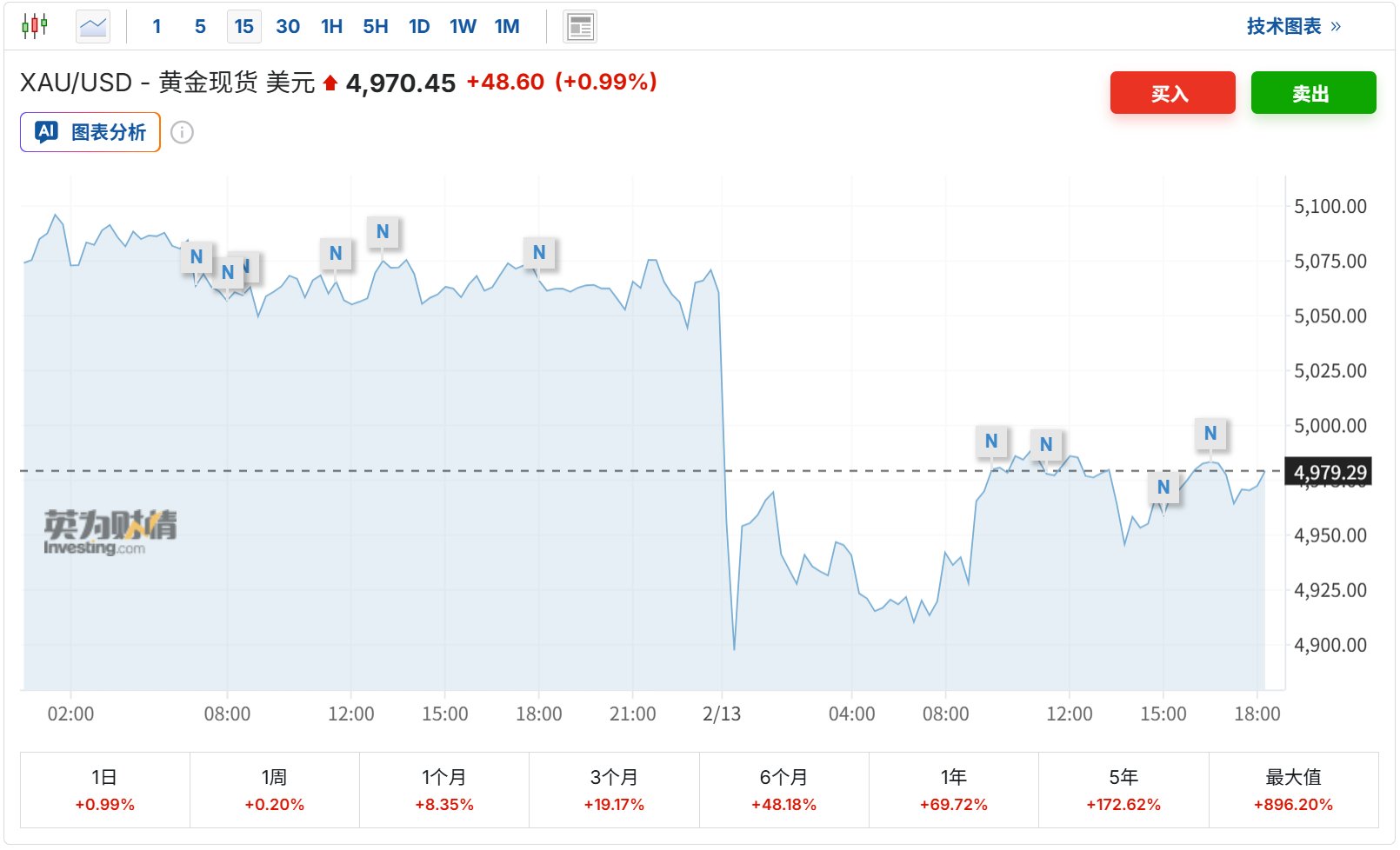
Core Viewpoint - Despite a recent pullback from the historical high of $5,600 per ounce, analysts at ANZ Bank suggest that this correction may attract new investments due to ongoing structural support and a lack of signs indicating a trend reversal, with expectations for prices to reach $5,800 per ounce by Q2 2026 [1][4] Group 1: Market Dynamics - Analysts from ANZ Bank, Sony Kumari and Daniel Hynes, indicate that the current gold price trend is fundamentally different from speculative bubbles seen in 1980 or 2013, driven instead by deep structural demand [3] - Factors such as loose U.S. monetary policy, escalating geopolitical tensions, ongoing policy uncertainty, and a weakening dollar are contributing to the current gold price dynamics [3] - The perception of credit risk associated with the dollar is prompting central banks and institutional investors to diversify their asset allocations, reinforcing gold's status as the "ultimate safe-haven asset" [3] Group 2: Future Projections - ANZ Bank has revised its gold price target for Q2 2026 from $5,400 per ounce to $5,800 per ounce, indicating a significant upward adjustment [4] - The bank also notes that silver prices are expected to remain closely tied to gold prices, with a forecast that silver will underperform gold, leading to a mean reversion of the gold-silver ratio to 70:1 [4] Group 3: Market Sentiment - There is a growing consensus among major Wall Street investment banks regarding bullish sentiment on precious metals, with Goldman Sachs setting a target price of $5,400 for the end of 2026, while UBS and JPMorgan have more aggressive forecasts of $6,200 and $6,300, respectively [5]
人民银行上海总部:持续做好现金使用环境建设,不断提升支付便利化水平
Bei Jing Shang Bao· 2026-02-13 11:20
Group 1 - The People's Bank of China Shanghai Headquarters held a meeting to summarize cash service and management work in Shanghai for 2025 and set tasks for 2026, emphasizing the importance of financial services for the public [1][2] - The meeting highlighted the need to strengthen the awareness of cash service as a strategic position, ensuring a good cash circulation environment and promoting high-quality development in cash services [1] - It was stressed to enhance scientific forecasting and accurately grasp cash operation trends, ensuring public demand for cash is met while maintaining a zero-tolerance policy towards counterfeit currency [1][2] Group 2 - The meeting called for improving the overall quality and efficiency of cash services by enhancing the cash usage environment and payment convenience [2] - There is a focus on building a comprehensive network for monitoring the refusal of cash payments and optimizing financial services for the elderly [1][2] - Research will be conducted on various aspects of cash management, including cash service innovation and counterfeit currency prevention, to provide decision-making references for the transformation of monetary and gold work [2]
央行节前发布重要数据:社融增量7.22万亿元
券商中国· 2026-02-13 11:06
Core Viewpoint - The financial data for January 2026 indicates a strong start to the year for China's economy, with significant growth in social financing and M2, reflecting effective monetary policy support for economic stability [1][2]. Group 1: Financial Growth Indicators - The social financing increment reached a historical high of 7.22 trillion yuan in January, exceeding the previous year by 166.2 billion yuan [1]. - M2 (broad money) grew by 9% year-on-year, surpassing market expectations, while M1 (narrow money) increased by 4.9% [1][2]. - Government bond financing in January amounted to 976.4 billion yuan, a year-on-year increase of 283.1 billion yuan, representing 13.5% of the total social financing, the highest level since 2021 [2]. Group 2: Monetary and Fiscal Policy - The People's Bank of China has adopted a more proactive macroeconomic policy, with a focus on collaboration between fiscal and monetary policies to enhance effectiveness [1][2]. - The central bank has implemented a flexible monetary policy, including a 0.25 percentage point reduction in structural tool rates to encourage bank lending to key sectors [2]. - The government has accelerated the issuance of bonds, with a notable increase in the scale of local government bonds to support economic activities [2][3]. Group 3: Credit and Loan Dynamics - In January, new loans totaled 4.71 trillion yuan, with a year-on-year growth of 6.1%, aligning with market expectations [4]. - Corporate loans increased significantly, with over 70% being medium to long-term loans, driven by the launch of major projects [5][6]. - Short-term loans for enterprises also saw a rise, attributed to seasonal factors such as year-end bonuses and increased operational funding needs [6]. Group 4: Cost of Financing - The average interest rate for newly issued corporate loans was approximately 3.2%, down about 20 basis points from the previous year, indicating a favorable borrowing environment [6][7]. - The transparency in corporate loan costs has improved, leading to lower non-interest costs and easing the financial burden on businesses [7]. Group 5: Policy Effectiveness and Future Outlook - The cumulative effects of monetary policy adjustments are expected to continue influencing the economy positively, with a focus on both stock and incremental policies [8][9]. - The current level of personal mortgage rates is comparable to the zero-interest periods in developed economies, suggesting a supportive environment for consumer borrowing [8].

人民银行:1月人民币存款增加8.09万亿元
Bei Jing Shang Bao· 2026-02-13 10:53
Core Insights - The People's Bank of China released the financial statistics report for January 2026, indicating a total deposit balance of 344.46 trillion yuan, a year-on-year increase of 10.1% [1] - The balance of RMB deposits reached 336.77 trillion yuan, reflecting a year-on-year growth of 9.9% [1] Deposit Growth - In January, RMB deposits increased by 8.09 trillion yuan, with household deposits rising by 2.13 trillion yuan, non-financial enterprise deposits increasing by 2.61 trillion yuan, fiscal deposits up by 1.55 trillion yuan, and deposits from non-bank financial institutions growing by 1.45 trillion yuan [1] - The balance of foreign currency deposits stood at 1.1 trillion USD, marking a year-on-year increase of 23.7% [1] - In January, foreign currency deposits rose by 43.8 billion USD [1]