
新能源

Search documents
创投月报 | 1月人工智能投资数量、金额登顶 恒旭资本四期基金首轮关账超20亿
Xin Lang Zheng Quan· 2026-02-04 07:18
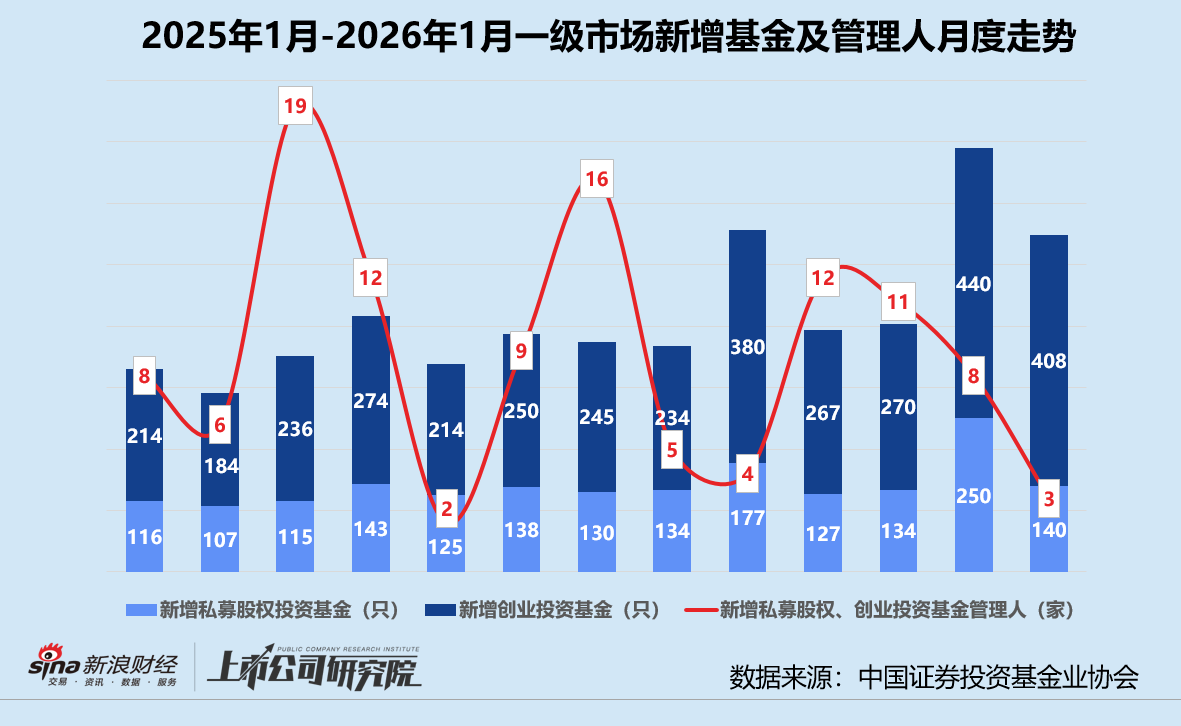
Core Insights - The private equity and venture capital fund managers registered in January 2026 saw a significant decline, with 8 new registrations, down 62.5% year-on-year and month-on-month, while 38 managers were deregistered, with over 60% being voluntary cancellations [1] - The total number of equity investment events in the domestic primary market reached 644 in January, with a total disclosed investment amount of approximately 52.999 billion yuan, reflecting a year-on-year increase of 2.1% and a 55.5% increase compared to January 2025 [3] - The average single investment amount in January was approximately 82.296 million yuan, showing a year-on-year increase of 52.5% [3] Investment Trends - Early-stage investments (seed, angel, and Pre-A rounds) accounted for 40.5% of total investment events, significantly higher than 29.2% in January 2025 and 33.4% in December 2025 [5] - The strategic financing round led the disclosed investment amount with 12.286 billion yuan, while A and B rounds also exceeded 10 billion yuan [5] - The AI sector saw a notable investment event with "Jumpspace" completing over 5 billion yuan in B+ round financing, marking the highest single financing record in the sector in nearly a year [3][5] Sector Performance - The AI sector topped the investment events with 122 occurrences, with approximately 45.1% of the funded companies being embodied intelligence firms [9] - The disclosed investment amount in AI reached 11.518 billion yuan, approximately 1.46 times that of the second-ranked advanced manufacturing sector, with a year-on-year growth of 197.8% [10] - Early-stage companies in AI accounted for 61.5% of the total investment events, with seed, angel, and Pre-A rounds showing significant activity [12] Regional Insights - Jiangsu province led with 102 investment events, while Shanghai's disclosed investment amount reached 16.833 billion yuan, with "Jumpspace" contributing nearly 30% of this total [14] - The disclosed investment amount in Jiangsu saw a significant decrease of 53.2% compared to the previous year, with an average single investment amount of only 2.729 million yuan [16] Active Institutions - The most active investment institutions included Hillhouse Capital, Shenzhen Capital Group, and Qiji Chuangtan, with several institutions having a significant number of investment events [19][21] - The largest fundraising activity was led by Hengxu Capital, which completed a fundraising of over 2 billion yuan for its fourth flagship fund, targeting investments in AI, semiconductors, and aerospace [22][24] Large Investment Events - There were 16 large investment events exceeding 1 billion yuan, totaling 27.760 billion yuan, accounting for approximately 52.4% of the disclosed investment amount [26] - Notable large investments included "Strong Brain Technology" raising about 2 billion yuan and "Deepway" securing 1.177 billion yuan in Pre-IPO financing [26][27] Emerging Sectors - The quantum technology sector showed strong performance with 7 companies disclosing a total of 510 million yuan in funding, including Turing Quantum's significant B round financing [29]

“能源绿色低碳转型”看山东之肥城:精心打造能源绿色低碳转型试点样板
Zhong Guo Fa Zhan Wang· 2026-02-04 06:43
Core Viewpoint - The city of Feicheng in Shandong Province is actively promoting the development of new energy and renewable energy sectors, achieving significant progress in green and low-carbon energy transformation, particularly in salt cavern energy storage and new battery electrode materials [1] Group 1: Energy Transformation Achievements - By 2024, the energy consumption per unit of GDP in Feicheng is expected to decrease by 26.2% [1] - As of September 2025, non-fossil energy consumption is projected to account for 31.5% of the total, with installed capacity of new and renewable energy reaching 1.6292 million kilowatts, representing 63.26% of total power generation capacity [1] - Feicheng's energy transformation has led to its recognition as a "Top Ten Industry" innovation leading area in the province, with its salt cavern energy storage industry cluster being selected as a first batch future industry cluster [1] Group 2: Organizational Leadership and Support - The municipal government has prioritized new energy initiatives in its 2025 government work report and established a dedicated industrial promotion committee to oversee the development of the new energy industry chain [2] - Specialized teams have been formed to focus on the salt cavern energy storage and new battery electrode materials sectors, facilitating coordinated development and addressing specific industry challenges [2] Group 3: Resource Allocation and Planning - Feicheng is focusing on gathering quality resources such as land and funding to support the new energy industry, with a comprehensive plan for salt cavern energy storage and gas utilization [3] - The city has secured significant funding for various projects, including a 100MW new carbon dioxide energy storage project and a 350MW compressed air energy storage project [3] Group 4: Traditional and New Energy Integration - The city is committed to maintaining stable energy production, with coal production expected to reach 1.0705 million tons in 2024 and significant coal storage capacity established [4] - New energy sources are also expanding, with total installed capacity for centralized and distributed solar power reaching 650,000 kilowatts and 600,000 kilowatts respectively, alongside wind power capacity of 195,000 kilowatts [4] Group 5: Salt Cavern Energy Storage and Lithium Battery Industry - Feicheng is developing a comprehensive salt cavern energy storage industry, with plans for a new energy storage industrial demonstration base covering over 2,500 acres and 22 ongoing projects [5][6] - The city is enhancing its lithium battery industry by establishing a complete industrial chain from lithium ore processing to battery recycling, with significant investments in new projects [7] Group 6: Technological Innovation and Low-Carbon Living - The city is fostering technological innovation in the energy sector through collaborations with numerous universities and research institutions, resulting in multiple awards and recognitions [8] - Efforts to promote low-carbon living include the development of green buildings, electric public transportation, and geothermal energy projects, contributing to a sustainable urban environment [9]


成本支撑依旧坚实 沪镍期货反弹上行
Jin Tou Wang· 2026-02-04 06:02
Group 1 - The domestic futures market for non-ferrous metals is showing a predominantly positive trend, with nickel futures experiencing a significant increase, reaching a peak of 137,770.00 yuan/ton, marking a rise of approximately 3.07% [1] - The current nickel market is characterized by a strong upward trend, supported by concerns over tight resource supply and rising boundary costs, despite a seasonal increase in stainless steel inventory due to the Chinese New Year [2] - Analysts from various institutions highlight that the supply-demand dynamics for nickel are improving, with expectations of a 10% to 15% decrease in nickel ore production from Indonesia, which could positively impact the market [2][3] Group 2 - The macroeconomic environment and overall market conditions are currently influencing nickel prices, with a strong US dollar previously causing declines in dollar-denominated metals [3] - The supply side is expected to remain tight due to seasonal weather impacts in major mining regions, which may limit production and shipping volumes [3] - There is a cautious sentiment in the market regarding further purchases at high prices, as many manufacturers have completed their pre-holiday stockpiling [3]
大逆转!近百亿,加仓!
Zhong Guo Ji Jin Bao· 2026-02-04 05:53
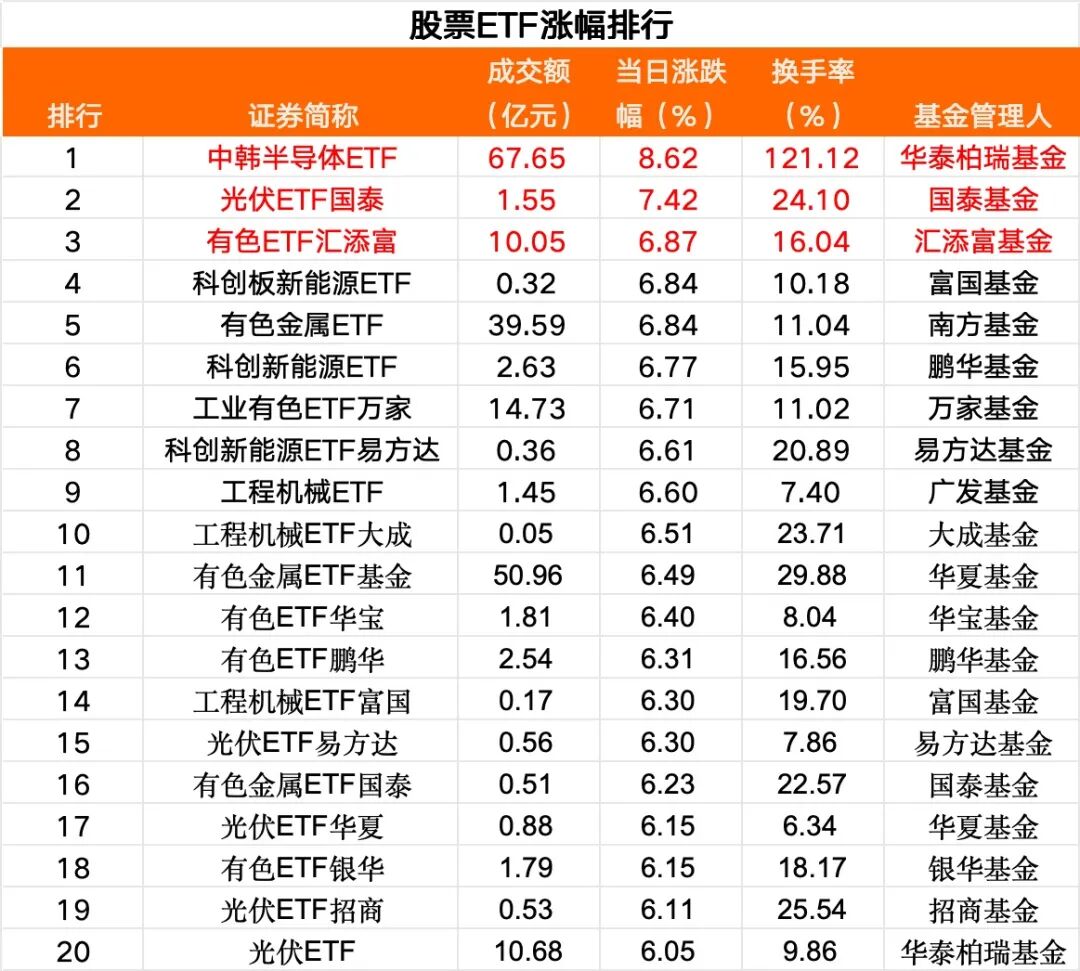
Group 1 - The A-share market experienced a reversal with net inflows after several days of capital outflows, with total trading volume exceeding 2.5 trillion yuan on February 3 [1] - On February 3, nearly 10 billion yuan flowed into the stock ETF market, marking one of the few days of net inflow since January [1][5] - The top-performing ETFs included those tracking the CSI 500, CSI 300, and STAR Market 50 indices, while sectors like non-ferrous metals and photovoltaics saw significant outflows [1][5] Group 2 - As of February 3, the total scale of stock ETFs reached 4.15 trillion yuan, with trading volume for stock ETFs at 298.75 billion yuan, a decrease of nearly 20 billion yuan from the previous trading day [2] - The leading sectors on that day were new energy and non-ferrous metals, with four of the top ten ETFs by increase in price belonging to the new energy sector [2][3] - The worst-performing ETFs included those related to new economy, Hong Kong Stock Connect technology, brokerage, and banking, with declines around 1% to nearly 7% [3] Group 3 - On February 3, the net inflow for stock ETFs was approximately 97.52 billion yuan, with 56 ETFs seeing inflows exceeding 100 million yuan [5][7] - The CSI 500 index led with a net inflow of 3.80 billion yuan, while the SGE Gold 9999 index saw a net outflow of 6.84 billion yuan [6] - Recent inflows into sector-specific indices included over 6.1 billion yuan into the semiconductor index and over 4.6 billion yuan into the STAR Market chip index [6] Group 4 - The top three ETFs by net inflow on February 3 were the CSI 500 ETF with 3.57 billion yuan, the Securities ETF with 1.12 billion yuan, and the A500 ETF with 973 million yuan [7] - Conversely, the ETFs with the highest net outflows included the Non-Ferrous Metals ETF and the Gold Stock ETF, with outflows of 4.18 billion yuan and 714 million yuan respectively [8] Group 5 - Major fund companies like E Fund and Huaxia Fund saw significant inflows into their ETFs, with E Fund's total ETF scale reaching 652.35 billion yuan, an increase of 9.64 billion yuan [9] - Notable inflows for E Fund included 711 million yuan into the CSI 300 ETF and 528 million yuan into the China Concept Internet ETF [9] - Fund manager Huang Yue from Guotai Fund expressed optimism for a spring market rally in Q1 2026, focusing on sectors like securities, new energy, semiconductors, and consumer services [9]
许永锞侯刚会见钦实集团董事长何旭东 共同见证南宁钦实新能源船舶智造基地项目投资协议签约
Xin Lang Cai Jing· 2026-02-04 05:06
Group 1 - The signing of the investment agreement for the Nanning Qinshi New Energy Shipbuilding Intelligent Manufacturing Base project marks a significant collaboration between Qinshi Group and Nanning, focusing on shipbuilding, smart ports, and shipping development [1][2] - Nanning is leveraging its strategic location, resources, policies, and rich application scenarios to enhance the "ship-port-navigation-trade" full industrial chain, which strengthens the confidence of entrepreneurs in investing in Nanning and the ASEAN market [2] - The local government aims to promote the integration of port, industry, city, and maritime trade, and is committed to developing key industries such as new energy, new materials, and advanced equipment manufacturing [1] Group 2 - Qinshi Group is recognized for its strengths in ship design and manufacturing, ship trading, and port operations, aligning well with Nanning's economic development goals [1] - The collaboration is expected to accelerate the construction of cooperative projects in shipbuilding, AI in shipping, port operations, and modern logistics, contributing to Nanning's high-quality development [2] - Key stakeholders from various companies and local government officials participated in the meeting, indicating a strong interest in fostering partnerships and investments in the region [2]

马斯克火箭与AI公司合并,后或与特斯拉合并,地空天机器与AI一体
Sou Hu Cai Jing· 2026-02-04 04:15
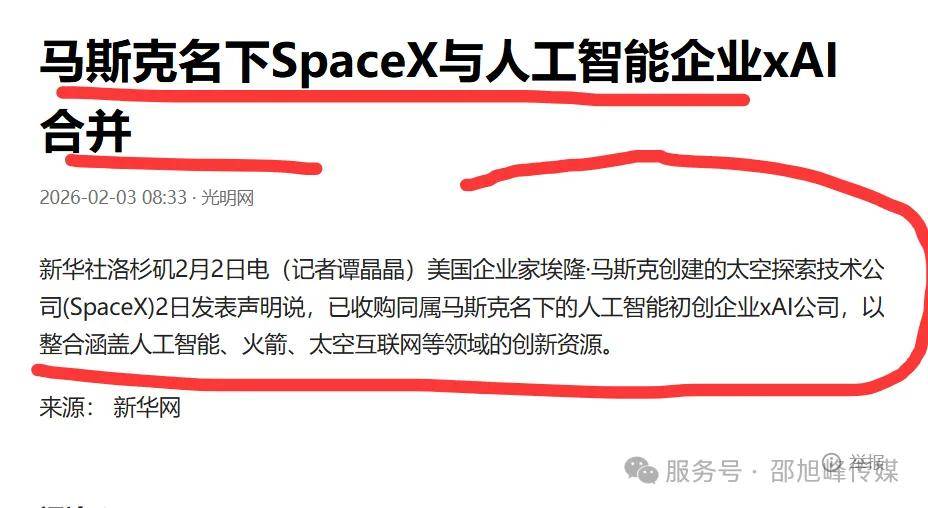
马斯克火箭与AI公司合并,后或与特斯拉合并,地空天机器与AI一体 ——马斯克是要在太空百万计的卫星和地面超级中心推超算,但由于谷歌在量子计算的绝对领先,可能最后还是谷歌AI接管一切, 除非英伟达和OpenAI重大突破,马斯克也全面介入量子计算,同时都在核电等领域突破和全面接入(咱们说的,是终端全面使用核 电) 邵旭峰 最新消息,马斯克旗下火箭公司与其近年倾力打造的xAI公司合并——全球知名社交平台X(原推特)在xAI旗下。 也就是马斯克旗下火箭、星舰飞船项目和AI及社交平台完全整合。 基于此,我判断,之后马斯克旗下特斯拉也可能与SpaceX继续整合,实现地空天智能机器与AI及社交平台高度整合的独立生态系统 闭环——你依稀可以看到机器人、车、飞行器打通——变形金刚成为现实?依赖AI高度智能化,互相助力发展。 请注意,这个事态,咱们这里还是最先预断的。 现在特斯拉市值已经在全球六七的位置(和博通、meta、台积电相当)——这样整合之后的公司,市值可能仅次于英伟达和谷歌, 从而形成全球最大GPU及综合生态提供者英伟达,独立超级生态谷歌(全球最大搜索、全球最大视频、三四十亿用户的安卓系统, 独立TPU支撑的AI集群以 ...



港股午评|恒生指数早盘跌0.41% 腾讯跌超3%拖累蓝筹
智通财经网· 2026-02-04 04:05
Group 1: Market Overview - The Hang Seng Index fell by 0.41%, down 110 points, closing at 26,724 points, while the Hang Seng Tech Index dropped by 2.2% [1] - The trading volume in the Hong Kong stock market reached HKD 151.4 billion in the morning session [1] Group 2: Company Performance - Tencent Holdings (00700) saw its share price decline by over 3%, contributing to the drop in the Hang Seng Tech Index, following WeChat's announcement to address violations related to Yuanbao links [1] - China National Airlines (00753) increased by 4%, Eastern Airlines (00670) rose by 7.2%, and Southern Airlines (01055) gained 5.9%, driven by strong demand for air travel during the upcoming Spring Festival [1] - Hydrogen energy stocks continued to rise, with Guofu Hydrogen Energy (02582) up over 23%, Beijing Jingcheng Machinery Electric (00187) increasing by 10%, and CIMC Enric Holdings (03899) rising by 3.7%, supported by clear hydrogen energy policies and overseas supply chain expansions [1] - JunDa Co., Ltd. (02865) increased by 7.8% amid reports of Elon Musk's team visiting multiple photovoltaic companies in China [1] - Longfor Group (03380) saw its stock rise over 22% during the day, closing up 5%, after the approval of a restructuring proposal for 21 bonds [1] - Dongpeng Beverage (09980) rose over 4% on its second day of trading, approaching a total market capitalization of HKD 150 billion, as the company partners with Sanlin Group to expand into Southeast Asia [1] - Highland Holdings (01676) fell over 35% due to recent transfer warehouse activities, following the completion of a placement of 39.184 million new shares [1] - The newly listed Guoen Technology (02768) debuted on the Hong Kong Stock Connect, rising 16% by midday [1] Group 3: Sector Trends - AI concept stocks experienced a decline amid market concerns over a new wave of AI replacement risks, with Inspur Digital Enterprise (00596) dropping by 7.38% and Kingsoft (03888) falling by 5.69% [2]

学习规划建议每日问答丨怎样理解推动煤炭和石油消费达峰
Xin Hua Wang· 2026-02-04 03:55
Core Viewpoint - The Chinese government aims to peak coal and oil consumption during the 14th Five-Year Plan period, aligning with its strategic decision to achieve carbon peak and carbon neutrality, while transitioning to a greener economy [1] Group 1: Energy Consumption Trends - Coal and oil consumption is expected to peak during the 14th Five-Year Plan, with fossil energy consumption's share projected to drop below 75% by 2030 [1] - Coal consumption is anticipated to peak around 2027, with growth in power and chemical industries, while sectors like steel and construction may see a decline [1] - Oil consumption is expected to peak around 2026, with fuel oil already at its peak and chemical feedstock oil continuing to grow [1] Group 2: Energy Structure Transition - The focus will be on enhancing the clean and efficient use of fossil energy, with a gradual reduction in coal consumption while ensuring energy security [2] - The government plans to implement total coal consumption control in key regions and promote the replacement of scattered coal [2] - There will be an emphasis on the integration of oil and gas exploration with renewable energy development [2] Group 3: Development of Non-Fossil Energy - The government aims to accelerate the construction of clean energy bases, including wind, solar, hydro, and nuclear power, while promoting distributed energy solutions [3] - By 2030, the share of non-fossil energy consumption is targeted to reach around 25% [3] Group 4: Capacity Regulation and Industry Challenges - The peak in coal and oil consumption may lead to structural issues in the coal and refining industries, potentially causing increased uncertainty in energy supply stability [4] - There will be a need for capacity regulation to optimize structure and layout, with a focus on reducing oil production while increasing chemical output [4] - The government encourages market-driven mergers and acquisitions to phase out inefficient capacities in coal and refining sectors [4]
开局之年如何布局?工银瑞信12位投研强将解码2026投资十大关键词
Cai Fu Zai Xian· 2026-02-04 03:34
Core Insights - The article emphasizes the importance of capturing investment opportunities aligned with China's 14th Five-Year Plan, focusing on high-quality development and technological self-reliance [1][2] Investment Strategies - The investment landscape for 2026 is shaped by the "14th Five-Year Plan," which serves as a guiding framework for strategic investments, emphasizing high-quality development and innovation [2] - Key investment opportunities are identified in three main sectors: traditional industries (e.g., chemicals, shipbuilding), emerging industries (e.g., AI, energy storage), and frontier technologies (e.g., embodied intelligence, nuclear fusion) [2] Innovation in Pharmaceuticals - Chinese innovative pharmaceutical companies are expected to experience significant growth, with the total amount of License-out agreements projected to exceed $121.6 billion by 2025, doubling from 2024 [3] - The introduction of AI models is anticipated to shorten drug development cycles and enhance success rates, leading to a revaluation of the innovative drug sector [3] Hong Kong Market Outlook - The Hong Kong stock market is viewed positively, with major investment banks highlighting the resilience and vitality of the Chinese economy, making it a preferred choice for asset allocation [4][5] - The analysis of Hong Kong tech assets reveals two main investment themes: a return to EPS growth and cash flow recovery, alongside a focus on leading internet platforms and emerging industries like smart driving [5] AI Industry Insights - AI is positioned as a transformative force comparable to previous industrial revolutions, with significant growth potential as applications become more widespread [6] - The commercialization of AI applications, particularly in smart driving and robotics, is expected to gain momentum, presenting investment opportunities in related companies [6] Renewable Energy Sector - The renewable energy sector is forecasted to continue its upward trend, with significant opportunities in lithium battery technology and new materials, particularly solid-state batteries [7] - The chemical industry is also expected to see a recovery in profitability, driven by demand growth and supply-side reforms [7] Financial and Real Estate Sector - The financial and real estate sectors are showing signs of recovery, with a rebound in second-hand housing transactions and improved profitability for insurance companies [8] - Investment opportunities are emerging in quality real estate firms and banks with strong wealth management capabilities [8] Consumer Sector Trends - The consumer sector is experiencing a shift, with new growth areas such as smart home products and outdoor lifestyle gaining traction [11] - The changing demographics and consumer preferences are expected to drive growth in sectors like travel, healthcare, and wellness [11] Fixed Income Investment Strategies - The fixed income market is anticipated to remain stable, with a focus on short-term and medium-term bond funds for liquidity and steady growth [14] - The overall bond market is expected to exhibit a fluctuating pattern, influenced by monetary policy and economic data [14]
含金量还在提升 工银瑞信12位投研战将Cue年度投资重点
Xin Lang Cai Jing· 2026-02-04 03:02
Core Viewpoint - The investment landscape for 2026 is shaped by China's "14th Five-Year Plan," emphasizing high-quality development and strategic investment opportunities in various sectors [1][2][3]. Group 1: Investment Strategy and Macro Trends - The importance of a broad perspective in investment is highlighted, focusing on understanding macro trends and industry dynamics [2][19]. - The "14th Five-Year Plan" serves as a guiding framework for investment, emphasizing high-quality development and the need for innovative production capabilities [19][20]. - The ongoing global industrial transformation, driven by AI and technological advancements, presents significant investment opportunities in traditional and emerging industries [20][21]. Group 2: Sector-Specific Insights - The innovative pharmaceutical sector is poised for growth, with Chinese companies expected to see a doubling of license-out revenues to $121.6 billion by 2025 [21][22]. - The Hong Kong stock market is viewed positively, with major investment banks recognizing its potential as a hub for leading companies in technology and smart driving [23][24]. - The AI sector is seen as a transformative force, with applications in various industries expected to drive significant investment opportunities [24][25]. Group 3: Renewable Energy and New Materials - The renewable energy sector is anticipated to continue its upward trend, with lithium battery technology expected to see significant advancements [25][26]. - The chemical industry is also expected to recover, driven by long-term demand growth and supply-side reforms [25][26]. Group 4: Financial and Real Estate Sector - The financial and real estate sectors are showing signs of recovery, with a rebound in second-hand housing transactions indicating positive market sentiment [26][27]. - Investment opportunities in the insurance sector are expected to improve, alongside a focus on banks and brokerages with strong wealth management capabilities [26][27]. Group 5: Consumer Sector Dynamics - The consumer sector is undergoing a transformation, with new trends emerging in smart home products and lifestyle consumption, driven by younger generations [28][29]. - The aging population is creating new market opportunities in tourism, healthcare, and wellness sectors [28][29]. Group 6: Long-term Investment Philosophy - The emphasis on scientific long-termism in wealth management highlights the importance of strategic asset allocation for sustainable growth [29][30]. - The focus on retirement planning underscores the need for consistent investment strategies that adapt to changing market conditions [30][31].