计算机

Search documents
——12月经济数据点评:基本面延续偏弱,通胀回升是亮点
Shenwan Hongyuan Securities· 2026-01-20 05:45
Group 1 - The core viewpoint of the report indicates that China's GDP growth rate for 2025 reached 5%, aligning with market expectations, but the economy still faces challenges such as weak domestic demand and external disturbances [1][3] - The report highlights a significant decline in fixed asset investment driven by the real estate sector, with a year-on-year decrease of 17.2% in real estate investment for December 2025 [3][12] - Consumer spending showed limited improvement, with retail sales growth for the year at 3.7%, down 0.3 percentage points from the previous month, primarily affected by declines in automobile sales and dining [3][24] Group 2 - Industrial value-added growth for December 2025 was reported at 5.9%, a decrease of 0.1 percentage points from November, indicating a divergence in production chains, with traditional sectors like steel and cement continuing to contract [3][6] - Inflation showed signs of recovery, with the Consumer Price Index (CPI) rising to 0.8% year-on-year in December, supported by an increase in food prices, particularly vegetables due to adverse weather conditions [3][10] - Fixed asset investment continued to decline, with a cumulative year-on-year decrease of 3.8% in December, reflecting a broader trend of reduced investment across various sectors [3][12]
中芯国际申请套刻误差测量方法专利,有利于降低获得套刻误差的难度
Sou Hu Cai Jing· 2026-01-20 05:30
声明:市场有风险,投资需谨慎。本文为AI基于第三方数据生成,仅供参考,不构成个人投资建议。 来源:市场资讯 国家知识产权局信息显示,中芯国际集成电路制造(上海)有限公司申请一项名为"套刻误差的测量方 法及系统、装置、程序产品和存储介质"的专利,公开号CN121348661A,申请日期为2024年7月。 专利摘要显示,一种套刻误差的测量方法及系统、装置、程序产品和存储介质,套刻误差的测量方法包 括:获取第一状态下的产品晶圆和参考晶圆的第一参考套刻误差,第一参考套刻误差为产品晶圆上的第 一前层套刻标记与参考晶圆上的第二前层套刻标记之间的套刻误差;获取第二状态下的产品晶圆和第一 状态下的参考晶圆的第二参考套刻误差,第二参考套刻误差为产品晶圆上的当层套刻标记与参考晶圆上 的第二前层套刻标记之间的套刻误差;根据第一参考套刻误差和第二参考套刻误差之间的偏差,获取产 品晶圆的当层套刻标记和第一前层套刻标记的套刻误差。本发明实施例中获取套刻误差不受第一前层套 刻标记与当层套刻标记之间纵向距离的限制,有利于降低获得套刻误差的难度。 天眼查资料显示,中芯国际集成电路制造(上海)有限公司,成立于2000年,位于上海市,是一家以从 ...

联想取得电子设备电池包控制专利
Jin Rong Jie· 2026-01-20 05:09
Group 1 - Lenovo (Beijing) Co., Ltd. has obtained a patent for "an electronic device," with authorization announcement number CN114421030B, applied for on December 2021 [1] - Lenovo (Beijing) Co., Ltd. was established in 1992 and is located in Beijing, primarily engaged in the manufacturing of computers, communications, and other electronic devices [1] - The registered capital of Lenovo (Beijing) Co., Ltd. is 565 million HKD [1] Group 2 - Lenovo (Beijing) Co., Ltd. has invested in 107 companies and participated in 5,000 bidding projects [1] - The company has 1,744 trademark information entries and 5,000 patent information entries [1] - Additionally, Lenovo (Beijing) Co., Ltd. holds 238 administrative licenses [1]

联想申请内存处理方法专利,以使得相机应用执行任务能够从缓存池中获得至少一个第一缓存区
Jin Rong Jie· 2026-01-20 05:02
Group 1 - Lenovo (Beijing) Co., Ltd. has applied for a patent titled "A Memory Processing Method, Device, and Electronic Equipment," with publication number CN121349648A, and the application date is August 2025 [1] - The patent abstract indicates that the application provides a memory processing method that includes monitoring the number of first cache areas available in a cache pool upon the activation of a camera application, and adjusting the number of cache areas in the cache pool based on this number [1] - Lenovo (Beijing) Co., Ltd. was established in 1992 and is located in Beijing, primarily engaged in the manufacturing of computers, communications, and other electronic devices, with a registered capital of 565 million Hong Kong dollars [1] Group 2 - According to Tianyancha data analysis, Lenovo (Beijing) Co., Ltd. has invested in 107 companies, participated in 5,000 bidding projects, and has 1,744 trademark records and 5,000 patent records [1] - The company also holds 238 administrative licenses [1]
格力钛新能源取得预充电装置及其控制方法专利
Sou Hu Cai Jing· 2026-01-20 04:55
格力钛新能源股份有限公司,成立于2009年,位于珠海市,是一家以从事计算机、通信和其他电子设备 制造业为主的企业。企业注册资本110333.5385万人民币。通过天眼查大数据分析,格力钛新能源股份 有限公司共对外投资了21家企业,参与招投标项目61次,财产线索方面有商标信息75条,专利信息4061 条,此外企业还拥有行政许可38个。 国家知识产权局信息显示,格力钛新能源股份有限公司取得一项名为"预充电装置、其控制方法和装 置、存储介质和处理器"的专利,授权公告号CN111669103B,申请日期为2020年5月。 天眼查资料显示,洛阳广通汽车有限公司,成立于2018年,位于洛阳市,是一家以从事汽车制造业为主 的企业。企业注册资本10000万人民币。通过天眼查大数据分析,洛阳广通汽车有限公司参与招投标项 目27次,专利信息111条,此外企业还拥有行政许可29个。 来源:市场资讯 声明:市场有风险,投资需谨慎。本文为AI基于第三方数据生成,仅供参考,不构成个人投资建议。 ...
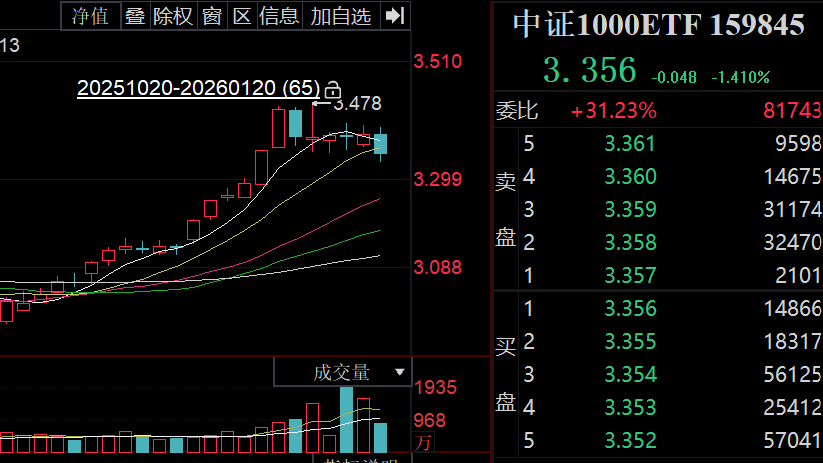
【中证1000ETF(159845.SZ)下跌1.41%,机构预计A股将在2026年继续走强】
Mei Ri Jing Ji Xin Wen· 2026-01-20 04:54
Market Performance - On January 20, the A-share market saw a collective decline in the three major indices, with the Shanghai Composite Index dropping by 0.35% [1] - The CSI 1000 ETF (159845.SZ) fell by 1.41%, while other broad indices such as the SSE 50 decreased by 0.12%, the CSI 300 by 0.52%, and the CSI 500 by 1.22% [1] ETF and Stock Performance - The CSI 1000 ETF's top 50 weighted stocks included notable gainers such as Ming Tai Aluminum Industry, which rose by 9.99%, and Shiyun Circuit, which increased by 2.27% [2] - Conversely, Cambridge Technology and Chunzhi Technology experienced significant declines of -7.96% and -7.45%, respectively [2] Industry Analysis - Key industries within the CSI 1000 ETF showed declines, with Electronics down by 1.58%, Power Equipment by 2.07%, Pharmaceuticals by 0.83%, Computers by 1.44%, and Machinery by 1.57% [3] - The CSI 1000 ETF experienced a net outflow of funds amounting to 9.032 billion yuan over the last five trading days and 8.315 billion yuan over the last ten days [3] Economic Insights - The State Council emphasized the importance of increasing consumer income as a means to boost domestic demand, focusing on the integration of livelihood improvement and consumption promotion [3] - Zheshang Securities projected that the A-share market will continue to strengthen through 2026, driven by liquidity, with a structural market characterized by low volatility dividends and technology growth [3] ETF Overview - The CSI 1000 ETF closely tracks the CSI 1000 Index, which consists of 1,000 small-cap stocks that are liquid and excluded from the CSI 800 Index, reflecting the price performance of a segment of small-cap companies in the A-share market [4]

中证1000指增如何把握Beta与Alpha? | 资产配置启示录
私募排排网· 2026-01-20 03:41
Group 1 - The core viewpoint of the article emphasizes the growing interest in the CSI 1000 Index Enhanced products, which aim to share Beta returns while striving for excess Alpha, particularly in a recovering market since 2025 [3] - The CSI 1000 Index features a small and mid-cap style, covering companies ranked approximately 801 to 1800 in A-share market capitalization, with a significant representation from high-growth sectors such as electronics, electrical equipment, pharmaceuticals, and computers [4] - The CSI 1000 Index typically exhibits higher elasticity and greater volatility compared to broader indices like the CSI 300 and CSI 500, making it more suitable for investors with a certain risk tolerance seeking potential excess returns through accepting short-term fluctuations [4] Group 2 - Since 2021, the Chinese government has introduced various policies to support the high-quality development of "specialized, refined, and innovative" small and medium-sized enterprises, with cumulative fiscal subsidies exceeding 10 billion by 2025 [7] - The combination of industrial upgrades and policy dividends provides a clear growth logic for the CSI 1000 Index in the medium to long term, particularly as high-tech enterprises constitute a significant portion of its constituent stocks [7] - The performance of private equity CSI 1000 Index Enhanced strategies has shown a clear "Beta + Alpha" advantage, with a strategy index return exceeding 36% over the past year, compared to less than 16% for the CSI 1000 Index [7] Group 3 - When selecting CSI 1000 Index Enhanced products, traditional metrics like return rate and volatility are important, but two new indicators are introduced: non-regular investment annualized return and regular investment annualized return [10] - Non-regular annualized return reflects the product's ability to generate returns from a single entry point, while regular annualized return measures the stability of performance over time with fixed frequency investments [12][13] - Products that perform well on both metrics are rare and indicate a more sustainable and evenly distributed source of Alpha, making them suitable for both one-time allocations and long-term regular investments [14] Group 4 - The article highlights the compounding effect of index enhancement, noting that in volatile market conditions, consistent outperformance against a benchmark can lead to significant excess returns over time [18] - The strategy of index enhancement focuses on closely tracking the benchmark while allocating more to quality stocks and less to underperforming ones, aiming to accumulate excess returns [19] - Long-term holding is suggested as the optimal approach for index enhancement, as short-term evaluations may not accurately reflect the strategy's true capabilities [19]

京东方取得像素电路及检测方法、显示装置专利
Sou Hu Cai Jing· 2026-01-20 03:40
Group 1 - BOE Technology Group Co., Ltd. has obtained a patent titled "Pixel Circuit and Detection Method, Display Device," with authorization announcement number CN118298761B, and the application date is May 2024 [1] - BOE Technology Group Co., Ltd. was established in 1993 and is located in Beijing, primarily engaged in the manufacturing of computers, communications, and other electronic devices. The registered capital is approximately 37.41 billion RMB [1] - The company has invested in 74 enterprises, participated in 303 bidding projects, and holds 775 trademark records and 5,000 patent records, along with 47 administrative licenses [1] Group 2 - Chengdu BOE Optoelectronics Technology Co., Ltd. was established in 2007 and is located in Chengdu, primarily engaged in the manufacturing of instruments and meters. The registered capital is 2.5 billion RMB [1] - Chengdu BOE has participated in 919 bidding projects, holds 5,000 patent records, and has 522 administrative licenses [1] - Beijing BOE Technology Development Co., Ltd. was established in 2016 and is located in Beijing, primarily engaged in the manufacturing of computers, communications, and other electronic devices. The registered capital is 38 million RMB [2] - Beijing BOE has invested in 1 enterprise, participated in 92 bidding projects, holds 3,836 patent records, and has 4 administrative licenses [2]

【盘中播报】沪指跌0.73% 国防军工行业跌幅最大
Zheng Quan Shi Bao Wang· 2026-01-20 03:37
Market Overview - The Shanghai Composite Index fell by 0.73% as of 10:27 AM, with a trading volume of 783.95 million shares and a transaction value of 1,378.36 billion yuan, an increase of 0.13% compared to the previous trading day [1] Industry Performance - Real estate, oil and petrochemicals, and beauty care sectors showed the highest gains, with increases of 0.86%, 0.72%, and 0.70% respectively [1] - The defense and military, comprehensive, and communication sectors experienced the largest declines, with decreases of 3.41%, 3.19%, and 3.06% respectively [1][2] Leading Stocks - In the real estate sector, Chengdu Investment Holdings led with a gain of 10.11% [1] - In the oil and petrochemical sector, Blue Flame Holdings increased by 2.86% [1] - In the beauty care sector, Yanjiang Co. rose by 9.34% [1] Detailed Industry Data - Real Estate: 0.86% increase, transaction value of 189.40 billion yuan, up 20.93% from the previous day [1] - Oil and Petrochemicals: 0.72% increase, transaction value of 80.28 billion yuan, up 26.01% from the previous day [1] - Beauty Care: 0.70% increase, transaction value of 35.84 billion yuan, up 11.01% from the previous day [1] - Defense and Military: 3.41% decrease, transaction value of 883.06 million yuan, up 45.81% from the previous day [2] - Communication: 3.06% decrease, transaction value of 754.04 million yuan, up 0.40% from the previous day [2]
基金1月19日参与8家公司的调研活动
Zheng Quan Shi Bao Wang· 2026-01-20 03:35
Group 1 - On January 19, a total of 14 companies were investigated by institutions, with 8 companies being surveyed by funds [1] - Shu Dao Equipment received the most attention, with 4 funds participating in the survey, while Mingyang Electric and Ruipu Biotech had 3 and 2 funds respectively [1] - Among the surveyed companies, there is 1 company from the main board, 6 from the ChiNext board, and 1 from the Sci-Tech Innovation board [1] Group 2 - The total market capitalization of the surveyed A-share companies includes 1 company with a market cap over 50 billion yuan and 5 companies with a market cap below 10 billion yuan, including Tianlu Technology and Shu Dao Equipment [1] - In terms of market performance, 6 of the surveyed stocks increased in the past 5 days, with the highest gains seen in Shiji Information (21.98%), Tianlu Technology (11.08%), and Mingyang Electric (6.95%) [1] - Conversely, 2 stocks experienced declines, with Longxin Technology and Shu Dao Equipment showing the largest drops of 9.72% and 4.68% respectively [1]