基金

Search documents
中科沃土基金迎新任总经理 年内14家公募高管变更
Xin Lang Cai Jing· 2026-02-13 15:18
Group 1 - The core point of the article is the recent management changes at Zhongke Wotu Fund, with the resignation of General Manager Yu Jianwei and the promotion of Assistant General Manager Zhong Guangzheng to the position of General Manager [1][2] - The public fund industry has seen an increase in executive turnover, with 14 public funds experiencing management changes involving 29 executives since the beginning of 2026 [2] - Zhong Guangzheng has a diverse background in finance, having held positions at Guangdong Development Bank, China Merchants Bank, and several fund management companies before joining Zhongke Wotu Fund in October 2025 [1] Group 2 - As of the end of 2025, Zhongke Wotu Fund's public fund management scale was only 0.75 million, ranking relatively low in the industry, with all six of its fund products classified as "mini funds" [2] - The largest fund under Zhongke Wotu Fund has a size of only 0.27 million, indicating challenges in scaling its fund offerings [2] - Recent changes in other public funds include the complete restructuring of Chunhou Fund's management and the appointment of new leadership at Allianz Fund, reflecting a broader trend of executive changes in the industry [2]
睿远基金迎增资 注册资本增至1.0495亿元
Xin Lang Cai Jing· 2026-02-13 15:18
Core Viewpoint - Ruiyuan Fund has completed a capital increase, raising its registered capital from 100 million yuan to 104.95 million yuan through a cash injection of 4.95 million yuan by employee shareholding platforms, without altering the existing shareholder structure [1][2]. Group 1: Capital Increase Details - The capital increase was achieved through contributions from existing shareholders, including Shanghai Yingyuan Enterprise Management Center and others, totaling 4.95 million yuan [1]. - After the capital increase, the actual controller Chen Guangming holds a 47.5653% stake, while seven employee shareholding platforms collectively hold 24.6309% [1][2]. - The new registered capital has been fully paid up, and the changes have been registered with the relevant authorities [1]. Group 2: Shareholding Structure - Chen Guangming, the founder of Ruiyuan Fund, is the largest shareholder with an investment of 49.9198 million yuan, representing a 47.57% stake [2]. - Other key shareholders include Deputy General Manager Fu Pengbo with an 11.43% stake, and several executives with smaller stakes, including Liu Guifang (6.86%), Lin Min (4.75%), and Zhao Feng (4.75%) [2]. - The total investment from the seven employee shareholding platforms amounts to 25.8502 million yuan [2]. Group 3: Fund Management Scale - As of the end of 2025, Ruiyuan Fund's public fund management scale is projected to reach 64.918 billion yuan, with six products under management [2]. - Among these products, five are mixed funds with a total scale of 45.709 billion yuan, and one is a bond fund with a scale of 19.209 billion yuan [2].
博时基金:首席信息官王德英转任公司首席技术专家
Jin Rong Jie· 2026-02-13 15:11
Group 1 - The core announcement is about the management changes at Bosera Asset Management Co., Ltd., where Vice President and Chief Information Officer Wang Deying is leaving his position due to job adjustments and will take on the role of Chief Technical Expert [1] - Chairman Zhang Dong will take over the position of Chief Information Officer following Wang Deying's departure [1]
百亿基金经理傅友兴卸任广发基金副总经理,多位外部老将密集加盟,权益投资格局生变
Sou Hu Cai Jing· 2026-02-13 14:17
Group 1 - The core point of the news is the resignation of Fu Youxing, the Deputy General Manager and Co-Chief Investment Officer of GF Fund, due to work reasons, managing two products with a total scale of 10.276 billion yuan, making him one of the few fund managers in the public offering industry with over 10 billion yuan in assets under management [2][3] Group 2 - Fu Youxing has over 13 years of experience in fund management, having joined the industry in 2002 and worked in various roles before becoming Deputy General Manager at GF Fund in 2006. His investment style focuses on fundamental research and companies with sustainable growth and strong competitiveness, achieving a best-term return of 187.2% on the funds he managed [3] Group 3 - The resignation of a billion-yuan fund manager from an executive position is not uncommon in the public offering industry, with two potential paths: returning to frontline investment research or gradually leaving the managed funds for other career opportunities. The future direction of Fu Youxing's career remains uncertain [3] Group 4 - GF Fund has been actively introducing external talent in the active equity investment sector, with notable recent hires including Wu Chenggen from Zhonggeng Fund, who has a five-year return of 166% on his previous fund, and Zhou Zhishuo from Jianxin Fund, who currently manages three products with a total scale of 17.8 billion yuan [4] Group 5 - The talent layout at GF Fund is evolving from a focus on track-type funds to a more diversified strategy, with managers specializing in absolute returns and cycle investments joining the team. The company currently has over 200 research and investment personnel and eight equity investment teams, with an average of over 10 years of experience among investment managers [4]


就业数据强劲打击降息预期,美股基金遭遇三周以来首次资金净流出
Hua Er Jie Jian Wen· 2026-02-13 13:08
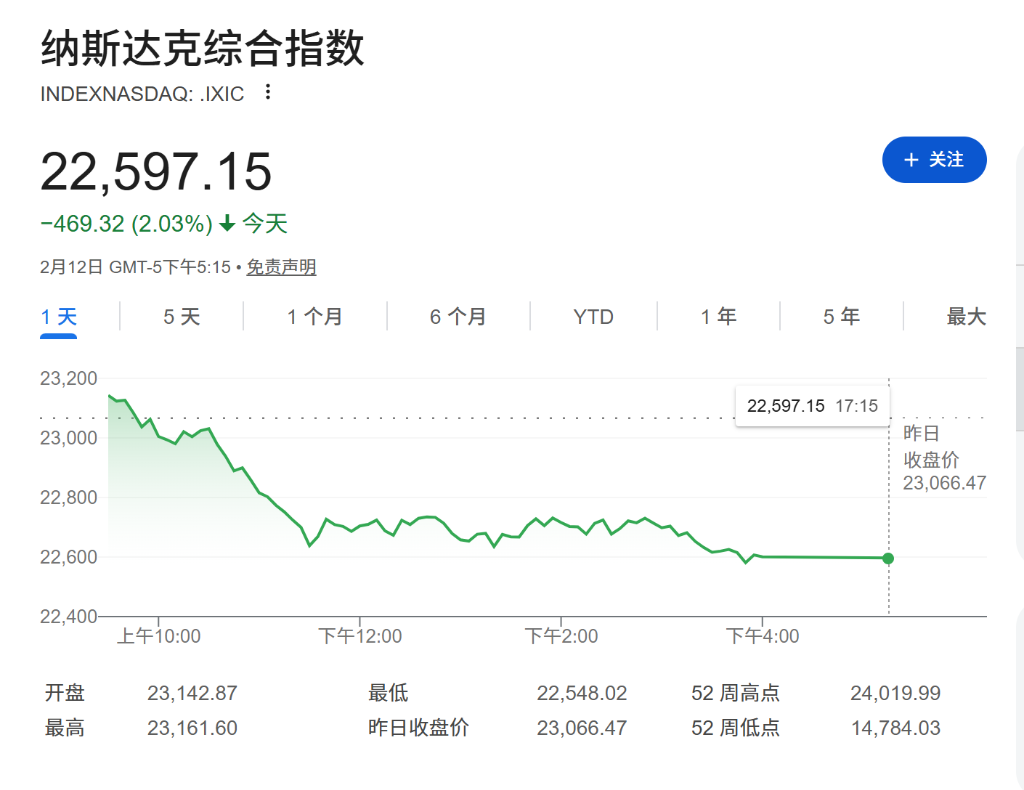
Group 1 - Strong employment report diminishes expectations for Federal Reserve rate cuts, leading to the first weekly net outflow from U.S. stock funds in three weeks, with investors selling $1.42 billion worth of U.S. stock funds as of February 11 [1] - The Nasdaq Composite Index fell by 2.03%, as market concerns shifted back to the disruptive impact of AI technology on sectors such as software, legal services, and wealth management, accelerating the withdrawal of funds from risk assets [1] Group 2 - Large-cap stocks experienced significant outflows, with U.S. large-cap stock funds facing a net outflow of $12.34 billion, while mid-cap stock funds recorded a net outflow of $787 million, indicating investors are taking profits or reducing risk exposure [5] - In contrast, small-cap stock funds saw a net inflow of $2.01 billion, suggesting some funds are seeking more attractive valuations or betting on the resilience of the U.S. economy while hedging against the volatility of large-cap stocks [5] Group 3 - The fixed income market continues to attract funds, with investors injecting $13.37 billion into U.S. bond funds, marking the sixth consecutive week of net inflows, reflecting a strong preference for stable yield assets amid uncertain interest rate paths [6] - Short- to medium-term investment-grade funds were the main beneficiaries, with net inflows of $4.29 billion, followed by short- to medium-term government and treasury funds with $3.09 billion, indicating a market focus on locking in current high yield levels [6] - Conversely, U.S. money market funds experienced a significant outflow of $25.83 billion after two weeks of net inflows, suggesting a reallocation of funds from cash positions to bonds or other income-generating assets [6]
加仓!重要信号
Zhong Guo Zheng Quan Bao· 2026-02-13 12:35
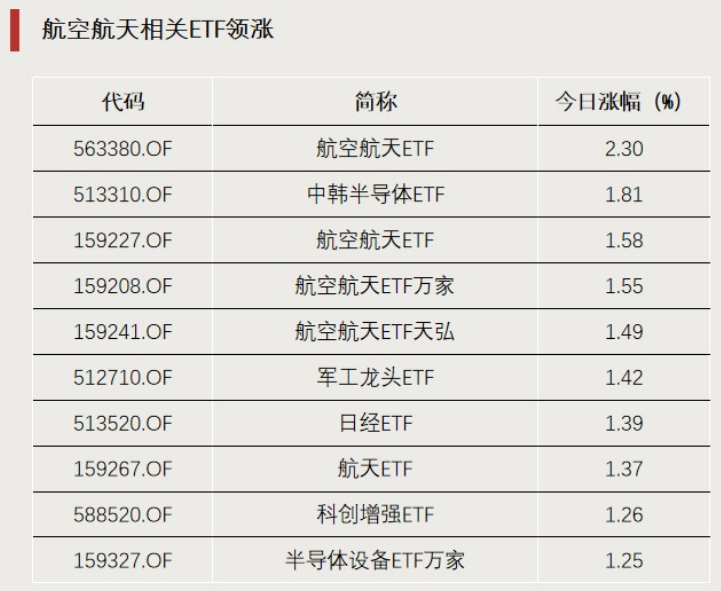
Group 1: Aerospace and Defense Sector Performance - On February 13, the A-share aerospace sector showed strong performance, leading to a rise in related ETFs, with five out of the top ten ETFs being aerospace-related [1][2] - The Aerospace ETF (563380) topped the gainers list with an increase of 2.3% [2][3] - Other notable gainers included military and semiconductor equipment ETFs, indicating a broader interest in these sectors [2] Group 2: ETF Trading Activity - As of February 13, the total trading volume of ETFs reached 386.196 billion yuan, a decrease of 67.372 billion yuan from the previous day [5] - Two ETFs tracking the CSI A500 index surpassed 10 billion yuan in trading volume, while the CSI 500 ETF (510500) and A500 ETF from Southern Asset Management exceeded 8 billion yuan [5][6] Group 3: Capital Flows into Hong Kong Stocks - Ahead of the Spring Festival, many investors are positioning themselves in Hong Kong stocks, as the A-share market will be closed for ten days [7] - On February 12, two ETFs tracking the Hang Seng Technology Index and one China concept internet ETF saw a combined net inflow of over 2.2 billion yuan [7][8] - The current valuation of Hong Kong stocks is at a historically low level, providing a favorable investment opportunity [8] Group 4: Market Outlook - The market is expected to gradually return to a focus on economic conditions, with potential for a rebound in February [9] - The rotation of sectors is anticipated to be a significant feature of the market, with growth sectors like AI and semiconductors showing clear upward trends [9]
上周科技股和贵金属暴跌时,全球资金逃向了哪里?
智通财经网· 2026-02-13 11:14
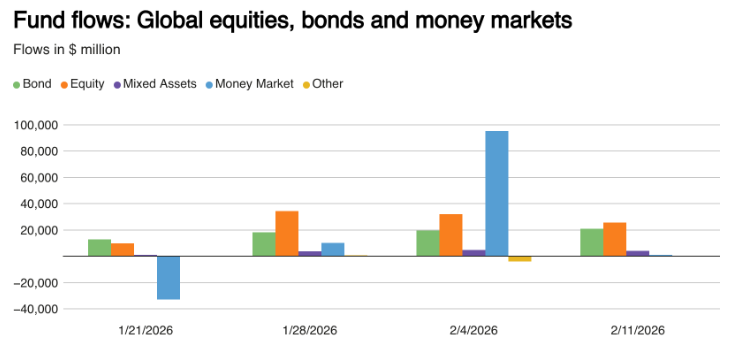
Group 1: Global Equity Fund Flows - European and Asian equity funds experienced strong inflows, with a total of $255.4 billion in global equity fund inflows for the week ending February 11, marking the fifth consecutive week of net inflows [1] - European funds saw a net inflow of $175.3 billion, the highest weekly record since at least 2022, while Asian funds had a net inflow of approximately $62.8 billion [1] - In contrast, U.S. equity funds experienced a net outflow of $14.2 billion, the first net outflow in three weeks, driven by concerns over high valuations and the impact of artificial intelligence on various sectors [1] Group 2: Global Bond Fund Flows - Global bond funds attracted investor interest for the sixth consecutive week, with net inflows of approximately $210.9 billion in the most recent week [4] - Short-term bond funds recorded net inflows of $48.7 billion, the highest since mid-December last year, while corporate bond funds and euro-denominated bond funds attracted $26.3 billion and $20.6 billion, respectively [4] Group 3: Emerging Markets Investment - Emerging market equity funds saw inflows of $8.52 billion, continuing a recent buying trend for the eighth consecutive week [7] - Bond funds in emerging markets reported a net inflow of $1.29 billion, according to data from 28,723 funds [7] Group 4: Commodity Fund Flows - Gold and precious metals funds attracted inflows for the 13th week out of the last 14, although the net inflow of $1.25 billion was the lowest in five weeks [6]
创业板人工智能ETF配置策略跟踪
Shanghai Securities· 2026-02-13 10:52
Group 1 - The report identifies Huabao Fund Management's Chi Chuang Data (300857.SZ) as the best convergence stock for the Chi Chuang Artificial Intelligence ETF (159363.SZ), which is expected to enter a high growth phase starting in 2023, with a projected PE ratio of 22 times based on the expected net profit for 2023 [2][8] - As of February 9, 2026, Chi Chuang Data's stock price reached a maximum of 238 CNY per share, closely aligning with the estimated fundamental value of 231.71 CNY per share under the 22 times PE valuation for 2028, indicating the reasonableness of this pricing basis [2][8] - The performance of Chi Chuang Data since November 2025 has been consistent with the trend of the Chi Chuang Artificial Intelligence Index, although the individual stock has shown greater volatility [3][9] Group 2 - From November 1, 2025, to February 9, 2026, the dynamic allocation strategy for the Chi Chuang Artificial Intelligence ETF achieved a final return of 14.72% with a maximum drawdown of 4.06%, indicating that while the dynamic strategy's returns and drawdowns were lower than a buy-and-hold strategy, its Sharpe ratio remained superior [3][9] - The report emphasizes the importance of dynamic position management based on the fundamental value range of Chi Chuang Data for the Chi Chuang Artificial Intelligence ETF [3][9]
周期风格占比提升,权益基金跑赢ETF——权益基金月度观察(2026/01)-20260213
Huafu Securities· 2026-02-13 10:32
- The report introduces a quantitative model for evaluating equity funds, using 22 benchmark indices as independent variables and fund returns as dependent variables. The model applies a rolling window regression with a 6-month window to calculate the R² matrix for each fund. The benchmark index with the highest average R² over the last six periods is selected as the reference index for fund performance evaluation[18][19][24] - The construction process of the model involves linear regression for each benchmark index and fund return, followed by rolling window regression to derive the R² matrix. The formula used is $ R² = 1 - \frac{\sum_{i=1}^{n}(y_i - \hat{y}_i)^2}{\sum_{i=1}^{n}(y_i - \bar{y})^2} $, where $ y_i $ represents fund returns, $ \hat{y}_i $ represents predicted returns, and $ \bar{y} $ represents the mean of fund returns[18][19][24] - The model is evaluated as effective in identifying the most relevant benchmark index for fund performance, providing a robust framework for fund classification and strategy analysis[18][24] - The backtesting results of the model show that the average R² value for equity funds decreased slightly from 0.7478 in December to 0.7336 in January, indicating a slight reduction in the fit of funds to single benchmark indices[34] - The report categorizes equity funds into five styles: large-cap, mid-small-cap, value, growth, and thematic sectors. The classification is based on the benchmark index with the highest R² value derived from the model[24][27][33] - The performance of mid-small-cap funds was the highest in January, with a median return of 8.18%, followed by growth funds at 7.08%, large-cap funds at 4.13%, value funds at 3.88%, and thematic sector funds at 3.37%[24][25][27] - The thematic sector funds are further divided into categories such as healthcare, cyclical, infrastructure, consumption, technology, finance, and advanced manufacturing. Among these, cyclical funds performed the best, with an average return of 21.6% for active funds and 18.2% for passive funds[27][30][32] - The report highlights high-rated funds, defined as AAA and AA+ funds, which demonstrate strong alpha sustainability and upward alpha trends. AAA funds are stable alpha-type funds suitable for long-term holdings, while AA+ funds exhibit steadily increasing alpha values, indicating strong potential for excess returns[47][48][49] - The report identifies new emerging funds, defined as funds receiving their first rating this month and managed by fund managers with less than three years of experience. These funds predominantly track indices such as CSI Dividend and CSI 300[63][64] - The report also highlights funds with significant rating upgrades, defined as funds whose ratings improved substantially compared to the previous month. These funds are primarily aligned with indices such as CSI Cyclical, CSI Dividend, and TMT (CITIC)[65][66]
“指数扛把子”胡洁离任,主动权益乏力的华宝基金接下来怎么办?
Xin Lang Cai Jing· 2026-02-13 09:52
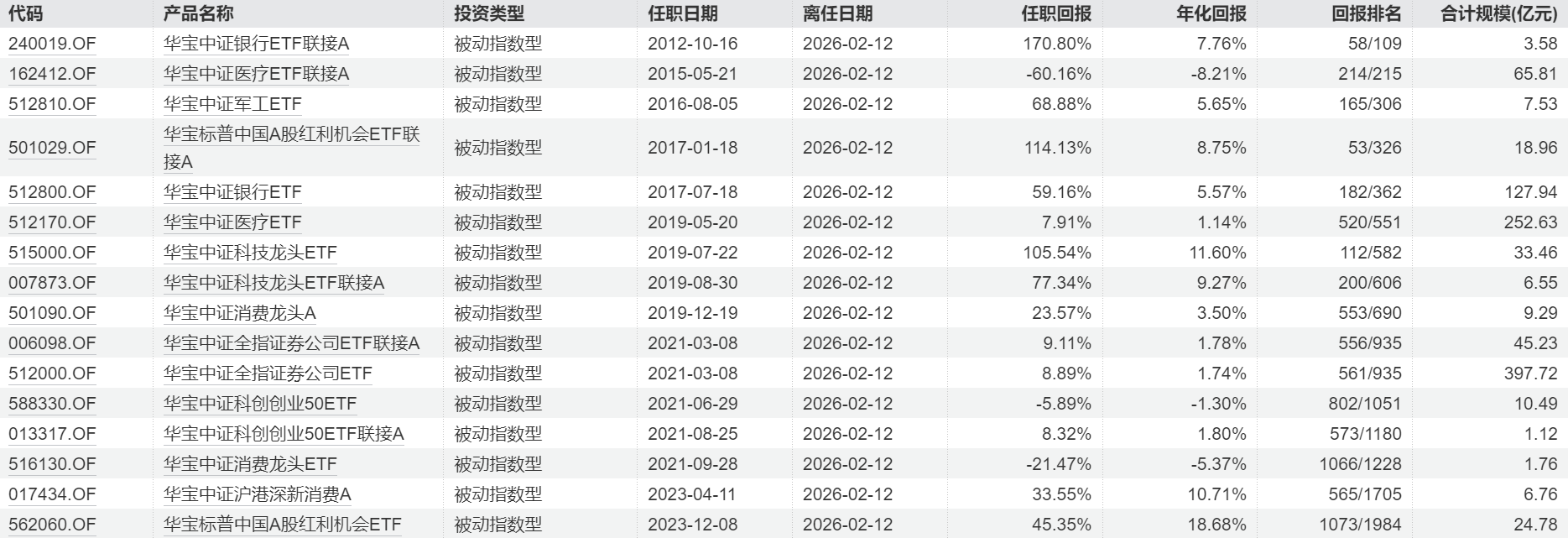
Core Viewpoint - The departure of Hu Jie, a veteran fund manager at Huabao Fund, marks a significant change in the management of the company's index funds, which collectively account for a substantial portion of the firm's total assets under management [1][2]. Group 1: Fund Manager Departure - Hu Jie has resigned from her position as fund manager for 16 index funds due to personal reasons, with her resignation effective as of February 12 [1]. - Hu Jie has been with Huabao Fund since June 2006 and has managed a total of 1,013.62 billion yuan across these funds [1][2]. Group 2: Fund Management Scale - As of February 12, Huabao Fund's total assets under management amount to 4,316.37 billion yuan, with nearly 1/4 of this attributed to Hu Jie's management [2]. - The fund's total includes 1,802.04 billion yuan in money market funds and 2,514.33 billion yuan in non-money market funds [2]. Group 3: Fund Performance and Strategy - Huabao Fund has a total of 278 public fund products, but only 7 funds exceed 10 billion yuan in size, indicating a significant number of smaller funds [5]. - The firm has been actively closing underperforming funds, with plans to liquidate 7, 9, and 7 funds in the years 2023, 2024, and 2025 respectively, primarily due to the poor performance of active equity funds [5]. Group 4: Future Management Changes - The management team at Huabao Fund is undergoing significant changes, with the departure of Chairman Huang Kongwei and the appointment of Xia Xuesong as his successor [6][7]. - Xia Xuesong previously led a fund to grow from 3.197 billion yuan to 119.504 billion yuan, indicating potential for growth in Huabao Fund's fixed income segment [7].