
半导体

Search documents
半导体精品公众号推荐!
国芯网· 2026-03-12 14:21
Group 1 - The article emphasizes the importance of revitalizing the domestic semiconductor industry in the context of an information-explosive era [1] - It suggests that in a fragmented information age, individuals need to focus on efficient ways to acquire high-quality information [1] - The article recommends that semiconductor professionals should follow five specific public accounts to stay updated [1] Group 2 - The recommended public accounts include "半导体技术天地" for technical resources and expert insights [3] - "全球电子市场" is highlighted as the leading platform in the semiconductor industry with a following of 500,000 professionals [5] - "半导体行业圈" and "半导体产业联盟" are also suggested as valuable communities for industry engagement [7][9] Group 3 - The article mentions a free open group with 80,000 members available for semiconductor professionals [12] - It provides a step-by-step guide for joining the group through the public account [13][15] - The article encourages contributions and collaborations within the semiconductor community [18]

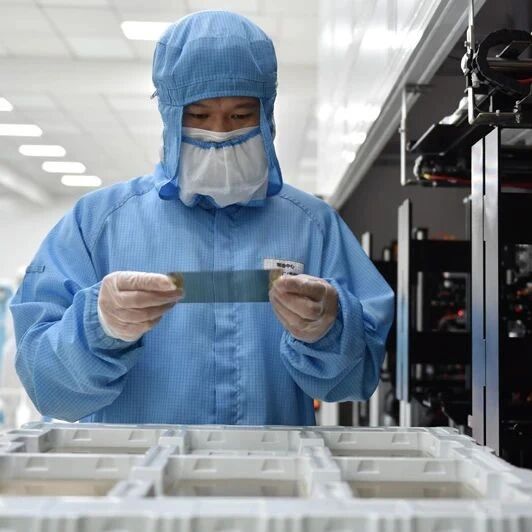
伊朗将袭击英伟达!
国芯网· 2026-03-12 14:21
国芯网[原:中国半导体论坛] 振兴国产半导体产业! 不拘中国、 放眼世界 ! 关注 世界半导体论坛 ↓ ↓ ↓ 3月12日消息,据伊朗官方媒体公布了一份清单,列出了近 30 个可能成为攻击目标的 地点。其中包括 英伟达公司的 三处设施。 2)英伟达位于海法的"主要且最大的研发中心"; 3)IBM 位于贝尔谢巴的AI研究及威胁响应中心; 4)Palantir 位于阿布扎比的战略合作中心及其位于特拉维夫的区域办事处; 5)Oracle 位于耶路撒冷的区域云服务办事处及其位于阿布扎比的总部; 据报道,伊朗已将亚马逊、谷歌、IBM、微软、英伟达、Oracle 和 Palantir 的设施列 为报复性打击的合法目标。伊朗伊斯兰革命卫队已确定了巴林、以色列、卡塔尔和阿 联酋境内的 29 个地点,这些地点设有办公室、数据中心和研究设施,伊朗计划摧毁这 些目标。 这份清单的标题为"伊朗的新目标",其中包括 三处英伟达设施、 五处亚马逊设施、五 处微软设施、六处 IBM 设施、三处 Palantir 设施、四处谷歌设施和三处甲骨文设施。 这些目标被描述为"敌方技术基础设施",以三张幻灯片的形式在 Telegram 上展示,附有 ...


国泰海通|策略:科技景气中枢上移,原油有色价格分化
国泰海通证券研究· 2026-03-12 14:03
Group 1: Economic Overview - The economic performance shows a divergence, with rising oil and chemical prices while gold and copper prices are under pressure due to geopolitical tensions in the Middle East [1][2] - The AI sector is experiencing an upward shift in its economic center, with an increase in semiconductor sales growth rates [1][2] - The real estate cycle is showing signs of marginal weakness, while tourism and export sectors remain strong [1][2] Group 2: Upstream Resources - Oil prices have surged due to escalating geopolitical tensions in the Middle East, with Brent crude oil futures increasing by 27.9% as of March 6 [3] - The chemical price index rose by 11.9%, while the oil transportation index (BDTI) and refined oil transportation index (BCTI) increased by 54.1% and 75.7%, respectively [3] - In contrast, gold and copper prices fell by 1.7% and 2.8%, respectively, while aluminum prices rose by 9.7% due to supply constraints and increased demand for minor metals driven by AI capital expenditures [3] Group 3: Technology and Manufacturing - The global semiconductor sales reached $82.54 billion and $22.82 billion in China in January 2026, with year-on-year growth rates of 46.1% and 47.0%, respectively [4] - The average prices for DRAM DDR3, DDR4, and DDR5 showed mixed trends, with DDR3 increasing by 8.0% and DDR4 decreasing by 3.1% [4] - The construction demand in the real estate sector has shown a marginal decline, reflecting a potential slowdown in fiscal fund disbursement [4] Group 4: Downstream Consumption - The transaction area for commercial housing in 30 major cities decreased by 7.6% year-on-year compared to the Lunar New Year in 2025, indicating a marginal decline in real estate market activity [5] - High-end liquor demand continues to decline, with prices for premium brands like Moutai dropping by 4.9% [5] - The tourism sector remains robust, with Shanghai Disneyland's crowd levels increasing by 69.7% compared to the same period last year, and service consumption prices rising significantly [5] Group 5: Transportation and Logistics - Passenger transport volume in ten major cities increased by 2.9% year-on-year, indicating strong post-holiday travel activity [6] - National road and rail freight volumes decreased by 9.3% and 0.3%, respectively, while express delivery volumes showed positive growth [6] - The Shanghai Containerized Freight Index (SCFI) rose by 11.7%, reflecting strong domestic export activity, despite a 6.1% decline in the Baltic Dry Index (BDI) due to geopolitical risks [6]
资讯日报:IEA 同意释放创纪录储备油-20260312
Guoxin Securities Hongkong· 2026-03-12 13:53
Market Overview - The Hang Seng Index closed at 25,899, down 0.24% for the day, but up 1.05% year-to-date[3] - The S&P 500 index closed at 6,781, down 0.08% for the day, and down 1.02% year-to-date[3] - The Nikkei 225 index rose 1.43% to close at 54,248, with a year-to-date increase of 9.31%[3] Energy Sector Insights - The International Energy Agency (IEA) announced the release of 400 million barrels of oil reserves, marking the largest strategic reserve release in history[9] - WTI crude oil futures rose over 4% to $87.25 per barrel, while Brent crude oil futures increased by 4.8% to $91.98 per barrel[9] - Coal stocks saw significant gains, with Huayli Resources up over 28% and Yancoal Australia up over 8% due to ongoing Middle East tensions affecting energy valuations[9] Automotive and Technology Stocks - NIO's stock surged over 14% after reporting a projected quarterly profit of 1.25 billion yuan and a revenue increase of 75.9% year-on-year[9] - Nvidia shares rose 0.68%, while major tech stocks like Apple and Microsoft saw slight declines of 0.01% and 0.22%, respectively[10] Market Risks and Concerns - The ongoing Middle East conflict remains a significant uncertainty, with analysts noting the hardline positions of both sides, complicating potential resolutions[9] - Safety risk warnings regarding AI applications have led to a reevaluation of valuations, with MINIMAX-WP and other stocks experiencing declines of over 6%[9]
黄仁勋为中国新出海叙事盖上印章
财富FORTUNE· 2026-03-12 13:07
Core Viewpoint - The article discusses the five-layer framework of AI proposed by NVIDIA CEO Jensen Huang, emphasizing the interdependence of energy, chips, infrastructure, models, and applications in the AI industry [1][4]. Group 1: AI Framework and Energy - Huang categorizes the AI industry into five layers: energy, chips, infrastructure, models, and applications, stating that successful applications drive demand across all layers, ultimately affecting energy consumption [1][4]. - The recent surge in the Chinese stock market for green energy and storage concepts coincides with Huang's framework, providing a test case for its validity [3][4]. - The OpenClaw phenomenon, an open-source AI framework, exemplifies the application layer's impact, as it enables AI to perform tasks beyond simple interactions, thus driving demand for underlying layers [5][6]. Group 2: Energy Consumption and Infrastructure - OpenClaw's rapid adoption has led to a significant increase in computational power demand, with token consumption reaching 8.52 trillion, indicating a new level of energy consumption [5][6]. - By 2025, China's total power generation capacity is projected to reach 3.89 billion kilowatts, with total electricity consumption exceeding 10 trillion kilowatt-hours, providing a robust supply for high-energy AI data centers [6][7]. - The Chinese government has recognized the importance of "computing and electricity collaboration" as a national strategy, mandating that new data centers use over 80% green energy, transforming green energy from an option to a necessity for AI infrastructure [6][7]. Group 3: Token Economy and Market Dynamics - The concept of "Token going overseas" highlights the potential for regions with abundant renewable energy to convert excess power into higher-value digital services, addressing energy waste issues [9][10]. - The growth in token consumption is staggering, with daily consumption increasing from 100 billion to over 30 trillion in just a year and a half, indicating a 300-fold increase [10][11]. - If the annual usage of domestic large models reaches 100 trillion tokens, the corresponding electricity consumption could rise to 87.5 billion kilowatt-hours, representing a significant increase from 0.0023% to 0.84% of total national electricity consumption [10][11].

蓝箭电子(301348) - 301348蓝箭电子投资者关系管理信息20260312
2026-03-12 12:59
Group 1: Product Strategy and Development - The company aims to optimize its product structure by increasing the proportion of high-power density and high-value-added products, focusing on automotive-grade power devices and advanced packaging technologies [2] - Current advanced packaging technologies include DFN, PDFN, QFN, TSOT, and system-in-package (SiP), with successful applications in ultra-thin chip packaging and flip chip technology [2] - The company plans to enhance its product performance to meet high-end customer demands for reliability and integration, particularly in emerging sectors like electric vehicles, industrial control, and 5G communications [3] Group 2: Capital Operations and Investments - The company will continue to extend its capital operations in alignment with its main business, with plans for acquisitions and equity investments, including a potential acquisition of Chengdu Xinyi [3] - The acquisition aims to extend the industry chain into chip design, promoting a collaborative development model of "design + packaging" [3] - A centralized and prudent financial management model will be implemented to ensure the funding needs for capital layout and maintain a stable financial structure [3] Group 3: Market Trends and Pricing Strategy - The power semiconductor industry is experiencing price increases, which the company plans to address through a cost-plus and differentiated pricing strategy [3] - The demand for power devices is expected to grow continuously, driven by sectors such as renewable energy and industrial control, with the company actively pursuing customer certifications and market introductions for automotive-grade power devices [3]
英伟达加大开源模型推广力度
Xin Lang Cai Jing· 2026-03-12 12:48
Core Insights - Nvidia plans to invest $26 billion over the next five years in open-source weight artificial intelligence models [1] - The company has launched its 128 billion parameter Nemotron 3 Super to compete with leading laboratories and promote the adoption of graphics processing units [1]
龙虾热”席卷全球之际 黄仁勋携开源模型炸场! 英伟达(NVDA.US)全栈野心托起“AI牛市叙事
Zhi Tong Cai Jing· 2026-03-12 12:05
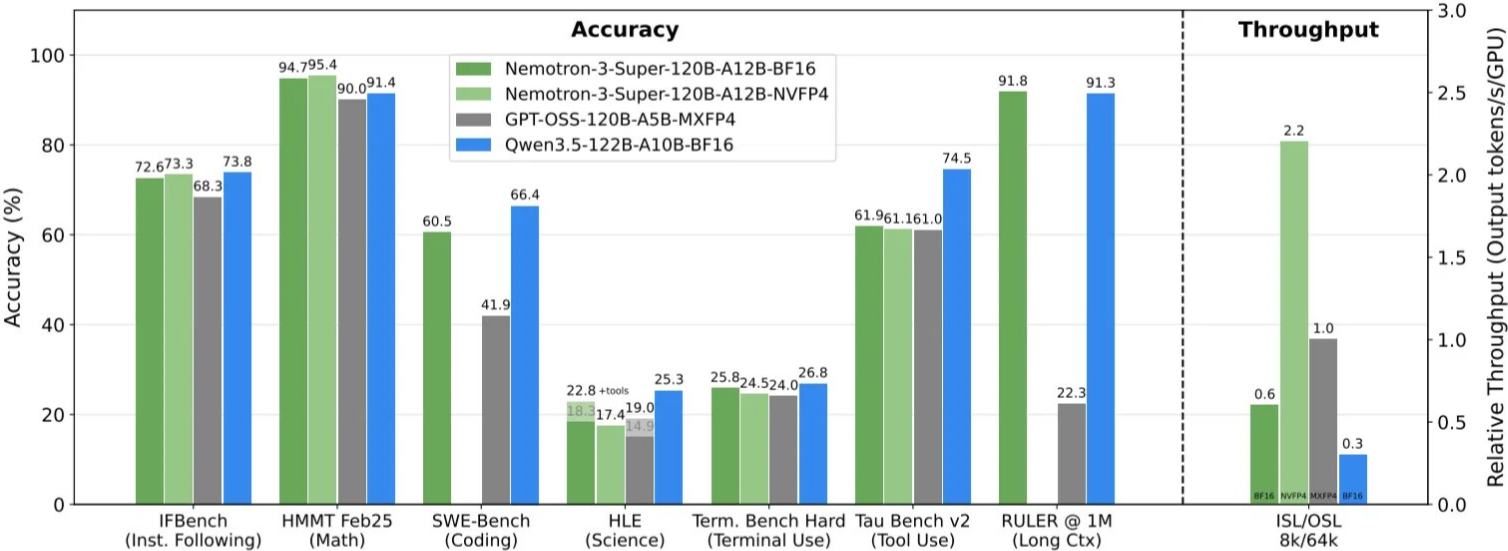
Core Insights - Nvidia has launched the Nemotron 3 Super, an open-source model designed for large-scale AI agents, aiming to transition from a chip supplier to a comprehensive AI ecosystem provider [1][10] - The model boasts significant performance improvements, including over three times the inference performance and up to five times the throughput compared to its predecessor [2][11] - Nvidia's strategy positions it as an AI infrastructure contractor, integrating hardware and software to support complex AI workflows [8][12] Group 1: Model Features and Performance - The Nemotron 3 Super features a mixed expert model architecture with 120 billion parameters, activating only 12 billion during inference, and supports a context window of up to 1 million tokens [3][5] - In benchmark tests, the model achieved an 85.6% success rate in OpenClaw tasks, closely competing with proprietary models like Claude Opus 4.6 and GPT-5.4 [1][10] - The model's design focuses on reducing activation costs and improving throughput, making it suitable for multi-agent workflows and complex task execution [4][11] Group 2: Industry Impact and Adoption - Major companies such as Palantir, Amdocs, and Siemens are actively deploying and customizing the Nemotron 3 Super for various applications, including telecommunications and cybersecurity [3][9] - The upcoming GTC 2026 conference is expected to showcase Nvidia's advancements in AI technology, reinforcing its market position amid concerns about competition [9][14] - Analysts are increasingly optimistic about Nvidia's stock, with expectations of significant price increases driven by the success of the Nemotron 3 Super and the company's shift towards a full-stack AI platform [12][14] Group 3: Market Trends and Future Projections - The demand for AI computing power is projected to grow significantly, with major tech companies expected to invest around $650 billion to $700 billion in AI infrastructure by 2026 [18] - Nvidia's competitive edge is strengthened by its AI GPU and CUDA ecosystem, which is becoming more integral to its overall business strategy [10][11] - The anticipated growth in AI workloads is expected to drive substantial increases in Nvidia's product sales, particularly among hyperscalers [14][17]
从“看不懂”到“下重注”,段永平投了3家AI新秀
阿尔法工场研究院· 2026-03-12 11:34
Core Viewpoint - The article discusses the recent investment activities of Duan Yongping, highlighting his significant shift towards AI companies and his aggressive increase in holdings of Nvidia, indicating a strong belief in the AI sector's potential [2][10]. Investment Activities - Duan Yongping's fund has newly invested in three AI companies: CoreWeave, Credo, and Tempus AI, which collectively represent only 0.28% of his total holdings, approximately 340 million RMB [4]. - His investment in Nvidia saw a dramatic increase from 0.7% to 7.72%, an increase of 1110%, making it the third-largest position in his portfolio, valued at around 9.5 billion RMB [4]. - He also increased his holdings in TSMC and made a small purchase of Google shares, indicating a strategic focus on AI-related investments [4]. Company Insights - **CoreWeave**: This company specializes in GPU computing power rental, initially focused on cryptocurrency mining before pivoting to AI. It has a high debt load and relies heavily on Microsoft for revenue, which constitutes 67% of its income [6][8]. - **Credo**: Known for its high-speed connectivity solutions in data centers, Credo's products, such as its active electrical cables, are critical for data transfer. The company recently became profitable and has seen its market value increase significantly [7][8]. - **Tempus AI**: This company operates in AI-driven precision medicine, utilizing genetic data to create AI diagnostic models. It has a high gross margin of 75% and serves 19 of the top 20 pharmaceutical companies globally [8]. Investment Philosophy - Duan Yongping's investment strategy reflects a deep understanding of the AI sector, transitioning from skepticism to a strong belief in its transformative potential. His approach emphasizes the importance of understanding the companies before investing, aligning with his philosophy of "not investing in what one does not understand" [10][11].



北交所半月报:北交所公司业绩快报全部发布,北证50公布新一轮调整方案-20260312
ZHONGTAI SECURITIES· 2026-03-12 11:29
Investment Rating - The industry investment rating is maintained at "Overweight" [2][33] Core Insights - The report highlights that as of March 1, 2026, the average market capitalization of the 296 constituent stocks in the North Exchange is 3.184 billion yuan, with the North 50 index, Shanghai and Shenzhen 300, ChiNext, and Sci-Tech 50 showing respective changes of +0.48%, +1.08%, +1.05%, and +1.20% during the reporting period [6][12] - The top five performing sectors in the North Exchange during this period are Oil and Petrochemicals (+21.79%), Environmental Protection (+7.97%), Transportation (+6.08%), Building Materials (+3.68%), and Nonferrous Metals (+3.13%) [21] - A total of 295 stocks were listed on the North Exchange, with 193 stocks rising, 96 falling, and 6 remaining flat, resulting in a rise ratio of 66.78% [23] Summary by Sections North Exchange Market Overview - As of March 1, 2026, the North Exchange has 296 constituent stocks with an average market capitalization of 3.184 billion yuan. The performance of major indices during the period from February 16 to March 1, 2026, is as follows: North 50 (+0.48%), Shanghai and Shenzhen 300 (+1.08%), ChiNext (+1.05%), and Sci-Tech 50 (+1.20%) [6][12] - The average daily trading volume for North A-shares during this period was 18 billion yuan, a decrease of 8.06% from the previous period [16] New Stocks on the North Exchange - Two new stocks were issued during this period: Haifeiman (920183) and Mirui Technology (920036) [27] Key News from the North Exchange - By February 27, 2026, all 295 companies on the North Exchange had released their 2025 annual performance reports. Of these, 187 companies achieved positive revenue growth, accounting for approximately 63%, with 29 companies experiencing revenue growth exceeding 30%. Additionally, 140 companies reported positive growth or reduced losses in net profit attributable to the parent company, representing about 47% [31] - The new adjustment plan for the North 50 index was announced, with companies such as Guangxin Technology, Tiangong Co., and Jikang Technology being added, effective from March 16 [31] Investment Strategy for the North Exchange - The report expresses optimism for the high-quality development of the North Exchange in 2026, suggesting a focus on sectors such as Data Centers, Robotics, Semiconductors, Consumer Goods, and Military Information Technology [29][32]