
债券

Search documents
两只“黑天鹅”,突袭
Zheng Quan Shi Bao· 2025-11-18 06:51
Group 1: Market Overview - Global market sentiment has rapidly deteriorated, with significant declines across major indices including a drop of over 3% in the Nikkei 225 and more than 2% in the MSCI Asia-Pacific index [1] - The cryptocurrency market has also been severely impacted, with Bitcoin falling below $90,000 and Ethereum dropping below $3,000 [1] Group 2: U.S. Interest Rate Expectations - Market expectations have shifted from anticipating no rate cuts in December to a belief that there will be no cuts in the first half of next year, influenced by internal disagreements within the Federal Open Market Committee (FOMC) [3] - The likelihood of a rate cut in December is now estimated at 50%, with inflation risks remaining a primary concern for the Federal Reserve [3] Group 3: Japan's Economic Impact - Japan's 10-year government bond yield has surged above 1.75%, nearing its highest level since 2008, due to expectations of a large-scale fiscal stimulus plan from Prime Minister Fumio Kishida [5][7] - Kishida's proposed stimulus plan could exceed 17 trillion yen, raising concerns about Japan's already high public debt levels [7] - Japan's economy contracted by 1.8% in the third quarter, marking its first negative growth in six quarters, primarily due to a decline in exports influenced by U.S. tariffs [7] Group 4: Global Liquidity Concerns - The rise in Japanese government bond yields is closely linked to global liquidity, affecting capital flows and potentially leading to increased global borrowing costs [8] - Analysts warn that sustained increases in Japanese bond yields could lead to a "global financial apocalypse," tightening liquidity and dragging global growth down to 1% [8]


科创债ETF国泰(551880)盘中飘红,近20日资金净流入超3.3亿元,关注平衡风险与收益的优质配置选择
Mei Ri Jing Ji Xin Wen· 2025-11-18 06:48
科创债ETF国泰(551880)盘中飘红,近20日资金净流入超3.3亿元。 当前,科创债市场正在加速发展中,风险共担工具、拓宽发债主体、减免费用、鼓励挂钩产品等支持性 政策,有望进一步强化债券市场服务科技创新需求力度。一方面,政策鼓励支持中长期资金加大对科创 债及科创债产品的配置,并且相比普债,科创债久期更长,与保险等长期资金的久期需求更加匹配,科 创债增量资金可期;另一方面,政策支持使得科创债估值天然比普债高,信用利差压缩的潜在空间仍 在。 科创债凸显独特投资价值。科创债ETF(551880)既能凭借高等级信用债底色抵御债市短期波动,又能 依托政策持续加码的红利,为投资者分享科技创新领域长期发展机遇,成为平衡风险与收益的优质配置 选择。 (文章来源:每日经济新闻) ...
金戈铁马入梦来,国债ETF5至10年(511020)做您债市进攻锋利的矛
Sou Hu Cai Jing· 2025-11-18 01:55
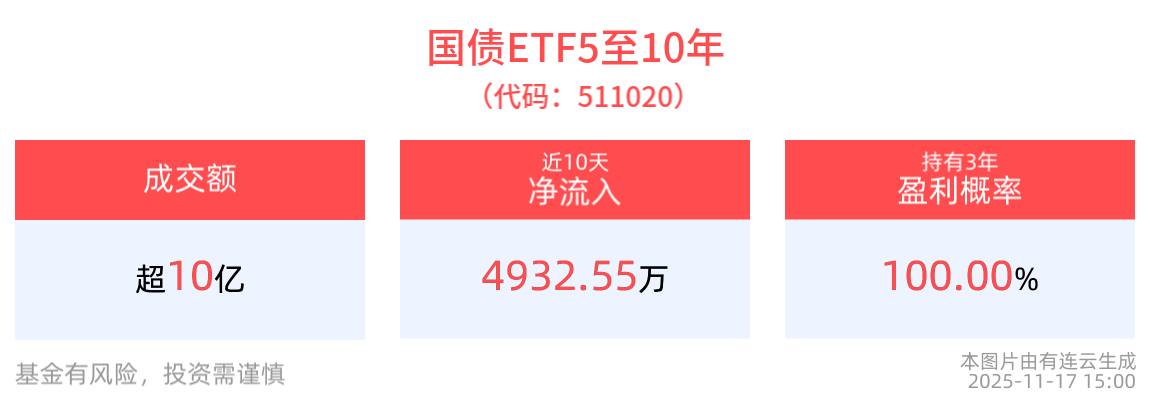
Group 1 - The article emphasizes the importance of focusing on the opportunity of the National Development Bank (NDB) and government bond yield spread compression, suggesting more active bond selections [1] - Floating rate bonds are considered relatively expensive overall, while the LPR floating rate bond 25 Agricultural Development 09 is viewed as reasonably valued [1] - In the credit bond sector, the 3-5 year duration of the "Er Yong" bond is recognized by investors for its combination of coupon and trading value, contingent on stable spreads between subordinated capital bonds and NDB bonds, as well as stable interest rates gradually compressing against government bonds [1] Group 2 - As of November 17, 2025, the 5-10 year government bond active bond index (net price) increased by 0.02%, while the government bond ETF for the same duration rose by 0.05%, with a latest price of 117.45 yuan [3] - The trading volume for the government bond ETF was active, with a turnover rate of 64.82% and a transaction value of 1.073 billion yuan, averaging 1.127 billion yuan in daily transactions over the past month [3] - The latest scale of the government bond ETF reached 1.656 billion yuan, with net inflows and outflows remaining balanced, totaling 49.3255 million yuan in the last 10 trading days [3] Group 3 - The government bond ETF has shown a net value increase of 22.13% over the past five years, ranking 30 out of 181 in the index bond fund category, placing it in the top 16.57% [3] - The fund's highest single-month return since inception was 2.58%, with the longest consecutive monthly gains reaching 10 months and a maximum increase of 5.81% [3] - The historical probability of profit over three years stands at 100%, with a monthly profit probability of 71.08% [3] Group 4 - The maximum drawdown for the government bond ETF over the past six months was 1.09%, with a relative benchmark drawdown of 0.46% [4] - The management fee for the government bond ETF is set at 0.15%, while the custody fee is 0.05% [4] - The tracking error for the government bond ETF over the past two months was 0.023%, closely tracking the 5-10 year government bond active bond index [4]
晨会纪要:2025年第196期-20251118
Guohai Securities· 2025-11-18 01:39
Group 1: Bond Market Insights - The bond market has shown overall stability with slight tightening of funds, characterized by major banks continuing to buy short-term bonds, indicating a stable outlook for short-term rates [4][5]. - Securities firms have begun to close positions on government bonds, with borrowing volumes at a low point, suggesting a cautious approach as the year-end approaches [4][5]. - Public funds are primarily investing in credit bonds, although the volume has decreased, indicating a preference for short-term investments [4][5]. Group 2: Semiconductor Material Substitution Opportunities - The tension in Sino-Japanese relations is expected to accelerate the domestic substitution of Japanese semiconductor materials, as Japan holds a significant market share while domestic production rates are low [6][8]. - Key sectors for potential investment include photoresists, wet electronic chemicals, electronic gases, masks, CMP polishing liquids, and sputtering targets, with specific companies identified for each category [8][9]. Group 3: Chemical Industry Outlook - The Chinese chemical industry is poised for a revaluation due to the anticipated slowdown in global capacity expansion, which could enhance cash flow and dividend yields for leading companies [9][10]. - The chromium salt industry is experiencing a value reassessment driven by increased demand from AI data centers and commercial aircraft engines, with significant price increases noted [9][10]. - Key opportunities in the chemical sector include low-cost expansion, improved industry conditions, new materials, and high dividend yields from state-owned enterprises [10][11][12]. Group 4: AI Computing and Infrastructure - Major cloud service providers (CSPs) are increasing capital expenditures significantly for AI infrastructure, with Google raising its 2025 capital expenditure guidance to $91-93 billion [36][37]. - OpenAI has secured substantial computing power agreements with major chip manufacturers, indicating a strong demand for AI capabilities [37][38]. - The trend towards "super nodes" in AI infrastructure is gaining consensus, with various companies announcing advancements in their super node products [39][40]. Group 5: Tencent Music Performance - Tencent Music reported a 20.6% year-over-year increase in revenue for Q3 2025, driven by an increase in ARPPU, which boosted online music subscription income [52][53]. - The company achieved a significant increase in non-subscription revenue, particularly from live performances and artist-related products, indicating diversification in income sources [54][55]. - Future revenue projections suggest continued growth, with expectations for revenue to reach approximately 329.79 billion yuan by 2025 [55].
大类资产早报-20251118
Yong An Qi Huo· 2025-11-18 01:38
Global Asset Market Performance - On November 17, 2025, the 10 - year treasury bond yields of major economies varied, with the US at 4.140%, UK at 4.534%, etc. The latest changes, weekly, monthly, and yearly changes also differed among countries. For example, the US 10 - year treasury bond yield had a latest change of - 0.009, a weekly change of 0.023, a monthly change of 0.159, and a yearly change of - 0.188 [3] - The 2 - year treasury bond yields also showed different trends. For instance, China (1Y) was 3.580% on November 17, 2025, with corresponding changes over different time periods [3] - The exchange rates of the US dollar against major emerging economies' currencies had various changes. For example, against the South African zar, the latest change was 0.58%, and the yearly change was - 6.37% [3] - The performance of major economies' stock indices on November 17, 2025, showed declines in most cases. For example, the Dow Jones had a latest change of - 0.92%, and a weekly change of - 2.34% [3] - The credit bond indices of different types (emerging economies' investment - grade, high - yield, etc.) had different values and changes on November 17, 2025. For example, the emerging economies' investment - grade credit bond index was 3516.030, with a latest change of 0.05% [3] Stock Index Futures Trading Data - On November 17, 2025, the closing prices of A - shares, CSI 300, SSE 50, ChiNext, and CSI 500 were 3972.03, 4598.05, 3012.07, 3105.20, and 7235.35 respectively, with corresponding percentage changes [4] - The PE (TTM) values of CSI 300, SSE 50, CSI 500, S&P 500, and German DAX were 14.14, 11.93, 32.98, 27.74, and 18.30 respectively, with环比 changes [4] - The risk premiums and their环比 changes of S&P 500 and German DAX were - 0.54 and 2.75 respectively, with环比 changes of 0.04 and 0.07 [4] - The latest values and 5 - day average values of capital flows in A - shares, main boards, etc., showed different trends. For example, the latest value of A - share capital flow was - 543.55, and the 5 - day average was - 629.80 [4] - The latest trading volumes and环比 changes of Shanghai and Shenzhen stock markets, CSI 300, etc., were provided. For example, the latest trading volume of Shanghai and Shenzhen stock markets was 19107.91, with a环比 change of - 472.88 [4] - The basis and amplitude of the main contracts of stock index futures (IF, IH, IC) were - 16.65, - 2.87, - 91.95 and - 0.36%, - 0.10%, - 1.27% respectively [4] Treasury Bond Futures Trading Data - On November 17, 2025, the closing prices of treasury bond futures T00, TF00, T01, TF01 were 108.485, 105.905, 108.240, 105.885 respectively, with no percentage changes [5] - The capital interest rates (R001, R007, SHIBOR - 3M) were 1.5596%, 1.5321%, 1.5800% respectively, with daily changes (BP) of 7.00, 4.00, 0.00 [5]
固收:年内债券投资思路
2025-11-18 01:15
Summary of Conference Call on Bond Investment Strategy Industry Overview - The focus is on the bond investment strategy for the year, particularly in the context of low interest rate expectations and limited downward space for both long-term (10-year government bonds) and short-term (1-year time deposits) rates [1][2][3]. Key Points and Arguments 1. **Interest Rate Expectations**: The current market has low expectations for interest rate cuts in the short term, which limits the downward movement of both long and short-term interest rates [2][3]. 2. **Investment Strategy for Year-End**: Investors should focus on institutional allocation intentions and the performance of the equity market. An increase in institutional allocation may compress the spread between government bonds and policy bank bonds [1][3]. 3. **Credit Bonds vs. Government Bonds**: The spread between credit bonds and policy bank bonds is thin, while the spread between credit bonds and government bonds is wider. Short-term credit bonds are positioned low, but there is still room for three to five-year credit bonds [4][5]. 4. **Monetary Policy Outlook**: The monetary policy is expected to maintain a loose growth-oriented approach next year, with limited impact from the current tightening of liquidity. The probability of easing measures this year is low, but the central bank may prepare for policy easing in Q1 next year [6][7]. 5. **Portfolio Construction**: For absolute return portfolios, a defensive stance with slightly lower duration is recommended, while relative return portfolios should seize opportunities such as the compression of spreads between policy bank bonds and government bonds [7][8]. 6. **Short-term vs. Long-term Strategies**: For short-term trading, focus on mid-term policy bank bonds due to clear returns. For long-term holding, consider 10-year secondary capital bonds, but be aware of their weaker liquidity [8][9]. 7. **Spread Compression Opportunities**: There are notable opportunities for spread compression between policy bank bonds and government bonds, which investors should monitor for potential profits [10][11]. 8. **Selection of Policy Bank Bonds**: Investors are advised to choose the main bond 215 over the new bond 220 for 10-year policy bank bonds due to liquidity considerations [11]. 9. **Changes in Investment Strategy**: Recent recommendations have shifted towards a more cautious approach as the year-end approaches, adjusting portfolios to mitigate risks associated with potential market volatility [14]. Other Important Considerations - The impact of new redemption regulations and changes in fund buying power for policy bank bonds should be closely monitored, as these factors will influence market trends at year-end and into next year [6][7]. - The use of hedging strategies, such as constructing combinations of 5-year secondary capital bonds with futures, can help mitigate risks and enhance returns [13].
【金工】医药主题基金表现占优,TMT、科创主题ETF受被动资金加仓——基金市场与ESG产品周报20251117(祁嫣然/马元心)
光大证券研究· 2025-11-17 23:03
Market Overview - In the week from November 10 to November 14, 2025, gold prices increased while domestic equity market indices collectively retreated. The comprehensive, textile and apparel, and retail trade sectors saw the highest gains, while the communication, electronics, and computer sectors experienced the largest declines [4]. Fund Issuance - A total of 25 new funds were established in the domestic market this week, with a combined issuance of 14.173 billion units. This included 14 equity funds, 4 FOF funds, 4 mixed funds, and 3 bond funds. Overall, 41 new funds were issued across the market, comprising 23 equity funds, 8 mixed funds, 5 FOF funds, 4 bond funds, and 1 REIT [5]. Fund Performance Tracking - The performance of long-term thematic funds showed that the pharmaceutical theme funds performed best with a gain of 4.69%, while TMT theme funds saw a significant decline of 4.42%. Other thematic fund performances included cyclical (2.00%), consumer (1.68%), financial real estate (0.77%), new energy (-0.43%), industry rotation (-0.68%), industry balance (-1.24%), and national defense and military industry (-1.95%) [6]. ETF Market Tracking - This week, various ETFs saw inflows, particularly TMT and Sci-Tech themed ETFs, driven by passive fund accumulation. The median return for equity ETFs was -1.08% with a net inflow of 11.729 billion yuan. Hong Kong stock ETFs had a median return of 1.32% and a net inflow of 8.432 billion yuan. Commodity ETFs, represented by gold ETFs, had a median return of 3.26% with a net inflow of 5.957 billion yuan [7]. Fund Position Monitoring - The estimated position of actively managed equity funds decreased by 0.19 percentage points compared to the previous week. In terms of sector allocation, funds increased their positions in electronics, home appliances, and automobiles, while reducing their holdings in computers, non-bank financials, and banks [8]. ESG Financial Products Tracking - This week, 30 new green bonds were issued, totaling 64.801 billion yuan. The domestic green bond market has steadily developed, with a cumulative issuance of 5.02 trillion yuan and 4,297 bonds issued as of November 14, 2025. The median net value change for active equity, passive index equity, and bond ESG funds was -1.67%, -1.13%, and +0.04%, respectively. High-quality governance, ecology, and ESG-themed funds showed significantly better performance [9].

“新债王”Gundlach:1.7万亿美元市场正充斥“垃圾放贷”,恐成下一个“金融雷区”
Hua Er Jie Jian Wen· 2025-11-17 17:30
作为资深债券投资者,Gundlach特别担心私人信用基金向散户投资者的扩张,称其创造了流动性承诺与 非流动性资产之间的"完美错配"。他预测:"下一次金融市场的重大危机将来自私人信用,它具有与 2006年次贷抵押贷款重新包装相同的特征。" 贝莱德最近决定,其向陷入困境的家装公司Renovo Home Partners提供的贷款价值从一个月前的票面价 值直接减记至零,成为Gundlach新近警告一个例证。 私人信用市场风险堆积 有新"债券之王"之称的DoubleLine Capital创始人Jeffrey Gundlach警告称,美股处于其职业生涯中"最不 健康"状态之一,并将私人信用市场的"垃圾放贷"比作2006年次贷危机前夕的投机行为。他建议投资者 持有20%的现金头寸,对冲即将到来的市场崩盘。 Gundlach在最近的媒体播客中表示,1.7万亿美元的私人信用市场正在进行"垃圾放贷",可能引发全球市 场下一轮崩盘。他认为当前股市"极其投机",认为投资者应避免在人工智能(AI)和数据中心领域进 行"极其投机性"的押注。 Gundlach认为,美股当前的状况"是我整个职业生涯中最不健康的(状况)之一"。他看到最明 ...
美债骗局落幕?38 万亿还不起本金,中国美元债成资本“避风港”
Sou Hu Cai Jing· 2025-11-17 15:40
Core Viewpoint - The issuance of China's $4 billion sovereign bonds in Hong Kong on November 5, with a subscription rate of 30 times, marks a significant event in the ongoing financial competition between China and the U.S., reflecting a reordering of global capital towards sovereign credit [2][3]. Group 1: Investor Behavior - The overwhelming demand for Chinese dollar bonds, with total subscriptions reaching $118.2 billion, indicates a strong pursuit of asset safety by professional investment institutions, including central banks and sovereign funds [3]. - The choice of Chinese bonds over U.S. Treasuries highlights a rational decision-making process focused on optimal risk-reward scenarios [3]. Group 2: U.S. Debt Situation - The current U.S. national debt has surpassed $38 trillion, with annual expenditures of $6 trillion against revenues of only $4 trillion, leading to a $2 trillion annual deficit that is sustained through borrowing [5]. - Interest payments on U.S. debt are projected to exceed $1.1 trillion in 2024, surpassing military spending and becoming the largest fiscal burden [5]. - Moody's has downgraded the U.S. sovereign credit rating to AA1 by 2025, undermining its last AAA credit status [5]. Group 3: Comparison of Sovereign Credits - China's sovereign credit is supported by a zero-default record, over $400 billion in annual trade surplus, and $3 trillion in foreign exchange reserves, making its dollar bonds attractive despite slightly higher interest rates compared to U.S. Treasuries [7]. - The contrast between the U.S. debt situation and China's financial strength indicates a shift in global capital preferences towards more stable and reliable assets [10]. Group 4: Strategic Implications - The issuance of Chinese dollar bonds is not merely a competitive move against the U.S. but a strategic step towards restructuring the global financial system, with the high subscription rate serving as a global endorsement of Chinese credit [15]. - This endorsement will benefit Chinese enterprises by allowing them to issue dollar bonds at lower financing costs, effectively creating a "credit passport" for them [15]. - The approach taken by China respects the existing international monetary system while gradually diluting the dominance of the U.S. dollar through market-driven credit order reconstruction [15][19]. Group 5: Global Development Impact - Funds raised from the issuance of Chinese dollar bonds will support infrastructure cooperation under the Belt and Road Initiative, aiming to liberate the dollar from U.S. debt games and genuinely serve global development [19]. - The contrast between China's financial contributions to global infrastructure and the G7's unfulfilled promises highlights different developmental pathways [20]. Group 6: Future Outlook - The scale of China's dollar bond issuance is expected to gradually increase, with a commitment to maintaining credit integrity and prudent financial practices, positioning China as a stabilizing force in the global financial market [22].

信用债市场周观察:票息策略优于久期策略
Orient Securities· 2025-11-17 15:39
1. Report Industry Investment Rating - No industry investment rating information is provided in the report. 2. Core Viewpoints of the Report - The current strategy for credit bonds is to focus on coupon hunting, which is superior to the duration strategy. The main areas for exploration include medium - and low - quality urban investment bonds and some entities with a large convexity in the yield curve [5][8]. 3. Summary According to the Table of Contents 3.1 Credit Bond Weekly Viewpoint - The bond market was dull last week, lacking a trading theme. Credit bonds showed a hesitant performance, and the previous downward trend in yields paused. Looking ahead, positive factors for credit bonds include the concentrated opening period of amortized - cost - based open - end bond funds, stable liquidity, and the approaching time for year - end allocation to build coupon positions for the next year. Negative factors include the halt of the rapid decline in yields, a continuous drop in turnover rate, the uncertainty of the public - offering fee regulation, and potential disturbances from the stock market [5][8]. 3.2 Credit Bond Weekly Review 3.2.1 Negative Information Monitoring - There were no cases of bond defaults and overdue, no enterprises with their main ratings or outlooks downgraded, and no bonds with their debt ratings lowered from November 10 to November 16, 2025. However, several companies had significant negative events, such as Shaanxi Tourism Group Co., Ltd. receiving a warning from the inter - bank market, and many companies facing issues like debt defaults, regulatory warnings, and restrictions on high - consumption of their legal representatives [11][12]. 3.2.2 Primary Issuance - Issuance volume remained high, but the maturity volume increased significantly, leading to a reduction in net financing. From November 10 to November 16, credit bond primary issuance was 269.9 billion yuan, a 7% decrease from the previous period. The total repayment amount rose to 238.5 billion yuan, resulting in a net inflow of 31.4 billion yuan. The cost of primary issuance continued to narrow slightly, with the AA + level showing a more significant reduction. The average coupon rates for AAA and AA + were 2.10% and 2.15% respectively, with the former increasing by 1bp and the latter decreasing by 11bp [12][13]. 3.2.3 Secondary Trading - The valuations of credit bonds with various ratings and tenors fluctuated within a narrow range. Only low - grade and long - term bonds showed a slight narrowing. Credit spreads remained flat in the short term and widened passively in the medium - and long - term. The turnover rate continued to decline, dropping 0.18 percentage points to 1.69%. The spreads of most industries widened by 1bp, while the real - estate industry's spreads narrowed by 2bp. Among real - estate enterprises, the spreads of Times Holdings, Rongqiao, Vanke, and Yuzhou Hongtu widened the most [5][17][24].