
天然气

Search documents
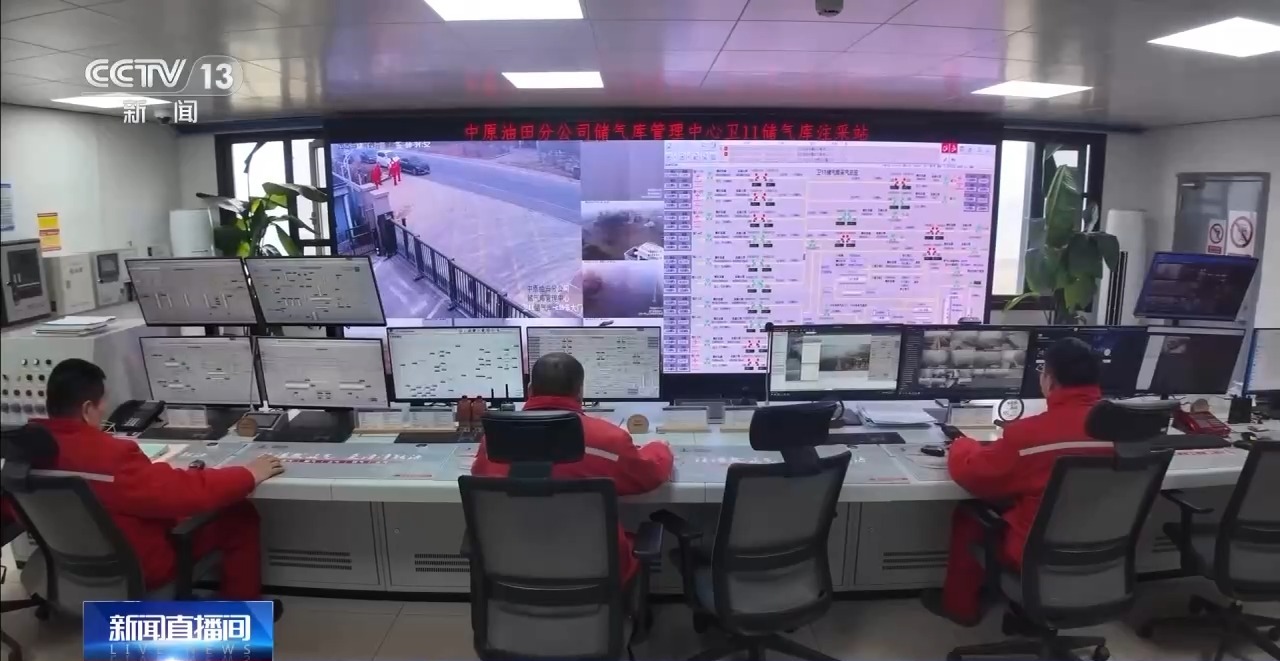
中原油田储气库群今冬供气已超1亿立方米
Xin Lang Cai Jing· 2025-12-20 09:50
Core Points - The article highlights the critical phase of natural gas supply assurance in China, particularly focusing on the Zhongyuan Oilfield gas storage facilities in North China, which have supplied over 100 million cubic meters of natural gas for the winter heating season as of December 18 [1] - The Zhongyuan Oilfield gas storage facilities consist of five underground gas storage sites with a total capacity exceeding 3.196 billion cubic meters, playing a vital role in the natural gas peak-shaving system in North China [1] - Since December, the gas storage facilities have entered the gas extraction phase, with peak daily gas extraction reaching 6.5 million cubic meters through the gas pipeline network [1] Group 1 - The Zhongyuan Oilfield gas storage facilities are crucial for ensuring natural gas supply during peak demand periods [1] - The management team is actively monitoring and controlling equipment conditions to ensure reliable gas supply for residents in Beijing, Tianjin, and Xiong'an New Area during the winter [3]

11月我国规上工业发电量同比增长2.7%,天然气产量同比增长5.7%
Xinda Securities· 2025-12-20 07:12
Investment Rating - The investment rating for the utility sector is "Positive" [2] Core Insights - In November, the industrial power generation in China increased by 2.7% year-on-year, while natural gas production rose by 5.7% year-on-year [4] - The report indicates a potential for profit improvement and value reassessment in the power sector due to previous supply-demand tensions [4] - The ongoing market reforms in electricity pricing are expected to lead to a slight increase in electricity prices, benefiting power operators [4] Summary by Sections Market Performance - As of December 19, the utility sector declined by 0.6%, underperforming the broader market [11] - The electricity sector fell by 0.66%, while the gas sector saw a slight increase of 0.11% [12] Electricity Industry Data Tracking - The price of thermal coal at Qinhuangdao Port (Q5500) was 711 CNY/ton as of December 19, down 42 CNY/ton week-on-week [20] - Coal inventory at Qinhuangdao Port decreased to 7.28 million tons, a decline of 20,000 tons week-on-week [26] - The average daily coal consumption for inland power plants was 3.758 million tons, down 166,000 tons/day week-on-week [29] Natural Gas Industry Data Tracking - The LNG ex-factory price index in China was 4,075 CNY/ton as of December 18, down 10.91% year-on-year [55] - Domestic natural gas apparent consumption in October was 34.77 billion cubic meters, a decrease of 1.6% year-on-year [4] - In November, LNG imports reached 6.94 million tons, an increase of 12.8% year-on-year [4] Key Industry News - The report highlights that the industrial power generation maintained growth, with November's output at 779.2 billion kWh, a 2.7% increase year-on-year [4] - The natural gas production in November was 21.9 billion cubic meters, reflecting a stable growth trend [4] Investment Recommendations - For the electricity sector, it is suggested to focus on leading coal power companies such as Guodian Power, Huaneng International, and Huadian International [4] - In the natural gas sector, companies with low-cost long-term gas sources and receiving station assets are recommended, such as Xin'ao Co. and Guanghui Energy [4]
新奥天然气股份有限公司 关于控股子公司开展资产支持专项计划 并获得深圳证券交易所无异议函的自愿性公告
Zhong Guo Zheng Quan Bao - Zhong Zheng Wang· 2025-12-20 06:37
Group 1 - The company plans to issue an asset-backed special plan using distributed photovoltaic power generation projects and energy storage projects as underlying assets, managed by CITIC Securities and Huatai Asset Management, with a total fundraising scale not exceeding 4 billion yuan [1][6] - The first phase of the issuance is expected to be 608 million yuan, with the specific issuance details to be confirmed in the final materials [1][6] - The asset-backed special plan aims to optimize the asset and financing structure, promote overall business development, and enhance the company's sustainability [2] Group 2 - The underlying assets consist of various distributed photovoltaic power generation projects and energy storage projects held by the company's subsidiary [6] - The repayment source for the asset-backed special plan will be the cash flow generated from the underlying assets [6] - The plan has received a no-objection letter from the Shenzhen Stock Exchange, confirming its compliance with listing requirements [1]

欧洲各国为什么不断砸钱援助乌克兰?真相很残酷:这绝不是慈善,是为了保命!
Sou Hu Cai Jing· 2025-12-20 05:15
不知道你有没有注意到,最近欧洲各国在对待乌克兰问题上的态度,发生了一种微妙且坚定的变化。从 最初的犹豫不决、支持有限,到如今几乎倾尽全力,调动库存并咬牙增援远程导弹和防空系统,甚至公 开讨论派兵进行军事培训。这种几乎拼命的姿态,背后真的是单纯出于道德和同情心吗?如果你把欧洲 的地图摊开,再结合他们近期的内政动向,你会发现一个更加冷酷的核心逻辑:欧洲之所以这么拼,是 因为他们深刻意识到,一旦乌克兰的火炮不再轰鸣,下一个在恐惧中颤抖的,可能就是他们自己。这不 仅仅是危言耸听,更是一场基于历史教训和现实威胁的冷酷地缘政治算计。 结语:一场基于恐惧的投资,终点在哪里? 归根结底,欧洲对乌克兰的全力支持,背后的驱动力核心 并非单纯的英雄主义或道德情怀,而是一种深深植根于生存恐惧中的理性计算。他们提供弹药,但更是 在为自己的安全、经济独立和政治稳定购买保险。这揭示了一个残酷的国际关系现实:当生存焦虑压倒 一切时,盟友之间的支持往往会变得异常务实且持久,因为这种支持本质上已经是一种自救。#热点观 察家#然而,最大的问题依然悬而未决:这笔保命钱要交到何时?欧洲的财政和民众的耐心并非无限。 这场以恐惧为动力的援助马拉松,终点线 ...

“迎峰度冬保供应”系列报道 数字技术赋能保供 各地筑牢群众温暖防线
Ren Min Wang· 2025-12-20 05:07
Core Viewpoint - The article emphasizes the importance of ensuring energy supply during the winter season, highlighting various measures taken across regions to secure energy resources and maintain stable supply for residents' heating needs [1][5]. Group 1: Energy Supply Measures - Various regions are increasing energy reserves, improving transportation lines, and enhancing adjustment capabilities to ensure energy supply during the winter [1]. - The total installed power generation capacity in the country reached 3.75 billion kilowatts by the end of October, an increase of 560 million kilowatts compared to the same period last year [1]. - As of November 26, the national regulated power plants had over 230 million tons of coal available, sufficient for approximately 35 days of use [1]. Group 2: Technological Innovations - In Shandong, the "Warm Nuclear No. 1" project utilizes a "dual-machine series large temperature difference" heating technology, which has saved approximately 1.29 million tons of raw coal and reduced carbon dioxide emissions by 2.36 million tons over six heating seasons [2]. - The natural gas surplus pressure power generation project in Jiangsu converts excess pressure from gas pipelines into mechanical energy, generating about 3 million kilowatt-hours of clean electricity annually, equivalent to reducing over 2,000 tons of carbon dioxide emissions [2]. Group 3: Preparedness for Winter Weather - Energy companies are conducting preemptive maintenance and developing emergency plans to ensure the safe and stable operation of equipment during winter cold waves [3]. - In Henan, a solar power station is monitoring environmental conditions to optimize energy production and ensure reliability during peak demand periods [3]. - A Beijing power supply company has implemented a comprehensive safety inspection system for heating electricity, including proactive household visits to identify potential hazards [3]. Group 4: Future Energy Demand and Recommendations - Experts predict that this year's heating season will experience longer durations and higher peak energy demands, potentially setting historical records for maximum electricity load and peak gas consumption [4]. - Recommendations include supporting coal and oil companies to expand resource reserves and encouraging the construction of green and intelligent energy facilities to enhance production capacity [4].
2025年1-10月中国液化天然气产量为2402.5万吨 累计增长15.4%
Chan Ye Xin Xi Wang· 2025-12-20 02:45
2020-2025年1-10月中国液化天然气产量统计图 数据来源:国家统计局,智研咨询整理 根据国家统计局数据显示:2025年10月中国液化天然气产量为264万吨,同比增长1.1%;2025年1-10月 中国液化天然气累计产量为2402.5万吨,累计增长15.4%。 上市企业:中国石油(601857),中国石化(600028),广汇能源(600256),新奥股份(600803),申能股 份(600642),深圳燃气(601139),重庆燃气(600917) 相关报告:智研咨询发布的《2026-2032年中国液化天然气(LNG) 行业市场调查研究及发展前景规划报 告》 知前沿,问智研。智研咨询是中国一流产业咨询机构,十数年持续深耕产业研究领域,提供深度产业研 究报告、商业计划书、可行性研究报告及定制服务等一站式产业咨询服务。专业的角度、品质化的服 务、敏锐的市场洞察力,专注于提供完善的产业解决方案,为您的投资决策赋能。 ...

升顶成功!实现毫米级精准就位
中国能源报· 2025-12-20 02:38
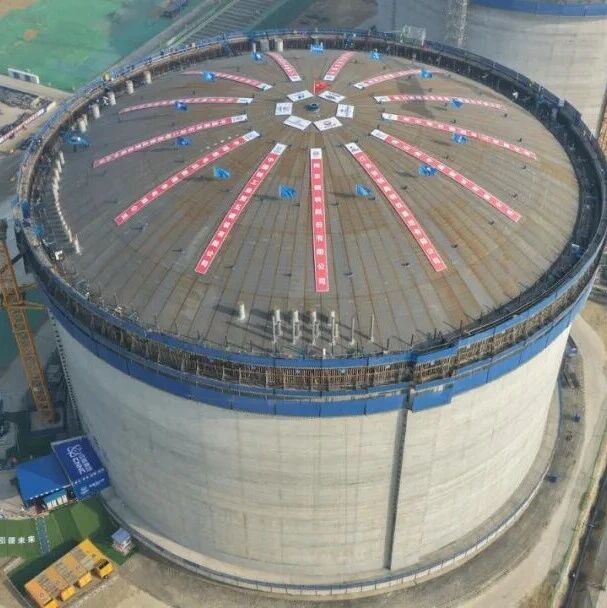
顶升作业也称升顶,是LNG储罐建设中工艺最复杂、操控难度最大的环节。其原理类似 吹气球,4台大功率专用风机持续输出稳定气流, 将近千吨的"钢帽子"稳稳戴到50余米 高的储罐顶部,实现毫米级精准就位。 升顶成功,"一口气"吹起千吨"钢帽"。 12 月 19 日 , 国 家 天 然 气 基 础 设 施 互 联 互 通 重 点 工 程 、 全 国 首 家 由 电 力 央 企 介 入 的 LNG (液化天然气)接收站项目—— 江苏华电赣榆LNG接收站首座储罐气压顶升作业圆满完 成。 项目规划建设3座22万立方米LNG储罐。项目投产后,每年将外输天然气42亿立方米。 来源:科技日报微信公众号 End 欢迎分享给你的朋友! 出品 | 中国能源报(c n e n e rg y) 编辑丨闫志强 ...
今年前三季度欧盟石油进口放缓 挪威美国现为主要供应国
Sou Hu Cai Jing· 2025-12-20 01:51
Group 1: Oil Imports - In the first three quarters of this year, the average monthly oil import volume in the EU decreased by 6.6% compared to the same period last year, while the average monthly import value dropped by 18.3% [1] - Norway and the United States are now the top two oil suppliers to the EU, accounting for 14.6% and 14.5% of the import value respectively in the third quarter [1] - Kazakhstan, Libya, and Saudi Arabia rank third to fifth in oil supply, with import value shares of 12.2%, 8.9%, and 6.8% respectively, while other countries account for 42.9% [1] Group 2: LNG Imports - In contrast to oil, the average monthly import volume of liquefied natural gas (LNG) in the EU increased by 25.9% year-on-year, with the average monthly import value rising by 36.1% [1] - The United States is the largest LNG supplier to the EU, providing 59.9% of the import value in the third quarter, followed by Russia at 12.7% [1] - Algeria, Qatar, and Nigeria rank third to fifth in LNG supply, with import value shares of 7.7%, 6%, and 3.4% respectively, while other countries account for 10.3% [1] Group 3: Gaseous Natural Gas Imports - The average monthly import volume of gaseous natural gas in the EU decreased by 4.9% year-on-year, but the average monthly import value increased by 3.1% [2] - Norway and Algeria are the top two suppliers of gaseous natural gas to the EU, with import value shares of 51.8% and 14.6% respectively in the third quarter [2] - The UK, Russia, and Azerbaijan rank third to fifth in gaseous natural gas supply, with import value shares of 13.4%, 10%, and 8.3% respectively, while other countries account for 1.9% [2]
升顶成功!实现毫米级精准就位
Huan Qiu Wang Zi Xun· 2025-12-20 01:02
Group 1 - The Jiangsu Huadian Ganyu LNG receiving station, the first LNG project involving a state-owned power enterprise, has successfully completed the gas pressure topping operation for its first storage tank [1][3] - The project is designed to construct three LNG storage tanks, each with a capacity of 220,000 cubic meters [1] - Once operational, the project is expected to supply 4.2 billion cubic meters of natural gas annually [1] Group 2 - The topping operation, known as "gas topping," is the most complex and challenging phase in the construction of LNG storage tanks [3] - The operation involves four high-power specialized fans that continuously output stable airflow to lift a nearly thousand-ton "steel cap" to the top of the storage tank, achieving millimeter-level precision [3]

江苏华电赣榆LNG接收站储罐顶升成功
Xin Lang Cai Jing· 2025-12-19 20:27
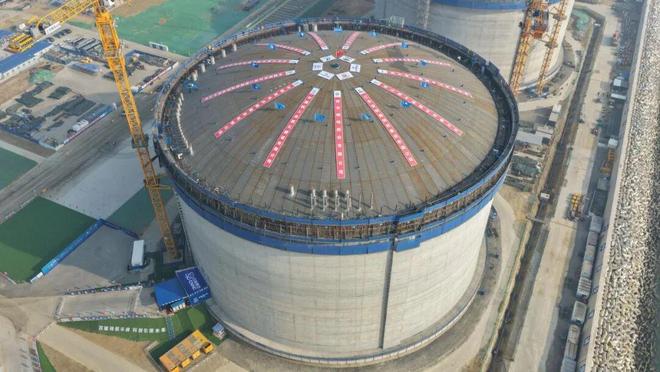
Core Insights - The successful completion of the gas pressure lifting operation for the No. 2 tank at the Jiangsu Huadian Ganyu LNG receiving station marks a significant advancement in China's capability for the independent construction of clean energy storage and transportation facilities [1] Group 1: Project Details - The gas pressure lifting is the most technically challenging core step in the construction of LNG storage tanks, with the No. 2 tank having a dome diameter of 88 meters and weighing over 900 tons, requiring precise lifting to a height of nearly 43 meters [1] - The project team utilized proprietary core technologies and applied national-level construction methods for large low-temperature storage tank dome gas pressure lifting, achieving breakthroughs in both construction precision and efficiency [1] Group 2: Environmental Impact - The Ganyu LNG receiving station is planned to have three large storage tanks, with an annual natural gas output capacity of 4.2 billion cubic meters upon full operation, which can meet the annual gas needs of 20 million households [1] - This project is expected to reduce carbon dioxide emissions by over 30 million tons annually, equivalent to planting 80 million trees [1]