
DeepSeek - R1

Search documents
微软急了:西方以外的市场,中国领先
Guan Cha Zhe Wang· 2026-01-13 10:30
Core Insights - Microsoft warns that U.S. AI companies are being surpassed by Chinese competitors in the race for users outside the West, with China's low-cost open-source models being a significant advantage [1][2] - Microsoft's research indicates that DeepSeek's R1 model has accelerated AI adoption in emerging markets, particularly in the Global South, allowing China to surpass the U.S. in the global market share of open-source AI models [1][2] - The competition is intensifying, with DeepSeek achieving significant market shares in countries like Ethiopia (18%) and Zimbabwe (17%) [3] Group 1 - Microsoft President Brad Smith emphasizes the need for international investment in African data centers to compete with heavily subsidized Chinese firms [3][4] - DeepSeek has gained substantial market shares in countries under U.S. sanctions, such as Belarus (56%), Cuba (49%), and Russia (43%) [4] - The application of AI is currently concentrated in developed countries, with only 14% of the population in Global South countries using AI compared to nearly a quarter in Global North countries [4][5] Group 2 - Smith warns that neglecting regions like Africa could lead to the emergence of AI systems that do not align with democratic values [5] - DeepSeek's R1 model was trained at a cost of $5.5 million, significantly lower than the expenses incurred by U.S. companies like OpenAI [5][6] - OpenAI's CEO Sam Altman acknowledges the potential flaws in the company's closed strategy and hints at a possible shift towards more open models in response to competition from DeepSeek [6]




2025科技观察:AI赶超、芯片“突围”、结构性重塑
Jing Ji Guan Cha Wang· 2026-01-13 07:49
Group 1: Global Innovation Index and China's Position - China has entered the global top ten in the Global Innovation Index for the first time, with the Shenzhen-Hong Kong-Guangzhou cluster ranking first globally, reflecting a significant enhancement in China's position within the global innovation system [1] - The new landscape of emerging industries in China is characterized by breakthroughs in core areas, optimized innovation ecosystems, and market-driven applications, particularly in fields like artificial intelligence, AI chips, quantum information, and biopharmaceuticals [1] Group 2: Advancements in Artificial Intelligence - In 2025, the Chinese AI company DeepSeek launched the open-source model DeepSeek-R1, achieving low training costs and performance on par with international leaders in tasks like mathematical reasoning and code generation, marking a significant development in global AI [1] - The year saw a surge in various AI applications, including AI assistants, search engines, and hardware like AI PCs and smartphones, driven by advancements in large models in natural language processing and multimodal capabilities [1] Group 3: Breakthroughs in Fusion Energy and Quantum Computing - China made substantial progress in fusion energy with the EAST device achieving a world record of 1 million degrees Celsius for 1000 seconds, indicating a shift from basic research to engineering practice [2] - The "Zu Chongzhi No. 3" superconducting quantum computing prototype set a new world record, outperforming the fastest supercomputers by a factor of trillions, showcasing China's leading position in quantum computing [2] Group 4: Robotics and Commercial Space - The commercial space sector witnessed reduced rocket launch costs and increased launch frequency, with satellite internet constellations entering a phase of dense networking and the low-altitude economy beginning to take shape [3] - The robotics industry is poised for significant growth, with numerous companies filing for IPOs, indicating a vibrant market and capital potential in the sector [3] Group 5: Policy and Competitive Landscape - The 20th Central Committee of the Communist Party of China emphasized technological innovation in its five-year plan, highlighting its importance for high-quality development in the tech industry [4] - The intensifying global tech competition is pushing Chinese companies to accelerate independent innovation and increase R&D investments, fostering a new wave of internationally competitive tech firms [5] Group 6: AI Chip Industry Developments - The demand for computing power in China has shifted from a focus on parameter competition to application implementation, leading to a breakthrough for domestic AI chip companies in the capital market [5] - 2025 marked a significant year for IPOs in the AI chip sector, with several companies successfully listing, indicating a transition of China's chip industry from a supplementary role to a core player [5]
AI应用投资方向浅析:从技术爆发到商业落地的路径探索
Xin Lang Cai Jing· 2026-01-12 12:28
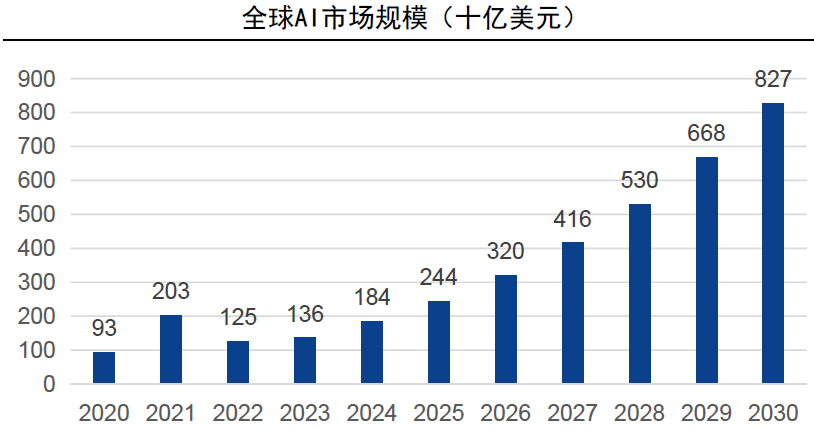
Core Insights - The AI industry has become a significant driver of global technological innovation and industrial transformation since 2023, with the market expected to grow from $244 billion in 2025 to $827 billion by 2030, reflecting a compound annual growth rate of 24% from 2020 to 2030, surpassing other technology sectors like IoT and public cloud [1][29] Investment Directions - The AI application investment landscape is evolving, presenting multi-layered opportunities from infrastructure to application scenarios [1] - The AI application industry chain consists of upstream (providing computing power and data services), midstream (solution development for various fields), and downstream (applications in sectors like internet, finance, education, healthcare, and industry) [2][16] - The global cloud computing market is projected to reach $692.9 billion in 2024, with a year-on-year growth rate of 20.3%, and is expected to approach $2 trillion by 2030, driven significantly by AI model training [2][16] Technological Development - AI technology has transitioned from being a "tool" to an "intelligent agent," with the AI ecosystem entering a mature phase by mid-2025, focusing on building interoperable architectures [1][16] - The development of large language models has accelerated, with significant increases in token usage, indicating a trend towards stronger performance and multi-task adaptability [4][18] Application Scenarios - The most notable applications of AI are in content creation and marketing, with generative AI driving innovation and efficiency across various sectors, including text, images, video, music, programming, and voice [6][20] - In the first half of 2025, global downloads of generative AI applications reached nearly 1.7 billion, with in-app purchase revenues nearing $1.9 billion, indicating a growing penetration of these applications in daily life [8][22] Cost Reduction and Efficiency - Current AI applications are more focused on cost reduction and efficiency enhancement rather than direct revenue generation, necessitating a shift in investment logic to emphasize how AI can reconstruct traditional business value chains [9][23] - In the education sector, platforms like Duolingo have leveraged AI to expand course offerings, resulting in a 41% year-on-year revenue growth in Q2 2025, highlighting the effectiveness of AI in driving business performance [10][24] Specific Investment Focus - Key areas for investment include content creation and traffic platforms, with companies like Douyin, Kuaishou, and Bilibili heavily investing in AI technology to enhance user engagement and monetization capabilities [11][25] - The marketing industry is evolving with AI transitioning from a tool to a decision-making entity, as evidenced by significant revenue growth for companies like BlueFocus [11][25] - AI applications are also gaining traction in vertical industries such as software development, gaming, and healthcare, with substantial efficiency improvements reported [12][26] Future Outlook - The integration of AI technology into various sectors is supported by national strategies, which will accelerate the commercialization of AI applications [15][29] - Companies that effectively integrate AI technology to optimize business processes and enhance user experiences are likely to stand out in the competitive landscape, creating value for investors [15][29]
华尔街见闻早餐FM-Radio|2026年1月10日
Sou Hu Cai Jing· 2026-01-10 00:01
Market Overview - The S&P 500 rose by 0.6%, reaching a new high, while the Nasdaq 100 increased by 1% [1] - Non-farm payroll data showed mixed results, reinforcing expectations that the Federal Reserve will maintain interest rates in January [1] - Intel's stock surged over 10% following a meeting between its CEO and Trump, while Oracle's shares rose nearly 5% [1] Currency and Commodities - The US dollar experienced a four-day increase, reaching a one-month high, with the USD/JPY pair surpassing 158 [2] - Bitcoin fell below $90,000 after a strong start to the week, while gold prices rose by 0.7%, surpassing $4,500 [3] - WTI crude oil saw fluctuations, initially rising by 2.3% before settling at a 0.6% increase [3] Chinese Market Developments - The A-share market saw a record trading volume exceeding 30 trillion, with the Shanghai Composite Index gaining 0.92% [4] - China's December CPI rose by 0.8% year-on-year, marking a 34-month high, driven by increased food prices [18] - The State Council's antitrust committee announced an investigation into the food delivery service industry's competitive practices [5] Company-Specific News - TSMC reported a 20% year-on-year increase in December revenue, driven by strong AI demand [28] - Minimax's stock surged 109% on its first day of trading in Hong Kong, raising approximately HKD 5.54 billion [25] - Intel's stock price increased by over 10% after a meeting between its CEO and Trump, with the government's investment in Intel doubling in value [34] Global Economic Indicators - The US non-farm payrolls increased by only 50,000 in December, below expectations, with the unemployment rate dropping to 4.4% [20] - The US consumer confidence index for January reached a four-month high, indicating stable inflation expectations [21] Strategic Moves - The US government is shifting its strategy regarding Venezuela, moving from military pressure to political engagement [23] - The potential merger talks between Rio Tinto and Glencore aim to create the world's largest mining company, driven by high copper prices [34]

华尔街见闻早餐FM-Radio | 2026年1月10日
Hua Er Jie Jian Wen· 2026-01-09 23:25
Market Overview - The U.S. Supreme Court has not yet announced its ruling on Trump's tariffs, with the next decision expected on January 14 [8] - Non-farm payroll data showed mixed results, with an increase of 50,000 jobs in December, below the expected 65,000, and the unemployment rate dropping to 4.4%, the lowest annual increase since 2020 [19] - The S&P 500 rose by 0.6%, reaching a new high, while the Nasdaq 100 increased by 1% [2] - The two-year U.S. Treasury yield rose by 4.39 basis points, reflecting market expectations for the Federal Reserve to maintain interest rates in January [2] Cryptocurrency and Commodities - Bitcoin fell below $90,000 after a strong start to the week, ending the week roughly flat [3] - Spot gold prices increased by 0.7%, surpassing $4,500, with a weekly gain of over 4% [3] - WTI crude oil saw a brief increase of 2.3% before settling at a 0.6% gain due to geopolitical tensions [3] Chinese Economic Indicators - China's December CPI rose by 0.8% year-on-year, marking a 34-month high, driven by increased food prices, particularly fresh vegetables, which rose by 18.2% [5][17] - The PPI has seen a continuous increase for three months, indicating rising industrial prices [17] - The Chinese Ministry of Finance announced the cancellation of VAT export rebates for 249 products, including solar energy products, starting in April [7][18] Company News - Intel's stock surged over 10% following a meeting between its CEO and Trump, with the U.S. government’s investment in Intel now valued at approximately $19.74 billion [33] - Minimax's debut on the Hong Kong stock market saw its shares soar by 109%, with significant backing from major investors like Alibaba and Tencent [11][23] - TSMC reported a 20.4% year-on-year increase in December revenue, driven by strong demand for AI chips and iPhone 17, alleviating market concerns about a potential bubble [28] Regulatory Developments - The State Council's Anti-Monopoly Committee announced an investigation into the food delivery service industry due to issues related to subsidies and pricing competition [6][18] - The U.S. is expected to release the results of its Section 232 tariff investigation, which could significantly impact the prices of silver, platinum, and palladium [19]

4100点之上的A股:从“资金牛”到“结构牛”的十年之变
Sou Hu Cai Jing· 2026-01-09 12:43
Core Insights - The A-share market has returned to the 4100-point level, marking a significant milestone not seen since July 31, 2015, but the underlying drivers of the market have fundamentally changed [1][4] - The current market is characterized as a "structural bull" driven by industrial upgrades and company quality, contrasting with the previous "funding bull" driven by liquidity and leverage [1][3] Market Dynamics - In 2025, the A-share annual trading volume exceeded 400 trillion yuan, with an average daily trading volume of approximately 1.7 trillion yuan, indicating a robust market environment [4] - The total market capitalization has surpassed 119 trillion yuan, with financing balances steadily increasing to about 2.5 trillion yuan, reflecting a shift in market dynamics [4] Structural Changes - The current "structural bull" market is marked by significant differentiation, supported by two main industrial pillars: "Technology" and "Resources" [6] - The "Technology" pillar includes investments in AI and related hardware, with a focus on real orders and performance, moving beyond mere speculation [7] - The "Resources" pillar, particularly in non-ferrous metals, is driven by global energy transition and manufacturing upgrades, reshaping long-term demand [7] Market Ecology Transformation - The transition from a "funding bull" to a "structural bull" signifies a systemic change in the A-share market ecology, evident in the shift of market capitalization leadership from traditional sectors to technology industries [8][9] - The capital market is optimizing resource allocation with unprecedented efficiency, aligning with China's industrial upgrade direction since the 14th Five-Year Plan [10] Institutional and Regulatory Developments - Continuous regulatory emphasis on enhancing capital market activity and investor confidence has led to improved company quality and returns [11] - In 2025, cash dividends from A-share listed companies reached a new high, reflecting a consensus among quality companies to prioritize returns [12] Investor Structure Evolution - The market's driving forces have shifted, with a notable increase in the influence of institutional and professional investors, contrasting with the previous dominance of individual investors [13][14] - Long-term funds such as insurance and pension funds are increasingly participating in the market, focusing on fundamental industry analysis and long-term value rather than short-term price fluctuations [14] Future Outlook - The consensus among market participants is that the characteristics of the "structural bull" driven by industry and company quality will become more pronounced, making a return to a broad-based "funding bull" unlikely [15] - Future investment strategies will need to adapt, emphasizing deep industry research and the identification of genuine company quality over chasing short-term market trends [15]

一年后,DeepSeek-R1的每token成本降到了原来的1/32
机器之心· 2026-01-09 06:16
Core Insights - DeepSeek recently updated its R1 paper, expanding from 22 pages to 86 pages, providing more detailed insights into its training pipeline and data validation methods [1] Group 1: Model Specifications and Performance - DeepSeek-R1, released on January 20, 2025, features 671 billion parameters and employs a MoE architecture, significantly enhancing training efficiency [4] - The cost per token for the R1 model has decreased to 1/32 within a year of its launch, showcasing remarkable cost efficiency improvements [6][18] - NVIDIA's collaboration with DeepSeek has led to a 36-fold increase in throughput since January 2025, further reducing inference costs [18] Group 2: Technological Innovations - NVIDIA's GB200 NVL72 system, designed for high-density workloads, connects 72 Blackwell GPUs, providing up to 1800 GB/s bidirectional bandwidth [11] - The Blackwell architecture includes hardware acceleration for NVFP4 data format, enhancing precision and performance during token generation [12] - The latest NVIDIA TensorRT-LLM software significantly boosts inference performance, particularly in various input/output sequence lengths [10][14] Group 3: Performance Metrics and Enhancements - The throughput of DeepSeek-R1 has improved dramatically, with Blackwell GPUs achieving up to 2.8 times higher throughput in the last three months [17] - The use of multi-token prediction (MTP) and NVFP4 technology on the NVIDIA HGX B200 platform has led to substantial performance gains while maintaining accuracy [21][24] - Continuous optimization of the entire technology stack by NVIDIA aims to enhance the efficiency of large language models and increase token throughput across existing hardware [30]

硬科技领衔驱动 A股市值破百万亿元
Nan Fang Du Shi Bao· 2026-01-08 23:12
Group 1: Market Performance - In 2025, the Shanghai Composite Index returned to the 4000-point mark for the first time in ten years, reflecting a significant recovery in market confidence [3] - The total market capitalization of A-shares exceeded 100 trillion yuan for the first time, reaching 118.91 trillion yuan by December 31, 2025 [3] - The cumulative trading volume for the year was 420.21 trillion yuan, a substantial increase of 62.64% compared to 2024 [3] Group 2: Regulatory Reforms - The "1+6" reform policy was implemented on the STAR Market, allowing unprofitable companies to list under a new growth tier, enhancing market inclusivity [4] - The new merger and acquisition regulations established a phased payment mechanism for share exchanges and extended the registration decision period to 48 months, improving regulatory flexibility [5] Group 3: Technology Sector Growth - The launch of DeepSeek-R1 sparked significant interest in the AI sector, leading to a surge in the Sci-Tech 50 Index, which saw a maximum increase of over 50% from its low point [5][6] - The rise of companies like Cambrian, which surpassed Kweichow Moutai to become the new "king of stocks," indicates a shift in investment focus from traditional consumer sectors to hard technology [6][7] Group 4: IPO and Fundraising Trends - The STAR Market and ChiNext received over 10 applications for IPOs from unprofitable companies, indicating a growing acceptance of high-tech firms in the capital market [4] - The total number of IPOs on the STAR Market and ChiNext reached 49, raising 619.12 billion yuan, accounting for 47.3% of the total IPO financing in the market [7] Group 5: Investor Engagement and Returns - A record cash dividend of 2.63 trillion yuan was distributed by A-share listed companies in 2025, with 37 companies announcing dividends exceeding 10 billion yuan [9] - The implementation of fee reforms in public funds has shifted the focus from scale to returns, enhancing investor satisfaction and encouraging long-term investment [8] Group 6: Market Discipline and Exit Mechanisms - Regulatory authorities intensified enforcement against financial fraud, with 17 cases investigated and fines totaling 230 million yuan, a 40% increase from 2024 [10] - The normalization of the delisting mechanism has accelerated the market's selection process, with over ten companies forced to delist due to significant violations [10]



2026年,谁还能在AI牌桌上坐得住?
创业邦· 2026-01-06 00:07
Core Insights - The year 2023 is defined as the "starting year" for AI, while 2024 is seen as the "acceleration year," and 2025 marks a critical selection phase in the AI industry as capital begins to retreat and the hype subsides [4] - The reality for AI entrepreneurs in 2026 is that the focus has shifted from merely having a large model to efficiently transforming AI into solutions that customers are willing to pay for [5] Group 1: Market Dynamics - The general large model startup avenue is officially closed, as training a competitive foundational model requires billions in investment and extensive engineering [7] - OpenAI's significant losses, exceeding $12 billion in a single quarter in 2025, serve as a warning that only state capital or trillion-dollar companies can afford to pursue this path [7] - Despite the closure of the general model startup route, opportunities remain for entrepreneurs through open-source models that lower the barriers to high-capability AI usage [8][9] Group 2: Entrepreneurial Strategies - Entrepreneurs are encouraged to leverage open-source foundations like Qwen2 or DeepSeek-V2.5 and focus on high-value, low-error vertical scenarios for application development [13] - The emphasis is on building systems that can deliver measurable ROI, rather than attempting to create new foundational models [15] - The most secure path for entrepreneurs is to utilize existing open-source models to create applications that solve specific, high-frequency, and high-willingness-to-pay problems [34] Group 3: Technological Trends - The focus has shifted from glamorous content generation to practical applications where AI can execute multi-step tasks and deliver measurable business value [17] - The emergence of embodied intelligence is highlighted as a significant area for China's AI industry, leveraging manufacturing capabilities and supply chain integration [20] - The production of embodied intelligent robots has reached a milestone, indicating a shift from experimental phases to large-scale production and real-world applications [24] Group 4: Investment Landscape - The landscape for AI startups is diversifying, with some companies pursuing IPOs while others opt for mergers and acquisitions as a means of exit [26] - The criteria for investors are evolving, with the ability to be acquired or integrated into larger industry frameworks becoming as important as the potential for public offerings [30] - The competition is intensifying, and the focus is shifting from who can enter the market first to who can sustain their position in the evolving landscape [35]


2025资本市场大件事:“慢牛”启幕,硬科技叙事迎来主场
Nan Fang Du Shi Bao· 2026-01-05 03:17
Market Performance - In 2025, the Shanghai Composite Index returned to the 4000-point mark for the first time in ten years, reflecting a shift in market confidence from "repair" to "surge" [4] - The total market capitalization of A-shares exceeded 118 trillion yuan, marking a historic high, with a cumulative trading volume of 42.021 trillion yuan, a significant increase of 62.64% compared to 2024 [4][5] Institutional Reforms - The "1+6" reform on the Sci-Tech Innovation Board was implemented, reopening the listing channel for unprofitable companies, enhancing the market's inclusiveness and efficiency [6] - New merger and acquisition regulations under the "2+5+5" framework were introduced, stimulating market activity and allowing for a more flexible review process, resulting in a 1.3 times increase in disclosed asset restructuring projects compared to the previous year [7] Technology Sector Growth - The launch of DeepSeek-R1 ignited interest in the AI sector, with related companies experiencing significant capital inflow, indicating a shift in valuation logic towards research and development potential [8][9] - The rise of technology stocks was underscored by the performance of companies like Cambrian, which surpassed Kweichow Moutai to become the new "king" of A-shares, reflecting a broader market trend towards hard technology investments [9][11] IPO and Fundraising Trends - The year saw a record number of IPOs in the "Two Innovation Boards" (Sci-Tech Innovation Board and Growth Enterprise Market), with 49 IPOs raising 61.912 billion yuan, accounting for 47.3% of total market IPO financing [12] - The public fund industry underwent reforms aimed at enhancing investor returns, with total net assets reaching 37.02 trillion yuan, marking a shift from a focus on scale to one on returns [14] Cash Dividends and Corporate Governance - A-share companies set a new record for cash dividends, totaling 2.63 trillion yuan, with 37 companies distributing over 10 billion yuan, indicating a trend towards improved shareholder returns [15][16] - Regulatory measures against financial fraud were intensified, with over 17 cases investigated and a significant increase in penalties, reinforcing market integrity and investor confidence [16] Industry Consolidation - The securities industry experienced a wave of consolidation, with major mergers such as Guotai Junan and Haitong Securities, enhancing the competitive landscape and service capabilities of the sector [13]
