中央处理器

Search documents
软银股价飙升10%,因旗下电信部门上调业绩预期,Arm业务实力增强支撑人工智能叙事
Jin Rong Jie· 2026-02-10 07:57
Group 1 - SoftBank Group's stock surged over 10% following its telecom subsidiary's upward revision of annual profit forecasts, fueled by renewed optimism around Arm and the company's AI business strategy [1] - SoftBank's telecom subsidiary reported a revenue increase of 8% year-on-year for the first nine months of fiscal 2025, reaching 5.2 trillion yen, marking a historical high for the period; operating income also rose by 8% to 884 billion yen [1] - The subsidiary raised its full-year revenue forecast from 6.7 trillion yen to 6.95 trillion yen and adjusted its operating income target to 1.02 trillion yen, indicating steady progress towards fiscal 2025 goals [1] Group 2 - Arm's growth is increasingly driven by AI-related advancements rather than just smartphone sales, with data center licensing revenue growing over 100% year-on-year [2] - The CEO of Arm stated that the data center business is expected to surpass mobile business in scale within a few years, with plans to supply half of the central processing units to major cloud service providers by year-end [2] - Despite not meeting Wall Street's expectations for licensing revenue, Arm achieved a record quarterly revenue of $1.242 billion in the last three months of 2025, driven by AI demand [2]

盘后暴跌8%!AMDQ1展望成“阿喀琉斯之踵”?数据中心激增40%难平市场担忧
美股IPO· 2026-02-04 01:02
Core Viewpoint - AMD's fourth-quarter earnings report disappointed the market, indicating that its progress in the AI sector has not met some investors' optimistic expectations [1] Financial Performance - AMD's Q4 sales increased by 34% to $10.3 billion, surpassing the average expectation of $9.7 billion [3] - Adjusted earnings per share were $1.53, exceeding the analyst average estimate of $1.32 [3] - The company's first-quarter sales forecast is approximately $9.8 billion, with a fluctuation of $300 million, while analysts had an average estimate of $9.39 billion [3] Segment Performance - Data center revenue grew by 39% to $5.38 billion, exceeding the analyst average prediction of $4.97 billion [3] - PC-related sales rose by 34% to $3.1 billion, also above the average expectation of $2.89 billion [3] - Gaming revenue increased by 50% to $843 million, although it fell short of the market average expectation of $855 million [4] - Embedded business revenue grew by 2.9% to $950 million, below the market average expectation of $961 million [4] Market Dynamics - AMD has begun selling an older model chip to China, generating $390 million in revenue last quarter, with an expected $100 million this quarter [6] - The company anticipates that large deals with OpenAI and Oracle, along with overall demand for AI devices, could bring in hundreds of billions in new revenue [6] - AMD is seen as continuing to gain market share from Intel, which recently provided a disappointing forecast regarding supply constraints [7]


盘后暴跌8%!AMD(AMD.US)Q1展望成“阿喀琉斯之踵”?数据中心激增40%难平市场担忧
Zhi Tong Cai Jing· 2026-02-04 00:17
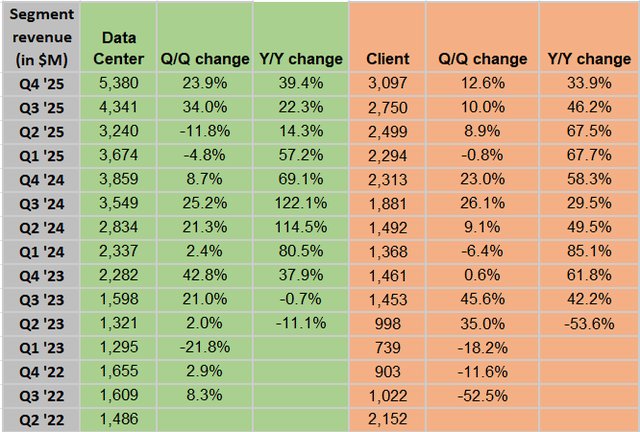
Core Insights - AMD's Q4 earnings report disappointed investors, particularly regarding its AI market progress, with Q1 sales forecasted at approximately $9.8 billion, below analyst expectations of $9.39 billion [1] - The company has begun selling an older chip model to China, which boosts sales but compresses profit margins [1] - AMD's stock fell 8% in after-hours trading following the earnings announcement, despite a 13% increase year-to-date [1] Financial Performance - AMD's Q4 revenue grew 34% year-over-year to $10.3 billion, surpassing the average expectation of $9.7 billion [1] - Adjusted earnings per share were $1.53, exceeding the analyst average estimate of $1.32 [1] - Data center revenue increased by 39% to $5.38 billion, above the forecast of $4.97 billion [2] - PC-related sales rose 34% to $3.1 billion, also exceeding the average expectation of $2.89 billion [2] Segment Performance - Gaming revenue for Q4 was $843 million, a 50% year-over-year increase but below the market average expectation of $855 million [4] - Embedded business revenue grew 2.9% to $950 million, falling short of the average forecast of $961 million [4] - The data center segment showed a quarter-over-quarter increase of 23.9% and a year-over-year increase of 39.4% [3] Market Position and Future Outlook - AMD is competing with Nvidia in the AI market, with expectations of launching a new generation of powerful designs in the second half of the year [1] - Recent agreements with OpenAI and Oracle reflect growing market interest in AMD's MI series AI accelerators, which compete directly with Nvidia's chips [5] - AMD's sales from older MI308 chips to China generated $390 million last quarter, with an expected $100 million in the current quarter [5]
AMD CEO称AI活跃用户增至10亿:未来全球AI算力需提升100倍
Sou Hu Cai Jing· 2026-01-06 06:52
Core Insights - AMD CEO Lisa Su highlighted the rapid growth of AI usage, with active users increasing from 1 million to 1 billion since the launch of ChatGPT, and projected that by 2030, active AI users will reach 5 billion, a milestone that took the internet decades to achieve [1] - To sustain the growth of AI, it is necessary to increase global AI computing power by 100 times in the coming years [3] - AMD, a major player in microprocessor and related IC design, announced that its ROCm software will enhance AI performance by five times by 2025, and introduced the Adrenalin Edition AI Bundle to simplify local AI environment deployment for PC-based AI development [4]
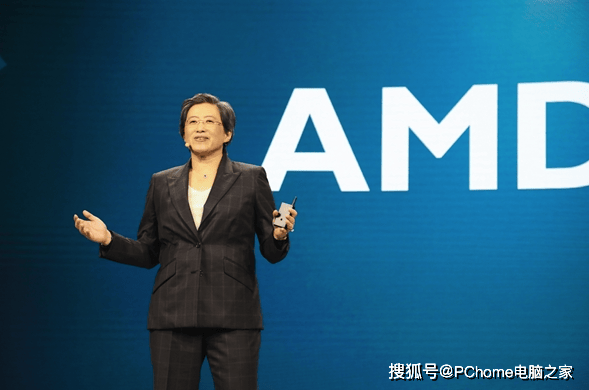
人工智能泡沫还是超级周期?AMD CEO 公开说出不为人知的一面
美股研究社· 2025-12-05 10:52
Core Viewpoint - AMD is not in an AI bubble but is in the "third year of a ten-year super cycle of computing demand" [1][10]. Group 1: AMD's Strategic Positioning - AMD has transitioned from being a "CPU follower" to a data center powerhouse [3]. - The company has reallocated R&D resources towards high-performance computing and AI, resulting in a data center business growth rate exceeding 50%, projected to rise above 60% [5][6]. - AMD aims to capture a double-digit market share in a projected $1 trillion data center market by 2030, leveraging its comprehensive product portfolio [6][8]. Group 2: Competitive Advantages - AMD's chiplet-first architecture and rack-scale systems provide a significant competitive edge [2]. - The company possesses unique capabilities across CPUs, GPUs, FPGAs, and ASICs, allowing for integrated solutions that adapt to changing workloads [6][8]. - AMD believes that GPUs will dominate the market for the next five years due to their programmability and flexibility, while custom ASICs will complement rather than replace them [7][12]. Group 3: Transition to System Solutions - AMD is evolving from a "chip company" to a "system company," focusing on full-stack solutions to enhance deployment efficiency [9][10]. - The acquisition of ZT Systems and partnerships for rack-level designs like Helios demonstrate AMD's commitment to this strategy [9][10]. Group 4: AI Market Dynamics - AMD's CEO asserts that the current AI landscape is not speculative but integral to productivity and innovation across various sectors [10][12]. - The demand for CPUs is rising due to the increasing need for general-purpose processing in AI applications, countering the notion that GPUs will solely dominate [11][12]. Group 5: Future Outlook - AMD's strategic focus on high-performance computing and AI positions it well for significant growth, with analysts projecting a potential stock price of $775, and in optimistic scenarios, close to $1000 [2].
直线拉升!芯片巨头释放重大利好!
天天基金网· 2025-10-24 01:24
Core Viewpoint - Intel's latest financial report indicates a significant positive shift, with the company achieving revenue growth for the first time in a year and a half, alongside a return to profitability and a notable increase in gross margin [3][4][7]. Financial Performance - Intel reported Q3 revenue of $13.7 billion, a 3% year-over-year increase, surpassing analyst expectations of $13.2 billion [4][8]. - Adjusted earnings per share (EPS) for Q3 were $0.23, compared to a loss of $0.46 in the same period last year, exceeding analyst expectations of $0.01 [4][7]. - The gross margin for Q3 was 40.0%, significantly higher than the expected 35.7% and up from 29.7% in Q2 [7]. Business Segments - The Client Computing Group (CCG) generated $8.5 billion in revenue, a 5% increase year-over-year, exceeding expectations of $8.2 billion [7]. - The Data Center and AI (DCAI) segment contributed $4.1 billion, a 1% decline year-over-year, but still above the expected $3.97 billion [7]. - The Foundry business generated $4.24 billion, falling short of the anticipated $4.51 billion [7]. Future Guidance - For Q4, Intel expects revenue between $12.8 billion and $13.8 billion, with an adjusted EPS of $0.08 and a gross margin of 36.5% [8]. - The CFO indicated strong chip demand leading to supply constraints, particularly from data center operators upgrading CPUs to keep pace with advanced AI chip applications [8][9]. Strategic Partnerships and Investments - Intel has secured $5.7 billion in government funding to support the expansion of the U.S. technology and manufacturing sectors [9]. - A partnership with NVIDIA was announced to develop customized data center and PC products, with NVIDIA agreeing to invest $5 billion in Intel stock [9][10]. Market Reaction - Following the earnings report, Intel's stock surged over 9% in after-hours trading, reflecting strong investor confidence [3][4]. - The broader U.S. stock market also saw gains, with major indices rising, driven by strong performances from technology stocks [11].

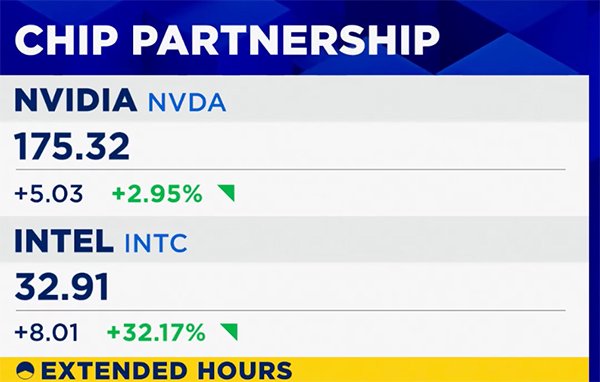
英特尔暴涨30%!英伟达50亿美元入股后,压力给到台积电、AMD…
Guan Cha Zhe Wang· 2025-09-18 15:43
Core Viewpoint - Nvidia announced a $5 billion investment in Intel, becoming one of its largest shareholders, aiming to support Intel's recovery and enhance collaboration in chip development for PCs and data centers [1][2]. Group 1: Investment Details - Nvidia will purchase Intel shares at $23.28 each, slightly below Intel's closing price of $24.90 on September 17, but above the $20.47 price paid by the U.S. government for Intel shares [1]. - This investment represents approximately 4% of Intel's shares, based on a market capitalization of $116 billion [1]. Group 2: Collaboration Aspects - Intel will integrate Nvidia's technology into its next-generation PC chips and develop processors for data center products based on Nvidia hardware [2]. - The collaboration aims to enhance data transfer speeds using Nvidia's proprietary technology, which is crucial for AI applications that require high-speed interconnects [2]. Group 3: Market Impact - The partnership is expected to pressure competitors like AMD and TSMC, with AMD's stock dropping nearly 4% and TSMC's by 2% following the announcement [3][4]. - Nvidia's investment is seen as a move to diversify its investments in the U.S. market and gain favor with the U.S. government [3]. Group 4: Industry Context - Nvidia has established a dominant position in AI computing, having developed relevant chips and software ahead of competitors [4]. - Intel, once a leader in the chip industry, has struggled to keep pace in the AI chip market, leading to a reliance on TSMC for high-end chip manufacturing [4].

黄仁勋:台积电是史上最伟大的公司之一
半导体芯闻· 2025-08-22 11:28
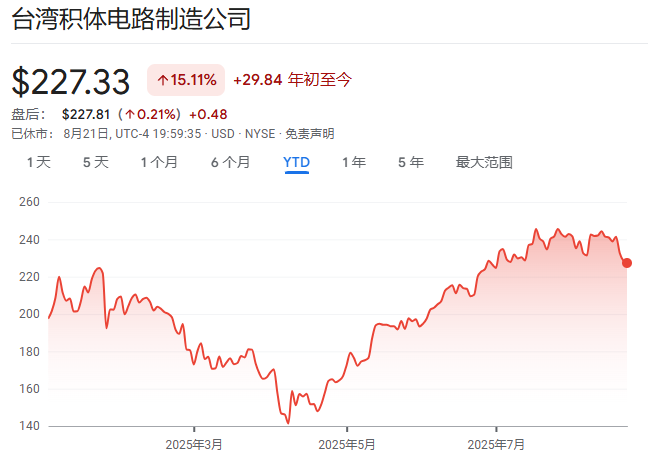
Core Viewpoint - Nvidia's CEO Jensen Huang praised TSMC during his visit to Taiwan, highlighting the company's significance and expressing that anyone looking to invest in TSMC would be "very smart" [1]. Group 1: Nvidia and TSMC Collaboration - Huang emphasized that TSMC is producing six new products for Nvidia, including a new central processing unit and a new graphics processing unit [1]. - Nvidia is planning to establish the "NVIDIA Constellation" project in Taiwan to accommodate its growing workforce, indicating a strong commitment to the region [6]. Group 2: U.S. Government Involvement in Semiconductor Industry - The U.S. government is considering acquiring stakes in semiconductor companies, including Intel, as part of discussions surrounding the CHIPS Act, which aims to revitalize U.S. semiconductor manufacturing [4]. - TSMC has received a commitment of $6.6 billion under the CHIPS Act to support the construction of three advanced chip manufacturing plants in Arizona [2]. Group 3: Market Reactions and Developments - TSMC's stock has increased by 6.5% year-to-date, reflecting positive market sentiment towards the company [6]. - Nvidia has requested some of its component suppliers to halt production related to the H20 graphics processor due to security concerns raised by China [6][7].


黄仁勋“推票”:台积电是人类历史上最伟大的公司之一,聪明人都想买他们股票
Hua Er Jie Jian Wen· 2025-08-22 05:59
Group 1 - CEO Jensen Huang praised TSMC, stating that anyone looking to invest in the company is "very smart" [1] - TSMC is manufacturing six new products for NVIDIA, including new CPUs and general-purpose processors for advanced computing, particularly AI [1] - TSMC's stock has risen by 15% this year, reflecting its strong market position as the largest chip foundry globally [1] Group 2 - NVIDIA announced its expansion plan in Taiwan, named the "NVIDIA Constellation" project, which includes a new office to accommodate local employees [3] - The company is collaborating with various chip companies, system suppliers, and manufacturers in Taiwan, indicating a busy supply chain and a need for a large number of engineers [3]
股价涨幅超英伟达,AMD(AMD.US)今夜需要一份“完美财报”回应市场
智通财经网· 2025-08-05 12:30
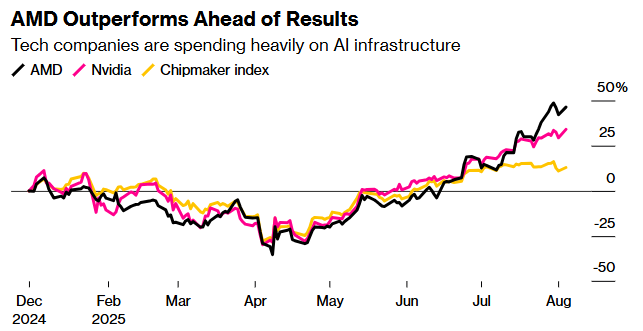
Core Viewpoint - AMD is expected to benefit from the competitive landscape in the artificial intelligence sector, with its stock price having risen significantly this year, outperforming Nvidia [1][3] Group 1: AMD's Performance and Market Position - AMD's stock has increased by 46% in 2025, indicating strong performance among chip manufacturers [1] - The company is gaining market share in the central processing unit (CPU) market by taking share from Intel [4] - AMD's revenue for the second quarter is projected to reach $7.4 billion, a 27% increase year-over-year [3] Group 2: Industry Trends and Competitors - The semiconductor sector has seen strong performance, with the Philadelphia Semiconductor Index rising by 13% [3] - Major tech companies like Meta, Microsoft, Amazon, and Alphabet are expected to invest over $340 billion in capital expenditures this year, primarily for AI capabilities [3] - Nvidia holds a dominant 95% market share in the GPU sector, while AMD only accounts for 5% [3] Group 3: Future Outlook and Analyst Sentiment - Global AI spending is projected to reach $500 billion by 2026, indicating significant growth potential for the semiconductor industry [4] - Analysts are cautious about AMD's growth prospects, with less than 70% recommending a buy, compared to nearly 90% for Nvidia [5] - AMD's stock is trading 15% above the average target price, suggesting limited return potential compared to its peers [5]