人工智能存储芯片

Search documents
全球先进封装市场新格局:AI驱动下的“三足鼎立”
势银芯链· 2026-03-27 03:11
Core Viewpoint - The global advanced packaging market is undergoing significant changes, with an estimated market size of $59.2 billion in 2025, reflecting a 25% year-on-year growth, and is expected to continue steady growth over the next five years [1]. Group 1: Market Leaders - TSMC and Intel lead the global advanced packaging industry, holding a combined 35% market share in the top 10, thanks to their advancements in 2.5D/3D packaging and glass substrate technologies [2]. - The demand for high-performance computing chips drives the necessity for advanced packaging technologies such as COWOS, EMIB, 3D SoIC, and Foveros, indicating a strong international market demand and the importance of technological depth [2]. Group 2: Key Players in Packaging - The top ten OSAT (Outsourced Semiconductor Assembly and Test) companies are crucial to the global advanced packaging capacity, serving markets like consumer electronics and automotive electronics through scalable manufacturing capabilities [3]. - Notably, three companies from mainland China are ranked among the top ten, with all showing double-digit revenue growth in advanced packaging for 2025, reflecting the strategic success of China's market demand and technological self-sufficiency [3]. - Sony, Samsung, and SK Hynix represent specific IDM (Integrated Device Manufacturer) capabilities in advanced packaging, with Sony leading in global shipments of CIS image sensors, while Samsung and SK Hynix see revenue growth driven by AI storage chips and increased orders for HBM products [3].


SK海力士,投资213亿美元建厂
半导体行业观察· 2026-02-26 01:30
Core Viewpoint - SK Hynix is reinforcing its leading position in the AI storage semiconductor sector by investing an additional 21.6 trillion KRW (approximately 14.9 billion USD) in its first wafer fab located in the Yongin semiconductor industrial cluster, bringing the total investment for the first phase to 31 trillion KRW (approximately 21.3 billion USD) [2][3]. Investment and Expansion Plans - The total investment for the first phase of the wafer fab has increased to approximately 31 trillion KRW, which includes an initial infrastructure cost of 9.4 trillion KRW announced in July 2024 [2]. - The new investment will be used to complete the structural framework of the first phase and build five clean rooms for phases two to six [2]. - The first clean room of the first fab is expected to commence production three months earlier than planned, moving from May 2027 to February 2027 due to efficient on-site process management [2]. Market Demand and Competitive Landscape - The demand for semiconductors is experiencing explosive growth, particularly in AI data centers, prompting SK Hynix to expand its production base ahead of schedule [2][3]. - Major global competitors, including TSMC and Micron, are also making significant facility investments to meet the surging demand for high-performance products like high-bandwidth memory (HBM) [3]. - Analysts predict that SK Hynix's annual operating profit could reach 272 trillion KRW this year, nearly seven times the previous year's record profit of 47.2063 trillion KRW [3]. AI Storage Chip Market Outlook - The AI storage chip market is projected to reach between 122 trillion KRW and 272 trillion KRW, with a forecasted supply shortage of approximately 30% compared to demand this year [4]. - The government has relaxed regulations, positively impacting the scale of investments, allowing for increased clean room space within factories [4]. Ecosystem Development - SK Hynix plans to attract around 50 materials, components, and equipment companies to the industrial cluster, aiming to create a mutually beneficial ecosystem that supports capacity expansion and the development of domestic partner companies [5].
SK海力士董事长承诺提高人工智能内存芯片产量
Xin Lang Cai Jing· 2026-02-23 05:22
Core Viewpoint - SK Hynix's parent company, SK Group, is committed to increasing the production of artificial intelligence storage chips to meet the surging demand from global data center construction [1] Group 1: Company Developments - Chairman Choi Tae-won stated that high bandwidth memory (HBM) chips are referred to as "monster chips," which have generated substantial profits for SK Hynix [1] - The company's stock price has more than quadrupled over the past year due to record profits [1] - Although specific details on the scale of the production expansion were not provided, SK Hynix indicated in January that its capital expenditures for 2026 will significantly increase compared to the previous year to meet HBM chip demand [1]
港股软件股重挫,金蝶国际跌5%,科网股大跌,百度跌近6%
2 1 Shi Ji Jing Ji Bao Dao· 2026-02-20 04:51
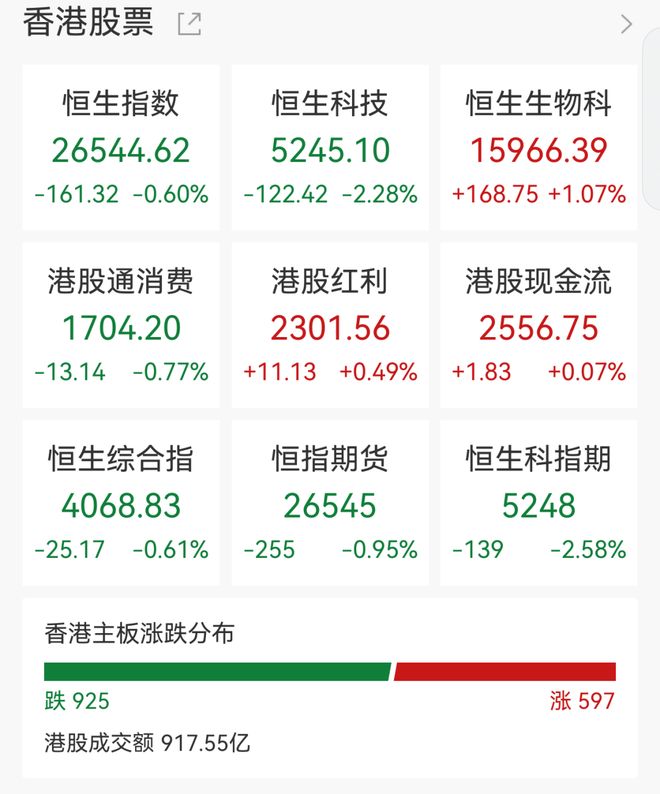
Market Overview - The Middle East situation is becoming increasingly tense, leading to heightened risk aversion, resulting in a decline in US stocks and a further drop in Hong Kong stocks on the first trading day of the Year of the Rabbit [1] - As of midday, the Hang Seng Technology Index fell by 2.28%, the Hang Seng Index decreased by 0.6%, and the National Enterprises Index dropped by over 1% [1] Stock Performance - The Hang Seng Index is at 26,544.62, down by 161.32 points or 0.60%, while the Hang Seng Technology Index is at 5,245.10, down by 122.42 points or 2.28% [2] - Semiconductor stocks weakened, with Huahong Semiconductor down over 3%, Shanghai Fudan down over 2%, and SMIC, Beike Micro, and ZTE all down over 1% [2] - Conversely, storage concept stocks performed well, with Lanqi Technology rising over 8% at one point, and Aixin Yuan Zhi increasing by 19.89%, reaching a historical high [2] Sector Highlights - The robotics sector continued its upward trend, with Yujian rising by 19%, Sutech increasing by over 9%, and Ubtech up by over 6% [3] - Oil sector stocks surged, with China Petroleum up by 4.58% and Yanchang Petroleum International up by 5%, driven by rising international oil prices amid escalating tensions between the US and Iran [3] - Within the Hang Seng Technology Index, Baidu Group fell nearly 6%, JD Health dropped over 5%, Tencent Music decreased over 4%, and Bilibili fell over 5% [3] Additional Stock Movements - Software sector stocks mostly declined, with Kingdee International down over 5% and Tian Shi Resources down over 3% [5] - In the consumer sector, both discretionary and staple consumer stocks collectively fell, with Laopu Gold down over 3% [5] - Spot gold prices fell by approximately $20, currently reported at $4,991.15 per ounce, while spot silver decreased by $1, now at $77.64 per ounce [5]
港股AI应用、存储芯片股,集体爆发!
Xin Lang Cai Jing· 2026-02-20 04:09
Market Overview - On February 20, the Hong Kong stock market experienced a decline on its first trading day of the Year of the Horse, with the Hang Seng Index, Hang Seng Tech Index, and other indices showing weakness, particularly the Hang Seng Tech Index which fell over 2% [1][8] - The Hang Seng Index closed at 26,544.62, down 161.32 points or 0.60%, while the Hang Seng Tech Index was at 5,245.10, down 122.42 points or 2.28% [2][9] AI and Robotics Sector Performance - Despite the overall market decline, AI application stocks surged, with Haizhi Technology Group rising over 28% to a peak of 154.4 HKD per share, marking a new high since its listing. Other notable gains included Zhiyuan up nearly 20%, and Yujian up over 18% [2][9] - The Spring Festival Gala showcased humanoid robots from four companies, highlighting advancements in robotics and AI technology, which have garnered significant public interest [4][11] - Douyin e-commerce reported a substantial increase in sales of robot products during the Spring Festival, with GMV growing 1680% and order volume increasing 655% from February 16 to 18 [4][11] Industry Insights - Dongwu Securities emphasized that advancements in core robotic capabilities are crucial for the technology's transition from laboratory to factory settings [5][12] - According to a recent report by招商证券, the AI application sector is witnessing simultaneous technological breakthroughs and intensified commercial competition, supported by national strategies for long-term development [6][12] - The report also noted that while index valuations are slightly high, the dual drivers of industry trends and policy benefits suggest potential upward movement in the market [6][12] Storage Sector Developments - On the same day, storage concept stocks in Hong Kong showed slight gains, with companies like 澜起科技 rising over 8% and 兆易创新 nearly 4% [6][12] - Reports indicated that Samsung Electronics is negotiating pricing for its latest generation of AI storage chips, which could be up to 30% higher than the previous generation [6][12]



大涨3.09%!韩国股市创新高,三星股价盘中一度上涨逾5%,今年以来上涨近50%
Jin Rong Jie· 2026-02-19 09:01
Group 1 - The Korean stock market experienced significant gains on February 19, with the KOSDAQ 150 index and futures rising sharply, leading to a temporary suspension of programmatic trading on the KOSDAQ market [1] - The Nikkei 225 index rose by 0.57% to close at 57,467.83 points, while the Seoul Composite Index increased by 3.09% to 5,677.25 points, reaching a historical high during the trading session [1] - Key stocks in the brokerage sector saw substantial increases, with firms like SANGSANGININV&SEC and SK Securities hitting the daily limit of 30% increase, and HMC Investment Securities rising over 29% [1] Group 2 - Memory chip stocks also performed strongly, with Samsung's stock price reaching a historical high of 190,900 KRW, closing up 4.86%, while SK Hynix rose by 1.59% [1] - Samsung's stock has surged nearly 50% year-to-date, continuing its rapid growth from 2025, amid reports of negotiations for pricing on its latest AI memory chips, which may be up to 30% higher than the previous generation [1] - KB Securities noted that the shortage of memory chips has intensified, with major clients' order fulfillment rates at only 60%, and AI data center companies accounting for 70% of Samsung's memory shipments [1] Group 3 - Citigroup analysts projected a 17.5% increase in DRAM supply and a 16.5% increase in NAND flash supply for the year, while demand for DRAM is expected to grow by 20.1% and NAND flash demand by 21.4%, indicating that demand growth continues to outpace supply [1]
陆家嘴财经早餐2025年11月30日星期日
Wind万得· 2025-11-29 22:25
Group 1 - The National Financial Supervision Administration issued a notice to enhance financial support for clients affected by the fire in Hong Kong, urging banks to provide repayment delays and support for disaster recovery [2] - The People's Bank of China emphasized the need to combat virtual currency speculation, stating that virtual currencies do not have the same legal status as fiat currencies and should not circulate in the market [3] - A joint meeting by the People's Bank of China and the Ministry of Science and Technology highlighted the importance of integrating financial support for technological innovation and optimizing policy measures to promote high-quality development [4] Group 2 - A survey by the All-China Federation of Industry and Commerce revealed that the internationalization of private enterprises is expanding, with overseas income projected to reach 52,149.66 billion yuan in 2024, a nearly 12% increase [5] - The establishment of the Xiong'an Service Base by the Shenzhen Stock Exchange marks a new phase in capital market services for technological innovation and industrial upgrades in the Xiong'an New Area [6] - The release of the "Beijing Artificial Intelligence Industry White Paper (2025)" predicts that the AI industry in Beijing will exceed 450 billion yuan by 2025, driven by advancements in AI applications [7] Group 3 - The Shanghai Financial Technology Development White Paper (2025) indicates that the financial technology industry in Shanghai is expected to reach approximately 440.5 billion yuan in 2024, with increasing applications of digital currency and AI [9] - Micron Technology plans to invest 1.5 trillion yen (approximately 96 billion yuan) to establish a factory in Japan for AI storage chips, with government subsidies of up to 500 billion yen [10] - The London Metal Exchange reported that copper futures reached a historical high, driven by supply shortages and strong demand, with UBS predicting further price increases due to global copper supply disruptions [13]