
元宝应用

Search documents
腾讯进入“AI烧钱阶段”,市场第一反应“不开心”,胜负手就看“未来几个季度的AI进展”
硬AI· 2026-03-19 02:37
Core Viewpoint - Tencent is entering a new strategic cycle driven by AI investments, prioritizing long-term AI infrastructure over short-term profit growth [3][5] Investment Strategy - Tencent plans to double its investment in AI products, including the "Hunyuan" model, by 2026, while reducing share buybacks this year [3][6] - The shift from share repurchase to increased AI investment has led to market volatility, with Tencent's ADR dropping 4% and its major shareholder Prosus falling 8% [3][6] Profit Expectations - Goldman Sachs has lowered Tencent's net profit growth forecast for 2026 to 7%, down from a previous estimate of 10%, due to increased operational costs associated with AI [6][7] - The operating profit margin is expected to narrow by 65 basis points in the 2026 fiscal year due to rising AI-related expenses [6][7] Valuation Multiples - Despite the downward revision in profit expectations, Goldman Sachs maintains a "Buy" rating on Tencent, citing potential for valuation multiple recovery [9] - Tencent's forward P/E ratio is currently around 16 times, lower than the 18 times at the beginning of the year and below international peers like META and Alphabet [9][13] Core Business Performance - Tencent's total revenue grew by 13% year-on-year in Q4 2025, with the gaming business increasing by 22% driven by AI efficiencies [10][11] - Marketing services revenue is expected to grow by 19% year-on-year, supported by enhanced AI advertising models [10][11] Future Focus - The recovery in valuation will depend on the successful integration of AI into core businesses and the commercial performance of new AI products like Hunyuan 3.0 and WeChat AI Assistant in the next 3 to 6 months [12][13]



腾讯被错杀了?
Hua Er Jie Jian Wen· 2026-02-13 13:02
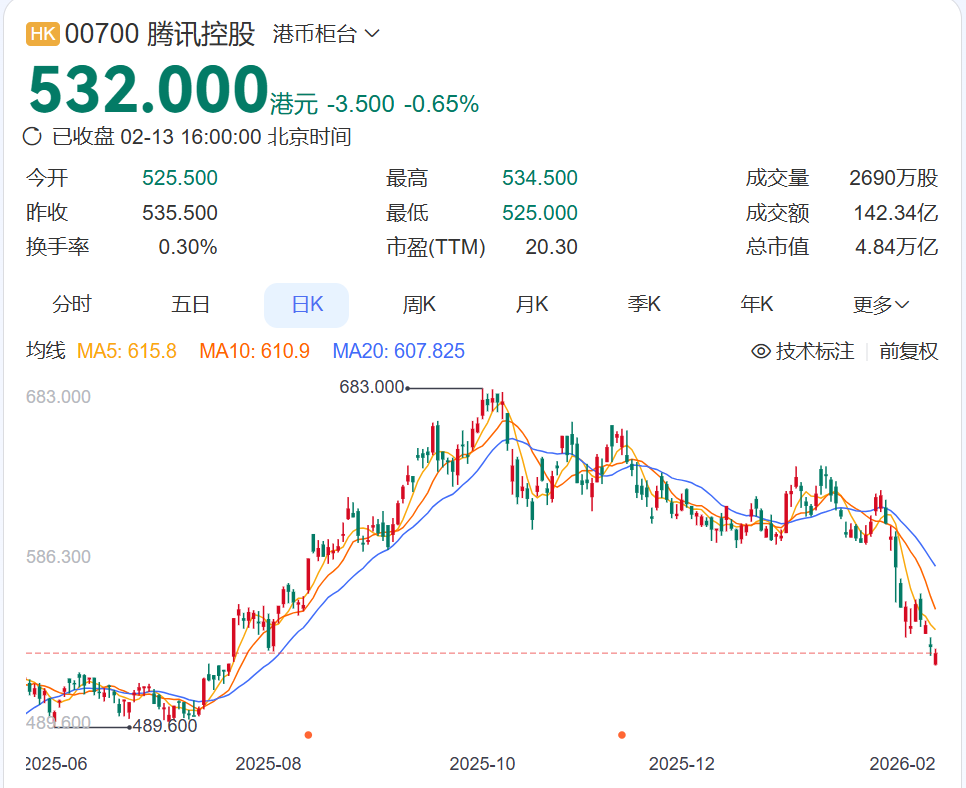
Group 1 - The core debate centers around which companies will emerge as winners in the AI space, leading to a mispricing of fundamentally strong companies like Tencent, which has seen its stock drop 10% this year and 21% from last year's peak [1] - Bernstein's research indicates that Tencent's stock decline is primarily due to concerns over its lagging AI model development and fears of disruption in the gaming industry, with the stock currently trading at a price-to-earnings ratio of 14-15 times its expected earnings for 2027, close to historical lows [3] - Alibaba has gained market favor due to its advancements in AI models, with a 30-40% growth in cloud revenue and the launch of its Qwen services, positioning it as a leader in the domestic AI competition [3] Group 2 - The recent "red envelope war" among Tencent, Alibaba, ByteDance, and Baidu aims to boost user growth for AI chatbots, but the effectiveness of cash incentives in driving user engagement remains questionable [4][5] - Despite significant increases in downloads and daily active users from the red envelope campaigns, overall user engagement, measured by daily active sessions and usage duration, has shown limited progress [5] - Tencent's AI model, mixed with its operational performance, has been under scrutiny, with its Turbo S model ranking seventh in a recent evaluation, reflecting the challenges it faces in AI development [8] Group 3 - Alibaba's strategy has become clearer with the launch of its Qwen services and a substantial investment of 3 billion RMB in user acquisition, which is expected to drive traffic to its e-commerce platforms [10] - The valuation of Alibaba's stock has remained higher than Tencent's, reflecting investor confidence in its cloud business and AI potential, with core e-commerce operations generating significant quarterly profits [11] - The ongoing capital expenditures for AI initiatives may limit Alibaba's strategic flexibility if investor tolerance for cash consumption decreases [10]
商业航天-VS-AI应用
2026-01-26 15:54
Summary of Conference Call Records Industry Overview - The conference call discusses the **cloud computing** and **AI application** industries, highlighting the impact of rising costs and investment strategies in these sectors [1][3][4]. Key Points and Arguments Cloud Computing Price Increases - Cloud computing prices have risen by **10%-15%** due to price hikes across the entire AI industry chain, affecting storage, CPU, and cloud infrastructure [3][4]. - Major cloud providers like **Amazon** and **Alibaba Cloud** have already increased their prices, with expectations that others, including **Tencent Cloud** and **Huawei Cloud**, will follow suit [4]. - The surge in **Token consumption** is driving a significant increase in computing power demand, indicating a long-term trend of rising cloud computing prices [4]. Investment in AI and Cloud Infrastructure - **ByteDance** plans to increase its **KMAX capital expenditure** to approximately **300 billion** by 2026, focusing on domestic chip procurement [5]. - The **ITC market** is currently led by **Dongyangguang**, followed by **Runze Technology** and **Daiwei Technology**, with liquid cooling technology companies like **Inveke** also expected to benefit [5]. Market Performance Comparison - The **commercial aerospace sector** has seen an average stock price increase of over **100%** since late November 2025, while the **AI application sector** has experienced an average increase of over **30%** since late December 2025, but has faced a **40%** correction [6][7]. - The commercial aerospace sector is viewed as having released some risk, while the AI application sector still holds potential for growth [7][8]. Strategic Moves by Major Players - **Tencent** has launched a **10 billion** cash incentive to promote its **Yuanbao application**, indicating a strong focus on AI [2][9]. - **ByteDance** is set to showcase its **Doubao** application during the 2026 Spring Festival, aiming to replicate the success of **Douyin** [9]. Additional Important Insights - The competition among major internet companies for **super entrance** in the AI space is intensifying, with **Alibaba** significantly increasing its advertising expenditures [8]. - Investment strategies for AI-related stocks include focusing on companies with strong ties to major players, leading firms in quality scenarios, and those with robust performance support [10][11]. Recommendations for Investors - Companies with strong partnerships with major firms, such as **Alibaba's Guangyun Technology** and **Tencent's BoSi Software**, are recommended for investment [10]. - High-performing companies with reasonable valuations and significant growth potential, like **Kingdee International** and **Hehe Fuxin**, are expected to perform well in 2026 [11].

腾讯(00700)电话会:2025年全年实际资本支出将低于指引,GPU储备足够内部使用,微信最终将推出一个AI智能体
智通财经网· 2025-11-13 23:49
Core Insights - Tencent's Q3 performance exceeded market expectations, driven by revenue growth in AI cloud services and a double-digit year-on-year increase in enterprise services revenue [1] - The company anticipates that its actual capital expenditure for 2025 will be lower than previous guidance but still higher than in 2024, with Q3 capital expenditure reported at 12.98 billion RMB, a 24% decrease year-on-year and over 32% decrease quarter-on-quarter [1][15] - Tencent's CEO highlighted ongoing upgrades to the Mix Yuan model architecture, which is expected to enhance the company's competitive edge in AI functionalities within WeChat [1][24] Financial Performance - Total revenue for Q3 reached 193 billion RMB, a 15% year-on-year increase, with gross profit at 109 billion RMB, up 22% year-on-year [4][8] - Non-IFRS operating profit was 73 billion RMB, reflecting an 18% year-on-year growth, while profit attributable to equity holders was 71 billion RMB, also up 18% year-on-year [4][8] - Revenue breakdown: Value-added services accounted for 50% of total revenue, with social networks contributing 17%, domestic games 22%, and international games 11% [7][8] Business Segments - In the gaming sector, domestic game revenue grew by 15% year-on-year, driven by titles like "Delta Force" and "Honor of Kings," while international game revenue surged by 43% year-on-year [9][11] - Marketing services revenue increased by 21% year-on-year to 36 billion RMB, supported by growth in advertising spending across major categories [12] - Financial technology and enterprise services revenue reached 58 billion RMB, a 10% year-on-year increase, with strong growth in commercial payment services and consumer credit [13] AI and Cloud Services - The growth of cloud services is constrained by the availability of AI chips, with the company prioritizing internal use over external leasing [1][36] - The Mix Yuan model's capabilities have been enhanced, particularly in complex reasoning tasks, and the company is actively recruiting top talent to support this initiative [17][24] - The company is developing an AI agent within WeChat that aims to assist users in completing various tasks, leveraging its extensive ecosystem [2][24] Strategic Partnerships - Tencent is in discussions with Apple regarding a payment agreement for mini-games and small programs, with expectations of a lower commission rate of 15% compared to the usual 30% [3][25] - The company expressed satisfaction with the progress made in its relationship with Apple, indicating potential future announcements [3][25] Future Outlook - The company expects continued growth in its international gaming segment, although growth rates may slow to align with potential trend lines [14] - The overall advertising growth is anticipated to continue, supported by improvements in consumer spending and the deployment of AI capabilities [25][38]
美银证券:引述腾讯控股(00700)指AI业务较同行有显著变现潜力 重申“买入”评级
智通财经网· 2025-05-29 08:09
Group 1 - The core viewpoint of the article is that Bank of America Securities maintains a "buy" rating for Tencent Holdings, with a target price of HKD 631, highlighting the potential of AI investments [1] - Tencent's management indicated that several AI products have entered the post-launch phase, but monetization will take several quarters to materialize [1] - The company is leveraging existing business operational leverage to fund AI investments, with short-term cost impacts primarily from depreciation [1] Group 2 - Tencent's commercial services department has four structural growth drivers: small store commissions, CRM services and enterprise WeChat software, security and real-time communication solutions, and GPU leasing [2] - The management remains optimistic about the long-term potential of enterprise services in China, with growth paths extending beyond infrastructure services to include software services [2] - Tencent is gradually enhancing monetization potential through increased traffic, improved ad click rates, and regular ad load increases [2]
超预期!腾讯Q1营收同比增13%,AI对广告和游戏业务产生贡献
Ge Long Hui· 2025-05-15 09:59
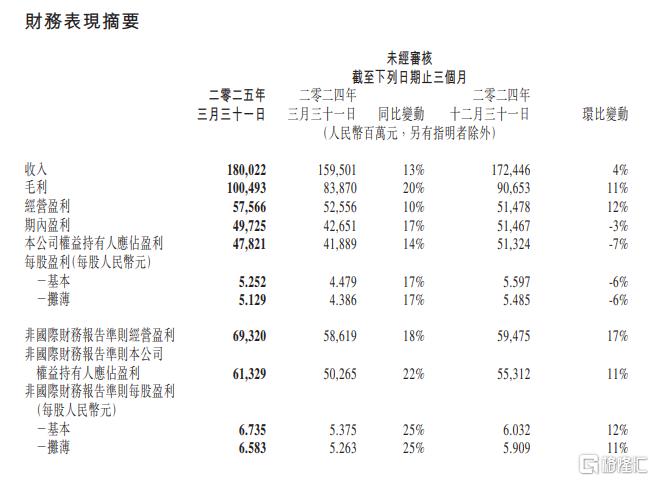
Core Insights - The company reported a revenue of 180.02 billion RMB for the first quarter, representing a year-on-year growth of 13%, surpassing the forecast of 175.6 billion RMB [1][2] - Net profit attributable to equity holders was 47.82 billion RMB, a 14% increase year-on-year, but below the expected 51.69 billion RMB [1][2] - The gross profit reached 100.49 billion RMB, up 20% year-on-year, with a gross margin improvement from 53% to 56% [1][2] Revenue Breakdown - Value-added services revenue was 92.13 billion RMB, growing 17% year-on-year, accounting for 51% of total revenue [5] - Marketing services revenue increased to 31.85 billion RMB, a 20% growth, driven by strong demand for advertising on platforms like WeChat [3][5] - Financial technology and enterprise services revenue was 54.91 billion RMB, reflecting a 5% year-on-year growth [3][5] Profitability Metrics - Operating profit was reported at 57.57 billion RMB, a 10% increase year-on-year [2] - Non-IFRS operating profit reached 69.32 billion RMB, up 18% year-on-year [2] - Earnings per share (EPS) based on non-IFRS measures was 6.735 RMB, a 25% increase compared to the previous year [2] Investment and R&D - The company invested 18.91 billion RMB in R&D, marking a 21% increase year-on-year [5] - Capital expenditures amounted to 27.48 billion RMB, with a significant year-on-year growth of 91% [5] Future Outlook - The company anticipates continued solid growth in high-quality revenue, with AI capabilities contributing positively to advertising and gaming sectors [6] - Increased investments in AI applications and opportunities within WeChat are expected to support financial stability despite additional costs [6]
多只宽基ETF,成交放量;腾讯一季度收入超1800亿元!贵州茅台拟调整股东大会召开地点→
新华网财经· 2025-05-15 00:26
Market Activity - On May 14, several broad-based ETFs saw significant trading volume, with Huatai-PB CSI 300 ETF trading at 4.893 billion yuan, an increase of 1.723 billion yuan from the previous day's 3.17 billion yuan. Huaxia SSE 50 ETF also saw its trading volume double to 3.514 billion yuan from 1.593 billion yuan [1][13] - The net subscription amount for technology growth ETFs has been notable, with Huaxia SSE Sci-Tech Innovation Board 50 ETF seeing a net subscription of 2.336 billion yuan and Jiashi SSE Sci-Tech Innovation Board Chip ETF at 1.012 billion yuan [1][13] Company Updates - Tencent Holdings announced a revenue of 180.022 billion yuan for Q1 2025, a year-on-year increase of 13%, with net profit attributable to equity holders at 47.821 billion yuan, up 14%. The company is increasing investments in AI opportunities within its applications [1][16] - Guizhou Moutai announced the adjustment of the venue for its 2024 annual shareholders' meeting due to an overflow of registered attendees, now set to be held at the Moutai Conference Center in Renhuai City, Guizhou Province on May 19, 2025 [1][7] Economic Indicators - The Ministry of Science and Technology, along with several financial regulatory bodies, released 15 policy measures to support technological innovation through venture capital, monetary credit, and capital markets [4] - The National Bureau of Statistics reported that in early May 2025, 12 out of 50 monitored production materials saw price increases, while 32 experienced declines. For instance, the price of live pigs decreased by 0.7% to 14.8 yuan/kg, and soybean meal dropped by 12.9% to 3,241.2 yuan/ton [4] - In April, the total social financing stock grew by 8.7% year-on-year, with M2 money supply increasing by 8% [6] Financial Sector Developments - The average interest rate for newly issued corporate loans in April was approximately 3.2%, down about 50 basis points year-on-year, while the average rate for personal housing loans was around 3.1%, down about 55 basis points [7] - The Ministry of Finance announced plans to issue 40 billion yuan in government bonds through competitive bidding, with the bonds set to start accruing interest on May 15, 2025 [5] Industry Trends - The banking sector is experiencing a wave of executive changes, with 9 chairpersons, 12 general managers, and 11 vice presidents changing across various firms, indicating a strong correlation with local economic conditions and a demand for versatile talent [9] - Industrial enterprises reported a 4.3% year-on-year increase in sales revenue in April, with high-tech industries and digital economy sectors growing by 15.3% and 13.4%, respectively [5]

持续加码AI!腾讯,最新公布
Zheng Quan Shi Bao· 2025-05-14 11:43
Core Insights - Tencent is significantly increasing its investment in AI, with a focus on enhancing product experience and generating high-quality revenue streams [1][2][3] Financial Performance - In Q1 2025, Tencent reported revenue of 1800.2 billion yuan, a year-on-year increase of 13% - Gross profit reached 1004.9 billion yuan, up 20% year-on-year - Operating profit (Non-IFRS) was 693.2 billion yuan, reflecting an 18% year-on-year growth - The growth rates of gross profit and operating profit have consistently outpaced revenue growth for ten consecutive quarters, indicating improved profitability [1] Revenue Breakdown - Marketing services revenue grew by 20% year-on-year to 318.5 billion yuan, driven by AI technology upgrades and enhancements in the WeChat transaction ecosystem - Value-added services revenue increased by 17% to 921.3 billion yuan, with the gaming segment seeing a 24% rise, supported by the "Evergreen Strategy" and AI optimizations in user experience - Financial technology and enterprise services revenue rose by 5% to 549.1 billion yuan, with notable growth in enterprise services and AI-related income [1] AI Strategy and Investments - Tencent's R&D expenditure reached 189.1 billion yuan, a 21% increase year-on-year, while capital expenditure was 274.8 billion yuan, marking a 91% year-on-year increase - The company is focusing on AI capabilities across its core products, enhancing user experiences and integrating AI into various applications [1][2] - Tencent's mixed Yuan model continues to evolve, with new models achieving significant improvements in international benchmark tests and advancements in generative AI [2] Future Outlook - The CEO emphasized that the high-quality revenue growth provides a solid foundation for long-term AI investments, which are expected to create substantial value for users and society [2] - Tencent plans to further increase its capital expenditures in 2025, with a focus on acquiring more GPUs to meet inference demands [3]
腾讯控股:AI能力已经对效果广告与长青游戏等业务产生了实质性的贡献
news flash· 2025-05-14 08:35
Core Viewpoint - Tencent Holdings announced a solid growth trend in high-quality revenue for the first quarter of 2025, driven by substantial contributions from AI capabilities in its advertising and gaming sectors [1] Group 1: Business Performance - The company reported that its AI capabilities have made a significant impact on its performance in effect advertising and evergreen games [1] - Tencent is increasing investments in new AI opportunities, particularly in its Yuanbao application and within WeChat [1] Group 2: Financial Strategy - During the phase of strategic investment in AI, the existing high-quality revenue will help absorb the additional costs associated with these AI-related investments, maintaining financial stability [1] - Tencent anticipates that these strategic AI investments will create value for users and society, leading to long-term and substantial incremental returns [1]