兴全趋势投资

Search documents
从创造超额到兑现利润,主动权益管理能力是如何炼成的?
券商中国· 2026-02-08 23:34
Core Viewpoint - The capital market in 2025 was driven by clear industry trends and rapid market rotations, with active equity funds demonstrating strong value capture capabilities, contributing over 2.6 trillion yuan in profits to investors, with active equity funds alone contributing approximately 1.1 trillion yuan [1] Group 1: Performance of Active Equity Funds - Active equity funds are valued for their ability to generate excess returns and convert them into real profits for holders, exemplified by Xingzheng Global Fund, which generated 40.94 billion yuan in profits for holders in 2025 [2] - Over the past decade, Xingzheng Global Fund's 28 active equity products averaged over 2 billion yuan in profits per product, with Xingquan Heiyi leading with 13.056 billion yuan in profits [3][4] - Xingzheng Global Fund's active equity funds established for over ten years achieved an average annualized return of 12.58%, providing long-term returns across market cycles [4] Group 2: Fund Manager Performance - Fund managers at Xingzheng Global Fund managing over 20 billion yuan have shown strong alpha generation capabilities, with their longest-managed products achieving excess returns over 1, 3, and 5 years [6][7] - In 2025, 26 out of 27 active equity funds managed by Xingzheng Global Fund outperformed their benchmarks, indicating a broad-based ability to generate excess returns across the platform [8] Group 3: Investment Methodology and Organizational Structure - The profit generation is supported by a systematic investment methodology and organizational structure, with flagship products providing long-term value and a diverse range of funds contributing to profit stability [10][11] - The investment approach emphasizes broad market selection and balanced allocation, avoiding reliance on single industries or styles, which helps manage large-scale funds effectively [12][13] - The platform's research and investment system ensures a high success rate in generating profits, with a focus on deep research and cross-group collaboration to uncover investment opportunities [14][15] Group 4: Long-term Value and Client Focus - The investment philosophy is rooted in a long-term value perspective, with a focus on creating sustainable returns for clients, supported by a robust assessment framework for fund managers [15][16] - The organizational culture promotes resilience and reduces dependency on individual star fund managers, ensuring stable investment capability output [16][17]

“顶流”基金经理大起底
Zhong Guo Ji Jin Bao· 2026-02-08 03:13
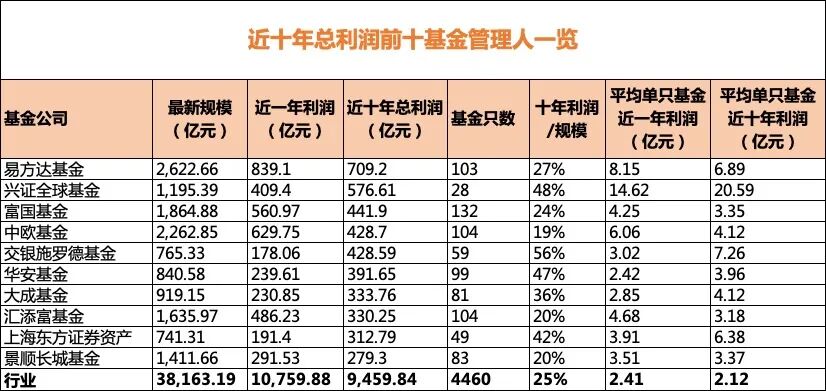
Core Insights - The active equity fund industry in China has generated nearly 1 trillion yuan in profits over the past decade, with significant contributions from leading fund companies [2][4] - Among 29 fund managers managing over 20 billion yuan, only 11 have consistently outperformed benchmarks over 1, 3, and 5 years, indicating a notable divergence in management capabilities [1][6] Industry Performance - The total profit generated by active equity funds in the last ten years reached 9,459.84 billion yuan, with an annual profit of 10,759.88 billion yuan in 2025 [2][4] - The top ten fund management companies contributed nearly 40% of the total profits, with E Fund, Xingzheng Global Fund, and Fortune Fund leading the profit rankings [3][4] Fund Manager Analysis - E Fund achieved the highest total profit of 709.20 billion yuan over ten years, while Xingzheng Global Fund demonstrated high profitability relative to its size, with a profit-to-scale ratio of 48% [4][6] - A select group of fund managers, including Yang Dong and Liu Jianwei, have shown exceptional performance, with some achieving over 100% excess returns over various time frames [7][8] Future Industry Trends - The industry is entering a new phase where the focus is shifting from mere scale growth to long-term value creation efficiency and the ability to manage large funds effectively [9] - Developing a robust investment research system that is resilient to market style changes and nurturing talent capable of managing large-scale funds will be crucial for high-quality development in the future [9]
“顶流”基金经理大起底!
Zhong Guo Ji Jin Bao· 2026-02-08 02:32
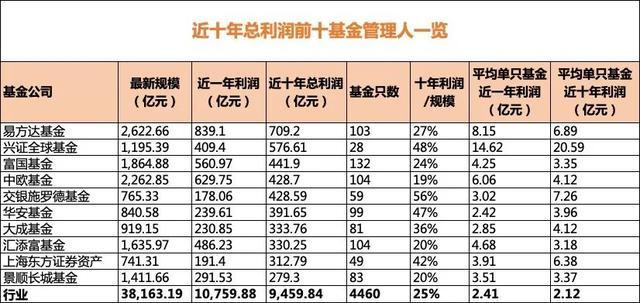
Core Insights - The active equity funds have generated nearly 1 trillion yuan in profits over the past decade, with significant contributions from leading companies [2][3][6] - The performance of top fund managers managing over 20 billion yuan has shown considerable differentiation, with only 11 out of 29 achieving sustained positive excess returns over various time frames [8][9] Industry Performance - As of the end of 2025, the total profit generated by active equity funds reached 9,459.84 billion yuan, with an annual profit of 10,759.88 billion yuan for the year 2025 [3][5] - The top ten fund companies contributed nearly 40% of the total profits, with E Fund, Xingzheng Global Fund, and Fortune Fund leading the profit rankings, each exceeding 40 billion yuan [5][6] Fund Manager Analysis - Among the 29 fund managers with assets under management exceeding 20 billion yuan, only 11 have consistently outperformed their benchmarks over the past year, three years, and five years [8][9] - Notable fund managers achieving high excess returns include Liu Jianwei from E Fund and Yang Dong from Guangfa Fund, with excess returns of 100.19%, 108.5%, and 114.9% over one, three, and five years respectively [10][12] Profitability Metrics - The "input-output ratio" indicates the efficiency of profit generation relative to fund size, with Jiao Yin Schroder Fund leading at 56%, significantly above the industry average of 25% [6][9] - The average profit per fund for Xingzheng Global Fund reached 20.59 billion yuan, nearly ten times the industry average of 2.12 billion yuan, showcasing strong research and investment capabilities [7][12] Future Industry Trends - The industry is entering a new development phase where the focus shifts from mere scale growth to long-term value creation efficiency and the ability to manage large-scale funds [12][13] - Building a research and investment system that is not reliant on market styles and can withstand market cycles will be crucial for high-quality development in the future [12]
兴证全球基金:明星基金经理失灵,权益大厂光环褪尽
Sou Hu Cai Jing· 2026-02-05 10:49
Core Insights - The departure of Dong Li, a once-prominent fund manager at Xingzheng Global Fund, marks a significant decline for the firm, which has seen its actively managed equity fund size shrink by over 40% from 2021 to 2025 [2][9] - Dong Li's management of two major funds resulted in cumulative losses exceeding 131 billion yuan, while generating over 10 billion yuan in management fees for the company, highlighting a stark contrast between fund performance and investor returns [3][4] Group 1: Fund Performance and Management Changes - Dong Li's management of the Xingquan Social Responsibility fund resulted in a return of -15.41% during his tenure, and his largest fund, Xingquan Trend Investment, suffered cumulative losses of 106.48 billion yuan from 2022 to mid-2025 [3][4] - The overall size of Dong Li's managed funds dropped from a peak of 386.31 billion yuan to 151.39 billion yuan by Q3 2025 [3] - The performance of other prominent fund managers at Xingzheng Global, such as Xie Zhiyu, has also deteriorated, with his managed fund size shrinking nearly 60% from its peak, and cumulative losses reaching 61.3 billion yuan from 2022 to 2025 [5][6] Group 2: Strategic Challenges and Market Position - Xingzheng Global Fund's actively managed equity fund size decreased from 2029.78 billion yuan at the end of 2021 to 1195.39 billion yuan by the end of 2025, reflecting a loss of over 800 billion yuan in four years [9] - The firm has struggled to adapt to changing market conditions, with significant losses in stock investments totaling 478.78 billion yuan from 2022 to mid-2025 [9] - The company's late entry into the ETF market, with its first product launched in December 2025, indicates a lag in strategic positioning compared to competitors [10] Group 3: Leadership Changes and Financial Performance - Leadership changes at Xingzheng Global Fund, including the departure of the former chairman and the appointment of new executives with research backgrounds, suggest an attempt to revitalize the firm's investment strategy [11] - The firm's management fee income has declined from 46.89 billion yuan in 2021 to 14.07 billion yuan in 2024, reflecting the impact of poor fund performance on revenue [11] - The company's overall revenue dropped from 65.68 billion yuan in 2021 to 32.79 billion yuan in 2024, with net profit also decreasing significantly during the same period [11] Group 4: Industry Context and Future Outlook - The challenges faced by Xingzheng Global Fund are indicative of broader issues within the public fund industry, including over-reliance on star fund managers and mismatches between performance and fees [12] - The decline of Xingzheng Global Fund's reputation as a leading equity fund provider raises concerns about its future viability in a competitive market [13]
兴证全球“换帅”求变,权益基金巨头能否重振雄风?
Xin Lang Cai Jing· 2025-12-30 07:43
Group 1: Management Changes - The recent management change at Xingzheng Global Fund involves veteran Zhuang Yuanfang becoming the chairman and Chen Jinqian as the general manager, indicating a new leadership core [1][7] - The transition follows the resignation of former chairman Yang Huahui due to age, with Zhuang having acted as chairman since June 23 [1][7] Group 2: Performance Decline - Xingzheng Global Fund was once a leading player in equity investments, achieving an average return of 369.78% from April 2012 to April 2022, significantly outperforming competitors [2][8] - However, following the departure of star fund manager Dong Chengfei in 2021, the company's performance has deteriorated, dropping to 12th place with an average return of 109.69% from April 2012 to April 2025 [2][8] Group 3: Managerial Challenges - The company is facing a talent gap in its equity fund management, with only Xie Zhiyu performing well among current managers, while others like Dong Li have underperformed significantly [3][9] - As of Q3 2025, the company's non-monetary scale has decreased to 288.83 billion yuan, ranking 20th in the industry, down from 305.88 billion yuan and 16th place in 2021 [3][9] Group 4: ETF Market Position - Xingzheng Global has been slow to enter the ETF market, launching its first product only in December 2025, while competitors have already established significant positions [4][10] - The total market size for ETFs reached 5.72 trillion yuan by December 1, 2025, with a notable growth of nearly 2 trillion yuan within the year, highlighting the competitive landscape [4][10] Group 5: Future Outlook - The management change is seen as a self-rescue effort amid declining performance, talent shortages, and lagging market positioning [5][11] - The new management faces the challenge of revitalizing equity investments and establishing a foothold in the competitive ETF market [5][11]
兴证全球“换帅”,7400亿基金大厂,能否再复当年勇?
Sou Hu Cai Jing· 2025-12-29 00:35
Group 1 - The core viewpoint of the news is the significant management changes at Xingzheng Global, with Zhuang Yuanfang becoming the chairman and Chen Jinqian being promoted to general manager, indicating a potential shift in the company's strategy [1][3] - The company has faced declining performance in its equity business, dropping from 3058.80 billion yuan in non-monetary scale in 2021 to 2888.32 billion yuan by the end of Q3 2025, falling from 16th to 20th place in the industry [3][10] - Xingzheng Global's late entry into the ETF market is concerning, as it only launched its first ETF product in December 2025, missing out on significant growth opportunities in a rapidly expanding market [3][11] Group 2 - The company, originally known as Xingye Fund, was established in 2003 and later restructured into a joint venture in 2008, gaining recognition for its strong performance in the equity market [4][5] - The departure of key fund managers, particularly the "Xingquan Five," has led to a significant decline in performance, with the average return dropping to 109.69% from a previous high of 369.78% [6][10] - The new general manager, Chen Jinqian, has a strong background in fixed income but faces challenges in revitalizing the equity and ETF segments, which are currently underperforming [13][15]
453人离任创纪录,顶流基金经理纷纷放手,背后原因不简单
Sou Hu Cai Jing· 2025-12-27 03:43
Core Viewpoint - The record number of 453 fund managers leaving their positions this year indicates significant changes in the fund industry, driven by a combination of top managers voluntarily relinquishing control of core products, performance pressures, and regulatory adjustments [2][36]. Group 1: Voluntary Resignation of Top Managers - Many leading fund managers are stepping down from managing core products, with notable figures like Liu Gesong and Lei Zhiyong making such moves recently [4][11]. - Liu Gesong's management of the Guangfa Small Cap Growth Fund has seen a reduction in assets from 33.4 billion to 27.5 billion yuan, reflecting a trend among top managers to pass responsibilities to newer talent [4][11]. - This trend of "passing the baton" is seen as a way to provide opportunities for newcomers while alleviating the pressure on seasoned managers [9][13]. Group 2: Performance-Driven Departures - A significant number of fund managers are leaving due to increasing performance pressures, with strict internal assessments leading to forced resignations for those with underperforming funds [15][21]. - The regulatory environment has intensified scrutiny, with performance-related pay being cut by at least 30% for managers whose funds significantly underperform benchmarks [19][27]. - This shift has resulted in a higher turnover rate, with many managers transitioning to research roles or leaving the industry altogether [21][25]. Group 3: Industry Restructuring and Regulatory Impact - The influx of new managers, totaling 593 this year across over 130 institutions, indicates that the fund industry is undergoing a significant restructuring rather than shrinking [23][36]. - Regulatory changes have prompted a focus on long-term performance and investor returns, moving away from a previous emphasis on scale and star managers [27][32]. - The tightening of regulations aims to enhance the quality of fund management, ensuring that only capable managers remain in the industry, which is expected to benefit investors in the long run [30][34].

年内453人离任创历史新高,顶流基金经理也难逃“洗牌”
Di Yi Cai Jing· 2025-12-24 13:37
Core Insights - The public fund industry is experiencing a significant personnel shift, driven by multiple factors including regulatory reforms, compensation adjustments, and the need for high-quality transformation [2][10] - Notable fund managers, such as Liu Gesong and Lei Zhiyong, have recently stepped down from their positions, raising market concerns about their future roles, although they have no plans to leave their companies [2][3] - The turnover rate of fund managers has reached a historical high, with 453 managers leaving their positions this year, a more than 30% increase compared to the previous year [3][6] Group 1: Personnel Changes - Liu Gesong announced his resignation from managing the Guangfa Small Cap Growth fund after over eight years, reducing his managed products from 5 to 4, with assets under management decreasing from 33.4 billion to approximately 27.5 billion [3] - The trend of fund managers stepping down is not isolated; it reflects a broader industry movement towards "mentoring the new generation" and focusing on investment management rather than administrative roles [4][5] - The industry has seen a notable increase in fund manager turnover, with over 5,015 funds experiencing changes in management this year, marking a more than 20% increase from the previous year [6][8] Group 2: Industry Dynamics - The industry is witnessing a shift towards a "return to investment research" trend, with several high-profile fund managers resigning from management roles to concentrate on investment [5][9] - The regulatory environment has intensified, with new performance assessment and compensation management frameworks being introduced, compelling fund managers to focus on improving investment quality and enhancing investor experience [8][9] - The understanding of management scale within the industry has become more rational, with practices like "top-tier managers reducing their load" and "performance-based product limits" becoming common [9][10]
冠军基金经理雷志勇卸任大摩万众创新
2 1 Shi Ji Jing Ji Bao Dao· 2025-12-24 07:02
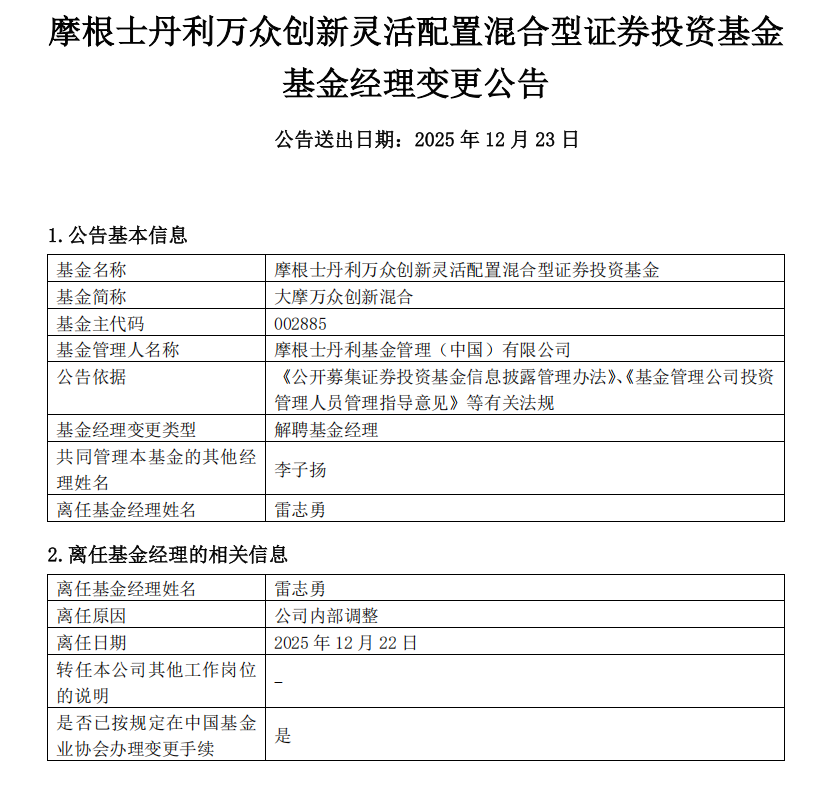
Core Viewpoint - The article discusses the transition of fund management from veteran manager Lei Zhiyong to the younger manager Li Ziyang at Morgan Stanley's Wan Zhong Innovation Fund, highlighting the trend of established fund managers passing on responsibilities to the new generation within the industry [1][5]. Group 1: Fund Manager Transition - Lei Zhiyong will leave the management of the Wan Zhong Innovation Fund on December 22, 2025, due to internal adjustments, while continuing to manage other funds [2][3]. - Li Ziyang, who has been with Morgan Stanley since 2020, will take over the management of the Wan Zhong Innovation Fund, continuing its investment focus in the defense and military sectors [4][5]. Group 2: Performance and Strategy - In 2024, Lei Zhiyong's fund, the Morgan Stanley Digital Economy Fund, achieved a remarkable 69.23% return, while the Wan Zhong Innovation Fund experienced a loss, highlighting significant performance divergence [6][7]. - The Wan Zhong Innovation Fund has struggled under Lei's management, with a cumulative return of -0.91% over five and a half years, contrasting with the strong performance of other funds he manages [7][8]. Group 3: Industry Trends - The practice of veteran fund managers mentoring younger talent and transitioning fund management responsibilities is becoming common in the industry, helping to alleviate the pressure on senior managers [5][6]. - As of December 23, 2023, there have been 3,920 funds that implemented a dual or multiple fund manager model this year, indicating a shift towards collaborative management structures [5].
基金经理,不能“旱涝保收”了
3 6 Ke· 2025-12-15 04:03
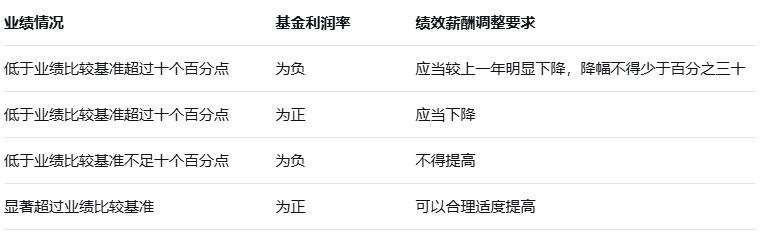
Core Viewpoint - The recent draft guidelines from the China Securities Regulatory Commission (CSRC) propose a performance evaluation mechanism for fund managers, emphasizing a tiered adjustment of performance compensation based on the past three years' performance against benchmarks and fund profitability [1][2]. Performance Evaluation Mechanism - Fund managers' performance compensation can be adjusted in four scenarios: a decrease of no less than 30% if performance is more than 10% below the benchmark with negative profitability, a decrease if performance is more than 10% below the benchmark with positive profitability, no increase if performance is less than 10% below the benchmark with negative profitability, and a reasonable increase if performance significantly exceeds the benchmark with positive profitability [1][2]. Current Fund Performance - Among 20 actively managed billion-level equity funds, 8 funds outperformed their benchmarks by over 10%, while 6 funds underperformed by over 10% as of December 9 [2]. Notable Fund Performances - The top-performing fund, Galaxy Innovation Growth A, managed by Zheng Weishan, achieved an excess return of 49.38% over three years, with a total return of 243% and an annualized return of 20.58% since its management began in May 2019 [4][5]. - Other notable funds include Dachen High Growth A, managed by Liu Xu, with a total return of 417.29% and an annualized return of 17.16% over 10 years, and Xingquan Business Model Preferred A, managed by Qiao Qian, with a total return of 203.42% and an annualized return of 16.11% over 7 years [5][7][8]. Investment Strategies - Zheng Weishan's strategy focuses on heavily investing in technology stocks, maintaining a high concentration in top holdings, while Liu Xu adopts a diversified approach across various sectors, balancing between well-known blue-chip stocks and smaller companies [5][7][9]. - Qiao Qian employs a flexible trading strategy with shorter holding periods and a diversified sector allocation, aiming to balance long-term investment judgments with short-term market fluctuations [9][10]. Implications of New Guidelines - The proposed guidelines aim to address the issue of fund managers' compensation being disconnected from performance, encouraging a stronger link between fund performance and manager remuneration [1][2][10].