瑞典克朗

Search documents
美银:历史数据显示石油价格冲击往往利好这些货币
美股IPO· 2026-03-08 00:48
Group 1 - The core viewpoint of the article highlights that historical oil supply shocks tend to favor certain currencies, particularly the US dollar and Canadian dollar, while currencies like the New Zealand dollar and Australian dollar face pressure [1][3] Group 2 - The analysis indicates that the foreign exchange market has reacted moderately to recent US-Israel military actions in Iran, with price movements largely aligning with expectations, including a general strengthening of the US dollar [3] - Historical analysis of geopolitical events disrupting global oil supply reveals a consistent pattern where currencies of oil-producing countries perform well, while those of energy-importing countries tend to weaken [3] - The Canadian dollar (CAD) and US dollar (USD) typically show strong performance during oil shocks, whereas the New Zealand dollar (NZD), Australian dollar (AUD), Swedish krona, and occasionally the Japanese yen (JPY) perform poorly [3] - The occasional weakness of the yen during oil shocks may reflect Japan's heavy reliance on energy imports, which can offset its traditional safe-haven status during market stress [3] Group 3 - Despite increased currency volatility due to Middle Eastern tensions, many hedging strategies remain attractively priced compared to past oil supply disruptions [3] - The article emphasizes that the volatility of CADJPY and NZDUSD may present valuable trading opportunities, with potential benefits from CADJPY positions in a rising oil price environment and shorting NZDUSD if conflicts persist [3] - The analysis notes that while volatility in the foreign exchange market has increased, many hedging trades are still below levels typically observed during previous oil shock events, suggesting that the market may be underestimating tail risks associated with geopolitical escalations [3]


巴克莱:美国关税裁决或利好风险敏感型货币
Xin Lang Cai Jing· 2026-02-23 00:33
Core Viewpoint - The U.S. Supreme Court's ruling on tariffs poses a greater obstacle to the White House's trade barriers and is beneficial for global economic growth [1] Group 1: Impact on Currency Markets - Barclays strategists, including Lefteris Farmakis, believe the ruling primarily benefits higher-risk currencies in the foreign exchange market [1] - They specifically highlight high-yield emerging market currencies and fundamentally strong G10 currencies, such as the Australian dollar and Swedish krona [1] Group 2: Implications for U.S. Assets - The ruling reflects the functioning of the U.S. system of checks and balances [1] - Under unchanged conditions, this development is expected to reduce investors' premium preference for U.S. assets and the dollar [1] Group 3: Fiscal Considerations - The fiscal implications of the ruling are noteworthy, particularly regarding potential stimulus effects from tariff refunds, which may prompt a response from the Federal Reserve [1]
特朗普的“新世界秩序”正推动瑞典转向欧元
Xin Lang Cai Jing· 2026-02-17 10:08
Core Viewpoint - Sweden is considering adopting the euro, marking a significant shift in its monetary policy, influenced by geopolitical concerns and its recent NATO membership [1][6][7] Group 1: Political Developments - The Swedish government has initiated discussions on the pros and cons of joining the eurozone, led by Finance Minister Elisabeth Svantesson [2][5] - Lars Calmfors, a prominent economist, has shifted his stance to support eurozone membership, citing changed geopolitical dynamics and the need for stronger European cooperation [8][10] - Political support for euro adoption is fragmented, with only the Liberal Party firmly in favor, while other parties remain undecided or opposed [11][10] Group 2: Economic Implications - Joining the eurozone could enhance Sweden's political ties within Europe and provide a stronger voice in monetary policy, potentially benefiting trade and investment [7][9] - Sweden's economy is increasingly synchronized with the eurozone, reducing the necessity for an independent monetary policy [3][8] - The volatility of the Swedish krona has been a concern for business leaders, who argue that adopting the euro would stabilize the currency and benefit the industrial sector [3][8] Group 3: Public Sentiment and Challenges - Public opinion remains divided, with nearly half of Swedes opposing euro adoption, although support has increased compared to a decade ago [10][11] - A significant barrier to euro adoption is the need for broad political and public support, as previous decisions have relied on public referendums [10][11] - If obstacles are overcome, transitioning from the krona to the euro could take at least four years, including a two-year period to establish exchange rate stability [11][10]

瑞郎本周涨约1.1%,瑞典克朗涨1.3%,挪威克朗涨约2%
Jin Rong Jie· 2026-02-13 21:35
Core Viewpoint - The article discusses the fluctuations in various currency pairs, highlighting the performance of the Euro, British Pound, and commodity currencies against the US Dollar during the week. Group 1: Currency Performance - The Euro appreciated by 0.04% against the US Dollar, closing at 1.1875, with a weekly gain of 0.51% [1] - The British Pound increased by 0.33% against the US Dollar over the week [1] - The US Dollar depreciated by 1.07% against the Swiss Franc [1] Group 2: Commodity Currencies - The Australian Dollar rose by 0.89% against the US Dollar [1] - The New Zealand Dollar increased by 0.44% against the US Dollar [1] - The US Dollar fell by 0.41% against the Canadian Dollar [1] Group 3: Scandinavian and Eastern European Currencies - The Swedish Krona appreciated by 1.31% against the US Dollar [1] - The Norwegian Krone increased by 1.98% against the US Dollar [1] - The Danish Krone rose by 0.50% against the US Dollar [1] - The Polish Zloty gained 0.73% against the US Dollar [1] - The Hungarian Forint increased by 0.14% against the US Dollar [1]
RIKSBANK EXCHANGES EU PAYMENT
Globenewswire· 2026-02-10 13:37
Group 1 - Sweden's EU membership requires monthly contributions to the EU budget, with payments made in Swedish kronor and exchanged into euro by a recipient central bank within the EU [1] - The Riksbank has scheduled an exchange of an EU payment amounting to SEK 5,764 million in February 2026, previously opting for exchanges to mitigate large fluctuations in the exchange rate [1] Group 2 - The exchanges conducted by the Riksbank do not serve any monetary policy purpose, and the impact on banking system liquidity is neutralized through FX-swaps [2] - The Riksbank plans to repurchase the equivalent euro amount in the foreign exchange market within two months following the exchange [2]

【环球财经】美元指数5日上涨
Xin Hua She· 2026-02-05 22:30
Core Viewpoint - The US dollar index increased by 0.21% on February 5, closing at 97.824, indicating a strengthening of the dollar against a basket of major currencies [1]. Currency Exchange Rates - The exchange rate for 1 euro was 1.1794 USD, down from 1.1809 USD the previous trading day [1]. - The exchange rate for 1 British pound was 1.3549 USD, down from 1.3663 USD the previous trading day [1]. - The exchange rate for 1 US dollar to Japanese yen was 156.90, up from 156.82 the previous trading day [1]. - The exchange rate for 1 US dollar to Swiss franc was 0.7774, up from 0.7766 the previous trading day [1]. - The exchange rate for 1 US dollar to Canadian dollar was 1.3682, up from 1.3668 the previous trading day [1]. - The exchange rate for 1 US dollar to Swedish krona was 9.0363, up from 8.9864 the previous trading day [1].
美元短期反弹难改长期弱势?借势布空或正当时!
Jin Shi Shu Ju· 2026-02-03 09:06
Group 1 - The core viewpoint of the articles indicates that despite a recent rebound attempt by the US dollar, its status as a safe-haven asset is not strengthening, particularly in the context of resilient economic performance and persistent inflation in the US [1][2]. - The Bloomberg Dollar Index recorded its largest two-day gain since April, driven by unexpectedly strong US factory data, which helped the dollar recover from a near four-year low reached last month, where it had declined approximately 1.3% [1]. - Jayati Bharadwaj from TD Securities predicts that the dollar will likely continue its recent rebound, with an expected increase of 2% in February, contrasting with the bearish sentiment that has suppressed the dollar's strength over the past month [1]. Group 2 - Bharadwaj suggests that all negative factors affecting the dollar will eventually manifest, recommending clients to take advantage of the dollar's rebound to establish short positions while going long on currencies like the euro, Australian dollar, British pound, and Swedish krona [2]. - Barclays Bank believes that the dollar's decline in January reflects ongoing weakness, as investor confidence in this global reserve currency has diminished to some extent [2]. - Analysts from Barclays note that the current dollar weakness occurs against a backdrop of significant resilience in the US economy, indicating a rise in risk pricing for the dollar and a growing skepticism about its reliability as a trade partner [2]. Group 3 - Concerns about potential disruptive changes in US trade policy persist, despite President Trump's announcement of a new trade agreement with India aimed at reducing tariffs on imports from India [3]. - DataTrek's Nicholas Colas highlights that the average decline of the dollar last month exceeded the monthly average for 2025, with the trend of dollar weakness against nearly all major currencies continuing into early 2026 [3].

黄金白银“闪崩”后绝地反攻 黄金暴涨近3% 美元反弹难阻避险狂潮
智通财经网· 2026-02-03 01:17
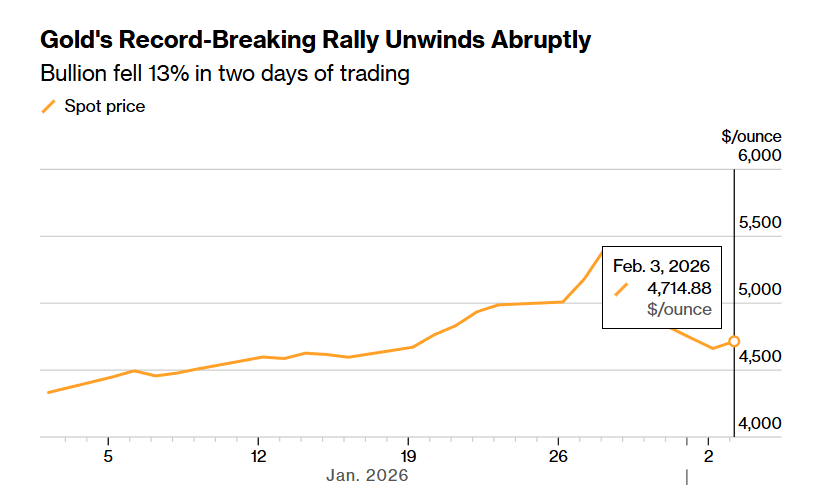
Group 1: Gold and Silver Market Trends - Gold prices have rebounded, recovering some losses after a previous drop of 13% over two days, with a recent increase of 2.9% approaching $4800 per ounce [1][4] - Silver prices also saw an increase of 5.1%, surpassing $83 per ounce, following a 7% decline earlier [1][4] - Deutsche Bank maintains its bullish forecast for gold, predicting prices could rise to $6000 per ounce [4] Group 2: Investor Behavior and Market Dynamics - Geopolitical tensions, currency devaluation, and concerns over the independence of the Federal Reserve have driven investors towards gold and silver, particularly from Chinese buyers [4] - The Chinese market is expected to see increased buying activity ahead of the Lunar New Year, which may influence market trends [4] Group 3: Dollar Performance and Predictions - Despite a recent rebound, analysts suggest the dollar may weaken further, with options pricing indicating bearish sentiment [5][6] - Some strategists predict a potential 2% increase in the dollar for February, contrasting with the previous month’s negative sentiment [7][8] - The dollar has experienced significant volatility, with recent economic data showing unexpected strength, which may support a short-term rebound [6][8]
美元创7月来最大单日涨幅 金银暴跌拖累大宗商品货币
Xin Lang Cai Jing· 2026-01-30 20:06
Core Viewpoint - The US dollar experienced a significant increase, marking its largest single-day gain since July, while precious metals like gold and silver plummeted, affecting the exchange rates of currencies from the Australian dollar to the Swiss franc [1][2]. Group 1: Market Performance - The US Dollar Index (DXY) ended the month with an approximate 0.9% increase, despite a decline of about 1.4% in January, which was the worst performance since August [1][2]. - The rebound of the dollar was attributed to the drop in precious metal prices and the appointment of Jerome Powell as the Federal Reserve Chairman [1][2]. Group 2: Currency Impact - The decline in precious metals has led to significant depreciation in currencies such as the Australian dollar, Swiss franc, and Swedish krona, which are heavily influenced by precious metal prices [1][2]. - Silver prices recorded the largest single-day drop in history, while gold prices experienced their largest decline since the early 1980s, ending a previous upward trend [1][2].
美元暴跌至四年低点!背后逻辑关乎你的钱袋子
Sou Hu Cai Jing· 2026-01-28 12:17
Core Viewpoint - The recent decline of the US dollar to a near four-year low is attributed to multiple factors, including the erosion of the Federal Reserve's independence, domestic political turmoil, and uncertainty in trade policies [2][8]. Exchange Rate Changes - The US dollar index fell to 96.219, a decrease of 0.84% in one day, with the euro rising to 1.1979 USD and the British pound to 1.3780 USD [2]. - The Japanese yen appreciated against the dollar, with 1 USD exchanging for 152.77 JPY, reflecting market speculation about potential intervention in the currency market [2]. Economic Fundamentals - The decline in the dollar's value is linked to the "confidence pricing logic" of exchange rates, where the dollar's status as a global reserve currency relies on the strength of the US economy and the independence of the Federal Reserve [3]. - Historical data shows that significant fluctuations in the dollar index are closely tied to the Federal Reserve's independence, which is currently under threat due to political pressures [4]. Trade Policies - Recent tariff increases on imports from South Korea by the Trump administration are seen as detrimental to market expectations, potentially leading to higher domestic inflation and retaliatory measures from trade partners [5]. - The unpredictability of US trade policies is causing global investors to reassess their positions in dollar-denominated assets, leading to capital outflows [5]. Political Environment - Ongoing political disputes between the Republican and Democratic parties regarding funding for the Department of Homeland Security raise concerns about a potential government shutdown, which could disrupt the release of key economic data [6]. - Historical precedents indicate that government shutdowns can negatively impact GDP growth, further eroding confidence in the dollar [6]. Currency Dynamics - The rise of the Japanese yen as a safe-haven currency is influenced by expectations of intervention in the currency market, as well as Japan's status as a major trading partner of the US [7]. - The offshore Chinese yuan has also seen fluctuations, recently falling below the 6.94 mark against the dollar, influenced by the overall weakness of the dollar and the relative stability of the Chinese economy [7]. Investment Implications - The current situation suggests that investors should diversify their currency holdings rather than solely relying on dollar assets, as the dollar's dominance may be weakening [8]. - Companies, especially those involved in imports and exports, are advised to implement currency hedging strategies to mitigate risks associated with exchange rate volatility [8].