
化工期货

Search documents
金融期货早评-20260324
Nan Hua Qi Huo· 2026-03-24 03:42
Report Industry Investment Rating - Not provided in the content Core Viewpoints - The core pricing lines of the global market in 2026 are as follows: Overseas, the "Mutually Assured Destruction (MAD)" balance between the US and Iran restricts the escalation of the conflict, but the secondary inflation risk from oil prices is reversing the global liquidity expectations, and the Fed's policy path is becoming more divergent. Domestically, Chinese assets have a triple safety premium, but the A-share market is still in a risk release stage. The core investment strategy in 2026 is "defense and counterattack" [2]. Summary by Directory Financial Futures - **Macro**: News drives the market. Fed officials have different views on interest rate hikes and cuts. The situation in the US - Iran conflict is complex, with Trump claiming progress in negotiations while Iran denying it [1]. - **RMB Exchange Rate**: Trump's claim of progress in US - Iran dialogue led to a drop in the US dollar index, and the RMB appreciated against the US dollar. Short - term export enterprises can lock in forward exchange settlement, and import enterprises can adopt a rolling foreign exchange purchase strategy [3]. - **Stock Index**: The A - share market fell due to liquidity shocks and geopolitical uncertainties. With the easing signal of the Middle East situation, the stock index may rebound, but the trend is unclear, so it is recommended to wait and see [5]. - **Treasury Bonds**: After the sharp fall of the A - share market, the bond market may rebound. It is recommended to use grid operations, sell high - position long orders in a timely manner, and gradually build long positions if the price continues to fall [6]. - **Container Shipping (Europe Line)**: The futures market is in a high - level volatile state, with a game between geopolitical emotions and the off - season fundamentals. It is expected to maintain a high - level wide - range shock in the short term [7][9][10]. Commodities New Energy - **Lithium Carbonate**: It fluctuates sharply in the short term. It is recommended to wait and see. In the medium and long term, the demand for lithium carbonate in downstream industries still has a strong support [12][13]. - **Industrial Silicon & Polysilicon**: It is affected by the callback cycle of the non - ferrous metal sector. In the long run, the demand for these two products will improve as the photovoltaic industry develops [14][15]. Non - ferrous Metals - **Copper**: After a sharp fall, the copper price rebounded. It is recommended to pay attention to the upper pressure when the price rebounds. If it fails to break through with heavy volume, the market may be volatile [17][18][19]. - **Zinc**: It was affected by systematic risks and rebounded slightly at night. It is expected to be weak in the short term due to inventory and macro factors [20]. - **Nickel - Stainless Steel**: The prices of nickel and stainless steel showed certain resilience. The supply of sulfur in the nickel industry chain is affected by the situation in the Strait of Hormuz, and there is a game between supply and macro - level factors [21][22]. - **Tin**: It followed the sector down and rebounded at night. It is expected to be weak in the short term and the long - term center of gravity may move upward [23]. - **Lead**: It oscillated and adjusted. It is expected to maintain an oscillatory operation under the pressure of inventory accumulation and cost support [24]. Oils and Fats & Feed - **Oilseeds**: The relaxation of Brazil's quarantine process affected the market. It is recommended to enter the market for reverse arbitrage between monthly spreads [25][26]. - **Oils**: The prices of oils fluctuated with crude oil. It is necessary to focus on the biofuel policies of Indonesia and the US this week [27]. Energy and Oil & Gas - **SC Crude Oil**: The crude oil price dropped sharply due to Trump's remarks. The negotiation situation is uncertain, and the short - term price is expected to fluctuate between $80 - 120 [29][30][31]. - **Fuel Oil**: The high - sulfur fuel oil strengthened slightly, and the low - sulfur fuel oil was dragged down by weak demand. The market's strength slowed down, but the price decline space is limited [32]. - **Asphalt**: Geopolitical disturbances are the core factors. The supply of asphalt is reduced, and the demand is weak. It is recommended to control positions and pay attention to combination strategies [33]. Precious Metals - **Platinum and Palladium**: They continued to decline under pressure. It is recommended to maintain a strategic long - position view on precious metals, and pay attention to position control [35][36][37]. - **Gold & Silver**: They had a V - shaped reversal. It is recommended to maintain a strategic long - position view, and they may oscillate at a low level in the short term [38][39]. Chemicals - **Pulp - Offset Paper**: The pulp spot price rose, and the market is expected to be neutral in the short term. Both pulp and offset paper futures can maintain interval trading [41][42]. - **Pure Benzene - Styrene**: The market fluctuated due to the changeable attitude of the US. They are expected to oscillate strongly in the short term, but the geopolitical situation is uncertain [43][44]. - **LPG**: The futures price rose sharply due to capital emotions. The market is expected to return to the fundamental logic, and the short - term price may oscillate at a high level [45][46][47]. - **Methanol**: The price was affected by the Iran - US situation. It is recommended to conduct a 5 - 6 reverse arbitrage and a 9 - 1 positive arbitrage [49]. - **PP & Propylene**: The night - session price fell due to the news of US - Iran negotiations. It is recommended to wait and see in the short term [50][51][52]. - **Plastic**: The night - session price fell with the oil price. It is recommended to wait and see in the short term [53][54][55]. - **Rubber**: Synthetic rubber fluctuated greatly, and natural rubber rose slightly. Synthetic rubber is expected to maintain a strong wide - range shock, and natural rubber is expected to oscillate and stabilize [61][62]. - **Glass & Soda Ash**: Soda ash has a high supply pressure, and glass is restricted by supply recovery expectations and high intermediate inventories [63][64][65]. Black Metals - **Rebar & Hot - Rolled Coil**: The cost of raw materials supports the steel price, but the high inventory of hot - rolled coils limits the upward space. The short - term price may rebound, but the height is limited [66][67]. - **Iron Ore**: The market is a mix of long and short factors. The price is supported in the short term but is under pressure in the medium and long term [68][69]. - **Coking Coal**: The price increase is mainly due to market expectations. It is recommended to gradually take profits on long positions and consider short - selling near - month contracts lightly if the price rises to a certain range [70]. - **Silicon Iron & Silicon Manganese**: They are supported by cost and oscillate strongly. The impact of the hurricane on manganese ore production areas needs attention [70][71]. Agricultural and Soft Commodities - **Hogs**: The futures price continued to fall. It is recommended to sell the call options of the main contract [73]. - **Cotton**: The cotton price has support below. It is necessary to pay attention to the export situation of US cotton [73][74][75]. - **Sugar**: The short - term sugar price may maintain an oscillatory pattern [76][77]. - **Eggs**: The egg price rebounded. It is recommended to sell the call options of the main contract [78]. - **Apples**: The futures market is driven by fundamentals and delivery logic, and the 05 contract is expected to maintain a strong oscillatory pattern [85][86]. - **Peanuts**: The futures price may fall if the Middle East situation eases. It is recommended to short lightly [87][88]. - **Red Dates**: The price may oscillate at a low level due to sufficient supply and weak demand [89]. - **Logs**: The spot price is firm, and the inventory is consumed. It is recommended to hold long positions in the early stage, reduce long - position holdings, and use interval trading and short - term short - selling strategies [90][91].
基差统计表-20260320
Mai Ke Qi Huo· 2026-03-20 08:23
Report Summary 1. Report Industry Investment Rating No information provided. 2. Core View of the Report No information provided. 3. Summary by Related Categories Metals and Non - metals - Copper: The spot price of SMM 1 electrolytic copper is 95790, with a main contract basis rate of - 0.29%, a monthly basis of - 82, and a change of - 0.18% compared to yesterday [3]. - Aluminum: The spot price of SMM A00 aluminum is 24455, with a main contract basis rate of 1.06% and a monthly basis of - 60 [3]. - Zinc: The spot price of SMM 0 zinc is 22960, with a main contract basis rate of 0.52% and a monthly basis of - 100 [3]. - Lead: The spot price of SMM 1 lead ingot is 16565, with a main contract basis rate of 0.30% and a monthly basis of - 80 [3]. - Tin: The spot price of SMM 1 tin is 354090, with a main contract basis rate of 0.51% and a monthly basis of 1800 [3]. - Nickel: The spot price of SMM 1 electrolytic nickel is 132050, with a main contract basis rate of 1.59% and a monthly basis of 2080 [3]. - Industrial Silicon: The spot price of SMM Fuluo Tongyang 553 silicon is 9100, with a main contract basis rate of 9.51% and a monthly basis of 832 [3]. - Carbonate Lithium: The spot price of high - quality battery - grade carbonate lithium is 145750, with a main contract basis rate of 0.27% and a monthly basis of 2550 [3]. - Gold: The price of AuT + D is 1065.26, with a basis rate of 0.20% and a change of 0.39 compared to yesterday [3]. - Silver: The price of Ag(T + D) is 17984, with a basis rate of 0.03% and a change of - 33 compared to yesterday [3]. Black Industry - Rebar: The spot price of HRB400 20mm in Shanghai is 3190, with a main contract basis rate of - 1.11% and a monthly basis of 40 [3]. - Hot - rolled Coil: The spot price of Q235B 4.75mm in Shanghai is 3320, with a main contract basis rate of - 1.27% and a monthly basis of - 47 [3]. - Iron Ore: The spot price of PB powder 61% in Qingdao is 837.9, with a main contract basis rate of 3.76% and a change of - 0.63% compared to yesterday [3]. - Coke: The spot price of quasi - first - class metallurgical coke is 1891.0, with a main contract basis rate of 0.03% and a monthly basis of - 286.0 [3]. - Coking Coal: The spot price of main coking coal (Meng 5) is 1272.0, with a main contract basis rate of 6.30% and a monthly basis of - 0.28% [3]. - Steam Coal: The spot price of Shanxi Q500 at Qinhuangdao Port is 801.4, with a main contract basis rate of 0.00% and a monthly basis of - 68.4 [3]. - Ferrosilicon: The spot price of FeSi75 - B in Inner Mongolia is 5824, with a main contract basis rate of - 0.46% and a monthly basis of - 370 [3]. - Manganese Silicon: The spot price of FeMn68Si18 in Hebei is 6238, with a main contract basis rate of - 0.61% and a monthly basis of - 38 [3]. - Stainless Steel: The spot price of 304/2B 2.0*1219 from Angang Lianzhong in Wuxi is 13970, with a main contract basis rate of 2.49% and a monthly basis of 345 [3]. Agricultural Products - Soybean: The spot price of first - class domestic soybean in Harbin is 4813, with a main contract basis rate of - 413 [3]. - Soybean Meal: The spot price of ordinary protein soybean meal in Zhangjiagang is 3320, with a main contract basis rate of 9.14% and a monthly basis of 271 [3]. - Rapeseed Meal: The spot price of ordinary rapeseed meal in Nantong is 2660, with a main contract basis rate of 8.88% and a monthly basis of 217 [3]. - Edible Oil: The spot price of first - class soybean oil in Zhangjiagang is 8890, with a main contract basis rate of 3.18% and a monthly basis of 370 [3]. - Rapeseed Oil: The spot price of rapeseed oil in Jiangsu is 10480, with a main contract basis rate of 6.35% and a monthly basis of 772 [3]. - Peanut: The spot price of Baisha peanuts (45% oil, 9% water) in Changtu is 9100, with a main contract basis rate of 11.14% and a monthly basis of 756 [3]. - Palm Oil: The spot price of 24 - degree palm oil in Guangdong is 9796, with a main contract basis rate of 0.76% and a monthly basis of 74 [3]. - Corn: The spot price of first - class national standard corn at Guyuquan Port is 2400, with a main contract basis rate of - 0.08% and a monthly basis of 16 [3]. - Corn Starch: The spot price of corn starch at the factory in Changchun is 2850, with a main contract basis rate of 4.82% and a monthly basis of 131 [3]. - Apple: The spot price (average of Yantai Qixia and Shaanxi Luochuan Red Fuji) is 8827, with a main contract basis rate of - 3.83 and a monthly basis of - 272 [3]. - Egg: The spot price of eggs in Hebei Cangzhou is 3651, with a main contract basis rate of - 7.93 and a monthly basis of - 674 [3]. - Live Pig: The spot price of one - yuan live pig in Henan is 13405, with a main contract basis rate of - 3.739 and a monthly basis of - 3455 [3]. - Cotton: The spot price of cotton price index 328 in Xinjiang is 15605, with a main contract basis rate of 10.38% and a monthly basis of 1117 [3]. - Sugar: The spot price of white sugar in Liuzhou is 5570, with a main contract basis rate of 0.98% and a monthly basis of 30 [3]. Chemical Industry - Methanol: The spot price of methanol in East China is 3182, with a main contract basis rate of 1.12% and a monthly basis of - 0.02% [3]. - Ethanol: The spot price of ethanol in East China is 5220, with a main contract basis rate of - 1.15% and a monthly basis of - 60 [3]. - PTA: The spot price of PTA in East China is 6834, with a main contract basis rate of - 1.08% and a monthly basis of - 74 [3]. - Polypropylene: The spot price of Hangzhou Shaoxing Sanyuan T30S is 9158, with a main contract basis rate of 3.73% and a monthly basis of 342 [3]. - Styrene: The spot price of styrene in East China is 10400, with a main contract basis rate of 1.78% and a monthly basis of 945 [3]. - Short - fiber: The spot price of Shanghai Fangxiang semi - bright natural white 1.56*38mm is 8450, with a main contract basis rate of - 1.56% and a monthly basis of 52 [3]. - Plastic: The spot price of Zhejiang Petrochemical 7042 in Yuyao is 8916, with a main contract basis rate of - 3.87 and a monthly basis of 360 [3]. - PVC: The spot price of East China SG - 5 Xinjiang Zhongtai is 5894, with a main contract basis rate of - 2.05 and a monthly basis of - 154 [3]. - Rubber: The spot price of Thai - produced rubber in Qingdao Bonded Area is 16770, with a main contract basis rate of 0.36% and a monthly basis of - 770 [3]. - 20 - number Rubber: The spot price of Thai 20 standard rubber in Qingdao Bonded Area is 13535, with a main contract basis rate of 4.63% and a monthly basis of - 12 [3]. - Soda Ash: The spot price of heavy - quality soda ash in Shahe is 1287, with a main contract basis rate of - 0.82% and a monthly basis of - 80 [3]. - Urea: The spot price of small - particle urea in Henan is 1909, with a main contract basis rate of 0.05% and a monthly basis of - 49 [3]. - Pulp: The spot price of bleached softwood kraft pulp (Silver Star, Chile) is 5456, with a main contract basis rate of - 2.41 and a monthly basis of - 120 [3]. Energy - Crude Oil: The spot price of Chinese Shengli oil in the Pacific Rim is 814.9, with a main contract basis rate of - 0.67% and a monthly basis of - 51.6 [3]. - Fuel Oil: The spot price of bonded marine fuel oil 380CST in Zhoushan is 5865, with a main contract basis rate of 17.04% and a monthly basis of 854 [3]. - Asphalt: The spot price of heavy - traffic asphalt in Shandong is 4625, with a main contract basis rate of - 8.97% and a monthly basis of - 415 [3]. - Low - sulfur Fuel Oil: The spot price of 0.5% low - sulfur marine fuel oil in Singapore is 6834, with a main contract basis rate of 10.76% and a monthly basis of 4613 [3]. - LPG: The spot price of LPG in Guangzhou is 6283, with a main contract basis rate of - 2.10% and a monthly basis of - 25 [3]. Stock Index - CSI 300: The spot price is 4586.6, with a main contract basis rate of - 0.22% and a change of - 3.3 compared to yesterday [3]. - SSE 50: The spot price is 2916.2, with a main contract basis rate of - 0.14% and a change of 22.4 compared to yesterday [3]. - CSI 500: The spot price is 7886.4, with a main contract basis rate of - 0.25% and a change of 7822.2 compared to yesterday [3].
安粮期货:原油
An Liang Qi Huo· 2026-03-18 02:28
Report Industry Investment Ratings No relevant content provided. Core Views of the Report - The ongoing war between the US, Israel, and Iran has made the blockade of the Strait of Hormuz a gray rhino event, causing oil prices to remain high. The supply of crude oil is expected to decline, and the market is in a state of shortage. The release of strategic oil reserves can only temporarily alleviate the supply gap. The price of crude oil will depend on the situation of the Strait of Hormuz and the balance between supply and demand [3][4]. - The Chinese government will continue to implement a more proactive fiscal policy in 2026, which will support the equity market, especially the infrastructure, consumption, and technology sectors. However, the overseas "stagflation" risk and the market's demand for verifying the economic recovery strength will suppress the global risk preference, and the market will continue to adjust with structural differentiation [5]. - Geopolitical risks have not pushed up the price of gold as expected. Instead, the soaring oil price has strengthened inflation expectations, leading to a significant cooling of the market's expectation of the Fed's interest rate cut. The dollar index and the 10 - year US Treasury yield have put pressure on the price of gold. The price of gold is expected to fluctuate in the short term, and there may be an opportunity to buy at a low price in the medium - to - long term [6][7]. - The price of silver is under pressure from the strengthening dollar and the market's short positions, but it is also supported by strong industrial demand and supply shortages. Traders should pay attention to the breakthrough of key intervals and control their positions [8]. - The prices of various chemical products are affected by factors such as the blockade of the Strait of Hormuz, supply and demand, and cost. The market trends of different chemical products vary, and investors need to pay attention to relevant factors [9][10][11][12][13][14][15][16][17][18]. - The prices of agricultural products are affected by factors such as international geopolitical situations, supply and demand, and policies. Different agricultural products have different market trends, and investors need to pay attention to relevant information [19][20][21][22][23][24][25]. - The prices of metals are affected by factors such as supply and demand, geopolitical risks, and inventory. Different metals have different market trends, and investors need to pay attention to relevant factors [26][27][28][29][30][31][32]. - The prices of black commodities are affected by factors such as policy expectations, supply and demand, and cost. Different black commodities have different market trends, and investors need to pay attention to relevant information [33][34][35][36][37][38][39]. Summaries by Relevant Catalogs Crude Oil - **Macro and Geopolitical Factors**: The war between the US, Israel, and Iran continues, and the blockade of the Strait of Hormuz has become a gray rhino event, causing oil prices to remain high. The US president's call for joint escort has received few responses, and it is difficult to resume navigation in the short term. The reduction in production by Middle Eastern oil - producing countries and the increased transportation costs due to rerouting after the blockade will give crude oil a certain premium [3]. - **Market Analysis**: The IEA predicts that the crude oil supply will decrease by 8 million barrels per day in March. If the blockade continues, the supply may continue to decline. The market has shifted from oversupply to shortage, with a gap of 10 - 20 million barrels per day, accounting for 10% of the dynamic balance. The release of strategic oil reserves can only make up for one - month's export gap if the Strait of Hormuz has zero traffic. The price of crude oil may drop significantly if the Strait is reopened after the refineries reduce their loads and demand declines further. If the Strait's traffic and the supply - demand balance do not return to normal during the peak summer season, the oil price will remain high [4]. - **Reference View**: Pay attention to whether the WTI main contract can hold the key position around $95 - 100 per barrel. The volatility of crude oil has increased [4]. Stock Index - **Macro Information**: The Chinese government will continue to implement a more proactive fiscal policy in 2026, aiming to stabilize the macro - economic situation and support the equity market, especially the infrastructure, consumption, and technology sectors [5]. - **Market Analysis**: The overseas "stagflation" risk has suppressed the global risk preference. The market's demand for verifying the economic recovery strength has increased. Some growth sectors are facing performance tests and changes in external liquidity expectations. Funds tend to flow to large - cap, low - valuation, and high - performance - stability sectors, and the market risk preference has decreased [5]. - **Reference View**: The main broad - based indexes will continue to adjust in a volatile manner, and structural differentiation may continue [5]. Gold - **Macro and Geopolitical Factors**: Geopolitical risks have not pushed up the price of gold as expected. Instead, the soaring oil price has strengthened inflation expectations, leading to a significant cooling of the market's expectation of the Fed's interest rate cut. The dollar index and the 10 - year US Treasury yield have put pressure on the price of gold [6]. - **Market Analysis**: The price of spot gold fluctuates within a range and once fell below $5000 per ounce this week. The main pressure on the gold market comes from the reconstruction of interest rate expectations. The SPDR Gold ETF has continuously reduced its positions slightly. If the oil price continues to rise slowly, the dollar and the US Treasury yield may continue to be supported, and the price of gold may continue to fluctuate in the short term to digest the selling pressure [7]. - **Operation Suggestion**: Maintain a neutral position before the Fed's interest rate meeting. If the geopolitical situation eases and the oil price drops, there may be an opportunity to buy at a low price. In the medium - to - long term, the allocation value of gold still exists [7]. Silver - **External Price**: On March 17, the silver market continued to be under pressure, and the London silver was struggling around the $80 per ounce mark. The macro - suppression factors are still obvious, and the Fed's interest rate cut expectation has been continuously suppressed due to inflation concerns caused by the Middle East situation. The strengthening dollar has made silver more expensive for non - US buyers [8]. - **Market Analysis**: Silver is experiencing a fierce game between its "commodity attribute" and "financial attribute". The support comes from strong industrial demand and continuous supply deficits, while the pressure comes from the increase in real interest rates and the long - short game in the speculative market. Although there is a supply shortage, a large number of short positions in the paper - silver market have formed a price - suppression mechanism. If the dollar index continues to rise, the silver price may test lower support levels; if the geopolitical situation eases and the dollar falls, the continuous supply shortage may push up the price [8]. - **Operation Suggestion**: Short - term traders should pay attention to the breakthrough of key intervals and be flexible within the range. Before the Fed's monetary policy path becomes clear, strictly control the position to deal with the current high - volatility environment [8]. Chemical Industry Rubber - **Market Price**: The spot prices of domestic whole - latex, Thai smoked three - piece, Vietnamese 3L standard rubber, and 20 - grade rubber are 16,700 yuan/ton, 19,900 yuan/ton, 17,000 yuan/ton, and 15,200 yuan/ton respectively. The raw material prices in Haikou are 74.3 Thai baht/kg for smoked sheets, 73 Thai baht/kg for latex, 58.5 Thai baht/kg for cup rubber, and 70 Thai baht/kg for raw rubber [9]. - **Market Analysis**: The Shanghai rubber market remains neutral. The continuous blockade of the Strait of Hormuz may have a negative impact on the demand for Shanghai rubber, but due to the off - season of rubber tapping, the raw material prices are still rising, so the downside space is limited. The raw material prices in Thailand are still at a high level, providing support for the rubber price. However, the domestic production areas are gradually starting to tap, and the supply is becoming more abundant. The blockade of the strait has increased the premium of energy - chemical products but also worried the market about the demand for natural rubber. The downstream demand shows that the capacity utilization rate of China's semi - steel tire sample enterprises last week was 78.73%, a month - on - month increase of 4.20% and a year - on - year decrease of 0.36%; the capacity utilization rate of full - steel tire sample enterprises was 71.80%, a month - on - month increase of 6.42% and a year - on - year increase of 2.81%. The inventory in Qingdao Bonded Area increased by 1.27% to 11.96 tons, and the general trade inventory increased by 0.04% to 68.04 tons. Under the influence of multiple factors, the upward trend of Shanghai rubber may slow down and turn into a wide - range shock [10]. - **Reference View**: The main contract of Shanghai rubber will fluctuate around 16,400 - 17,500 yuan/ton [10]. Plastic - **Spot Information**: The mainstream spot prices in North China, East China, and South China are 8,414 yuan/ton, 8,665 yuan/ton, and 8,977 yuan/ton respectively, with month - on - month decreases of 60 yuan/ton, 126 yuan/ton, and 105 yuan/ton [11]. - **Market Analysis**: On the supply side, the operating rate of China's polyethylene plants last week was 82.39%, a month - on - month decrease of 4.5171%; the production affected by plant maintenance was 9.104 tons, a month - on - month increase of 2.076 tons. On the demand side, the overall operating rate of polyethylene downstream enterprises last week was 33.83%. As of March 13, 2026, the inventory of Chinese polyethylene production enterprises was 57.54 tons. On March 17, the closing price of L2605 was 8,496 yuan/ton, and the futures price declined. Geopolitical factors are expected to support the high price of crude oil, the cost side is strong, the downstream rigid demand may improve slightly but the procurement is cautious, the supply is expected to decrease, the inventory is maintained at a reasonable level, and the macro - situation is still uncertain. The polyethylene market is expected to fluctuate in a relatively strong range under the game of multiple factors, and the price is difficult to continue to rise significantly [11]. - **Reference View**: It is expected that plastics will fluctuate in a relatively strong range in the short term, and attention should be paid to geopolitical disturbances [12]. Methanol - **Spot Information**: The spot price of methanol in Zhejiang is 2,865 yuan/ton, an upward fluctuation of 20 yuan/ton from the previous trading day. The spot price in Xinjiang is 1,750 yuan/ton, the same as the previous trading day. The spot price in Hebei is 2,340 yuan/ton, the same as the previous trading day [13]. - **Market Analysis**: The closing price of the main methanol futures contract MA605 is 2,847 yuan/ton, an upward fluctuation of 0.35% from the previous trading day. In terms of inventory, the total port inventory is 131.28 tons, with a significant reduction of 13.07 tons compared with the previous period. Among them, the inventory in South China decreased by 3.51 tons, and the inventory in East China decreased by 9.56 tons. On the supply side, the upstream coal - to - methanol still has profits, and the operating rate of the domestic methanol industry is 90.15%, maintaining a high level; on the demand side, the loss of MTO profits has increased, the operating rate of the device is maintained at 84.08%; the operating rate of the MTBE device is 68.94%, and the demand for traditional downstream products (acetic acid, formaldehyde) is still weak, mainly for rigid - demand procurement, suppressing the price elasticity. Internationally, the Middle East conflict has blocked the shipping in the Strait of Hormuz, and the Brent crude oil has rebounded again, with the increase once expanding to about 4%. The cost support of methanol has been strengthened; the risk of supply interruption of Iranian methanol supports the price [13]. - **Reference View**: Methanol futures may fluctuate at a high level in the short term, presenting a pattern of strong geopolitics and weak reality. Pay close attention to the navigation situation of the Strait of Hormuz and the dynamics of Iranian devices. Track the Middle East situation and the destocking of port inventory, and be vigilant against the intensification of the negative feedback in the industrial chain [13]. PTA - **Spot Information**: The spot price in East China is 6,770 yuan/ton, a decrease of 190 yuan/ton [14]. - **Market Analysis**: The logistics risk in the strait has led to a shortage of PX supply, and domestic refineries have reduced their loads preventively, so the short - term cost support is strong. The supply of PTA is steadily increasing. In terms of device operation, a 3.6 - million - ton device in East China reduced its load on March 12, but other devices such as Yisheng New Materials and Dushan Energy have restarted or increased their loads one after another, and the overall supply has maintained a growth trend. The demand of the downstream polyester industry is slowly recovering. Among the sub - products, the output of polyester industrial yarn has increased significantly; the capacity utilization rate of PET chip fiber has increased from 81.37% to 86.22%, indicating that the downstream operation is gradually improving. However, the inventory of PTA factories has accumulated, mainly because the recovery rhythm of downstream demand is slower than the supply growth rate, and the market's concern about supply interruption has prompted more inventory building [14]. - **Reference View**: In the short term, continue to pay attention to geopolitical disturbances. In addition, the recovery of downstream demand is still the key [14]. Ethylene Glycol - **Spot Information**: The spot price in East China is 4,780 yuan/ton, a decrease of 75 yuan/ton [15]. - **Market Analysis**: In March, multiple domestic coal - based and oil - based devices are planned for maintenance, and external Iranian devices are shut down (with an annual capacity of 450,000 tons). Coupled with the blockade of the Strait of Hormuz, the import expectation has decreased, and the domestic ethylene glycol production has decreased significantly, and the supply side has continued to tighten. The demand of the downstream polyester industry remains stable, and the capacity utilization rate is maintained at around 83.83%. The downstream inventory - building willingness has increased. It is worth noting that the polyester industry accounts for 94% of ethylene glycol consumption and is greatly affected by the cost side in the short term [15]. - **Reference View**: Pay attention to the trend of the cost - side oil price and downstream demand, and it will fluctuate in a short - term range [15]. Soda Ash - **Spot Information**: The mainstream price of heavy soda ash in the Shahe area is 1,236 yuan/ton, the same as the previous period. There are slight differences among different regions. The mainstream price of heavy soda ash in East China is 1,250 yuan/ton, in North China is 1,280 yuan/ton, and in Central China is 1,230 yuan/ton, all the same as the previous period [16]. - **Market Analysis**: On the supply side, the overall operating rate of soda ash last week was 87%, a month - on - month increase of 0.23%. The soda ash output was 80.92 tons, a month - on - month increase of 0.22 tons. There were few maintenance enterprises during the week, and the supply remained at a high level. In terms of inventory, the manufacturer's inventory last week was 1.9317 million tons, a month - on - month decrease of 15,500 tons, a decrease of 0.80%, and the inventory decreased slightly. It is understood that the social inventory has increased steadily and is close to 280,000 tons. The demand performance is average. Overall, there is no major change in the soda ash market, and the fundamentals are still weak. However, the international situation is changeable, and it is expected that the market will still fluctuate highly, but the upside space may be limited due to the fundamental pressure. Pay attention to macro and policy dynamics, enterprise maintenance situations, and inventory changes [16]. - **Reference View**: The market continued to decline slightly yesterday. It is recommended to be cautious about chasing high in the short term [16]. Glass - **Spot Information**: The market price of 5 - mm large - plate glass in the Shahe area is 1,044 yuan/ton, the same as the previous period. There are slight differences among different regions. The market price of 5 - mm large - plate glass in East China is 1,250 yuan/ton, in North China is 1,070 yuan/ton, and in Central China is 1,090 yuan/ton, all the same as the previous period [17][18]. - **Market Analysis**: On the supply side, the operating rate of float - glass last week was 71.05%, a month - on - month increase of 0.24%. The weekly glass output was 1.0333 million tons, a month - on - month decrease of 6,400 tons. One production line in North China was ignited, and one production line in North China and one in Northwest China were shut down
美伊冲突如何影响期货市场?
Zhong Xin Qi Huo· 2026-03-02 06:57
1. Report Industry Investment Rating No relevant information provided. 2. Core Viewpoints of the Report - The U.S.-Iran conflict has significant impacts on various sectors, with prices in energy, precious metals, chemicals, and container shipping likely to be affected [8][9]. - The development of the conflict has three scenarios, each with different impacts on the market [8][27]. - Different sectors will respond differently to the conflict, with some being more directly affected and others being more indirectly affected [9][10][11]. 3. Summary by Directory Event Development Progress - On February 28 local time, the U.S. and Israel launched airstrikes against Iran, and Iran retaliated by targeting U.S. military bases in the Middle East. Iran's Supreme Leader Ayatollah Khamenei was reported killed in an attack on the same morning [21][23][59]. - As of March 1, most vessels around the Strait of Hormuz remained congested and awaiting passage [22][59]. - Three scenarios for subsequent event development are envisioned: symbolic Iranian retaliation and rapid regime transition; stable Iranian regime and intensified retaliation; prolonged but contained conflict [27][62]. Crude Oil - Crude prices have been supported by U.S.-Iran tensions since January, and after the February 28 military escalation, the market will test whether geopolitical risks translate into actual supply disruptions [9][31][63]. - If conflicts remain limited to military targets and end quickly, Brent crude is expected to trade between $70–$78/bbl before retreating. If production or transport is impacted, short-term price elasticity will increase [9][31][63]. - China's domestic crude futures may see additional support from rising tanker costs and increased demand for alternative crudes, widening the spread between domestic and international benchmarks [9][31][63]. Chemicals - Chemicals like methanol, MEG, fuel oil, and LPG may rise short-term due to geopolitical, cost, and transport concerns, but major facilities in the region remain largely undamaged [10][50]. - Continued attention is needed on conflict duration and strait accessibility [10][50]. Natural Gas - The impact of the Iran situation on the global natural gas market depends primarily on traffic through the Strait of Hormuz [11][38][69]. - A phased slowdown in trade flows following a conflict escalation would provide bullish support to gas prices in Europe and Asia. If a sustained and significant drop in Middle Eastern LNG exports emerges later, it would further stimulate price increases in Eurasian gas markets [11][38][69]. Precious Metals - Precious metals may benefit from rising safe-haven demand in the short term, but the sustainability of rallies depends on the severity and longevity of geopolitical tensions [12][39][70]. - Gold and silver prices could challenge recent highs in March [13][40][70]. Container Shipping - Freight rates on Middle Eastern container routes have already increased, and war surcharges are a key focus. Other routes may follow [14][41][71]. - The Middle East accounts for ~5% of global container volume, with ~3% transiting the Strait of Hormuz [14][41][71]. - The April contract highs could reach 1,450–1,500 points [14][41][72]. Non-Ferrous Metals - The U.S.-Iran military conflict is likely to intensify concerns over potential supply shocks in the near term, providing upward impetus to base metal prices [15][42][73]. - In the medium term, base metals are expected to continue to exhibit a volatile but bullish trend [15][42][73]. Ferrous Metals - The impact of the U.S.-Iran conflict on ferrous metals is primarily sentiment-driven, with minimal direct supply or cost transmission [16][44][74]. - Higher oil prices may raise seaborne iron ore transport costs, but with a lag [16][44][74]. Agriculture - The U.S.-Iran conflict affects the agriculture sector mainly through oil price volatility, with synthetic rubber being the most sensitive [17][45][75]. - Traditional crops may see mild gains from higher fertilizer costs, but historical data shows low sensitivity in agricultural markets [18][45][75]. U.S. Treasuries - A prolonged conflict could erode the safe-haven appeal of U.S. assets [19][46][76]. - Treasury yields are more tied to domestic fundamentals than geopolitics [19][46][76]. Chinese Government Bonds - Risk-off sentiment may support bond markets, but policy uncertainty looms [20][48][78]. - Short-term, bonds may see upward momentum, but pre-meeting policy speculation could lead to range-bound trading. Medium-term, potential RRR/cut cuts may support a bullish bias [20][48][78].
金融期货早评-20260206
Nan Hua Qi Huo· 2026-02-06 03:31
Group 1: Macroeconomics - The European Central Bank and the Bank of England maintained their benchmark interest rates unchanged. The ECB kept its three key interest rates steady for the fifth consecutive meeting, while the BoE's decision, with four out of nine policymakers voting for a 25 - basis - point cut, signaled a dovish stance [1]. - The UK's GDP growth forecast was downgraded to 0.9%, and the unemployment rate is expected to rise to 5.3%, indicating weak domestic demand. The visit of UK's Starmer to China is seen as a practical choice to break through growth bottlenecks [2]. - The US 12 - month JOLTS job openings reached a new low since September 2020, and the US Challenger job cuts in January hit a record high for the same period since 2009, surging 205% month - on - month [4][5]. Group 2: Exchange Rates - The RMB - US dollar exchange rate showed a trend of first depreciation and then appreciation. The on - shore RMB against the US dollar closed at 6.9408 at 16:30, down 32 basis points, and the night - session closed at 6.9363. The central parity rate was set at 6.9570, down 37 basis points [3]. - Due to weak US employment data and AI - related panic, the market's risk - aversion demand increased, supporting the US dollar index. The RMB's appreciation momentum may decline after the holiday as seasonal settlement demand weakens [3]. - Short - term export enterprises are advised to lock in forward settlement at around 7.01, and import enterprises can adopt a rolling purchase strategy at the 6.93 level [4]. Group 3: Stock Index Futures - The stock index fell collectively, with the large - cap index relatively more resilient. The trading volume in the two markets dropped to around 2.1 trillion yuan. The short - term stock index is expected to continue to adjust, with the large - cap index outperforming, but the adjustment range is limited [4][5]. Group 4: Treasury Bonds - Treasury bond futures rose across the board. The open - market operation injected cross - festival funds, and the money market was stable. The yield of spot bonds declined across the board. The bond market may gain upward momentum as the A - share market is likely to adjust [5][6]. Group 5: Container Shipping (European Routes) - The main contract EC2604 of container shipping on European routes fluctuated widely. The market's core contradiction lies in the game between geopolitical risks and weak fundamentals. Short - term, it will maintain a volatile pattern with limited upside [6][7][8]. - It is recommended to shift long positions on the medium - term during intraday adjustments and take profits on the March contract at high levels. Short - term, consider shorting lightly at high levels [6][8]. Group 6: New Energy (Carbonate Lithium and Industrial Silicon) - Carbonate lithium futures prices fell, with a daily decline of 9.81%. The trading volume increased by 70.48%, and the open interest decreased by 30,100 lots. It is recommended to reduce positions before the Spring Festival to avoid risks [9]. - Industrial silicon and polysilicon futures prices declined. They are expected to trade in a narrow range, with industrial silicon between 8300 - 9100 and polysilicon between 48000 - 52000 [10][11][13]. Group 7: Non - ferrous Metals - Copper prices fell. It is recommended to seize the opportunity to replenish inventory when prices decline. The copper market is affected by factors such as inventory changes and holiday - related demand [15][16][20]. - Aluminum prices may oscillate, with support at 23000 - 23500. Alumina prices are expected to oscillate in the short - term, with a long - term weakening trend. Cast aluminum alloy prices are also expected to oscillate [21][22][23]. - Zinc prices are expected to fluctuate widely in the future. Nickel - stainless steel prices are affected by the broader market and are expected to be weak and volatile. Tin prices are likely to follow the sector in wide - range adjustments [23][24][26]. - Lead prices are expected to be weakly volatile, with support at the bottom but lacking upward drivers before the Spring Festival [26][27]. Group 8: Oils and Fats, and Feeds - For oilseeds, the external market of US soybeans is strong. Domestic soybean meal is expected to rebound in the short - term, and rapeseed meal is difficult to have an independent upward trend. It is recommended to participate in long positions in spreads and single - side trades lightly [28]. - For oils, the short - term is expected to be in a consolidation phase. The overall situation in the first quarter is still supported, and short - selling is not recommended [29]. Group 9: Energy and Oil & Gas - Fuel oil is in a weak operation. The supply of high - sulfur fuel oil is gradually recovering, and the demand is mainly in the bunkering market. The long - term high - sulfur cracking trend is downward [31]. - Low - sulfur fuel oil has a low cracking spread. The supply is relatively abundant, and the demand is stable. The inventory decline provides a slight boost [31][32]. - Asphalt prices are struggling to rise. The short - term is expected to be in a volatile state, with limited upside and downside [32][33][34]. Group 10: Precious Metals - Platinum and palladium prices in NYMEX retreated significantly. The short - term "tightening trade" does not change the long - term "loosening trend." Attention should be paid to position control [34][35][36]. - Gold and silver prices fell under pressure. In the short - term, they are weak and may continue to decline. In the long - term, the upward trend remains unchanged, and it is recommended to buy on dips [36][37][38]. Group 11: Chemicals - Pulp and offset paper futures prices rebounded from lows. It is recommended to hold short positions in pulp futures and consider short - term long positions in offset paper futures [39][40]. - LPG prices are affected by the US - Iran negotiation. Attention should be paid to the negotiation results [40][41][42]. - PX - PTA is recommended to be bought on dips. The processing fee of PTA is expected to narrow [43][44][45]. - MEG - bottle chips are weakly volatile. The short - term is expected to be in a range - bound state [45][46]. - Methanol is recommended to be observed on the long - side. 3 - 5 and 5 - 9 spreads can be shorted, and the MTO spread can be widened [46][47][48]. - Plastics and PP are weakly volatile. It is recommended to observe in the short - term and focus on post - holiday inventory accumulation and demand recovery [48][49]. - Pure benzene and styrene are in a consolidation phase. It is recommended to observe in the short - term and pay attention to geopolitical and demand factors [49][50][52]. - Rubber prices are supported at the bottom. It is recommended to be lightly - positioned before the long holiday and consider option strategies [53][57][81]. - Urea prices are expected to correct in the short - term. It is recommended to exit long positions [57][58]. - Glass and soda ash are weakly volatile. Soda ash is in an oscillating state, and glass is in a situation of weak supply and demand [58][59][60]. - Propylene is affected by cost, supply - demand, and market sentiment. Attention should be paid to risks [60][61]. Group 12: Black Metals - Rebar and hot - rolled coils are in a state of inventory accumulation and are expected to be weakly volatile. The price range of rebar 2605 is expected to be between 3050 - 3200, and that of hot - rolled coils 2605 is between 3200 - 3350 [62]. - Iron ore is in a state of weak supply and demand. It is recommended to observe cautiously before the Spring Festival [63][64]. - Coking coal and coke prices fell. The short - term rebound has limited sustainability [64][65]. - Ferrosilicon and ferromanganese are in an oscillating pattern with support at the bottom and pressure at the top. The price range of ferrosilicon 05 is between 5400 - 5900, and that of ferromanganese 05 is between 5700 - 6100 [65][66][67]. Group 13: Agricultural and Soft Commodities - Hog prices are in a bottom - grinding state. It is recommended to observe before clear demand signals and consider spread strategies [69]. - Cotton prices are expected to be strong but are restricted by the price difference between domestic and foreign cotton. It is recommended to buy on dips [70][71][72]. - Sugar prices are expected to have limited upward space, with pressure at the 60 - day moving average [72][73]. - Egg prices fell below the previous low. It is recommended to sell call options on JD2603 - C - 3100 [74]. - Apple prices are likely to be strong. The consumption peak is coming to an end, but the delivery contradiction provides support [81][82][83]. - Red date prices are expected to be in a low - level oscillation in the short - term and face pressure in the long - term [84][85]. - Log prices may rise. It is recommended to try long positions on dips and sell put options [86][87].
国泰君安期货:前瞻中央经济工作会议,期货投资的“几个看点”
Xin Lang Cai Jing· 2025-12-09 05:33
Core Viewpoint - The recent Central Political Bureau meeting serves as a precursor to the Central Economic Work Conference, indicating that a more proactive fiscal policy and moderately loose monetary policy will continue into 2026, suggesting a sustained loose funding environment for the commodity market [3][9]. Group 1: Economic Policy Insights - The combination of "expansive fiscal policy + loose monetary policy" is expected to create a macro backdrop that supports the commodity market [3][9]. - Attention should be paid to the language used in future statements, particularly phrases like "increase macro control" and "strengthen counter-cyclical and cross-cyclical adjustments," which may indicate a stronger policy commitment and boost market sentiment [3][9]. Group 2: Fiscal Policy Considerations - Key focus areas include the deficit rate and the scale of special bonds, which reflect the government's leverage efforts. If these exceed market expectations, it suggests a more aggressive push for economic growth, positively impacting demand for commodities like copper and stock index futures [10][11]. - The allocation of funds will be crucial, whether directed towards "new infrastructure, new urbanization, and major projects," or towards "large-scale equipment updates" and "consumer goods replacement," influencing demand trends in various commodity sectors [11][12]. Group 3: Monetary Policy and Real Estate - The extent of monetary policy adjustments will directly signal liquidity levels. Confirmation of a continued loose monetary stance could lower financing costs and enhance market risk appetite, potentially directing funds into the futures market [12][13]. - The real estate market's stabilization in 2026 is critical for the price trends of black commodities. The absence of specific mentions regarding the real estate market in this year's meeting raises questions about potential new policies to stabilize the sector [13]. Group 4: Market Expectations and New Opportunities - The market often reacts to new expectations, so the conference's potential establishment of quantifiable targets for consumption or investment growth, or emphasis on new investment areas like "AI+" or "green consumption," could inject new trading momentum into relevant sectors [5][12]. - The final outcomes will depend on the official communiqué released after the conference, with potential for increased price volatility during the meeting as market expectations evolve [5][12].


一、动力煤:宝城期货品种套利数据日报(2025年11月21日)-20251121
Bao Cheng Qi Huo· 2025-11-21 01:36
1. Report Industry Investment Rating No relevant information provided. 2. Core View of the Report The report presents the daily arbitrage data of various futures varieties on November 21, 2025, including the basis, inter - period spreads, and inter - variety spreads of power coal, energy chemicals, black metals, non - ferrous metals, agricultural products, and stock index futures. [1][5][22][28][39][49] 3. Summary by Relevant Catalogs 3.1 Power Coal - The basis of power coal from November 14 to November 20, 2025, was 32.6 yuan/ton, and the spreads of 5 - month minus 1 - month, 9 - month minus 1 - month, and 9 - month minus 5 - month were all 0 [2] 3.2 Energy and Chemicals 3.2.1 Energy Commodities - The basis data of fuel oil, crude oil/asphalt, INE crude oil from November 14 to November 20, 2025, are presented, along with their price ratios on some dates [7] 3.2.2 Chemical Commodities - **Basis**: The basis of rubber, methanol, PTA, LLDPE, V, and PP from November 14 to November 20, 2025, shows different values and trends [9] - **Inter - period Spreads**: The inter - period spreads of 5 - month minus 1 - month, 9 - month minus 1 - month, and 9 - month minus 5 - month for rubber, methanol, PTA, LLDPE, PVC, PP, and ethylene glycol are provided [10] - **Inter - variety Spreads**: The inter - variety spreads of LLDPE - PVC, LLDPE - PP, PP - PVC, and PP - 3*methanol from November 14 to November 20, 2025, are presented [10] 3.3 Black Metals - **Inter - period Spreads**: The inter - period spreads of 5 - month minus 1 - month, 9 - month (10) minus 1 - month, and 9 - month (10) minus 5 - month for rebar, iron ore, coke, and coking coal are given, with a note on the rebar's main contract months [21] - **Inter - variety Spreads**: The inter - variety spreads of rebar/iron ore, rebar/coke, coke/coking coal, and rebar - hot rolled coil from November 14 to November 20, 2025, are presented [21] - **Basis**: The basis of rebar, iron ore, coke, and coking coal from November 14 to November 20, 2025, shows different values [22] 3.4 Non - ferrous Metals 3.4.1 Domestic Market - The domestic basis of copper, aluminum, zinc, lead, nickel, and tin from November 14 to November 20, 2025, is provided [30] 3.4.2 London Market - On November 20, 2025, the LME spreads, Shanghai - London ratios, CIF prices, domestic spot prices, and import profit and loss of copper, aluminum, zinc, lead, nickel, and tin in the London market are presented [33] 3.5 Agricultural Products - **Basis**: The basis of soybeans No.1, soybeans No.2, soybean meal, soybean oil, and corn from November 14 to November 20, 2025, is provided [39] - **Inter - period Spreads**: The inter - period spreads of 5 - month minus 1 - month, 9 - month minus 1 - month, and 9 - month minus 5 - month for soybeans No.1, soybeans No.2, soybean meal, soybean oil, rapeseed meal, rapeseed oil, palm oil, corn, sugar, and cotton are given [39] - **Inter - variety Spreads**: The inter - variety spreads of soybeans No.1/corn, soybeans No.2/corn, soybean oil/soybean meal, soybean meal - rapeseed meal, soybean oil - palm oil, rapeseed oil - soybean oil, and corn - corn starch from November 14 to November 20, 2025, are presented [38] 3.6 Stock Index Futures - **Basis**: The basis of CSI 300, SSE 50, CSI 500, and CSI 1000 from November 14 to November 20, 2025, is provided [50] - **Inter - period Spreads**: The inter - period spreads of next - month minus current - month and next - quarter minus current - quarter for CSI 300, SSE 50, CSI 500, and CSI 1000 are given [50]
前十月全国期货市场成交额同比增长近22%
Guo Ji Jin Rong Bao· 2025-11-13 11:42
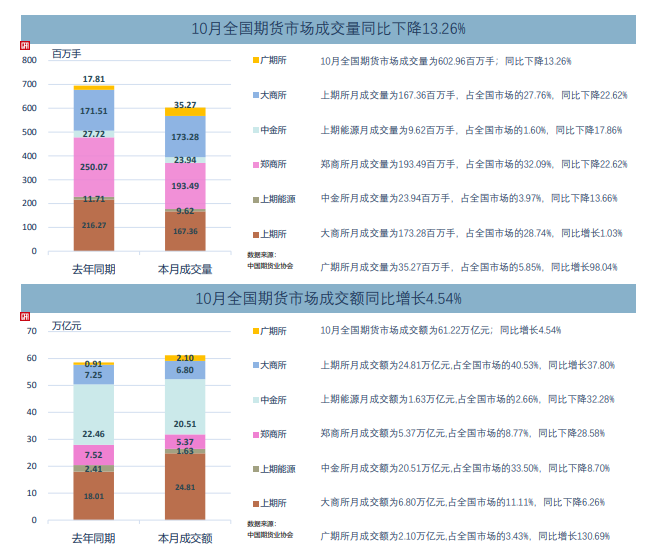
Core Insights - In October, the national futures market in China experienced a trading volume of 603 million contracts and a trading value of 61.22 trillion yuan, representing a year-on-year decrease of 13.26% in volume but an increase of 4.54% in value [1] - From January to October, the cumulative trading volume reached 7.347 billion contracts and a cumulative trading value of 608.84 trillion yuan, showing year-on-year growth of 14.86% in volume and 21.82% in value [3] Trading Analysis - The decline in October's trading volume is attributed to the National Day and Mid-Autumn Festival holidays, which reduced trading days by five, along with liquidity shocks from capital inflows and outflows [5] - Financial futures and options saw a decrease in both trading volume and value due to the A-share market closure and fewer trading days [5] - The steel and building materials sector also experienced a decline in trading volume and value, influenced by low real estate sentiment and cyclical downturns [5] - Agricultural products, including oilseeds, soft commodities, and feed, contributed significantly to the drop in trading scale in October [5] - The energy and chemical sectors faced a similar decline in trading volume and value, further impacting the overall trading scale [5] - In contrast, the precious metals sector showed positive growth in both trading volume and value, emerging as a standout performer in October [5] Market Outlook - Despite the decline in October, the overall trend for the first ten months indicates significant year-on-year growth in trading volume and value, driven by surges in precious metals and financial futures [6] - The energy and chemical sectors also contributed positively to the trading scale, while the non-ferrous metals sector benefited from various market dynamics [6] - Looking ahead, it is anticipated that November will see a substantial rebound in trading volume compared to October, with projections for 2025 indicating that trading volume and value will exceed 8.8 billion contracts and 73 trillion yuan, respectively, setting new historical records [6]
广发期货日评-20250918
Guang Fa Qi Huo· 2025-09-18 05:06
Group 1: Report Industry Investment Ratings - No industry investment ratings provided in the report Group 2: Core Views of the Report - The market may price in the probability of the Fed restarting rate cuts ahead of the September FOMC meeting. If volatility continues to decline, consider a long straddle options strategy for stock index futures [2]. - In the bond market, sentiment has improved, and Treasury bond futures have strengthened. The 10 - year Treasury bond yield may peak at 1.8% without incremental negative news, but downward movement is limited in the short - term. T2512 is expected to trade between 107.5 - 108.35 [2]. - Gold may enter a high - level consolidation phase, and the long straddle options strategy should be closed with profit. Silver's volatility has declined, and it is trading between 40.5 - 42.5 dollars. Consider selling out - of - the - money put options at high prices [2]. - The main contract of the container shipping index (European line) is in a weak oscillation. Consider a spread arbitrage between the December and October contracts [2]. - Coal supply contraction expectations have resurfaced, and coking coal has driven up steel prices. Iron ore prices are supported by resuming shipments, rising hot metal production, and restocking demand [2]. - In the non - ferrous metals market, copper is expected to trade between 79000 - 81500. Alumina may oscillate widely around 2900 in the short - term. Aluminum and aluminum alloy are expected to trade within certain ranges [2]. - In the energy and chemical market, the short - term crude oil market lacks strong drivers. The urea supply pressure may ease after the maintenance season, but demand restricts the upside. PX and PTA are expected to oscillate in the short - term [2]. - In the agricultural products market, palm oil is supported by falling production. Sugar is expected to be shorted in the short - term, and cotton should be observed on a wait - and - see basis [2]. - In the special and new energy products market, glass and rubber should be observed for the sustainability of spot sales. Industrial silicon is in a strong oscillation, and lithium carbonate is expected to trade between 70,000 - 75,000 [2]. Group 3: Summaries by Related Catalogs Financial - **Stock Index Futures**: The export chain has risen, and A - share major indices are in the green. Consider a long straddle options strategy if volatility declines [2]. - **Treasury Bond Futures**: Bond market sentiment has improved. T2512 is expected to trade between 107.5 - 108.35. Use a range - trading strategy and be cautious about chasing up in the short - term [2]. - **Precious Metals**: Gold may enter high - level consolidation, and the long straddle options strategy should be closed with profit. Silver is trading between 40.5 - 42.5 dollars. Consider selling out - of - the - money put options at high prices [2]. Black - **Steel**: Coal supply contraction expectations have resurfaced, and coking coal has driven up steel prices. Short - term long positions are recommended [2]. - **Iron Ore**: Shipments have resumed, hot metal production has risen, and restocking demand supports prices. Consider long positions in the 2601 contract between 780 - 850 and short hot - rolled coils [2]. - **Coking Coal**: Coal production area减产 expectations have increased, and downstream restocking demand has improved. Consider long positions in the 2601 contract between 1150 - 1300 and short coke [2]. - **Coke**: The second round of price cuts has been implemented, and the third round is difficult. Consider long positions in the 2601 contract between 1650 - 1800 and short coke while long coking coal [2]. Non - Ferrous - **Copper**: The 25bp rate cut was in line with expectations, and the price is expected to trade between 79000 - 81500 [2]. - **Alumina**: Supply - side disturbances in Guinea have increased. It is expected to oscillate widely around 2900 in the short - term [2]. - **Aluminum and Aluminum Alloy**: Aluminum is expected to trade between 20600 - 21000, and aluminum alloy between 20200 - 20600 [2]. - **Zinc**: The price is stronger overseas than in China, and social inventories are increasing. It is expected to trade between 21800 - 22800 [2]. - **Tin**: Supply is tight, and it is in high - level oscillation between 265000 - 285000 [2]. - **Nickel and Stainless Steel**: Nickel is in a weak oscillation between 120000 - 125000, and stainless steel is slightly weakening between 12800 - 13400 [2]. Energy and Chemical - **Crude Oil**: The short - term market lacks strong drivers. Wait and see on a single - side basis. Resistance levels are set for WTI, Brent, and SC. Consider expanding opportunities on the options side after volatility increases [2]. - **Urea**: Supply pressure may ease after the maintenance season, but demand restricts the upside. Consider selling out - of - the - money put options at high prices [2]. - **PX and PTA**: PX is expected to oscillate between 6600 - 6900 in September. PTA is expected to be tight in September but weak in the medium - term, oscillating between 4600 - 4800 [2]. - **Other Chemicals**: Short - fiber, bottle - chip, ethanol, etc. each have their own supply - demand situations and corresponding trading suggestions [2]. Agricultural Products - **Palm Oil**: Production has declined, supporting its strong performance. Observe if the main contract can stay above 9500 [2]. - **Sugar**: Overseas supply is expected to be ample. Short - sell in the short - term and watch the 5600 resistance level [2]. - **Cotton**: Old - crop inventories are low before new - cotton is widely available. Adopt a wait - and - see approach [2]. Special and New Energy - **Glass and Rubber**: Observe the sustainability of spot sales. Rubber trading sentiment has weakened, and prices have slightly declined [2]. - **Industrial Silicon**: Spot prices have slightly increased, and it is in a strong oscillation between 8000 - 9500 [2]. - **Lithium Carbonate**: The macro - environment is favorable, and it is in a tight - balance in the peak season. It is expected to trade between 70,000 - 75,000 [2].